In the process of preparing for moving, interior design, office relocation, and job searching or changing careers, government-funded education is a thankful system that significantly eases the financial burden. However, to faithfully complete the training course and fully receive the various subsidies and allowances provided by the state, ‘attendance checks’ serve above all as the most critical core standard. This is because no matter how well you understand the class contents and how good your test scores are, you can face setbacks if you fail to meet the attendance criteria.
Then, how are attendance checks conducted in government-funded education, and how are tardiness, early leave, or absences handled? Also, what conditions must be carefully considered to receive 100% of the training incentives and special allowances that are paid out handsomely every month? In this article, we will easily understand everything about attendance management in government-funded education and the allowance payment conditions. We hope you will secure all benefits without loss through systematic attendance management and wise responses!

Core 1: National Tomorrow Learning Card Attendance Check Methods and Recognition Criteria
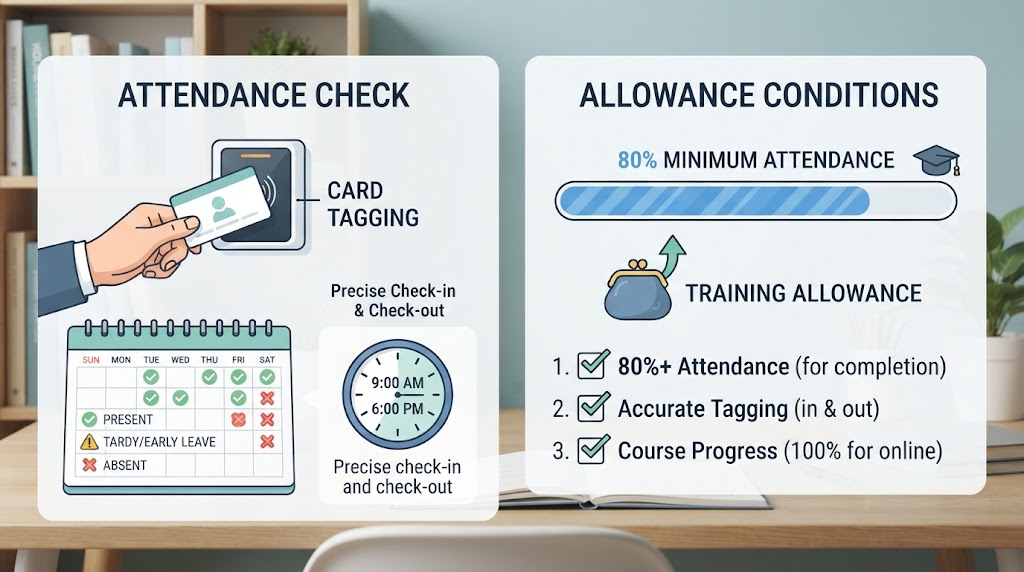
The part that you must thoroughly adapt to first while taking government-funded education courses is the daily ‘attendance check’. Since training courses utilizing the National Tomorrow Learning Card follow the strict attendance management system of the Ministry of Employment and Labor, you can be recognized for normal attendance only by accurately recording entries and exits according to prescribed methods, rather than simply participating in classes.
In the case of offline (in-person academy) classes, you must tag your National Tomorrow Learning Card (credit or check card) on the designated attendance terminal or accurately check your entry and exit times respectively through the Ministry of Employment and Labor vocational training attendance management app on your smartphone. Special caution is required before and after class, as forgetting to bring your card or omitting the tagging can result in being processed as absent. Conversely, in the case of online (remote) courses, you must achieve 100% lecture progress within the designated learning period for that session’s attendance to be recognized.
💡 Core checkpoints for attendance recognition and management
- Mandatory entry/exit tagging: You must complete identity verification and attendance tagging immediately before class starts and right after it ends to avoid being processed for tardiness or early leave.
- 80% attendance magic line: A formal completion certificate is issued only when you achieve an attendance rate of at least 80% of the entire training course. Failing to meet this results in a drop-out process where support benefits expire, so this must be defended as the top priority.
Since attendance checks are the absolute foundation of completing government-funded education and a framework that must never be missed, you must thoroughly understand the attendance method from the first day and develop a habit of managing it faithfully.
Core 2: Tardiness, Early Leave, and Absence Processing Regulations and How to Avoid Penalties
While living a work or school life, situations may arise where you are tardy, leave early, or are absent due to unavoidable circumstances. Government-funded education also has regulations considering these exceptional situations, but because they are handled according to the strict management standards of the Ministry of Employment and Labor, leaving them unattended carelessly can result in severe disadvantages. Therefore, the second core point you must thoroughly understand is ‘regulations for handling tardiness, early leave, and absence, and tips to avoid penalties’.
In government-funded training courses, tardiness, early leave, and stepping out are converted into absences if they accumulate over a certain number of times. Generally, 3 instances of tardiness, early leave, or stepping out are processed as 1 absence, and as absences increase, the overall attendance rate drops, increasing the risk of falling below the 80% completion standard. If you inevitably have to be absent or tardy, you must notify the training institution in advance and submit supporting documents (objective statement of reasons such as a medical certificate or wedding invitation) to minimize disadvantages.
💡 Practical tips to wisely avoid penalties
- Cumulative count management: Since minor tardiness or early leaves can quickly turn into absences when piled up, you must frequently check and manage your usual attendance status.
- Checking attendance exception recognition reasons: When legally recognized exceptional reasons occur—such as reserve forces training, family events of immediate relatives, or hospital medical treatment—you must thoroughly submit supporting materials so that your attendance can be recognized.
If you accurately understand the regulations and prepare thoroughly, you can wisely prevent situations where you fail or receive disadvantages in the training course even if unavoidable circumstances arise.


Core 3: Training Allowance and Special Allowance Payment Conditions and Support Amounts
One of the most welcome benefits for those who faithfully take government-funded education courses is the ‘training allowance and various special allowances’ that land in their bank accounts every month. Rather than just receiving tuition support, it is a system where the state provides cash-equivalent subsidies so that trainees can ease the burden of livelihood during the training period and concentrate fully on learning. However, this subsidy cannot be received by just anyone, and clear payment conditions must be met.
Training allowances are generally paid to unemployed people or trainees meeting specific qualification requirements who take long-term training courses of 140 hours or more (such as national core/strategic industry job training, K-Digital Training, etc.). The support amount is applied differentially depending on the individual’s support type (participation in the National Employment Support System, receipt of unemployment benefits, etc.), and the allowance for that month is fully calculated and paid only when an attendance rate of 80% or higher is achieved. If the attendance rate falls short of the criteria or you drop out midway, you will not receive the corresponding allowance.
💡 Core checkpoints for receiving 100% of the allowance
- Defend an attendance rate of 80% or higher: Since the absolute standard for paying training incentives is achieving an attendance rate of 80% or higher for that month, faithful attendance management directly leads to cash benefits.
- Pre-register the receiving account: Your receiving account under your own name must be accurately registered on the Employment 24 platform so that you can smoothly receive incentives without delay.
If you thoroughly understand the payment conditions and amount calculation methods in advance, you can foster practical competencies through government-funded education while smartly securing neat living expense support benefits at the same time.

마치며: 출석률 80% 달성과 수당 100% 수령을 위한 실전 팁
Conclusion: Practical Tips for Achieving an 80% Attendance Rate and 100% Incentive Reception
So far, we have looked into the essential rules and benefits related to attendance checks and allowance payments in government-funded education. From checking attendance precisely via terminal tagging or app records to preventing penalties from tardiness or absences and keeping track of the 80% attendance threshold, every single step plays a vital role in securing your training incentives without a hitch. By managing your daily attendance with diligence and familiarizing yourself with the payment conditions beforehand, you can successfully complete your course while maximizing all financial and career benefits.
This concluding summary utilizes a formal yet encouraging register (존댓말 style equivalent) appropriate for guiding trainees toward successful course completion.
The phrase ‘80% attendance threshold’ highlights the critical baseline required by South Korea’s Ministry of Employment and Labor (고용노동부) to officially graduate and receive training allowances.
Maintaining accurate attendance records ensures that you avoid unexpected disqualifications or deductions from your monthly financial support.
Explore related government training topics:
How do I check my remaining National Tomorrow Learning Card balance online?
What should I do if my attendance tagging error is not recognized?
Are there additional allowances for participants enrolled in K-Digital Training?
Korean version: 한국어로 읽기