Introduction: Why Heavy Bulky Waste Is Always Overwhelming to Dispose Of
Here is a clean revision of the draft for the same subheading [1. Introduction: Why Heavy Bulky Waste Is Always Overwhelming to Dispose Of] provided in the previous turn. Please check the content and feel free to let me know anytime if any revisions are needed!
[Draft]
Introduction: Why Heavy Bulky Waste Is Always Overwhelming to Dispose Of
When moving, doing a major cleanup, or redecorating your home, one of the biggest hurdles you face is troublesome ‘bulky waste’.
From old wardrobes you’ve used for a long time, to bulky mattress springs, and heavy double-door refrigerators or sofas… when the time comes to throw them away, a wave of helplessness hits you, starting with “How on earth am I supposed to get this outside?” Even if you apply for a bulky waste sticker at the community center and drag it down to the disposal area yourself, the exhausting ordeal of going up and down stairs while sweating profusely is beyond imagination.
In the end, when you lack the time or find it too difficult to handle alone, you end up calling a professional home organization company or waste disposal service. It is not uncommon to be surprised after receiving an estimate. Have you ever wondered, “The amount of waste is similar, so why is my estimate higher?”
There is a very decisive reason hidden behind this. It is the building’s ‘elevator availability’ and working environment conditions.
Did you know that this seemingly minor difference of having an elevator has a much bigger impact on waste disposal costs than you might think? In this article, we will thoroughly examine how waste disposal costs vary depending on elevator availability, along with practical tips to smartly save on costs.
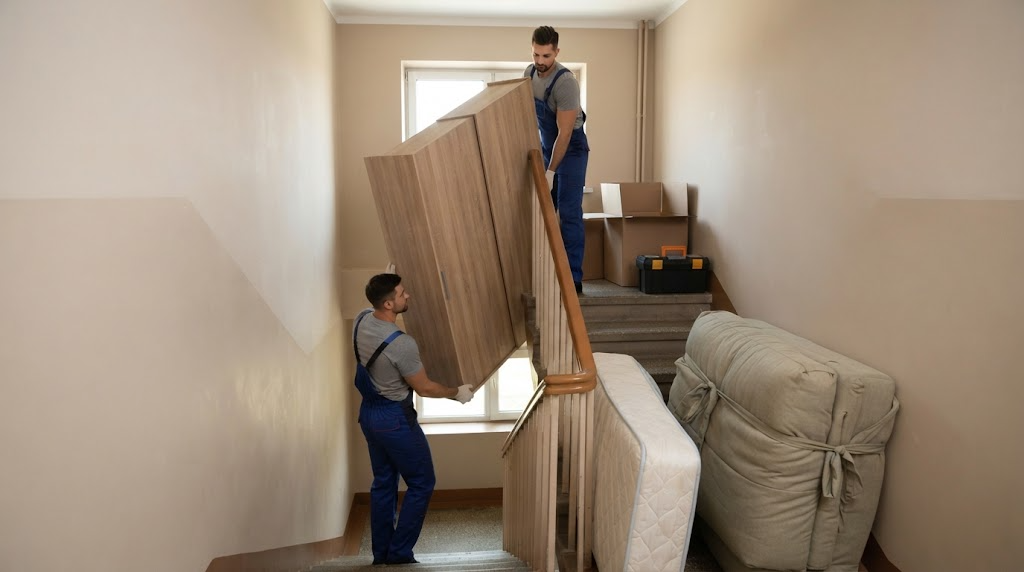
3 Core Factors That Determine Bulky Waste Disposal Costs
Here is a clean summary of the draft for the same subheading [2. 3 Core Factors That Determine Bulky Waste Disposal Costs] provided in the previous turn. Please check the content and feel free to let me know anytime if any revisions are needed!
[Draft]
3 Core Factors That Determine Bulky Waste Disposal Costs
When you get estimates through waste disposal companies, you can see that the costs vary wildly from house to house. To resolve the question, “The types of waste are similar, but why is there a cost difference?”, let’s look at the 3 core factors that influence bulky waste disposal costs.
- Type and Total Volume (Quantity) of Waste
This is the most fundamental factor. The basic cost varies depending on whether the items are bulky and difficult to dismantle furniture like mattresses, wardrobes, and sofas, or simple storage cabinets and small home appliances.
The basic collection fee is determined by how much of a 1-ton truck standard the total volume takes up (e.g., half-truck, full truck load, etc.).
- Floor Level of the Collection Site and Elevator Availability
This is also the core topic of this article. It determines the difficulty of the process of moving waste out of the house and up to the vehicle.
Depending on whether there is an elevator or which floor it is on, the worker’s required time and physical exhaustion vary extremely, which greatly affects the cost calculation.
- Working Environment and Labor Input Conditions (Stair Work, Ladder Truck Availability, etc.)
If there is no elevator at all, or if it is an alleyway or high-rise building where it is difficult to park a ladder truck, the working method changes completely.
When heavy furniture has to be carried down the stairs directly by workers (stair work surcharge) or special equipment needs to be mobilized, additional labor and costs occur.
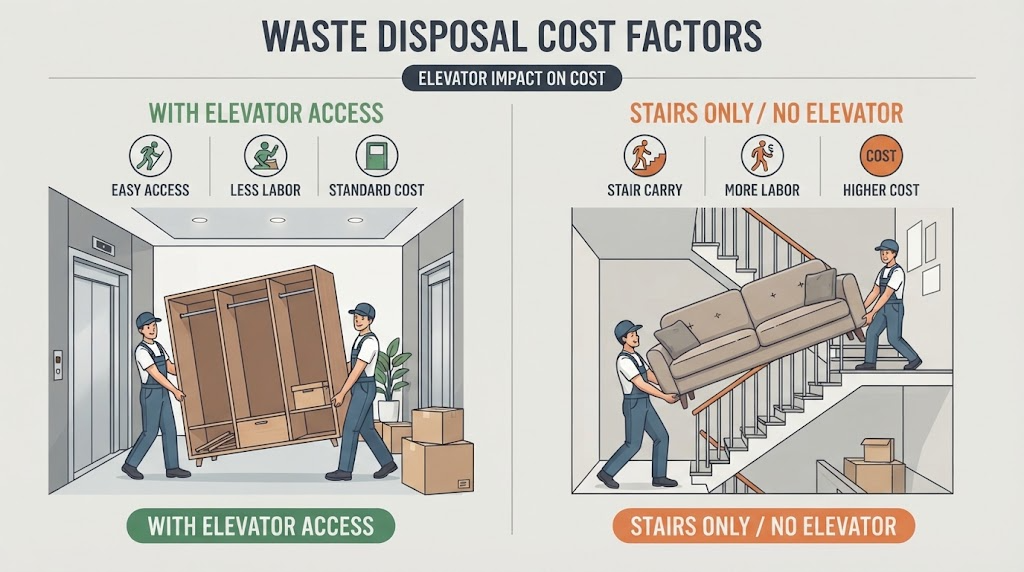
Complete Analysis of Cost Differences Based on Elevator Availability
Here is a clean revision of the draft for the same subheading [3. Complete Analysis of Cost Differences Based on Elevator Availability] provided in the previous turn. Please check the content and feel free to let me know anytime if any revisions are needed!
[Draft]
Complete Analysis of Cost Differences Based on Elevator Availability
The variable you feel the most when receiving estimates from waste disposal companies is ‘elevator availability’. Let’s compare the specific reasons why a cost difference occurs even when disposing of the exact same 1-ton truckload of furniture and belongings.
- When an Elevator Is Available: Smooth Movement and Efficient Work
Characteristics: Since large furniture or appliances can be loaded directly onto the elevator and sent down to the 1st floor, the work path is very clean.
Cost Impact: Since the physical exertion of the labor is low and the working time is shortened, companies often do not charge separate additional surcharges beyond the basic collection cost (labor cost + vehicle cost). (However, exceptions may apply if it is a high floor or if the furniture size is too large to fit in the elevator.)
- When There Is No Elevator (Stair Work): Extreme Physical Exertion and Additional Costs Occur
Characteristics: This applies to villas, low-rise houses, or buildings where the elevator is under inspection or unavailable due to specifications.
Why costs go up:
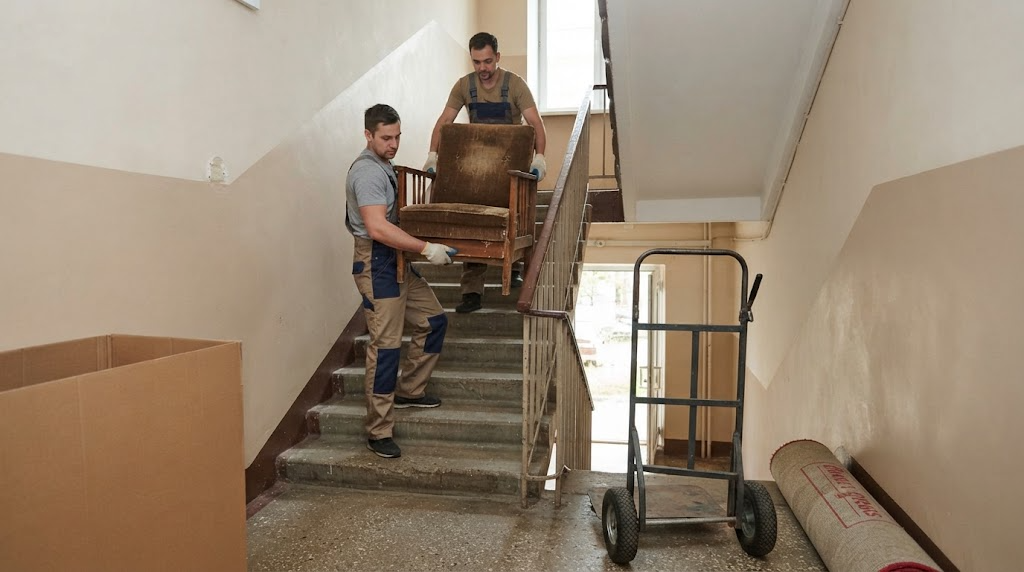
Additional labor input: Heavy items weighing tens of kilograms, such as refrigerators, washing machines, and wardrobes, must be carried down the stairs directly by two or more workers.
Time consumption and risk of safety accidents: Working while going up and down stairs on the 3rd or 4th floor or higher takes more than twice as much time as usual, and the risk of worker injury and physical exhaustion is severe.
Cost impact: Due to this, a ‘stair work surcharge (additional fee per floor)’ is usually applied, and the higher the floor (e.g., a 5-story villa rather than a 2-story one), the more the estimate cost jumps.
💡 Key Point:
If you live in a high-rise building without an elevator, you must notify the company in advance about “which floor the building is on and whether there is an elevator” when requesting an estimate to prevent embarrassing situations where you are asked for extra fees on-site later.
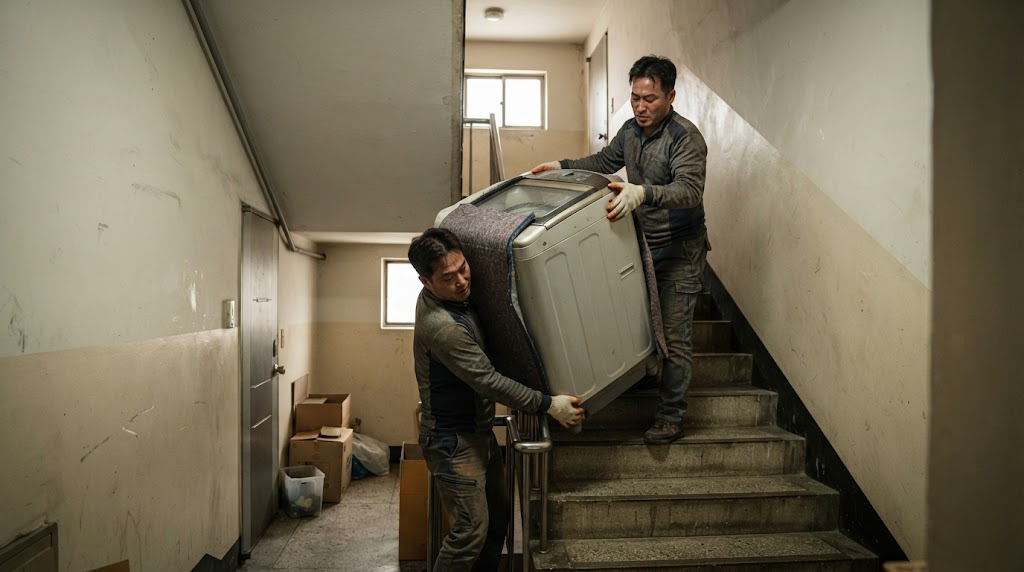
Ladder Truck vs Manual Stair Transport: When Should You Use Which?
Here is a clean revision of the draft for the same subheading [4. Ladder Truck vs Manual Stair Transport: When Should You Use Which?] provided in the previous turn. Please check the content and feel free to let me know anytime if any revisions are needed!
[Draft]
Ladder Truck vs Manual Stair Transport: When Should You Use Which?
When disposing of bulky waste in a villa or multi-family housing without an elevator, the biggest dilemma is whether to ‘call a ladder truck or do manual stair transport’. It’s easy to think that a ladder truck is always better, but the pros and cons vary clearly depending on the on-site conditions.
Shall we compare which method is the most reasonable for your situation?
- Using a Ladder Truck: When It’s a High Floor or When Bringing Down a Large Amount of Luggage at Once
Recommended for these sites:
When it is a high floor of the 3rd floor or higher, but there is no elevator or it is unusable.
When there are many large furniture and home appliances such as refrigerators, washing machines, and wardrobes, and they are too bulky to move down the stairs at all.
Pros and Cons:
Pros: Heavy loads can be safely and quickly lowered right out of the window and loaded onto the vehicle, reducing the risk of worker injury and drastically shortening working time.
Cons: If the alley in front of the building is too narrow or blocked by power lines, street trees, etc., so that there is no space to set up a ladder truck, it cannot be used at all. In addition, ladder truck rental costs are added separately.
- Manual Stair Transport: When It Is Low-Rise or Ladder Truck Entry Is Impossible
Recommended for these sites:
When the building is as low as 1 to 2 floors, or when the amount of luggage is not very large.
Alleyway houses where the road in front of the building is narrow or complicated so that a ladder truck cannot be parked.
Pros and Cons:
Pros: Since there are almost no location restrictions, work is possible in any environment.
Cons: Since workers have to go up and down the stairs themselves, the higher the floor, the higher the ‘stair surcharge’ and labor costs go, and the risk of furniture damage or safety accidents is relatively high.
💡 Smart Selection Tip:
When receiving an estimate, please inform the company’s expert in detail about your home’s floor and surrounding alley conditions (whether a ladder truck can be installed). An experienced company will accurately judge which method is more advantageous in terms of cost and safety.
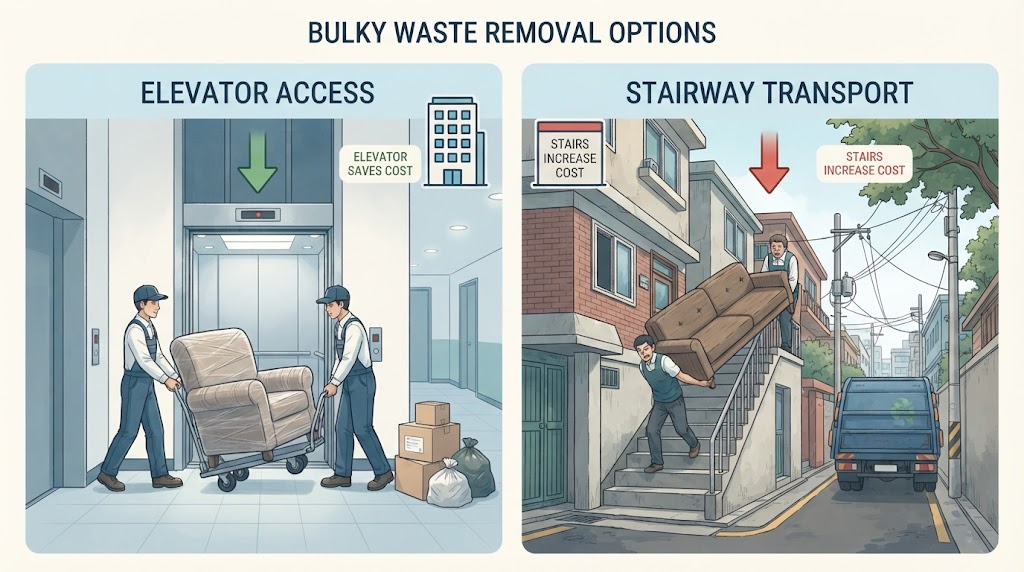
Practical Tips & Precautions to Save on Waste Disposal Costs
This is the draft of the body text for the fifth subheading [5. Practical Tips & Precautions to Save on Waste Disposal Costs] of the Naver blog post. We have organized valuable tips to cut down costs and prevent unnecessary spending.
[Draft]
Practical Tips & Precautions to Save on Waste Disposal Costs
Even if you know that waste disposal costs vary depending on elevator availability or stair work, it is human nature to want to save even a little bit when it comes time to actually pay. Check out these 3 practical tips to definitively reduce costs and prevent post-dispute issues!
- Utilize ‘Free Visiting Collection’ for Recyclable Home Appliances
For large home appliances such as refrigerators, washing machines, air conditioners, and TVs, if you use ‘e-Cycle Governance (Waste Home Appliance Free Visiting Collection Service)’, a designated technician will come directly into your house and collect them for free.
Even if there is no elevator or it is a high floor, if it is a single home appliance item or meets the collection standards, you can resolve it without spending costs, so it is best to check this first.
- Segregate and Dispose of Small-Scale Bulky Waste Using Local Government Stickers
For small amounts of waste such as desks, drawers, and chairs, rather than calling a professional company, it is much cheaper to issue a bulky waste disposal sticker online from your jurisdiction’s community center or district office website and place it directly at the designated location.
Since company estimates basically include labor costs and vehicle dispatch fees, handling small items you can throw away yourself in advance and leaving only the really heavy and large items to the company is the shortcut to saving costs.
- Transparently Disclosing the ‘Working Environment’ During Advance Estimation (Preventing Additional Fees)
When inquiring for an estimate from a company with photos or videos, you must accurately inform them of the on-site situation without omission, such as “It is a 4th-floor villa without an elevator” or “Ladder truck use is impossible due to a narrow hallway.”
Surprisingly, there are many cases where people only provide a rough status and are later asked for on-site additional fees on the day of service due to stair work or the deployment of extra labor. You can prevent disputes by getting a confirmed estimate in advance.
If there are any parts of the written content that need modification, or if you need the final step [6. Conclusion and Summary of Smart Waste Disposal to Save Both Costs and Physical Energy] written, please feel free to let me know!
Conclusion: Summary of Smart Waste Disposal to Save Both Costs and Physical Energy
This is the draft of the body text for the final subheading [Conclusion: Summary of Smart Waste Disposal to Save Both Costs and Physical Energy] of the Naver blog post. It neatly summarizes the entire content and contains a positive closing message.
[Draft]
Conclusion: Summary of Smart Waste Disposal to Save Both Costs and Physical Energy
Has your anxiety regarding bulky waste disposal, which seemed so overwhelming ahead of moving or house cleaning, been somewhat relieved through today’s content?
Waste disposal costs are not determined solely by the ‘amount of luggage to throw away’. Please remember that, as we examined today, the building’s ‘elevator availability’ and ‘on-site working environment (stair work, ladder truck status, etc.)’ are very important keys that dictate the cost.
Lastly, we summarize the core points to save both costs and physical energy.
- Check for free collection first: Actively utilize free visiting collection services through ‘e-Cycle Governance’ for large home appliances like refrigerators and washing machines!
- Segregate and dispose of small luggage yourself: Save on labor costs by directly disposing of small luggage or furniture that you can throw away using local government bulky waste stickers!
- Share the on-site situation transparently when getting company estimates: You must accurately notify them in advance of the elevator availability, floor, and alley conditions to prevent a ‘bomb’ of additional fees on the day!
Rather than recklessly tackling it with brute physical force, if you smartly choose a disposal method tailored to your home environment and the characteristics of your luggage, you will be able to wisely save time, money, and your precious physical energy.
We hope the helpful tips provided today were of small assistance to your independent living and fresh new start. We will return with more useful daily living information. Thank you!
The drafts for the entire article are now complete! If you need any additional modifications or need a blog post on a different topic, please feel free to tell me anytime!
Korean version: 한국어로 읽기