
The Appeal and Selection Criteria of ‘Practical Certifications’ That Can Overcome Major Barriers
Are you hesitating to take on a new challenge because your college major was different, or because you have worked in a different field for a long time? As boundaries between majors are increasingly blurring in the job search and career change markets, ‘practical-centered certifications’ allow even non-majors to secure a definitive edge.
Let’s take a closer look at the appeal of practical certifications that can easily overcome major barriers, as well as the selection criteria for choosing the course that best fits you among numerous certifications.
- Why ‘Practical Certifications’ Become a Powerful Weapon for Non-Majors
Overcoming limitations of academic background and major: Whether in public institutions, general corporations, or startups, the most important factor during recruitment is “Can this person immediately handle practical work?” A certification directly connected to the job role often serves as a much stronger proof than a degree.
Maximizing learning efficiency: Re-taking a degree program from scratch consumes years of time and money, but practical certifications allow you to efficiently prove your job competencies in a short period through just a few months of intensive study and government-supported training.
High synchronization with the field: The subjects of practical certification exams are closely linked to programs used in actual fields (e.g., Excel, accounting programs, database queries, etc.), making the certification acquisition process itself a form of practical training.
- 3 Core Criteria for Choosing a Certification Without Regret
To choose the right course among countless certifications, you must carefully consider the following three criteria:
① Job universality (Is it widely recognized?): Rather than a certification used only by a specific company, it is advantageous to first choose a popular certification recognized as a basic spec or preferential condition across various industries and job roles (office administration, finance/accounting, IT, etc.).
② Barrier to entry and study period (Is it realistically achievable?): If you are a non-major, instead of rashly challenging high-difficulty technical certifications from the start, stepping up by beginning with introductory certifications where you can build basic concepts step-by-step (e.g., Computer Literacy, Computerized Accounting, etc.) is the shortcut to reducing the probability of failure.
③ Connection with Employment24 (HRD-Net) government support: Preparing solely through self-study leaves many stumbling blocks and heavy financial burdens. It is recommended to check in advance whether a government-supported training course is established for the certification so that you can enjoy a systematic curriculum and training allowance benefits together.
💡 Tip: Rather than worrying “Can I really do it?”, choose a certification in a field closest to your current work experience or interests (e.g., Computer Literacy if you do a lot of Excel and document work, Computerized Accounting if you are interested in handling numbers) and take your first step with a light heart.
In the next table of contents, we will take a detailed look at Computer Literacy and Computerized Accounting & Tax, which are representative office and management support field certifications suitable for non-majors to tackle.
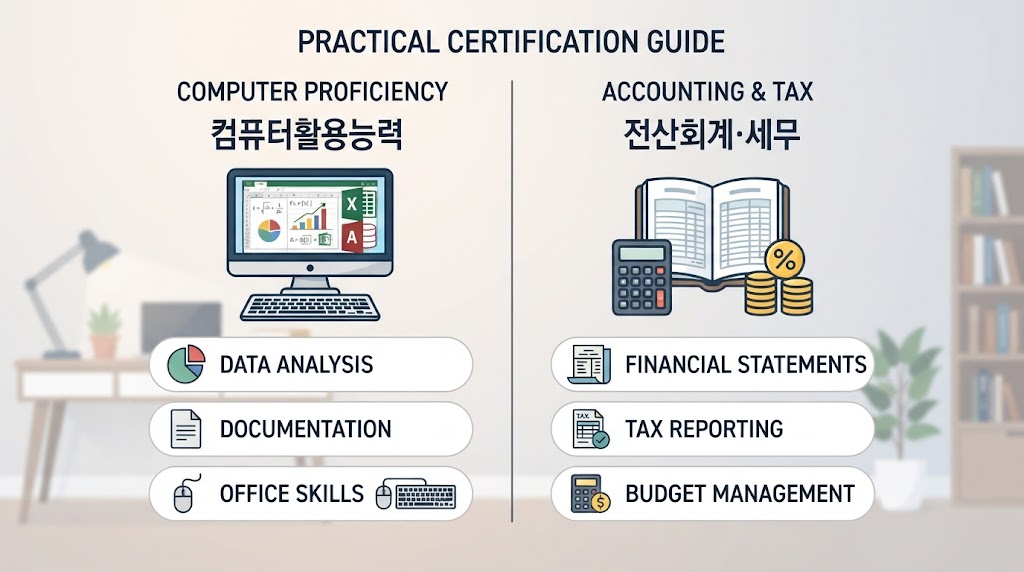
Office and Management Support Fields: Computer Literacy and Computerized Accounting & Tax
Computer Literacy and Computerized Accounting & Tax are the representative certifications that non-majors should challenge first when entering roles universally required by any company, such as office work, management support, general affairs, HR, and accounting.
Let’s examine why these two certifications serve as powerful weapons for non-majors and how best to prepare for them.
- Computer Literacy (Level 1 / Level 2): The Basics and Cheat Key for All Office Workers
Computer Literacy, which verifies the ability to utilize Excel and databases (Access), is the ultimate office certification recognized by office workers throughout South Korea.
Direct job applicability: No matter which department you are assigned to, there is no place where Excel is not used—such as document drafting, data organization, and statistical analysis. Shortcut and function utilization skills learned through certification study are applied directly to practical work after joining the company.
Grade selection tips:
Computer Literacy Level 2: Covers Excel practical basics and functions, making it relatively easy for non-majors to acquire in a short period (2 to 4 weeks). It is utilized as a basic specification when applying for general small and medium-sized enterprise office positions.
Computer Literacy Level 1: Adds databases (Access) and significantly increases spreadsheet difficulty, making it quite challenging, but it can receive strong preferential treatment in public institution recruitment bonuses and large enterprise/financial sector document screening processes.
- Computerized Accounting Level 1 & 2 and Computerized Tax Level 2: An Accounting Entry Course Accessible Even Without a Sense for Numbers
These are nationally certified licenses proving that you understand corporate fund flows and can proficiently handle accounting programs. Although many non-majors worry, “I’m weak with numbers, can I do this?”, passing in the short term is fully possible through systematic educational courses.
Computerized Accounting Level 2 / Level 1: Covers accounting principles, basic financial statement preparation, and computerized program (such as KcLep) data entry practices. For non-majors, it is common to start targeting Computerized Accounting Level 1 to solidly build foundational accounting knowledge and slip entry skills.
Computerized Tax Level 2: A core specification recognized as immediate readiness when getting hired by small-to-medium enterprises and tax law firms, expanding into tax practice such as value-added tax and income tax as a step up after acquiring Computerized Accounting Level 1.
- Efficient Learning Strategy Through Government-Supported Training Linkage
When preparing for the above certifications through self-study, it is easy to waste time getting stuck on unfamiliar functions or accounting journal entry principles.
Utilization of a systematic curriculum: Enrolling in government-supported Computerized Accounting & Tax or Computer Literacy training courses established through Employment24 (HRD-Net) allows you to dramatically increase your passing rate by receiving close guidance from instructors from basic concepts to past exam problem solving.
Training allowance benefits: If you faithfully attend and complete the course during the training period, you can even receive training allowance support, significantly easing your financial burden.
💡 Tip: If you are interested in general office administration tasks, you can maximize your document screening pass rate by first acquiring Computer Literacy Level 2 (or Level 1) to prove your document creation and data processing abilities, and adding Computerized Accounting Level 1 to catch two birds—’administration and finance’—at once.
In the next table of contents, we will take a detailed look at SQLD and digital competency certifications, which are great for non-majors to tackle in the IT and data analysis fields.

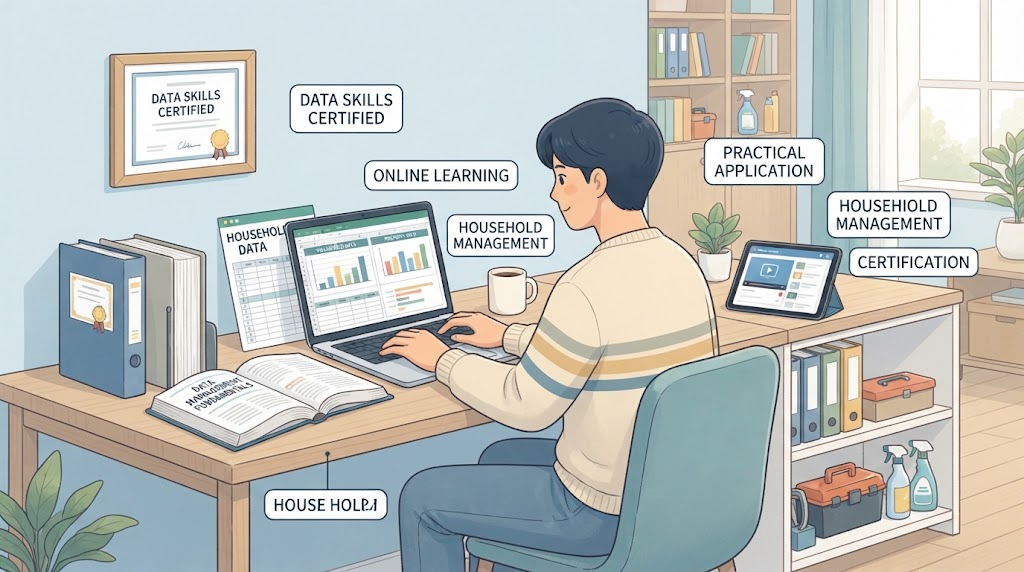
IT and Data Analysis Fields: SQLD, Engineer Information Processing (Check Eligibility Requirements), and Digital Competency Certifications
As the digital transformation (DX) era accelerates, data analysis skills and basic IT literacy are becoming powerful differentiating weapons not only in IT and development job groups but also in general planning, marketing, and management support roles.
Let’s look at representative certifications that are great for non-majors to tackle when entering the IT and data analysis fields, along with points to keep in mind when preparing.
- SQLD (SQL Developer): A Data Introductory Certification That Non-Majors Can Also Challenge
This is a nationally certified private license that verifies the ability to handle SQL (Structured Query Language), which is the core of databases (DB).
The foundation of data competency: Modern companies store and utilize numerous pieces of information, such as customer data and sales data, in databases. Regardless of your job role, the ability to query and handle data becomes a major strength.
Accessibility for non-majors: Compared to Engineer Information Processing, it has relatively fewer restrictions on eligibility requirements and a clear exam scope, making it a realistic IT certification that non-majors or liberal arts job seekers can pass in a short period if they study concepts step-by-step.
- Engineer Information Processing: The Ultimate Officially Recognized Certification in the IT & Software Field (Must Check Eligibility Requirements)
This is a national technical qualification widely considered the ‘bible’ in software development employment and public institution IT job recruitment.
Overwhelming public credibility: Because it verifies in-depth knowledge across overall IT such as programming, operating systems, databases, and software engineering, it is called an essential course for IT majors.
Strict eligibility requirements: According to the National Technical Qualifications Act, you can only take the exam if you are a major in a related field or have practical work experience (or completion of government-supported training, etc.). If you are a non-major, you must check in advance whether you meet the eligibility requirements (e.g., meeting qualifications through Credit Bank System or completion of Employment24-designated government-supported training).
- Digital Competency and Advanced OA Certifications (Big Data Analytics Professional, etc.)
Big Data Analytics Professional: A certification evaluating data collection, processing, and model analysis abilities, which has recently been gaining great attention among non-majors looking to leap into data analyst or marketing data roles.
Practical application value: Not only acquiring the certification itself, but the basics of Python or statistical concepts covered during the preparation process enable in-depth data analysis beyond Excel in practical work.
- Success Strategies for Non-Majors Acquiring IT Certifications
Solidly building up step-by-step from the basics: If non-majors study blindly focusing on memorization, they easily get stuck on applied problems. It is effective to utilize government-supported training courses through Employment24 (HRD-Net) that teach basic programming or database structures centered around hands-on practice.
Connecting with practical portfolios: Rather than stopping at certification acquisition, if you melt simple data analysis projects or tool utilization experiences based on what you learned into your resume or cover letter, you can perfectly compensate for the weaknesses of being a non-major.
💡 Tip: If you want to grow your IT capabilities, rather than aiming for grandiose developer courses from the start, we recommend lightly knocking on the door with SQLD or basic data analysis certifications that allow you to understand the basic structure of databases beyond Excel.

How Non-Majors Overcome Limitations Using Government-Supported Training (National Tomorrow Learning Card)
Have you ever felt lost because you wanted to challenge a new field but weren’t a related major, or didn’t know where to start? For non-majors who easily feel the limits of self-study and give up, the National Tomorrow Learning Card and government-supported training system serve as the most reliable and realistic breakthrough.
We organize the know-how for non-majors to overcome their experienced limitations and successfully approach employment and career changes.
- Utilizing a ‘Systematic Basic Curriculum’ That Breaks Down the Wall of Self-Study
If you go to a bookstore alone and open a certification test book, you are likely to get stuck from the very first page due to unfamiliar terms and concepts.
Step-by-step learning from basics to practical work: Government-supported training courses are structured with systematic curricula tailored to the eye level of non-majors, ranging from ‘basic introductory classes’ to ‘advanced and certification preparation classes’.
Feedback from active industry instructors: You can ask professional instructors real-time questions and receive feedback on practical know-how or exceptional error situations that you cannot know when studying alone, maximizing learning efficiency.
- Searching for Customized Courses for Non-Majors via Goyong24 (HRD-Net)
Choosing a course that fits you perfectly among countless training courses determines your passing rate.
Customized Filtering: Carefully review keywords and reviews on the Goyong24 website, such as ‘Non-Majors Welcome’, ‘Start from Basics’, and ‘Excellent Trainee Satisfaction’.
Utilizing National Key and Strategic Industry Job Training: For fields with labor shortages or promising sectors fostered by the government (such as IT, digital, and specialized administration), various tracks are prepared where even non-majors can build practical competence with support close to 100%.
- The ‘Training Allowance’ System to Ease Economic Burdens
Many people hesitate to learn due to worries about living expenses or transportation costs while studying.
Building a Stable Learning Environment: You can significantly ease economic burdens through training allowances paid when you meet a certain attendance rate (such as 80% or more of the prescribed training days).
Complete Immersion: It serves as a financial safety net that allows you to concentrate on education while balancing part-time work or livelihood activities, helping you complete the course to the end without dropping out.
- Building a ‘Practical Portfolio’ Beyond Obtaining a Certification
What companies expect from a non-major is not simply a piece of certificate paper, but proof that “I can actually accomplish this work.”
Result-Centric Education: Excellent government-supported courses include practical project (portfolio) creation processes where you directly build programs or write documents during the training period, as well as preparing for certification.
Resume Differentiation: You can transform the weakness of having a non-major background into a powerful strength stating, “I have solidly equipped my job competencies through these practical projects and certifications.”
💡 Tip: The wall of a major is not as high as you think. Right now, search for government-supported courses in the fields you are interested in on Goyong24 (HRD-Net), issue your National Tomorrow Learning Card, break the prejudice of being a non-major, and proudly take your first step toward a new career!
Korean version: 한국어로 읽기