
What is the Youth Housing Benefit Separate Payment System? (Purpose and Background)
An increasing number of young people are starting to live independently away from their parents in other regions due to college admission, employment, or work. With fixed expenses such as monthly rent and maintenance fees piling up, the housing burden on young people is growing day by day.
If your parents belong to a basic livelihood security household (housing benefit recipient household), you must pay close attention to the ‘Youth Housing Benefit Separate Payment System,’ which allows young children living apart to also receive housing cost support. Here are three key points highlighting the purpose and core background of the system.
- Alleviating the Housing Cost Burden of Low-Income Youth Living Apart from Parents
Because the existing housing benefit system calculated subsidy amounts based on a ‘single household’ on the resident registration, it was difficult for children to receive separate support even if parents and children resided at different addresses.
Due to this, there was a contradiction where the burden of monthly rent incurred while college students or early-career young adults resided in other regions for academic or employment purposes was entirely transferred to the parents’ household.
The Youth Housing Benefit Separate Payment System was introduced to directly relieve the housing cost burden of such low-income household youths and help them establish a stable foundation for self-reliance.
- Supporting Inevitable Housing Separation Due to Studies and Employment
Housing independence among the youth demographic is mostly achieved through studies (entering university), employment, or work duties (job changes, etc.).
It prevents young people who cannot afford monthly rent for studio apartments or officetels in other regions solely through parental economic support from giving up their studies or being driven into poor living environments due to housing cost pressures.
It contains the purpose of resolving welfare blind spots by having the state recognize the existence of youth living apart from their parents as a separate household member and splitting (separating) and paying housing benefits based on actual residential locations.
- Guaranteeing Self-Reliant Growth and Fair Opportunities for Youth Children
Housing stability is the most important foundational strength for young people to take their first steps into society and achieve complete self-reliance.
Regardless of the parents’ income level, it guarantees that youth children of housing benefit recipient households can receive rightful housing support corresponding to the separation of their residential areas.
Through this, helping them enjoy fairer opportunities to enter society without being restricted in education or job-seeking activities due to economic reasons is the core social background of this system.
Tip. Core of Utilizing the System
Your parents’ household must already be selected as housing benefit recipients, and the form in which the child resides independently must align with address requirements to receive benefits. Since it is not automatically paid simply because you live separately, it is important to accurately check the system requirements.
[AI Image Generation Prompt Guide for Insertion (16:9)]
Style: Warm, modern, and clean lifestyle photography, bright indoor daylight, cozy studio apartment interior, text-free.
Scene Description: A young student or professional sitting at a neat wooden desk in a bright, modern single-room apartment, studying on a laptop with soft morning light streaming through a large window, wide 16:9 aspect ratio, high resolution, realistic textures, absolutely no text, no watermark, no logos.
Negative Prompt: Hangul text, cluttered desk, dark shadows, low resolution, messy dust, cartoon style.
Separate Payment Support Eligibility and 3 Strict Requirements
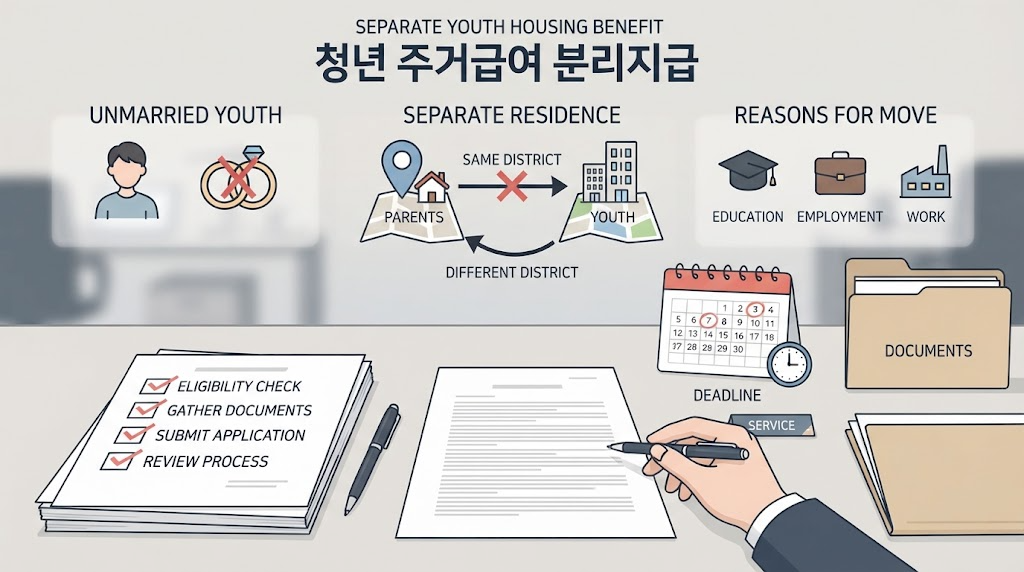
No matter how good the purpose of the youth housing benefit separate payment system is, the criteria are applied so strictly that if you fail to meet even a single established requirement, you cannot be selected. You cannot receive it unconditionally just because you live apart from your parents, and you can only enjoy the benefits by passing all 3 demanding core requirements set by the state.
We thoroughly break down the 3 strict requirements you must check to receive the youth housing benefit separate payment.
- Unmarried Children Aged ’19 to Under 30′ of Existing Housing Benefit Recipient Households
This is the recipient qualification and age standard that serves as the primary prerequisite.
Recipient household prerequisite: The existing household including the parents must already be selected as a housing benefit recipient (median income of 50% or less) under the National Basic Livelihood Security Act. If the parents’ household is not a recipient, youth separate payment cannot be applied for either.
Age requirement: The child’s age must be 19 years old or older to under 30 years old. (※ However, depending on exceptional situations such as military service or studies, detailed criteria of some local governments or legal interpretations may apply, but fundamentally you must fall within this age range.)
Marital status: You must be an ‘unmarried’ child who is not in a legal marital status to be included as a target.
- Separation of ‘City/County/District’ on Resident Registration Between Parents and Youth (Different Administrative District Mandatory)
This is one of the demanding requirements that many people misunderstand or fail to meet.
Administrative district separation: The parents’ resident registration address and the youth child’s resident registration address must be in different cities, counties, or districts (administrative districts).
No separation allowed within the same city/county/district: For example, if parents live in Mapo-gu, Seoul, and the child obtains a studio room and transfers their address to Seodaemun-gu, Seoul, they are excluded from the separate payment target because they belong to the same ‘Seoul’ city. (※ However, it is recognized only when administrative district boundaries are completely different, such as between Seoul and Gyeonggi Province, or city and county units.)
- Separation of Residence Due to ‘Inevitable Reasons’ Such as College Admission, Employment, or Work Duties
To prevent ‘fake transfers’ where addresses are only formally relocated, actual residential purposes and reasons are strictly screened.
Recognized reasons: You must prove that the youth child cannot live together with their parents due to actual college admission (studies), employment, or work duties (job change, appointment, etc.) and is maintaining an independent housing form in another region.
Necessity of evidence: To back this up, objective documents proving actual residence and the reason for separation are required along with the lease agreement, such as a certificate of enrollment, certificate of employment, or 4 major public insurances subscription details.
Tip. Precautions When Reviewing Requirements
There are many cases where people apply thinking “I’ll just move my address” only to get rejected through actual residence investigations because the residential facts differ or the administrative district conditions are not met. Before applying, make sure to check first whether the city/county/district codes on the resident registration copies of the parents and child are completely different.
[AI Image Generation Prompt Guide for Insertion (16:9)]
Style: Clean, professional editorial and administrative concept photography, bright natural daylight, text-free.
Scene Description: A neat desk setup featuring an official household registry document or application form alongside a modern laptop showing an administrative checklist, symbolizing strict eligibility verification. Wide 16:9 aspect ratio, high resolution, realistic textures, absolutely no text, no watermark, no logos.
Negative Prompt: Hangul text, messy desk, dark shadows, low quality, blurred documents, cartoon style.
Application Methods and Essential Required Documents
Once you have checked all the demanding requirements of the youth housing benefit separate payment system, it is time to take concrete steps on how to apply and what documents to prepare to actually receive the benefits. We thoroughly organize the offline and online application methods and essential required documents so that you can apply perfectly at once without any missing documents.
- Application Methods (Offline vs. Online)
Youth housing benefit separate payment can be conveniently submitted through agencies with jurisdiction over your residence.
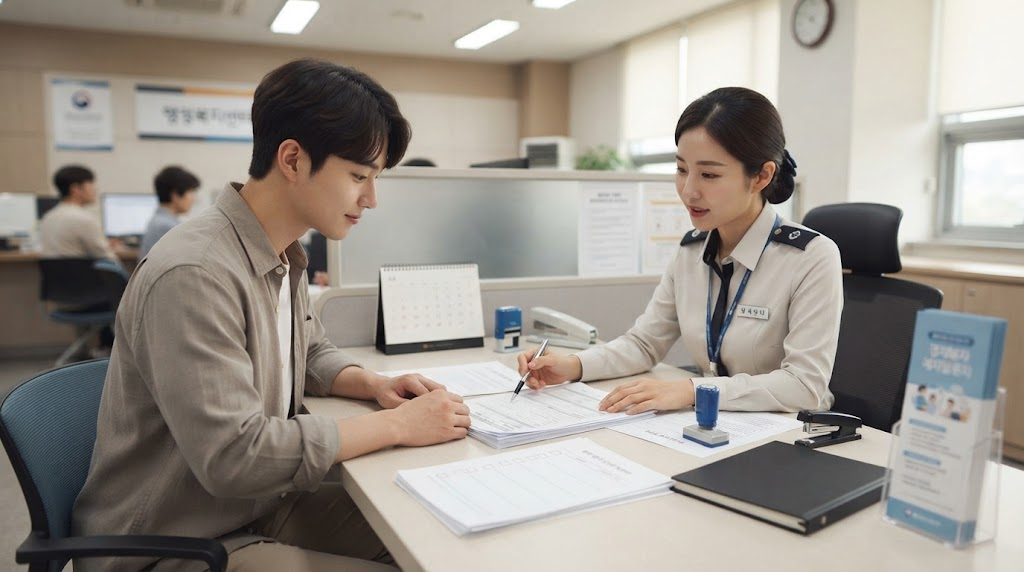
Offline application (Visiting the Administrative Welfare Center):
Visit the eup, myeon, or dong administrative welfare center (community center) with jurisdiction over your parents’ resident registration address in person to apply. (※ You must submit it to the administrative welfare center with jurisdiction based on your parents’ residence, who are the existing housing benefit recipient household, not the youth child’s residence.)
It has the advantage that missing documents can be supplemented immediately through consultation with the responsible official upon visit.
Online application (Bokjiro Website):
If visiting is cumbersome, you can apply 24 hours a day anytime through South Korea’s representative welfare portal ‘Bokjiro (bokjiro.go.kr)’ official website or mobile app.
After logging in with a joint certificate (public certificate) or financial certificate, you can proceed by selecting the ‘Housing Benefit’ item in the welfare service application menu.
- Essential Required Documents Checklist
The most important thing when applying for separate payment is objective evidentiary data proving the ‘reason for separation of residence between parents and child’ and the ‘lease relationship in the youth’s name.’ You must prepare the following documents without omission to prevent rejection.
① Social Security Benefit Provision (Change) Application Form and Pledge: This is a basic application form available at the administrative welfare center or fillable on Bokjiro.
② Youth Child’s Lease Agreement (Monthly Rent Contract): This is the original (or copy) of the lease agreement for the residence in another region (studio, officetel, etc.) concluded in the youth’s name.
③ Income, Property, and Residence Fact Verification Documents (Proof of Reason for Separation):
If a college student: Certificate of enrollment or certificate of leave of absence
If an office worker: Certificate of employment, employment/wage confirmation, or 4 major public insurances subscription details confirmation (※ Core material proving that the relocation of residence is due to studies or work duties.)
④ Bank Account Copy in the Youth’s Name: A copy of the bank account passbook in the youth’s own name to stably receive the housing benefit paid separately every month.
⑤ Family Relationship Certificate and Other Documents: Detailed family relationship certificates, etc., may be required to prove the relationship between parents and the youth child and their unmarried status.
Tip. Final Check Tip Before Application
Before submitting documents, it is most certain to check in advance through Government24 or the community center whether your parents’ household’s existing housing benefit recipient status is being maintained and whether the child’s resident registration address has been accurately relocated to a different city/county/district from the parents.
[AI Image Generation Prompt Guide for Insertion (16:9)]
Style: Clean, professional editorial and administrative concept photography, bright natural daylight, text-free.
Scene Description: A neatly organized wooden desk displaying an official welfare application form, a laptop open to an online portal, and a blue pen, symbolizing a successful administrative application process. Wide 16:9 aspect ratio, high resolution, realistic textures, absolutely no text, no watermark, no logos.
Negative Prompt: Hangul text, messy desk, dark shadows, low quality, blurred documents, cartoon style.

Payment Methods, Amount Calculation Criteria, and Precautions
Once you have passed the demanding requirements and completed your application, it is time to understand the practical details of how subsidies will actually be deposited, how much will be calculated, and what precautions to take to maintain your eligibility.
We walk you through the payment methods for the youth housing benefit separate payment, core criteria for amount calculation, and precautions that could lead to disadvantages if overlooked.
- Payment Method and Account Deposit Principle
Once the separate payment system is approved, there is a clear difference in how you receive money compared to existing housing benefits.
Deposit into a separate account in the youth’s name: Unlike the existing method where funds were consolidated into the representative account of the parents’ household, housing benefits are separately deposited directly into a designated account in the name of the youth child living in another region on a set date every month.
Payment cycle: Because it is deposited independently on the regular monthly housing benefit payment date separate from the parents’ household grant, it is practical for helping the youth directly pay for their studio room monthly rent (lease fee).
- Amount Calculation Criteria (Reflecting Standard Rent by Region and Number of Household Members)
The separate youth housing benefit amount is calculated based on the standard rent according to the ‘region (grade)’ and ‘number of household members’ where the child actually resides.
Differential by regional grade: The upper limit of standard rent you can receive maximum varies depending on whether the region where you live is Seoul (Grade 1), Gyeonggi/Incheon (Grade 2), Metropolitan Cities/Sejong (Grade 3), or other cities/counties (Grade 4). (Example: A youth residing in the Seoul area receives a relatively higher standard rent compared to other regions.)
Reflection of actual rent: However, if the contracted monthly rent amount is lower than the standard rent for that region, only the actual monthly rent is paid, and even if it exceeds the standard rent, support is provided only up to the set upper limit. (※ In the case of a deposit, it is converted into monthly rent and reflected in the calculation criteria.)
- Precautions for Maintaining Recipient Eligibility and Preventing Fraudulent Receipt
Special care is required because if circumstances change or regulations are violated while receiving separate payments, subsidies can be suspended or subject to recovery measures.
Immediate reporting upon residence change or address restoration: If the studio lease ends and you move, or if you end up re-joining the same address as your parents due to the end of studies or employment, you must report it to the competent administrative welfare center.
Prevention of fraudulent receipt and post-verification: If it is discovered that you only formally relocated your address without actually residing there (fake transfer) or used a false lease agreement, the entire wrongfully received housing benefit will be recovered, and future welfare support eligibility may be restricted. You must faithfully respond to regular actual residence investigations.
Tip. Amount Checking Tip
If you are curious about exactly how much separate housing benefit you can receive based on your place of residence and lease contract conditions, you can utilize ‘Welfare Service Mock Calculation’ on the Bokjiro website or inquire in advance about the approximate estimated recipient amount through the responsible official at your local community center.
[AI Image Generation Prompt Guide for Insertion (16:9)]
Style: Warm, professional, and clean minimalist editorial photography, bright indoor daylight, text-free.
Scene Description: A clean modern smartphone resting on a bright wooden desk showing a digital banking deposit notification screen for welfare support, with a cozy minimalist apartment interior background. Wide 16:9 aspect ratio, high resolution, realistic textures, absolutely no text, no watermark, no logos.
Negative Prompt: Hangul text, cluttered desk, dark shadows, low quality, cartoon style.

Summary and Pre-Application Checkpoints
For low-income youths pursuing studies or working in other regions away from their parents, the ‘Youth Housing Benefit Separate Payment System’ is like rain during a drought, drastically easing the burden of monthly rent. However, because the benefits are significant, the eligibility requirements and procedures are demanding, making thorough preliminary preparation essential.
We outline the final summary and 3 pre-application checkpoints you must remember for a successful application and smooth subsidy collection.
[Final Checkpoints Before Applying for Youth Housing Benefit Separate Payment]
Step 1: Re-confirming Maintenance of Existing Housing Benefit Recipient Eligibility for Parents’ Household
Content: The core prerequisite of the separate payment system is that the parents’ household must already be a National Basic Livelihood Security housing benefit recipient. If changes have occurred to your parents’ recipient status or if they have been disqualified based on income and property investigation results, the youth separate payment cannot proceed either, so you must check this first.
Step 2: Checking Separation Status of ‘City/County/District’ Administrative Districts on Resident Registration and Actual Residence Match
Content: Check in advance via Government24 or similar services to see if the addresses on the resident registration copies of the parents and child are completely separated into different cities, counties, or districts. (Cases where only the neighborhood (dong) was moved within the same city/gu are excluded from eligibility.) In addition, in preparation for actual residence investigations that may be conducted unannounced in the future, you must be able to prove that you actually reside in the studio room.
Step 3: Inquiring in Advance with the Community Center After Securing Essential Documents (Lease Agreement and Certificate of Enrollment/Employment)
Content: Once the lease agreement in the youth’s name and proof of studies (certificate of enrollment) or work (certificate of employment) are completely prepared, rather than visiting blindly, it is safest to contact the responsible official at the administrative welfare center with jurisdiction over your parents’ residence by phone first to have the detailed requirements reviewed finally.
Although it may feel somewhat complicated due to strict conditions, if you accurately understand the requirements and prepare step by step, you can receive reliable housing cost support every month and concentrate fully on your studies and career. We sincerely cheer for your successful housing independence!
[AI Image Generation Prompt Guide for Insertion (16:9)]
Style: Warm, inspiring, and clean lifestyle photography, bright morning sunlight, modern and cozy studio interior, text-free.
Scene Description: A clean, spacious, and cozy modern studio apartment with warm sunlight streaming through a large window, a neatly made bed, and a tidy desk setup, symbolizing a stable and successful independent living arrangement. Wide 16:9 aspect ratio, high resolution, absolutely no text, no watermark, no logos.
Negative Prompt: Hangul text, cluttered boxes, dark atmosphere, low resolution, messy dust, cartoon style.
Do you need help organizing the overall HTML code or English SEO metadata (title, keyword, description) for this youth housing benefit separate payment posting?
Yes
Korean version: 한국어로 읽기