Introduction: Overcoming the Final Hurdle of Youth Housing Support Policies: The “Asset Criteria”
“Have you ever had the painful experience of carefully reviewing various youth housing support policies offered by the government and local authorities amidst soaring jeonse/monthly rent prices and housing cost burdens, checking eligibility thoroughly, only to be blocked by the unfamiliar ‘asset criteria’ item despite steadily passing the income criteria and having to turn away? Or have you ever felt anxious and nervous, wondering if a small car under your name, modest savings you’ve accumulated, or stock investments might cause disadvantages in government support screening?”
To open wide the doors of various policy financial products and public rental housing that strongly support the housing stability of youths, the trickiest and most decisive final hurdle that must be passed is precisely ‘understanding the asset criteria to accurately verify the combined amount of vehicle value and financial assets’.
Even if your income meets the support criteria, if financial assets such as deposits, savings, and stocks, or the value of vehicles owned by yourself or household members exceed the set cutoff by even a single won, you will be eliminated without exception from the selection targets. Therefore, thorough preliminary verification before application is essential.
“If I accurately combine the total deposits and stock assets in my bank account with the current vehicle value of my old car, will it safely fall below the government’s baseline?”
“Are you curious about the know-how to transparently calculate all your asset details and prepare without errors, beyond simple income proof?”
The success or failure of a successful youth housing support application depends on objectively reviewing your asset status in advance through Hometax and the Korea Insurance Development Institute. If you meticulously examine everything from the vehicle value calculation method to the complex scope of financial assets and debt reflection criteria, you can establish a much clearer and more systematic preparation plan than you think.
“No more unfair losses of hard-prepared housing support opportunities right before your eyes due to not knowing the criteria properly!”
“We will clearly dissect everything about the process of checking youth housing support asset criteria by confirming the vehicle value and combined financial assets, and perfectly outline the criteria for building a smart housing ladder without failure.”
Then, what are the specific asset calculation methods for each youth housing support project and the practical tips for accurately checking your assets? Let’s examine all of those essential checkpoints one by one from now on!

Understanding Asset Criteria by Youth Housing Support Project (Vehicle Value vs. Total Assets)
“Have you ever felt lost at the words ‘total assets’ and ‘vehicle value’ that commonly appear when looking at youth housing support policies with reassuring names like Happy Housing, Youth Safe Housing, and Beonimok Jeonse Loan? Or have you ever felt frustrated because the asset criteria are subtly different for each support project, making it confusing to figure out where your assets actually fall?”
The core step that serves as the backbone for successfully receiving youth housing support benefits is precisely ‘accurate understanding of asset criteria by youth housing support project and establishing the concepts of vehicle value and total assets’.
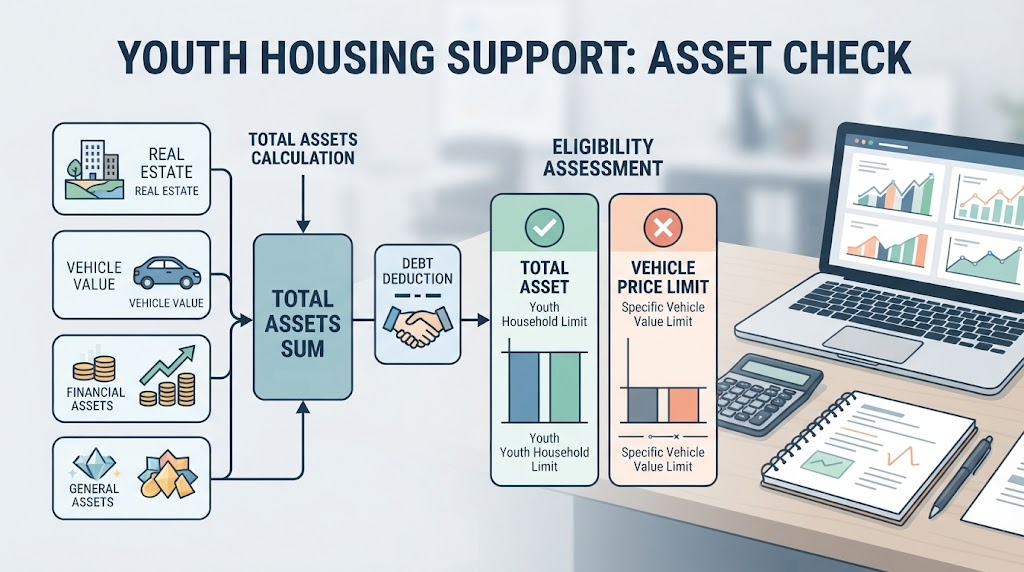
Housing support projects implemented by the government and the Housing and Urban Fund strictly review the ‘total asset value’, which is the sum of real estate, automobiles, financial assets, and general assets held by the applicant minus liabilities, in addition to simple income. In particular, they separately apply individual ‘vehicle value criteria (e.g., 30 million won or less)’ to prevent the ownership of high-priced vehicles.
“How do the asset upper limits required by Happy Housing and Beonimok Loans specifically differ?”
“Do you want to thoroughly dissect how the asset items you own are added up in the total asset calculation formula?”
The success or failure of youth housing support asset screening depends on accurately matching the asset baseline specified in each project’s announcement (e.g., mid-to-high 200 million won total assets for youth households as of 2026) with the calculation method. You can prevent wasted trips only if you accurately understand the method of excluding liabilities such as loans from the total of housing, land, automobiles, and financial assets, and the principle of how the vehicle value operates as a separate baseline.
“Let’s check the core guide that will refreshingly break down the barriers of complex and tricky housing support asset criteria!”
Then, how are the specific total asset limits and vehicle value criteria applied to each major youth housing support project structured? Let’s examine all of those essential checkpoints one by one from now on!
How to Check Vehicle Value Under Your Name (Practical Guide Using Korea Insurance Development Institute and Hometax)
“Ahead of applying for youth housing support, did you want to accurately check whether the value of the car under your name barely exceeds the support criteria (e.g., 30 million won or less), but felt lost on where and how to look it up because used car market prices differ from the Korea Insurance Development Institute standard value? Or were you anxious because you didn’t know how to find your car’s exact standard vehicle value even after looking at Hometax or General Insurance Association public disclosure materials?”
The essential practical process that must be mastered to perfectly verify the vehicle value—the item most commonly causing disqualification or confusion in youth housing support asset screening—is precisely the ‘practical guide to checking vehicle value under your name using the Korea Insurance Development Institute and Hometax’.
Since the vehicle value evaluated in government housing support projects is based on the ‘standard vehicle value’ (or the Ministry of the Interior and Safety’s standard market value) calculated by the Korea Insurance Development Institute, rather than commercial used car transaction prices, you must check it through official query channels to prevent errors.
“What is the trick to finding the Korea Insurance Development Institute standard value in just 1 minute based on your vehicle’s exact model year and displacement?”
“Are you curious about smart tips for checking your car’s tax base standard market value in Hometax’s year-end tax settlement simplification or property tax reporting corner?”
The success or failure of checking vehicle value depends on the accurate input of the vehicle manufacturing date, model number, and the Korea Insurance Development Institute’s vehicle standard value query system. Without relying simply on internet portal market prices, you must directly apply the calculation method officially recognized by government support screening agencies to completely prevent the misfortune of screening disqualification.
“No more frustration of hesitating to apply for housing support due to your ambiguous car market price!”
“We will clearly dissect everything about the practical guide to checking vehicle value under your name using the Korea Insurance Development Institute and Hometax, and perfectly outline the criteria for smart asset verification without failure.”
Then, what are the specific procedures and precautions for checking and verifying your car’s exact vehicle value through the Korea Insurance Development Institute website and Hometax? Let’s examine all of that essential information one by one from now on!

Know-how on Calculating Combined Financial Assets (Savings, Stocks, Insurance, and Debt Reflection Criteria)
“Did you smoothly pass the automobile value check in the youth housing support asset screening, but get a headache trying to figure out where financial assets are counted and how debts are deducted when combining the savings, stock investments, and insurance products you’ve diligently accumulated over the years? Or were you anxious because you didn’t know whether your overdraft account or student loan under your name is actually reflected in lowering your total financial assets?”
The core know-how that must be understood to calculate the total amount of financial assets without error—which requires the most detailed calculation and is a decisive variable determining success or failure in youth housing support asset criteria screening—is precisely the ‘method of calculating combined financial assets applying savings, stocks, insurance, and debt reflection criteria’.
Government and Housing and Urban Fund asset screenings broadly combine all cash-convertible financial assets, including demand deposits, savings deposits, stocks, beneficiary certificates, bonds, insurance policies, and even pension savings. Conversely, official debts such as bank loans or overdraft accounts are subtracted from total assets according to certain criteria.
“How are the stock evaluation amounts under my name and insurance products with surrender values upon cancellation reflected accurately in asset calculation?”
“Are you curious about the recognition scope and evidentiary tips to safely deduct your held debts from your combined financial assets or total assets?”
The success of successful financial asset calculation depends on the accurate submission of balance proofs and officially recognized debt certificates aligned with each financial institution’s asset query reference date. You must check each item meticulously to avoid making the mistake of casually calculating it in your head or considering only the principal deposits, only to exceed the baseline due to the combination of interest income or stock evaluation amounts.
“Let’s escape from the swamp of complex and tricky financial asset calculations and find a refreshing answer!”
Then, how is the specific combined financial asset know-how structured, ranging from savings to stocks, insurance, and debt reflection? Let’s examine all of that essential information one by one from now on!

Tips for Pre-Inspection to Prevent Asset Criteria Exceedance and Screening Disqualification
“As you prepare to apply for youth housing support, you’ve worked hard to calculate everything from vehicle value to financial assets like savings, stocks, and insurance. But are you nervous until the very end, wondering if there are hidden asset items you missed that might narrowly exceed the strict asset screening criteria and result in an unfair notice of disqualification? Or are you curious about what definitive preventive measures can perfectly block requests for supplementation or judgments of ineligibility after submitting documents?”
The final core milestone that must be understood to safely cross the threshold of final acceptance through all document submission and application steps of youth housing support programs is precisely the ‘know-how on pre-inspection to prevent asset criteria exceedance and screening disqualification’.
Since government and Housing and Urban Fund housing support screenings check all income and assets of applicant household members through the Social Security Information System, even a slight error in calculating old savings accounts you were unaware of, minor land shares, or vehicle values can instantly lead to disqualification, requiring careful attention.
“When is the golden time to self-diagnose assets in advance before applying and organize or adjust unnecessary assets?”
“Are you curious about smart coping methods to correct asset over-calculation errors that commonly occur during the screening process and prepare explanatory materials?”
The success or failure of passing asset screening successfully depends on pre-asset checks through sites like Bokjiro or the My Home portal before the official application date, and meticulousness in correcting misunderstandings about name changes or asset dispersion. In particular, wise preliminary management tailored to asset calculation reference dates—such as cash conversion of matured savings, stock sale timing, and vehicle name organization—determines success or failure.
“Let’s build a thorough defensive barrier so you won’t shed tears over shocking news of exceeding criteria!”
Then, what are the specific practical pre-inspection tips to proactively prevent asset criteria exceedance and perfectly avoid screening disqualification? Let’s examine all of those essential concluding pieces of information one by one from now on!

Conclusion: Taking a Step Closer to the Dream of Homeownership Through Perfect Preparation for Strict Asset Criteria
“Amidst the soaring housing cost burden, you desperately desired various youth housing support benefits provided by the government and local authorities. But did you put aside your anxious heart, wondering if you would be unfairly disqualified due to a lack of information while hitting the barrier of complex and tricky ‘asset criteria’, and are you now ready to climb up a solid housing ladder through thorough pre-inspection? Or are you hesitating and delaying your application while wondering if you can truly become the protagonist of housing support benefits?”
As we conclude the entire journey of checking youth housing support asset criteria by verifying vehicle value and combined financial assets, the ultimate core point we must remember is precisely the ‘execution power to overcome information gaps and proactively pre-verify asset criteria’.
The numerous housing support policies prepared by the government and the Housing and Urban Fund do not grant qualifications first to those who simply wait. The series of processes—meticulously checking your vehicle value in advance through the Korea Insurance Development Institute, closely examining everything from savings to stocks, insurance, and debt reflection criteria, and thoroughly inspecting asset items before official application—is the ultimate housing stability strategy to wisely navigate times of high inflation and high interest rates.
“Based on the valuable asset query know-how you learned today, would you like to check your asset status starting tomorrow directly through Hometax and Bokjiro sites and boldly challenge yourself?”
“Do you want to avoid repeating the foolish regret of missing out on your precious share of housing support opportunities due to a single clue of information deficiency?”
Connect to relevant portals right now and carefully recheck the asset criteria announcement notices for your residential area and target business. A little interest and thorough preliminary preparation will provide practical help in your daily life and serve as a stepping stone of seed money heading toward the dream of stable homeownership and housing independence.
“Valuable housing support benefits that everyone else receives—now, don’t hesitate and bravely seize them with your own hands!”
“As we finish the grand journey of checking youth housing support asset criteria by confirming vehicle value and combined financial assets, we sincerely cheer for you to be reborn as a truly smart housing expert with no failures by perfectly preparing for strict asset criteria.”
Start your wise first step right now toward a smart youth housing support challenge without failure!
Korean version: 한국어로 읽기