Introduction: The Importance of Maintaining Health Insurance Dependant Status and the Core of Income Criteria Changes
“Amid soaring prices and a high-inflation, high-interest trend, have you ever felt relieved while maintaining your dependant status under your child’s or family member’s health insurance to alleviate the burden of health insurance premiums that are paid fixedly every month, or felt overwhelmed wondering, ‘Could my dependant status be revoked suddenly due to minor financial or business income generated in my name, hitting me with a local subscriber health insurance premium bomb?’ Or have you ever felt anxious hearing from people around you that the workplace subscriber dependant system is great, but not knowing the exact income criteria changes and requirements that cause dependant status to be revoked?”
The core of the most sensitive and groundbreaking qualification management system implemented by the National Health Insurance Act to solidly alleviate the economic burden within the health insurance system is ‘understanding the exact reflection procedures for dependant disqualification income criteria and financial/business income’.
To enhance fairness and fiscal soundness in the health insurance system, the government excludes individuals with income and assets exceeding certain standards from being dependants and converts them into local subscribers to levy premiums, thereby operating a strict qualification verification system that prevents indiscriminate free-riding and levies premiums on those with actual payment capacity.
“How much of a direct impact will the interest/dividend income or small-scale business income I actually earned this year have on the National Health Insurance Service’s dependant disqualification criteria?”
“If you are curious about the practical merits and risks that changes in comprehensive income amounts reported annually to the National Tax Service—rather than simple temporary income—have on maintaining your status?”
The success or failure of maintaining health insurance dependant status depends on an accurate understanding of annual summed income criteria (e.g., KRW 20 million or less per year, etc.), familiarizing oneself with the reflection criteria for financial and business income, and accurately grasping the timing and procedures by which National Tax Service income data is linked to the Service. To prevent the unfortunate event of receiving a local insurance premium levy notice overnight after being complacent thinking, ‘Surely I won’t get disqualified with this much income,’ you must carefully examine the criteria for each income item.
“No more unfair situations where you lose precious health insurance dependant benefits right before your eyes and bear tens of thousands of won in local insurance premiums due to a failure to properly understand the criteria!”
“We will clearly uncover everything about the process of income criteria for loss of dependant status and financial and business income reflection procedures, and perfectly pin down the standard for smart health insurance qualification defense without failure.”
Then, what exactly are the specific income criteria changes and practical mechanisms of financial and business income reflection that you must know to maintain your health insurance dependant status? From now on, let’s examine all of those essential checkpoints one by one!

Core Requirements and Income Summation Scope for Health Insurance Dependant Disqualification
“Have you ever lived without health insurance premium worries while listed as a dependant under your child’s workplace subscription, but felt nervous wondering, ‘Could my total income in my name actually exceed the summation criteria and cause me to suddenly lose my dependant status one day?’ Or have you ever felt anxious hearing from people around you that dependant criteria have been strengthened and that people have been disqualified due to summed income amounts, wondering if your own status is safe?”
The most decisive first step that serves as the backbone of successful health insurance dependant qualification defense and risk management is ‘accurate identification of the core requirements and income summation scope for health insurance dependant disqualification’.
When judging dependant qualifications, the National Health Insurance Service simultaneously screens income and property requirements. For income requirements in particular, it strictly examines whether the annual summed comprehensive income amount reported to the National Tax Service exceeds a certain standard (currently KRW 20 million or less per year). What is important here is that not only single income, but all comprehensive income held by an individual—including financial income, business income, earned income, pension income, and other income—is included in the summation targets.
“Does the summed amount of various income that I collect every year exceed the inexhaustible baseline for dependant disqualification set by the Service at KRW 20 million per year?”
“If you want to thoroughly check what differences exist in the application method of income summation criteria even if you have a different household on resident registration or live apart from your parents?”
The success or failure of dependant qualification screening depends on accurately calculating the annual summed income of KRW 20 million, distinguishing between income included in summation targets and tax-exempt/separately taxed income excluded, and precisely matching complex requirements with property tax tax base criteria (such as disqualification when the property tax tax base exceeds KRW 540 million up to KRW 900 million while annual income exceeds KRW 10 million). To prevent the unfortunate event of receiving an ineligible notice during the regular or occasional income reconciliation process of the National Health Insurance Service after simply guessing roughly, you must carefully examine the criteria for each item.
“No more unfair situations where you lose precious dependant qualifications in an instant and get converted to a local subscriber due to a failure to properly understand the criteria!”
“We will clearly uncover everything about the core requirements and income summation scope for health insurance dependant disqualification, and perfectly pin down the standard for smart health insurance qualification maintenance without failure.”
Then, how exactly are the criteria for the income summation scope and the core disqualification requirements that you must remember composed? From now on, let’s examine all of those essential checkpoints one by one!
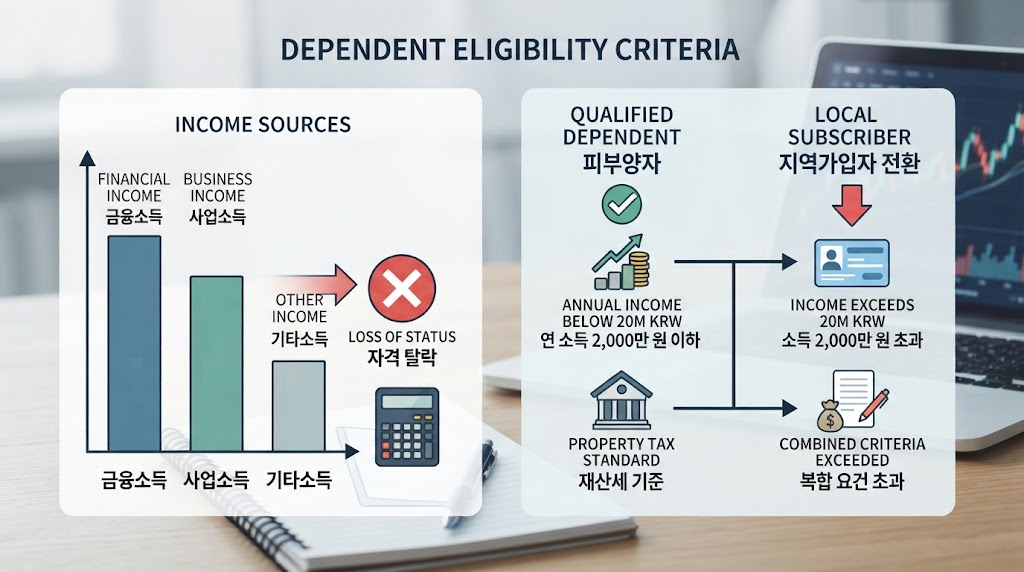
Financial Income Reflection Criteria and Calculation Procedures for KRW 20 Million in Interest and Dividend Income
“Have you ever worried that financial income generated in minor amounts, such as deposit interest or stock dividends, might crack your health insurance dependant status? Or were you frustrated and confused thinking, ‘Financial income is reportedly tax-exempt only up to KRW 20 million per year, so if I don’t exceed this standard, can I unconditionally maintain dependant status, or does it get summed with other income to become a pretext for disqualification?’”
The highlight of health insurance dependant qualification defense and the decisive step that retirees and the elderly managing financial assets must examine most sensitively is ‘full understanding of financial income reflection criteria and calculation procedures for KRW 20 million in interest and dividend income’.
When screening dependant income requirements, the National Health Insurance Service takes as its standard the summed amount of interest income and dividend income subject to National Tax Service comprehensive income taxation. Here, financial income as a whole is not unconditionally summed; whether the total sum of an individual’s financial income exceeds KRW 10 million per year serves as the primary turning point. If the annual total sum of financial income exceeds KRW 10 million, **the entire amount of financial income**—not just the excess portion—is summed with other comprehensive income (business, earned, pension, etc.) and reflected in the screening criteria for an annual summed income of KRW 20 million.
“Does the total sum of deposit interest and stock dividends that I receive in my bank account every year exceed the threshold of KRW 10 million per year, which is the financial income summation standard compiled by the Service?”
“If you are curious about the know-how to safely protect your health insurance dependant status by utilizing tax-exempt and separately taxed financial products (e.g., ISA accounts, tax-exempt comprehensive savings, etc.)?”
The success or failure of financial income reflection depends on accurately distinguishing between financial income subject to comprehensive income taxation under tax law and income subject to separate taxation (such as low-rate separate taxation of KRW 20 million or less), and simulating your total financial income amount in line with the annual National Tax Service income data reflection timing. To prevent suffering setbacks by being included in the National Health Insurance Service’s dependant summation criteria after feeling relieved simply because it concluded with separate taxation of KRW 20 million or less from a tax perspective, you must carefully examine the detailed specs.
“No more unfair situations where you miss out on dependant benefits you could enjoy or get hit with a sudden insurance premium bomb due to a failure to properly understand financial income reflection criteria!”
“We will clearly uncover everything about financial income reflection criteria and calculation procedures for KRW 20 million in interest and dividend income, and perfectly pin down the standard for smart asset management and qualification defense without failure.”
Then, what exactly are the specific financial income summation criteria, the taxation target determination method under tax law, and practical financial asset rearrangement know-how to prevent dependant disqualification? From now on, let’s examine all of those essential checkpoints one by one!

Business Income Reflection Criteria and Application Procedures for Unregistered Businesses and Housing Rental Income
“Have you ever been flustered upon hearing the bolt-from-the-blue news that your health insurance dependant status was revoked just because you earned modest pocket money as a freelance or received a one-time commission without business registration, or simply received a small amount of monthly rent by renting out a small housing unit? Or were you frustrated and confused thinking, ‘Why can’t I maintain my status when business income is not much after subtracting necessary expenses?’, or ‘How does the Service catch unregistered businesses or housing rental income?’”
The most fatal trap in health insurance dependant qualification defense and the decisive stage where retirees and side-job workers most frequently get disqualified is ‘full understanding of business income reflection criteria and application procedures for unregistered businesses and housing rental income’.
The National Health Insurance Service applies very strict standards to business income when screening dependant income. The core diverges sharply depending on the presence or absence of business registration. First, in the case of **businesses with business registration**, if the annual business income amount (income amount obtained by subtracting necessary expenses from sales) **exceeds KRW 0 (meaning if even KRW 1 occurs)**, dependant status is immediately lost (excluding exceptional regulations such as registered persons with disabilities and national merit recipients). On the other hand, in the case of **unregistered businesses without business registration (freelancers, personal service providers, etc.)**, dependant status can only be maintained if the annual business income amount is **KRW 5 million or less**. In addition, even if it is a single-housing unit combined for a married couple or a housing unit with a standard market price of KRW 900 million or less, if **housing rental income** occurs, it is summed and reflected as business income regardless of separate taxation, requiring special caution.
“Does the total amount of business income that I reported to the National Tax Service while working as a freelancer exceed the threshold of KRW 5 million per year, which is the criterion for unregistered businesses?”
“If you want to completely avoid the structure where, even if a registered business number exists and even KRW 1 of net income occurs, it is immediately detected by the National Health Insurance Service system and you get disqualified from dependant status?”
The success or failure of business income reflection depends on accurately recognizing the income criterion limit according to the presence or absence of business registration (exceeding KRW 0 vs. KRW 5 million or less), checking whether housing rental income generation occurs, and managing the timing when National Tax Service data is reflected to the Health Insurance Service after each year’s comprehensive income tax reporting in May. To prevent the occurrence of receiving a dependant qualification revocation notice after being complacent thinking, ‘Surely it’s fine since my income is only a few hundred thousand won,’ you must carefully examine the detailed specs.
“No more unfair situations where you forfeit precious health insurance dependant benefits or retroactively pay unexpected local insurance premiums due to a failure to properly understand business income reflection criteria!”
“We will clearly uncover everything about business income reflection criteria, application procedures for unregistered businesses and housing rental income, and perfectly pin down the standard for fail-safe smart side-job management and qualification defense.”
Then, what exactly are the specific income limit criteria by presence/absence of business registration, the housing rental income calculation method, and practical income dispersion know-how to prevent dependant disqualification? From now on, let’s examine all of those essential checkpoints one by one!
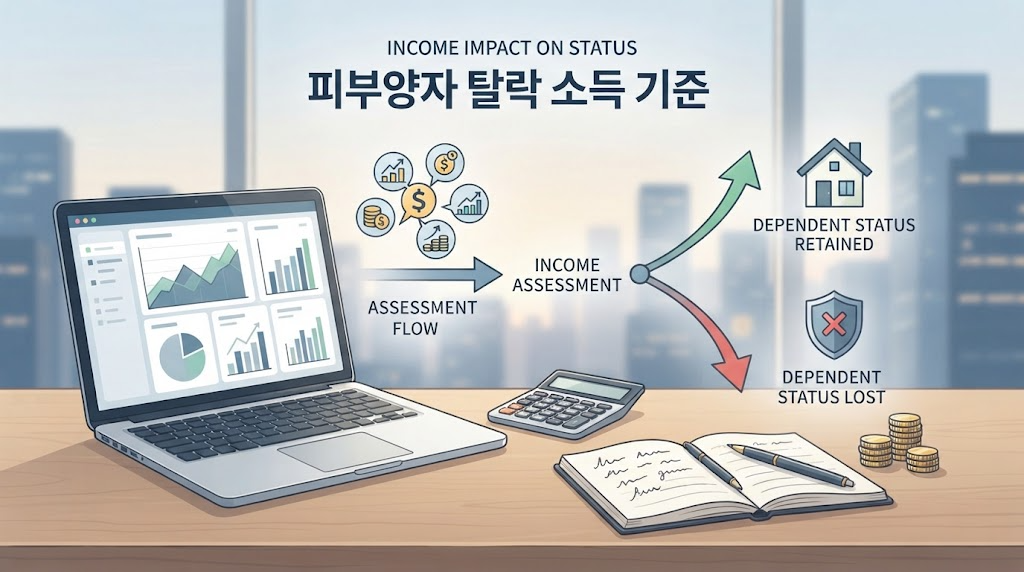
Practical Guide to National Health Insurance Service Income Reflection and Qualification Loss Notice Verification and Response
“Have you ever faced a ‘National Health Insurance Qualification Change (Loss) Notice’ suddenly arriving in your mailbox one day, and felt your vision go dark thinking, ‘Why is my dependant status already gone just because of income that occurred temporarily last year?’, or ‘How am I supposed to afford local health insurance premiums that will come out to tens of thousands of won every month?’ Or have you ever felt helpless wondering when income gets reflected in the National Health Insurance Service long after the National Tax Service comprehensive income tax reporting has ended, and how you should respond when receiving a qualification loss notice?”
The decisive practical stage that decorates the grand finale of health insurance dependant qualification defense and defends against an unexpected local insurance premium bomb is ‘full understanding of the practical guide to National Health Insurance Service income reflection timing, qualification loss notice verification, and response’.
Every year, the National Health Insurance Service receives comprehensive income tax reporting data and property tax tax base data attributable to the previous year from the National Tax Service to periodically re-reconcile dependant income and property requirements (usually reflecting previous year income around October to November every year, or through occasional reconciliation). Therefore, because income is not reflected in the Health Insurance Service the exact moment it is captured by the National Tax Service, but rather with a lag of several months, failing to predict and prepare for your own income fluctuation details in advance can lead to the mishap of retroactively losing dependant status belatedly and being levied local insurance premiums all at once.
“When I receive a notice that I have lost my dependant status, what are the specific explanation procedures and golden time to raise an objection to the Service or reduce income?”
“If you are curious about the know-how to wisely utilize the voluntary continuous subscription system or other relief methods to prevent an insurance premium bomb converting you to a local subscriber upon dependant disqualification?”
The success or failure of responding to a health insurance qualification loss notice depends on real-time qualification inquiries through the The Health Insurance app or the National Health Insurance website, preliminary monitoring tailored to the Service’s income reflection timing (such as regular reconciliations in the second half of every year), and prompt correction claims when reasons for qualification recovery occur due to business closure, suspension, or income reduction. You must carefully examine step-by-step coping methods to avoid making the mistake of panicking or neglecting bills upon receiving them and ending up paying default disposition or excessive insurance premiums.
“No more unfairly bearing the brunt of unfair health insurance premiums due to a failure to properly understand the Service’s income reflection system and qualification loss response methods!”
“We will clearly uncover everything about the practical guide to National Health Insurance Service income reflection and qualification loss notice verification and response, and perfectly pin down the standard for fail-safe smart health insurance risk defense.”
Then, what exactly are the specific Health Insurance Service income linkage timing, qualification loss notice verification methods, and practical objection and relief strategies to minimize the burden of local insurance premiums? From now on, let’s examine all of those essential concluding information pieces one by one!

Conclusion: Protecting Health Insurance Dependant Status Through Thorough Preliminary Income Checks
“Leaving behind the days when you earnestly wanted to maintain your child’s or family member’s health insurance dependant status to alleviate the burden of health insurance premiums spent every month amid surging prices and a high-interest trend, but felt anxious not knowing when your qualifications would be revoked upon hitting the barrier of complex and strict income criteria and financial/business income reflection, or worried whether you might be unfairly converted to a local subscriber due to minor income generation or omissions—are you now ready to embark on thorough preliminary checks and complete income management? Or have you been hesitating and postponing your preparation, wondering if you could truly become the protagonist of maintaining health insurance dependant status?”
Concluding the entire journey of the process of income criteria for loss of dependant status and financial and business income reflection procedures, the final core point we must remember is ‘execution power to overcome the information gap and proactively verify and prepare income criteria’.
The numerous qualification screening criteria prepared by the National Health Insurance Service do not hand benefits first to those who simply wait. Carefully examining the annual summed comprehensive income amount criterion of KRW 20 million or less, closely grasping the financial income (interest/dividend) summation criterion exceeding KRW 10 million per year and the business income limits according to business registration presence (exceeding KRW 0 vs. KRW 5 million or less), and thoroughly preventing mistakes in line with the National Tax Service income data linkage timing—this series of processes is truly the ultimate asset and health insurance risk management strategy to wisely navigate through the high-inflation and high-interest era.
“Based on the valuable dependant qualification defense know-how learned today, if you want to check your own financial income and business income status right from tomorrow and prepare for it with confidence?”
“If you do not want to repeat the foolish regret of missing your precious share of dependant benefits and getting hit with an unexpected local insurance premium bomb due to a single clue of lack of information or negligent income management?”
Access the National Health Insurance website or The Health Insurance app right now to carefully review your qualification status and recent income reflection details once more. Small interest and thorough advance preparation will provide practical economic help to your daily life and become a large primer seed money to design stable asset management and solid housing and living stability.
“All the prime National Health Insurance dependent benefits that everyone else receives, now don’t hesitate and proudly seize them with your own hands!”
“Concluding the entire epic journey of the reflection procedure for financial income and business income under the income criteria for disqualification as a dependent, we sincerely cheer for you to be reborn as a truly smart National Health Insurance qualification recipient who perfectly prepares for demanding income criteria and achieves failure-free success.”
Start your wise first step toward maintaining failure-free and smart National Health Insurance dependent qualifications right now!
Korean version: 한국어로 읽기