Introduction: Why do the costs of upper and lower endoscopies during health checkups vary?
Regular health checkups are essential for protecting one’s health, and among them, upper and lower endoscopies—which allow doctors to directly check the condition of the stomach and colon and detect diseases early—are considered vital examinations. However, when you actually check the costs to book a checkup, you have probably been taken aback at least once by how much prices vary from hospital to hospital and depending on the purpose of the examination. While some places are relatively inexpensive, others charge hundreds of thousands of won, leading to the question, “How on earth are endoscopy costs calculated?”
The reason why there is a difference in upper and lower endoscopy costs is clear. It is because the health insurance application criteria change completely depending on whether you are eligible for a health checkup supported by the government or if you choose a general (comprehensive) health checkup on your own. In addition, the final cost varies significantly depending on the size of the hospital (clinic, hospital, general hospital), whether or not sedation anesthesia is used, and whether additional procedures such as polyp removal or biopsy are performed during the examination.
Let’s take a detailed look one by one at how to understand the structure of health checkup upper and lower endoscopy cost calculation methods and wisely choose the most reasonable and economical checkup method for yourself!
💡 Blog Tip: In this part, accompanying illustration images showing someone looking perplexed at the cost difference while looking at a hospital reception desk or medical expense receipt, or comparing various checkup price lists, can greatly enhance readers’ empathy and immersion.

Comparison of Health Insurance Application Criteria: National Health Checkup vs General Health Checkup
The very first and core step in understanding the difference in upper and lower endoscopy costs is ‘through what pathway you receive the examination’. Even for the exact same upper or lower endoscopy, the scope of health insurance application and the copayment calculation method change completely depending on whether it is conducted within the framework of a national health checkup or a general (comprehensive) health checkup chosen by an individual out of necessity.
To successfully compare costs and establish a reasonable checkup plan, the specific health insurance application criteria for the two types are as follows:
■ Step 1: Application criteria and characteristics of national health checkup upper and lower endoscopies
Among the national health checkup programs, stomach cancer screening is conducted every 2 years for men and women aged 40 or older, with the government covering most of the cost. At this time, the copayment is very low, around 10% or so (or free for eligible individuals).
On the other hand, for colorectal cancer under the national cancer screening program, a fecal occult blood test (stool test) is first performed for those aged 50 or older, and a colonoscopy is conducted with health insurance (or government support) applied only when abnormal findings are discovered or upon a doctor’s recommendation.
■ Step 2: Cost structure and differences of general (non-benefit/comprehensive checkup) endoscopies
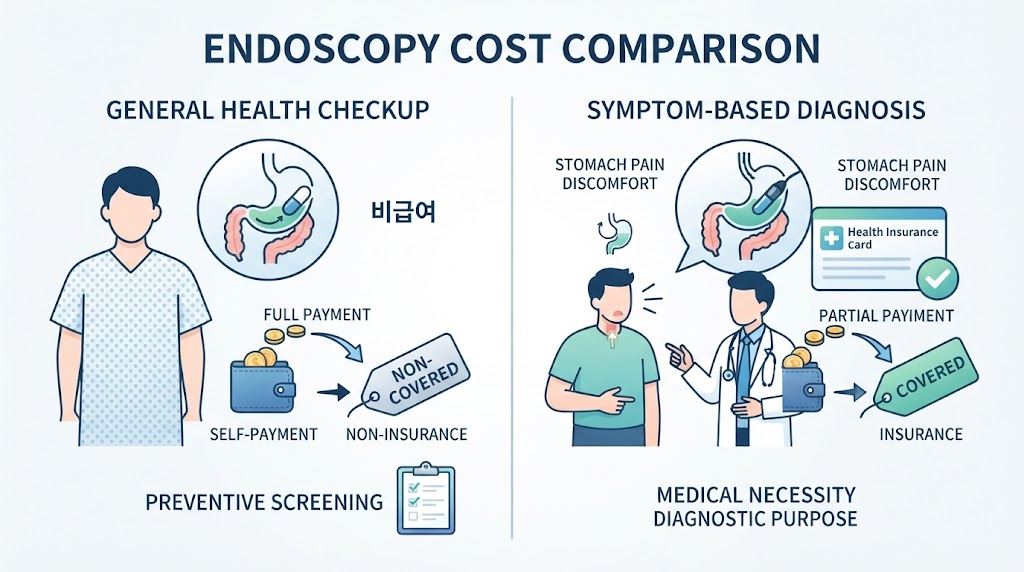
This applies when you do not fall into the national health checkup target age group, or when you apply to include upper and lower endoscopies in your comprehensive health checkup package out of health concerns or for preventive purposes even without special symptoms.
In this case, because it is classified as a ‘non-benefit’ medical service item to which government support does not apply, you must pay the entire examination cost set by the hospital out of pocket. For this reason, price deviations occur significantly among medical institutions.
■ Step 3: Distinguishing general treatment (insurance-applied) endoscopies according to symptom manifestation
An endoscopy performed for disease diagnosis after a doctor’s consultation due to digestive-related symptoms such as indigestion, abdominal pain, or bloody stools—not for health checkup purposes—is applied with health insurance as ‘care benefits for the purpose of disease diagnosis’. In this case, you can receive the examination much cheaper than health checkup non-benefit costs.
Simply clearly recognizing the difference in health insurance application criteria can wisely prevent unnecessary checkup cost expenditures.
💡 Blog Tip: In this part, accompanying a clean table or infographic image that allows readers to intuitively understand information—such as the national health checkup target inquiry screen or a comparison of copayment structures between national checkup items and general comprehensive checkup items—will be very useful for readers.
Core Elements of Upper and Lower Endoscopy Cost Calculation Methods
If you understand the detailed structure of how upper and lower endoscopy examination costs are composed and calculated, you can clearly understand the reason for the amount written on your hospital medical expense receipt. Endoscopy examination costs are not determined solely by the act of inserting and observing with endoscopy equipment; rather, the final cost is calculated by complexly adding up various medical acts, consumables, and additional procedures.
To successfully analyze costs, the specific core elements constituting the upper and lower endoscopy cost calculation methods are as follows:
■ Step 1: Consultation fee and basic practice fee
This is the cost incurred during the pre-examination interview and consultation with a specialist before the endoscopy, as well as the basic examination process immediately before and after the procedure. It is calculated according to the basic unit price determined by the Medical Service Act and is differentially applied depending on the size of the hospital.
■ Step 2: Endoscopy insertion fee and equipment/anesthesia fee (including sedated endoscopy)
This is the fee for the procedure itself of inserting endoscopy equipment into the human body for observation. In particular, for ‘sedated endoscopy’ chosen by many people, drug costs used for sedation induction (such as midazolam, propofol, etc.), monitoring equipment usage fees, and recovery room stay costs are added as non-benefit items, which becomes a major factor in cost increases.
■ Step 3: Biopsy and polyp removal (factors causing additional costs)
If an abnormal lesion such as gastritis, adenoma, or a polyp is discovered during the endoscopy examination and a sample is taken (biopsy) or an immediate ‘polyp removal’ procedure is performed, a major change occurs in cost calculation. Biopsies or polyp removals are additionally billed as health insurance benefits or non-benefits, and costs are differentially calculated based on the number or size of removed polyps.
If you familiarize yourself with the detailed elements of endoscopy cost calculation in advance, you can establish a reasonable budget without being taken aback by unexpected additional costs.
💡 Blog Tip: In this part, accompanying a table classifying endoscopy medical expense statement items (consultation fee, sedation fee, biopsy fee, etc.) for easy viewing or a receipt analysis illustration image can help readers understand the cost structure much more specifically and easily.

Comparison of Endoscopy Costs by Hospital Size (Clinic, Hospital, General Hospital)
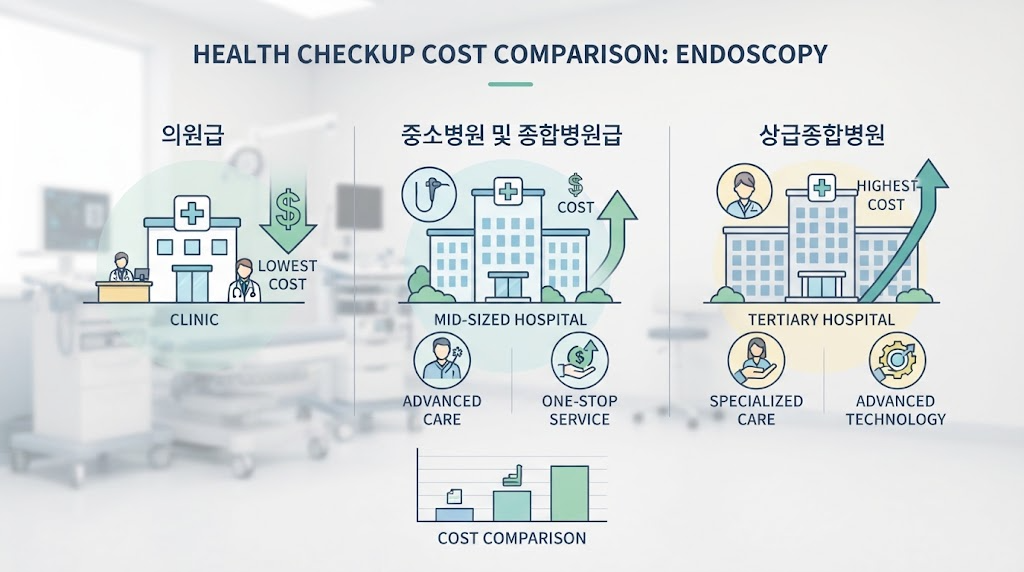
Even for the exact same upper or lower endoscopy examination, the final billed cost shows significant differences depending on the size of the medical institution you visit. This is because South Korea’s medical system applies different ‘classification surcharge rates’ to consultation fees, hospitalization fees, and examination fees depending on the size of the medical institution (clinic level, hospital level, general hospital level, tertiary general hospital), which especially has a great impact on the pricing method for sedation fees or comprehensive checkup packages classified as non-benefit items.
To select a reasonable checkup hospital, the specific characteristics and differences in endoscopy costs by hospital size are as follows:
■ Step 1: Neighborhood clinic-level medical institutions (department clinics, internal medicine clinics, etc.)
Characteristics and Costs: This is generally the stage where you can receive an endoscopy examination at the most reasonable and economical cost. The classification surcharge rate is the lowest, and the sedated endoscopy costs categorized as non-benefit (such as sedation fees) are also formed relatively cheaper compared to large hospitals.
Advantages: Accessibility is good, reservation and examination proceed promptly, and unnecessary cost burdens can be minimized, making it the most preferred scale for national health checkups or general upper and lower endoscopies.
■ Step 2: Small-to-medium-sized hospitals and general hospital-level medical institutions
Characteristics and Costs: Compared to clinics, they are equipped with advanced equipment and spacious facilities, with specialized medical staff residing. Accordingly, basic unit prices and classification surcharge rates are applied slightly higher than those of clinics.
Advantages: When polyps or specific lesions are discovered during the examination, it is easy to link them to one-stop precision medical treatment or additional treatment, and it is advantageous when receiving various blood tests or imaging tests together in connection with a comprehensive health checkup program.
■ Step 3: Tertiary general hospitals (university hospital level)
Characteristics and Costs: They possess the highest level of medical equipment and subspecialists, but tertiary general hospital surcharges are added across consultation fees and examination fees, making non-benefit endoscopy costs the highest.
Precautions: They are often not designated national health checkup hospitals, and they are mainly used when digestive disease symptoms are severe or when referred with a precision diagnosis opinion from another hospital, rather than for simple health checkup purposes. Visiting for general health checkup purposes can result in a very heavy cost burden.
If you compare the cost differences and pros and cons by medical institution size in advance, you can choose the optimal hospital that best fits your budget and health condition.
💡 Blog Tip: In this part, organizing the characteristics, average cost levels, and recommended targets of clinics, hospitals, and tertiary general hospitals in a clean table format that allows readers to grasp information quickly and clearly will be very useful for readers.
Tips and Cost-Saving Know-How for a Wise Endoscopy Checkup
Upper and lower endoscopy costs can vary by hundreds of thousands of won depending on the purpose of the examination, hospital selection, and prior preparation. To wisely reduce unnecessary expenses while protecting your precious health, it is important to remember a few practical saving know-hows and pre-checkpoints.
To look specifically at the core tips you must know for a successful and economical endoscopy checkup:
■ Step 1: Check national health checkup eligibility and free/discount benefits first
Access the health checkup form sent by the National Health Insurance Service annually or biennially, or the ‘National Health Insurance Service’ website (or The Health Insurance app), to first check whether you are a target for stomach or colorectal cancer screening this year.
If you fall under the national cancer screening target, you can significantly lower your copayment or receive the examination for free, so utilizing the national checkup course before booking a general non-benefit comprehensive checkup is the biggest money-saving tip.
■ Step 2: Pre-inquire ‘Non-Benefit Medical Expense Information’ from the Health Insurance Review and Assessment Service
Because endoscopy sedation costs or upper and lower endoscopy examination costs conducted as non-benefits are autonomously set by each medical institution, price deviations are large.
By using the ‘Non-benefit Medical Expense Information’ menu on the official website or mobile app of the Health Insurance Review and Assessment Service (HIRA), you can transparently compare endoscopy sedation fees and examination fees by hospital within your residential area, so compare prices in advance before visiting and choose a reasonable place.
■ Step 3: Avoid unnecessary duplicate examinations and utilize medical history
If you already have a history of receiving an upper or lower endoscopy or related digestive examination at another hospital within the past 1 to 2 years, bring or link your examination results to avoid unnecessary re-examinations.
In addition, proceeding with the examination after a doctor’s consultation for the ‘purpose of disease diagnosis’ rather than a simple checkup because digestive symptoms are clear can be a clever way to reduce costs by receiving health insurance application.
If you utilize wise pre-inquiry and meticulous comparison know-how, you can complete an optimal endoscopy checkup with definitely lower cost burdens and high satisfaction!
💡 Blog Tip: In this part, neatly organizing examples capturing the Health Insurance Review and Assessment Service non-benefit medical expense inquiry screen or items to check before a checkup in a checklist format will be very useful for readers to apply directly in real life.

Conclusion and Health Checkup Cost Comparison Summary
So far, we have carefully examined everything from the calculation method of health checkup upper and lower endoscopy costs, the differences between national health checkups and general checkups, cost structures by hospital size, to practical saving know-how to reduce unnecessary expenses. Endoscopy costs, which may have vaguely felt expensive, can be designed reasonably depending on whether health insurance applies, non-benefit items such as sedation fees, and the classification surcharge rates of medical institutions.
To summarize the core contents for a successful health checkup and cost reduction:
■ Prior check of national checkup eligibility: Minimize copayments by utilizing government support benefits (stomach and colorectal cancer screenings) first
■ Utilization of prior price comparison: Compare endoscopy and sedation costs by region and hospital in advance through Health Insurance Review and Assessment Service non-benefit medical expense inquiries
■ Purpose distinction according to symptoms: Wisely understand the application criteria for comprehensive checkups for prevention purposes and care benefits for disease diagnosis purposes
Regular upper and lower endoscopies are the surest investment to detect diseases early and protect your precious health. Based on the cost calculation methods and know-how guided today, we sincerely cheer for you to choose a reliable hospital tailored to your budget and wisely complete a health checkup with low burdens and high satisfaction! If this information was useful, don’t forget to leave likes, comments, and neighbor additions!
💡 Blog Tip: In this part, placing a neatly organized health checkup cost comparison summary infographic or an illustration image of someone smiling brightly and spending a warm, healthy daily life can warmly and perfectly adorn the conclusion of the posting.
Korean version: 한국어로 읽기