Introduction: Understanding the National Tomorrow Learning Card Before You Start
Are you preparing for a new job, considering a career change, or looking to strengthen your job competencies? The government provides various state-funded support benefits to help citizens develop their lifelong vocational skills. Among them, the most representative and powerful system is the “National Tomorrow Learning Card”.
However, when trying to issue the card, it is easy to feel overwhelmed, wondering, “Am I eligible?” or “Where should I apply?” Furthermore, if you enroll in a course impulsively without thorough research and have to quit due to unforeseen circumstances, you might face unexpected disadvantages.
In this post, we will thoroughly organize everything from the basic usage methods of the National Tomorrow Learning Card to the training course withdrawal and dropout procedures you need to know in case of emergencies. Be sure to read until the end and make the most of your state-funded support benefits wisely!

How to Use the National Tomorrow Learning Card (From Application to Enrollment)
The National Tomorrow Learning Card is a system where the government supports training costs so that individuals can build their competencies in response to the rapidly changing labor market environment. We will break down the entire process from issuance to actual enrollment into four easy-to-understand steps.
Step 1. Apply for Card Issuance (Employment 24 and Jurisdiction Employment Center)
Before getting the card, checking your eligibility is the top priority. While any South Korean citizen can apply, certain individuals such as public officials, private school staff, and self-employed individuals with annual sales above a certain amount may be excluded.
Application Method: You can choose between online or offline methods.
Online Application: Log in to the integrated employment support portal “Employment 24 (goyong24.go.kr)” website using a joint certificate (or financial certificate) and apply.
Offline Application: You can visit the local employment center having jurisdiction over your residence in person with your ID card to apply.
Support Limit: A basic account limit of 3 million won to 5 million won is granted per person, and the card’s validity period is 5 years from the issuance date.
Step 2. Explore and Select the Desired Training Course (HRD-Net / Employment 24 Utilization Tips)
Once your card is issued, you need to find the training course that suits you.
Search Platforms: You can search for various online and offline training courses nationwide through Employment 24 or the vocational training portal HRD-Net.
Course Selection Tips:
Carefully check the self-payment ratio according to your card support rate (which varies depending on general participants, employment success packages, National Employment Support Systems, etc.).
It is important to compare reviews, employment rates, and training days to carefully choose a course that fits you well.
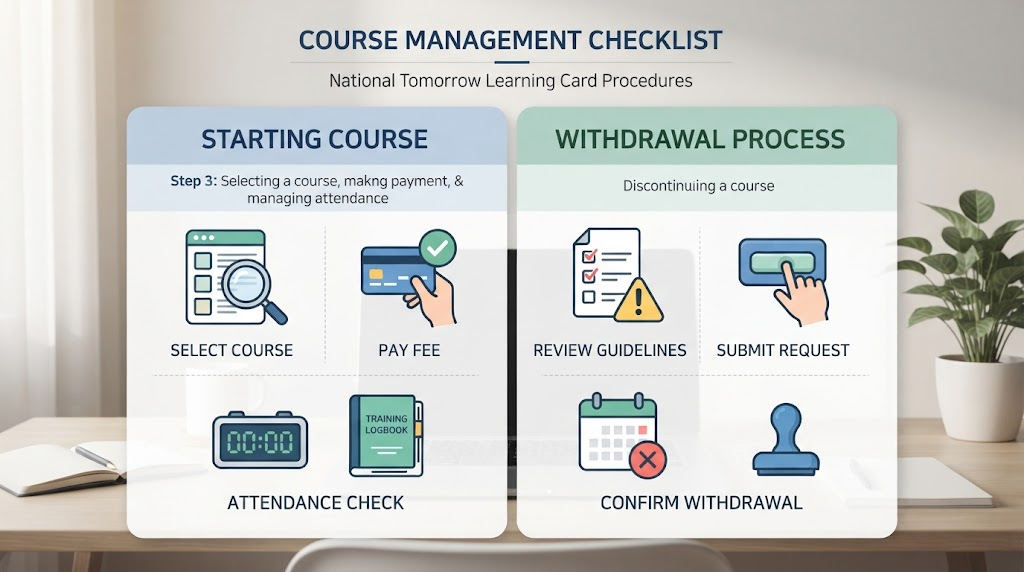
Step 3. Course Enrollment and Self-Payment Method
Once you have found a course you like, proceed with course enrollment.
- Online Course Application: Select the desired course on Employment 24 or HRD-Net and click the [Course Application] button.
- Check and Approve Support Eligibility: Depending on the training course, consultation or approval from the local employment center may be required.
- Self-Payment Settlement: Once approval is completed, you must finish paying the self-payment amount using your own card (credit or check card) to complete the final course registration. (You can participate normally in the training only after payment is completed.)
Step 4. Attendance Management and Training Allowance (Training Subsidy) Payment Conditions
Once the course begins, thorough attendance management is the key to passing and completing the course.
Attendance Check: When entering and leaving the training institution, you must check in for attendance with identity verification through the Employment 24 attendance management app (or designated terminal).
Attendance Rate Criteria: You must attend 80% or more of the total training days to be recognized for completion.
Training Subsidy Payment:
If requirements such as a course with a daily training time of 5 hours or more are met and the attendance rate is 80% or more, a designated training subsidy is provided.
Since additional subsidies are paid for participants of the National Employment Support System or certain vulnerable groups, it is recommended to actively utilize them.
What If Unforeseen Circumstances Arise? Training Course Withdrawal and Dropout Regulations
While it is best to faithfully complete training courses with the National Tomorrow Learning Card, situations may arise where it becomes difficult to continue taking classes due to unavoidable reasons such as sudden employment, worsening health, or personal circumstances.
In such cases, simply stopping classes or cutting off contact can lead to unexpected disadvantages, so you must know the exact course withdrawal (dropout) regulations and proper coping methods in advance.
- What is Course Withdrawal (Dropout)?
Concept: This refers to failing to complete the training and quitting halfway due to personal reasons, illness, employment, etc., after the training course has started.
Importance of Proper Procedures: If you decide to withdraw from a course, you must not stop arbitrarily, but must follow procedures that comply with regulations to minimize penalties and prevent disadvantages when reusing the card in the future.
- What to Do First When Withdrawing from a Course
- Notify the Training Institution Immediately: You must clearly communicate your intention to withdraw to the training institution (academy) representative immediately upon the occurrence of personal circumstances.
- Prepare Reason Verification: If there are objective reasons such as employment, job transfer, illness (requiring a medical certificate), or an accident rather than a simple change of mind, disadvantages can be reduced or exempted. Since supporting documents are required, it is safe to check with the training institution in advance.
- Major Disadvantages Resulting from Unexcused Absence
If you are expelled (dropped out) due to cutting off contact without formal procedures or unexcused absences, the following strict penalties will be applied.
Account Balance (Support Limit) Deduction:
In the event of a dropout or expulsion, a certain amount will be deducted from your account balance regardless of the remaining training cost. (Usually, the penalty increases according to the number of times: a 200,000 won deduction for the 1st deduction, a 500,000 won deduction for the 2nd deduction, and a 1,000,000 won deduction for 3 or more deductions.)
Reduction of Support Limit and Restriction on Card Usage:
Repeated dropouts pose major constraints on receiving state-funded support benefits in the future, so even if you must quit inevitably, you must go through formal administrative processing.

Course Withdrawal Procedures and Step-by-Step Precautions
When you inevitably have to quit a National Tomorrow Learning Card training course, you must thoroughly follow prescribed administrative procedures before letting emotions take over to minimize damage. If you have decided to withdraw from a course, be sure to check the steps and precautions below before proceeding.
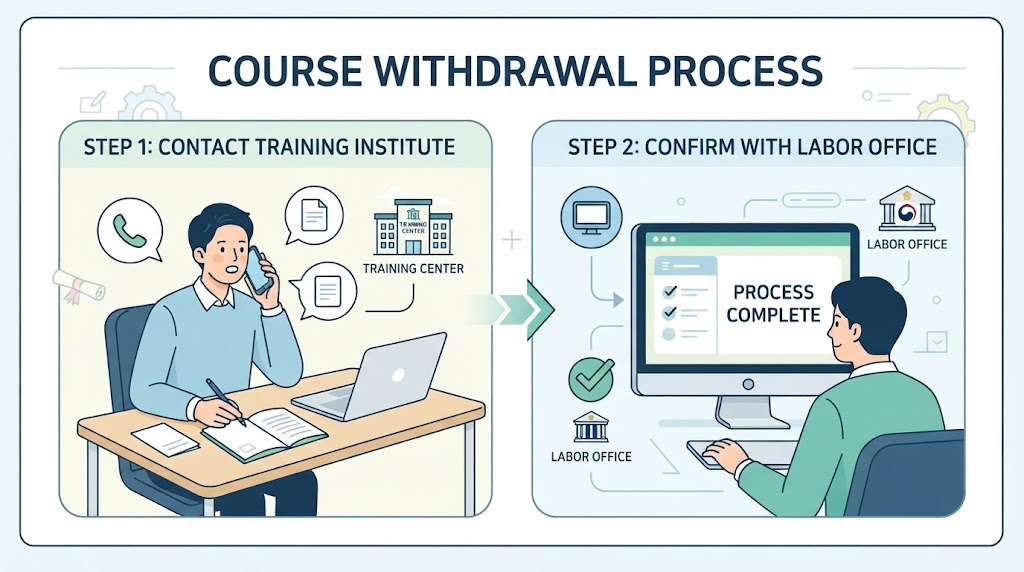
Step 1. Notify the Training Institution of Intent and Reasons for Course Withdrawal
The very first thing you must do is contact the administrative representative of the training institution (academy) you are currently attending to officially state your intention to withdraw.
Do not just end it verbally; you must communicate your intention containing a clear reason for withdrawal.
In this process, be sure to ask the representative whether objective supporting documents (employment proof, medical certificate, moving confirmation, etc.) are needed to reduce future disadvantages and begin preparations.
Step 2. Employment Center Reporting and Course Withdrawal (Dropout) Processing
Notifying the training institution does not mean all procedures are complete.
The training institution must report to the jurisdiction employment center when a course withdrawal (dropout) occurs.
It is safe for trainees themselves to check through the Employment 24 system or the jurisdiction employment center representative to see if the final processing status has been properly reflected as “dropout (course withdrawal).” If administrative processing is omitted, setbacks may occur in attendance or balance calculations.
Precaution 1: Check Self-Payment Refund (Return) Criteria
The most sensitive part when giving up training is the “self-payment refund” issue.
The self-payment refund amount is calculated based on the timing of training withdrawal (training hours and remaining days) according to relevant regulations such as the Enforcement Decree of the “Act on the Development of Vocational Skills of Workers.”
The sooner you quit right after the opening of the course, the more amount you can get refunded, but as the training period exceeds a certain level or approaches the final stage of the course, the refund amount may be non-existent or very small.
Therefore, as soon as you decide to withdraw from the course, you must check the training institution’s tuition refund standard table and proceed with the refund application together.
Precaution 2: Fatal Disadvantages Resulting from Unauthorized Disappearance and Absence
Actions such as cutting off contact with the thought “I’ll just stop attending since it’s bothersome” or unexcused absences are strictly prohibited.
If processed for expulsion due to unexcused absence, you will receive a larger account balance deduction penalty than a simple course withdrawal.
In severe cases, taking state-funded training courses itself may be restricted for a certain period in the future, or you may receive disadvantages in government subsidy benefits, so you must finish by going through normal administrative procedures.
Reuse of the Tomorrow Learning Card and Disadvantages Guide After Course Withdrawal
Many people worry after inevitably quitting a training course midway: “Can I use my card again in the future?” or “How much will the penalty be?” We will precisely outline the account balance deduction criteria, card reuse conditions, and penalties to watch out for after course withdrawal.
- Account Balance (Support Limit) Deduction Criteria Upon Course Withdrawal
If you drop out (withdraw from a course), a certain amount of your National Tomorrow Learning Card account balance (support limit of 3 million to 5 million won) will be cut regardless of the remaining training cost.
Penalty According to Number of Deductions:
Upon 1st dropout: 200,000 won deducted from the account balance
Upon 2nd dropout: 500,000, won deducted from the account balance
Upon 3 or more dropouts: 1,000,000 won deducted from the account balance
Things to Note: As the number of times accumulates, the deducted amount increases, which may reduce your remaining support limit and cause a budget shortage when you want to take other courses you wish to learn in the future.
- Possibility of Reusing the Tomorrow Learning Card After Course Withdrawal
The card itself can continue to be used: Quitting a course does not mean the card itself expires or is immediately suspended. Within the validity period of the card (5 years from the issuance date), you can reapply and use other training courses within the remaining limit.
However, restrictions may occur for a certain period: If you are processed for a dropout due to dishonorable reasons such as poor attendance rate or unexcused expulsion, the application for new training courses may be restricted for a certain period, so you must check the exact restriction period through the employment center.
- Precautions and Penalty Prevention Tips for Future State-Funded Support Benefits
Cautious Re-challenge: Frequent course withdrawals can work disadvantageously during the consultation process with employment center representatives or future evaluations for additional subsidies (such as National Employment Support System training allowances).
Must Explain Inevitable Reasons: If you withdraw midway due to unavoidable reasons such as disease, natural disaster, or objectively recognized employment, there is an exception clause where you can be exempted from or have penalties (account deductions, etc.) mitigated by submitting supporting documents to the employment center. Therefore, active communication with the academy and the jurisdiction employment center when a reason for withdrawal occurs is the most important thing.

Conclusion: Advice for Wise Utilization of State-Funded Support
So far, we have carefully examined everything from the basic usage methods of the National Tomorrow Learning Card to the procedures and penalties when you must inevitably give up a training course.
While the National Tomorrow Learning Card is a reliable self-development subsidy that anyone can enjoy, responsible utilization must be premised since it is a system operated with national budgets. When choosing a course, please think carefully about whether it fits your aptitude and future career path, and if unavoidable circumstances arise, do not panic, but minimize damage by going through the normal administrative procedures and verification processes guided today.
We support your precious challenge toward learning. We hope you successfully achieve your desired goals through wise utilization of state-funded support!
Korean version: 한국어로 읽기