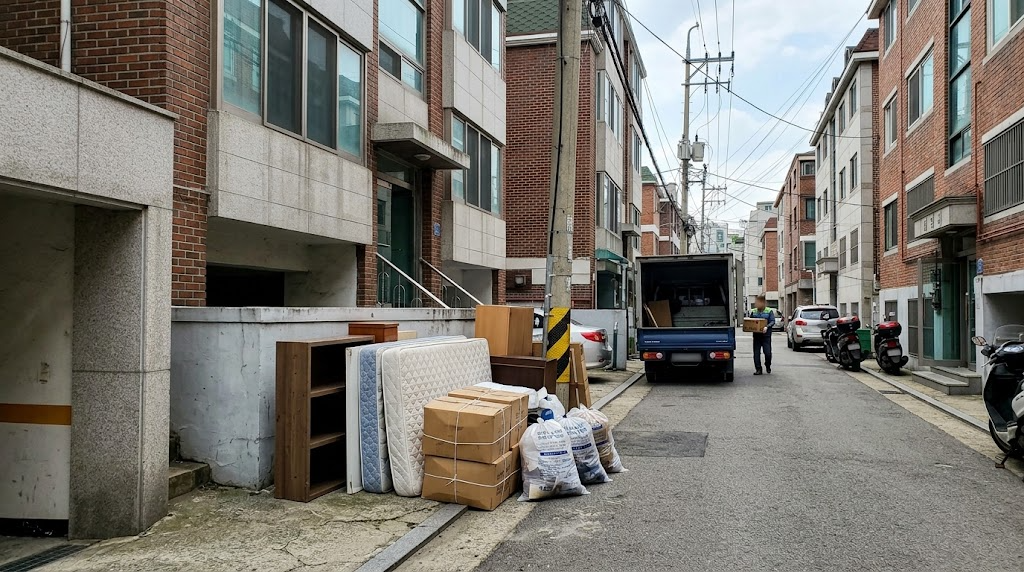
Our Neighborhood’s ‘Designated Disposal Spot’ and Proper Disposal Timing
This is a main body section written considering mobile line breaks and information delivery tailored to Naver Blog readability. You can copy and use it right away.
- Our Neighborhood’s ‘Designated Disposal Spot’ and Proper Disposal Timing
In villa or studio apartment areas where separate recycling stations are not provided like in apartment complexes, the most perplexing moment arrives on moving day.
“Where on earth should I leave this big mattress and desk?”
“If I put a sticker on it and leave it anywhere in the alley, will they take it away on their own?”
To tell you the conclusion first, leaving it at ‘just any alley corner’ can be subject to a fine. Here is a clear summary of disposal principles that allow collection vehicles to collect items smoothly while avoiding friction with neighboring residents.
① Disposal Location: Inside the Villa Parking Lot vs. In Front of My House Gate?
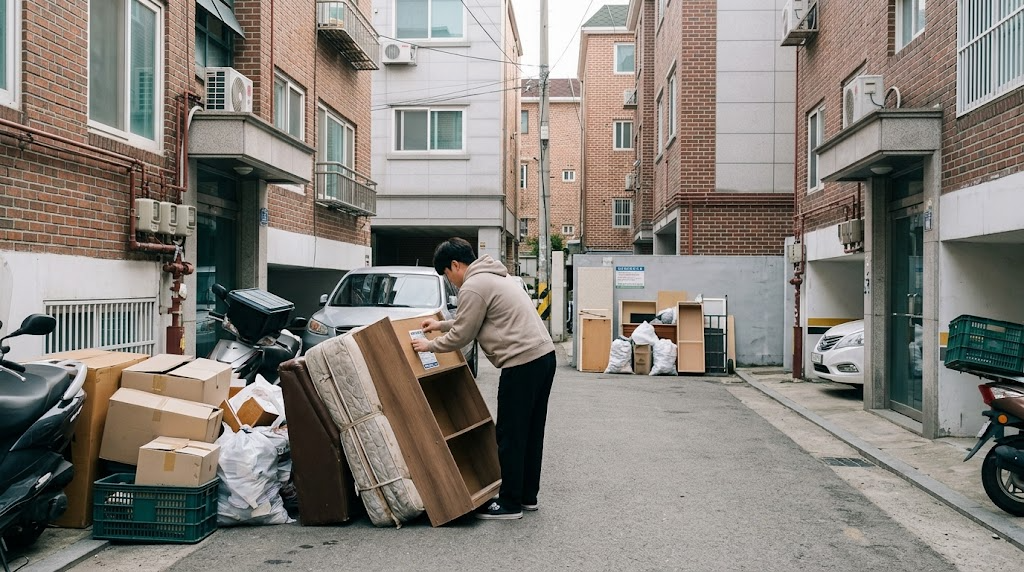
The basic disposal principle in dense studio and villa areas is ‘in front of my house gate (curbside door-to-door disposal).’
Basic Principle (In front of the main gate / Next to the building entrance):
The standard practice is to gather items right next to the main entrance of the villa building where you lived or at a flat spot inside the building boundary line so that collection workers can see and load them directly from the road.
Precautions When Using a Piloti Parking Lot Corner:
People often place items deep inside the piloti parking lot out of concern that it might rain. However, if it encroaches on other residents’ parking lines or obstructs car door opening and closing, civil complaints will follow immediately. If you use part of the parking lot, you must secure a corner spot unrelated to the vehicle movement line.
Places You Must Never Place Items:
Curved corners of narrow alleys (obstructing vehicle visibility)
Fire truck access routes and surroundings of fire hydrants
In front of someone else’s house wall or commercial building entrances
💡 Tip: If it is a dead-end alley that is too narrow for collection trucks to enter at all, it is safe to inquire in advance with the jurisdictional community service center or cleaning agency and dispose of items at a safe roadside spot at the entrance of the alley that does not interfere with traffic.
② Disposal Timing: Why You Should Not Put Items Out During the “Day of Moving”
Since most moves take place during the day, waste is often unloaded onto the roadside right while unloading items from the moving truck. However, according to local government cleaning administration standards, stacking items on the street during daytime hours can be subject to crackdowns for ‘damaging the urban landscape and obstructing traffic.’
Standard Disposal Hours: From after sunset (dusk) the day before the collection date to before 12:00 AM midnight
Realistic Coping Methods for Moving Waste:
Items coming out during the day of moving: Unless a same-day collection has been scheduled, it is best to first arrange them under the building’s interior staircase landing or in an idle space of the parking lot, and then take them out to the designated location during the evening.
Aligning with the advance disposal reservation date: Collection days are determined by day of the week (e.g., Monday, Wednesday, Friday collection, etc.) for each local government and neighborhood (dong). The best way to reduce the moving day’s hustle and bustle is to dispose of them in advance on the evening before the collection day right before the moving day.
③ 3-Line Checklist to Prevent Tangled Movement Lines on Moving Day
- Separate from the ladder truck/moving truck movement line: Stacking waste within the operating radius of the ladder truck or right behind the moving truck’s trunk delays the loading work.
- Check the weather forecast for rain: Since mattresses or fabric sofas absorb water and increase in weight by 2 to 3 times, collection may be refused or delayed, so if rain is forecast, you must cover them with a waterproof tarp or plastic sheet.
- Leave a photo of the completed disposal: If you take a photo clearly showing the sticker (or registration number) after disposing at the designated location, restoration verification with the landlord and move-out security deposit settlement will go smoothly.
Sorting and Disposal Standards by Item (Furniture, Home Appliances, Mixed Waste)
This is a main body section applying mobile-friendly line breaks, bold text emphasis, and table summaries optimized for Naver Blog readability. You can copy and use it as is.
- Sorting and Disposal Standards by Item (Furniture, Home Appliances, Mixed Waste)
When sorting out moving luggage, all kinds of trash pour out all at once.
“Will they collect it if I force it into a volume-rate garbage bag?”
“Do I also have to pay money and attach stickers to discarded home appliances one by one?”
Trying to save costs can inadvertently result in a collection refusal sticker being attached or a fine being imposed, so you must remember the clear disposal formula for each waste type.
① Bulky Household Waste (Furniture, Bedding, Sundries)
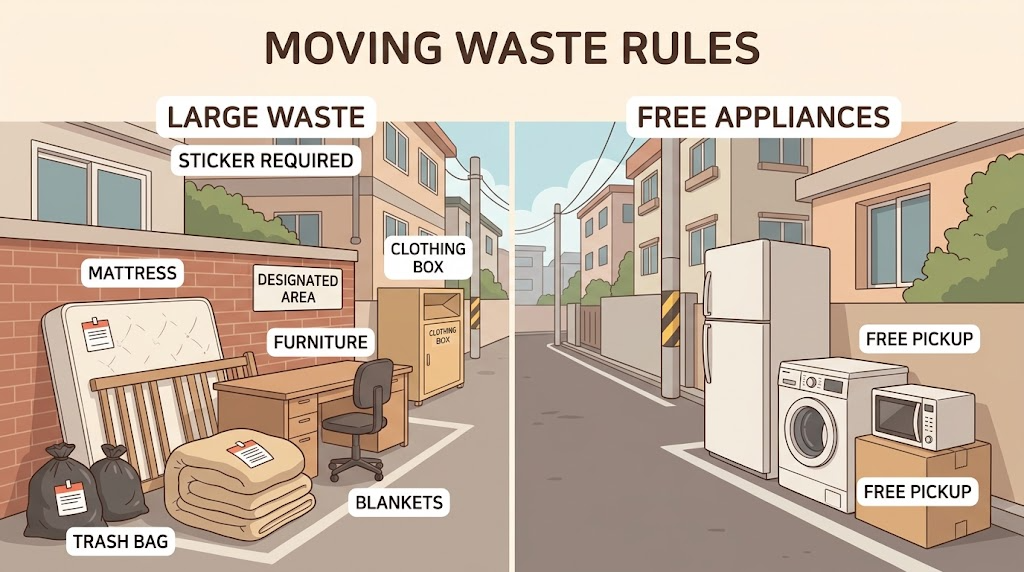
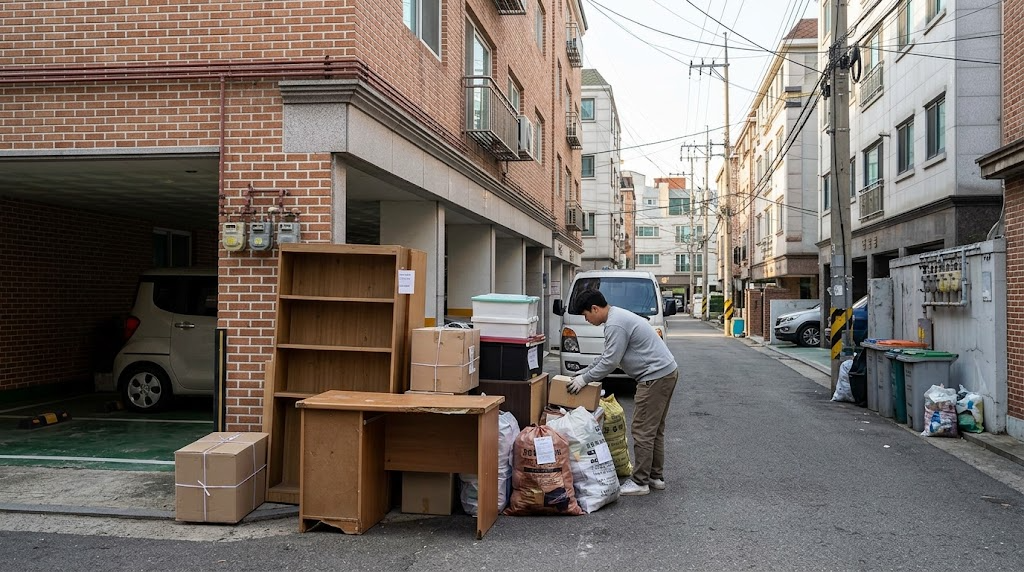
All items that do not fit into a volume-rate bag (maximum size 100L or 75L) are subject to attaching a bulky waste sticker.
- Bed mattress & frame:
The mattress and frame are separate items, and fees are set individually. (Different fees occur depending on single/queen sizes)
- Desk, chair, chest of drawers, clothes rack:
The standard is to put them out in their finished product state. Even if you completely smash drawers or other items into board form to reduce volume, they will only be collected if you receive a sticker based on the furniture’s original standard dimensions.
- Bedding & pillows (Caution!):
- Cotton duvets, latex pillows, toppers: Items that cannot be placed in clothing donation bins. You must attach a bulky waste sticker or dispose of them in a volume-rate bag.
- Thin single-layer blankets, regular clothes: If uncontaminated, disposal in alley clothing donation bins is possible.
② Waste Home Appliances: How to Throw Away for Free Without Spending Money
Broken home appliances or electronic devices left behind can be collected 100% free of charge without the need to purchase local government stickers.
- Large appliances (Free on-site pickup for single items):
- Target items: Refrigerator, washing machine, air conditioner, TV, microwave oven, air purifier, etc.
- Method: Advance reservation at ‘e-Circulation Governance (Waste Home Appliance Free On-site Collection Service)’
- A technician visits directly on the designated date and collects them free of charge.
- Small appliances (Bulk bundle disposal):
- For small appliances such as hair dryers, toasters, irons, electric fans, and rice cookers, on-site pickup is not possible for just 1 single item (visiting is usually possible when disposing of 5 or more at the same time).
- For small quantities of 1 to 2 items, it incurs no cost at all if you drop them directly into the small waste home appliance collection bin in front of a nearby community service center.
⚠️ Caution: Appliances whose original form is severely damaged or whose parts have been disassembled (e.g., removing a refrigerator motor) are excluded from free collection, so they must be disposed of as bulky waste for a fee.
③ Non-combustible Waste: Required Items for Special Standard Bags (PP Sacks)
These are representative items that burst general waste volume-rate bags or cause collection refusal when placed inside. Non-combustible materials must be separately contained by purchasing ‘special standard bags (orange/white non-combustible PP sacks)’ sold at marts or convenience stores.
- Applicable items:
- Ceramic bowls, porcelain plates, mugs, glass cups, broken mirrors
- Flowerpots (ceramic/earthenware) as well as repotting soil and gravel
- Interior tile pieces, bathroom accessory plastic composites
- Safety tips for disposing of glass items:
Broken glass or sharp shards can pierce through sacks and injure collection workers, so they must be wrapped in newspaper or thick cardboard boxes and tightly sealed with tape before being placed into the sack.
📋 Moving Waste Disposal Standards Summary Table at a Glance
| Category | Key Items | Disposal Method | Disposal Cost |
|---|---|---|---|
| Bulky Furniture | Mattress, chest of drawers, sofa, clothes rack | Attach local government bulky waste sticker | Paid (Graduated by item specification) |
| Large/Small Appliances | Refrigerator, TV, washing machine, rice cooker, electric fan | e-Circulation Governance visit reservation or community center collection bin | Free |
| Non-combustible Waste | Tableware, broken mirrors, flowerpots, ceramics | Dispose inside special standard bag (PP sack) | Paid (Sack purchase cost) |
| General Household Trash | Small sundries, old paper, leftover odds and ends | Standard volume-rate bag / Recyclables sorting and disposal | Paid (Volume-rate bag cost) |
You can proceed to write the next step content right away:
3 Ways to Issue Bulky Waste Stickers (Online and Offline)
This is a main body section applying mobile line breaks, bold text emphasis, and step-by-step numbered lists tailored to Naver Blog readability. You can copy and use it right away.
- 3 Ways to Issue Bulky Waste Stickers (Online and Offline)
On the day before or the day of moving, many people find themselves flustered because, although sorting through items to throw away is finished, they do not know where to buy stickers.
From methods that single-person households or studio residents without a printer can solve in 5 minutes with just a smartphone, to neighborhood offline purchase methods, here is a summary of the 3 fastest and simplest issuance routes.
① The Simplest Method: Using Mobile Apps (Bbaki / Yeogiro)
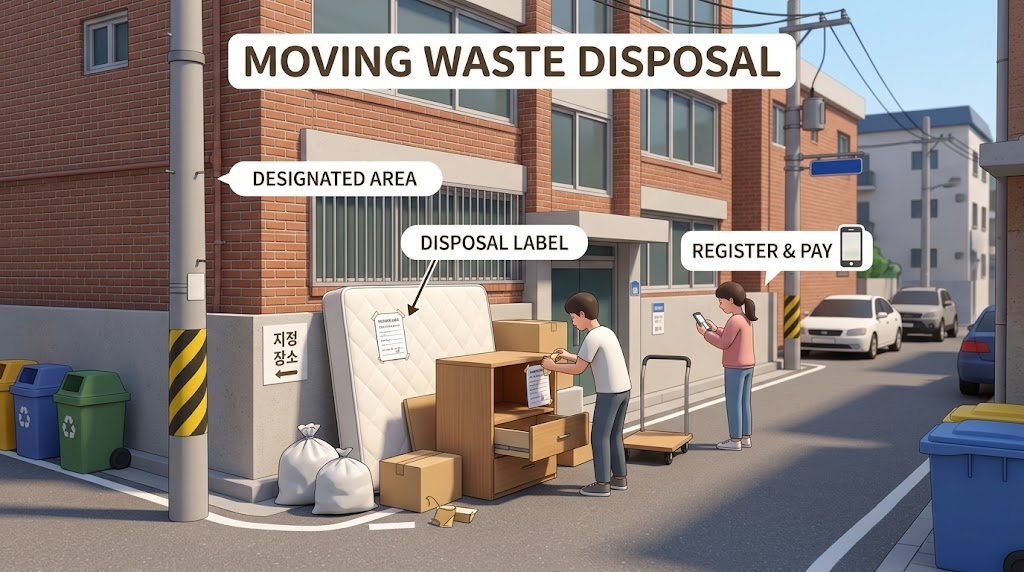
These are waste collection-dedicated apps operated in partnership with most local governments recently. No printer is needed at all, and everything from payment to checking the disposal number can be completed immediately via smartphone, making this the most recommended method for studio and villa residents.
- Representative apps: Bbaki, Yeogiro (Check which app is partnered with the district office having jurisdiction over your residential area)
- Application procedure:
- Download the app and select your residential area (City/District/Dong)
- Take a photo of the item to discard and select dimensions (AI automatically recognizes items and estimated fees)
- Enter desired disposal date/time and detailed disposal spot (e.g., Right side of OO Villa parking lot entrance)
- Pay fee via mobile
- Attachment tip (When there is no printer):
Write the [8–10 digit reservation confirmation number] issued after payment is completed largely on an A4 sheet or cardboard scrap with a permanent marker, and tape it securely to the front of the waste with packaging tape for normal collection.
② Applying via PC: Online Registration on the Jurisdictional District/City Office Website
This is the traditional internet registration method, suitable for those who do not wish to install separate apps.
- Application procedure:
- On a portal site `[Residential area### 3. 3 Ways to Issue Bulky Waste Stickers (Online and Offline)
Once sorting through your moving items is finished and the furniture and luggage to be discarded are decided, it is now time to obtain a legitimate disposal certificate (sticker).
In the past, you unconditionally had to visit the neighborhood community service center in person, but now the routes to apply in 3 minutes via smartphone or PC have become diverse. Choose the most convenient method tailored to your moving schedule and situation.
① Online Application on Jurisdictional District Office/Local Government Websites (Possible even without a printer)
This is the most reliable standard course when you have time to keep a PC turned on during moving preparation or when working on a desktop.
- Access the local government portal: Search [Name of City/District Office of residence] + bulky waste in the Naver search bar, and access the online collection application page of the jurisdictional local government.
- Enter disposal information: Select the disposal location (detailed address), desired disposal date, and item specifications to discard (e.g., single mattress, 3-tier drawer, etc.).
- Pay fees: Pay the fee via credit card or bank transfer.
- Attach report certificate (★Core):
- If you have a printer: Put the printed report certificate in a transparent plastic bag and tape it to the front of the waste.
- If you do not have a printer: Without needing to print, write [Registration number, item name, disposal date, payment amount] largely with a permanent marker on an A4 sheet or memo paper and tape it securely so it does not get wet from rain or wind, and it will be normally collected in the same way.
② Using Mobile Simple Disposal Apps (Payment after taking photos)
This is the most recommended method to resolve things immediately with a smartphone when measuring furniture dimensions is bothersome and you do not know the exact specification names.
- Representative services: Officially partnered local government apps such as ‘Bbaki’, ‘Yeogiro’, etc.
(Dedicated affiliated apps differ by local government, so searching your residential area after installing the app is required)
- Usage procedure:
- Set your address after launching the app
- Take a camera photo of the furniture/goods you want to discard and upload it
- Check automatic item matching through AI or category search
- Proceed with mobile simple payment (Kakao Pay, Naver Pay, card, etc.)
- Attachment method: After payment is complete, simply write the ‘reservation number (registration number)’ displayed on the screen largely on a piece of paper and attach it to the waste.
💡 Studio Apartment Living Tip (Drop-off Service): If you live alone in a single-person household and find it difficult to carry heavy beds or drawers down to the 1st-floor alley yourself, you can apply for the paid add-on service ‘Waste Drop-down Service’ within mobile apps (such as Bbaki) to dispose of them with the help of a worker.
③ Offline Purchase: Visiting Neighborhood Convenience Stores, Marts, and Community Service Centers
This is the method to obtain a paper sticker right away in your neighborhood if online payment is inconvenient or you urgently need a sticker on moving day.
- Sales locations: Jurisdictional community service centers, designated volume-rate bag-selling convenience stores (CU, GS25, 7-Eleven, etc.), neighborhood small and medium-sized marts
- Purchasing tips:
- Before entering a convenience store or mart, take photos with your smartphone or take notes of the approximate dimensions (width/height length, number of drawer compartments, seating capacity, etc.) of the furniture to be discarded. After telling the clerk “Please give me a bulky waste sticker,” look at the specification table and purchase the corresponding amount voucher (e.g., 3,000 won voucher, 5,000 won voucher, etc.).
- Filling out and attaching:
- Completely write the disposer’s name, phone number, disposal item, and disposal date at the top of the sticker with an oil-based marker.
- Wipe away dust or moisture from the furniture surface, stick the adhesive side on, and it is safe to wrap the borders once more with clear packaging tape so it does not blow away in the wind.
🔍 Comparison of Pros and Cons by Issuance Method
| Category | Online (District Office Website) | Mobile App (Bbaki/Yeogiro) | Offline (Convenience Store/Mart) |
|---|---|---|---|
| Pros | Zero risk of omission with official portal | Fast item verification via photo shooting | Immediate acquisition of physical stickers possible |
| Cons | Identity verification on local government sites is cumbersome | Service partnership status varies by local government | Possibility of inventory (amount voucher) depletion by convenience store |
| Attachment Method | Handwritten memo or printout attachment | Handwritten reservation number attachment | Direct attachment of physical sticker |
You can complete the text or prepare for publishing with the next steps:
Frequently Occurring Troubles and Precautions (Preventing Fines)
This is a main body section applying mobile line breaks, bold text emphasis, and precaution boxes tailored to Naver Blog readability. You can copy and use it right away.
- Frequently Occurring Troubles and Precautions (Preventing Fines)
“I tried to save a few thousand won on stickers and ended up receiving a fine notice of 1 million won.”
Alleys densely packed with studio apartments and villas are areas where local government environmental enforcement squads and mobile CCTVs most frequently conduct crackdowns. Especially during moving season, civil complaints from neighboring residents regarding passage inconvenience surge, so to avoid paying unnecessary fines due to minor negligence, you must check the following 4 trouble types.
① Sticker Theft/Loss and Damage to Registration Numbers
If someone removes the bulky waste sticker placed on an alley, or if it gets wet and torn by rain and wind, sanitation workers have no choice but to handle it as ‘illegally dumped waste.’
Prevention Rules:
When attaching physical stickers or handwritten memos, seal all four corners completely with clear packaging tape.
If you attach paper only roughly by the corners with tape, it easily falls off due to moisture or strong winds.
Always take proof photos: Right after completing attachment, take a smartphone photo so that [the full view of the furniture + the attached sticker/registration number] appears clearly in one frame. Even if a sticker is lost and a collection refusal warning is posted, submitting payment records and photos will waive the fine.
② Insufficient Amount and Under-reporting of Items (No. 1 Reason for Collection Refusal)
These are cases of intentionally reporting smaller items to pay lower fees, or registering disassembled furniture with reduced dimensions.
Representative Rejection Cases:
When a Queen (Q) size mattress is reported reduced to a Single (S)
When paying the fee for a 3-tier drawer for a 5-tier drawer
When labeling a 2-person sofa as a 1-person armchair
Outcome: The collection agency attaches a ‘Collection Refusal (Fee Underpaid)’ warning sticker after an on-site inspection and leaves it behind as is. If left neglected for several days, fine imposition procedures may proceed due to obstruction of alley passage, so when dimensions are ambiguous, it is safer to report one grade higher.
③ Fine Standards for Alley Illegal Dumping (Enforcement Decree of the Wastes Control Act)
Disposing of waste outside of designated places or methods will result in administrative measures pursuant to Article 68 of the Wastes Control Act.
Illegal dumping of portable waste such as cigarette butts and tissues: 50,000 won
Illegal dumping of household waste using plastic bags, wrapping cloths, etc.: 200,000 won
Illegal dumping using transport equipment such as vehicles or handcarts: 500,000 won
Unattended abandonment of waste generated during business activities or bulky waste: Up to 1 million won or less
⚠️ Studio alley CCTV enforcement: Recently, high-definition smart CCTVs for illegal dumping surveillance operate 24 hours a day in villa alleys, and fines are imposed by opening volume-rate bags and tracing personal identification details such as mail and receipts.
④ Ladder Truck and Moving Truck Operational Movement Collision on Moving Day
In multi-family residential areas where alley widths are narrow, traffic becomes paralyzed even if only 1 vehicle is stopped.
Stacking waste where ladder truck outriggers (supports) are set up or behind the moving truck’s cargo bed entangles worker movement lines and delays moving time.
Since collection trucks usually enter at dawn or early morning, you must stack items after moving vehicles have withdrawn, securing a passage of at least 1m along the edge of the road or the outer wall boundary of the building.
⑤ Immediate Action Tips When Collection Is Delayed
If items have been neglected in the alley for more than 2 to 3 days even though the scheduled disposal date has passed, you should check in the following order.
- Check application details: Confirm whether the status is ‘Awaiting Collection’ on the mobile app or district office website
- Directly contact the cleaning agency: Contact the phone number of the cleaning agency for each dong indicated on the sticker printout or registration confirmation text message, and share the disposal location address and registration number
- Since local government cleaning vehicles often circulate in corresponding alleys only on specific days of the week, checking the reason for the delay helps prevent civil complaints in advance.
These are the next tasks to complete the full post:
Writing the epilogue and move-out settlement checklist
Recommending tags and main thumbnail phrases for Naver search optimization
Korean version: 한국어로 읽기