Introduction: The First Crossroads After Issuing Your Tomorrow Learning Card
Once you are issued the Ministry of Employment and Labor’s National Tomorrow Learning Card, the excitement of a new challenge is soon followed by realistic concerns. This is the crossroads of choosing: “What course and in what format should I take?”
Especially when selecting a training course, the two major giants you encounter first are “online remote classes” and “offline on-site practical training.” Deciding whether to sit at a classroom desk listening to a live explanation from an instructor and practicing, or to study non-face-to-face while looking at a monitor from your room’s desk or a cafe, is a crucial first step that determines your course completion rate and employment outcomes.
- “Should I listen comfortably at home, or go straight to the academy?” Realistic concerns
Looking through the list of government-funded training courses, even when the curriculum is identical or similar, online-only courses and collective (on-site) education are often separated.
For those who need to utilize spare time while working or going to school, remote classes with no spatial constraints come across as attractive.
On the other hand, if the technology being handled focuses on practical equipment operation or team projects, anxiety naturally precedes as to whether you can properly learn just by looking at a screen at home.
- Decisive impact on learning efficiency and lifestyle patterns
Depending on which method you choose, your daily routine and learning efficiency will change completely.
Remote classes allow you to save commuting time and take courses flexibly according to your personal schedule, but without thorough self-directedness, it is easy to fall behind on progress.
On-site practical training can enhance immersion through regular attendance and immediate feedback from instructors, but it entails the physical burden of having to travel according to a set time and place.
- The wisdom of finding the optimal education format tailored to you
Rather than blindly following methods that others find convenient or popular courses, you must comprehensively consider your current situation (job seeker vs. employed worker), your learning tendencies, and the characteristics of the job you want to learn.
In the next section, we will thoroughly analyze the advantages and limitations of government-funded online (remote) classes, which have no constraints of time and space.

Analysis of Advantages and Limitations of Government-Funded Online (Remote) Classes
When trying to develop your capabilities using the National Tomorrow Learning Card, one of the most popular choices is online (remote) education. This is because it significantly relieves time burdens for office workers and job seekers by allowing them to take courses via smartphones on their commute or PCs at home.
Therefore, we will carefully examine the pros and cons of what powerful weapons non-face-to-face remote classes possess and, conversely, what points to watch out for.
- 3 Powerful Advantages of Government-Funded Online Remote Classes
Absolute freedom of time and space: Without the need to attend a classroom at a set time, you can progress with your learning on weekends or late at night according to your daily schedule, making it easiest to balance work and study.
Repeat viewing and personalized speed control: Lectures on difficult-to-understand concepts or complex theories can be paused and rewound to listen to repeatedly, which is advantageous for enhancing learning comprehension.
Savings on commuting time and costs: You can save on transportation costs and round-trip travel time consumed going back and forth to the academy every day, resulting in low physical and financial drain.
- Limitations and Precautions of Online Classes That Will Cost You If Missed
Since disadvantages and limitations naturally accompany convenience, you must thoroughly prepare for them.
Requirement for high self-directed learning ability: If you only check attendance, play lectures in the background, or procrastinate, you will easily fall behind on progress, leading to cramming or the risk of failing course completion.
Limitations in utilizing practical equipment and hands-on practice: There is a big difference between viewing programming coding or tax accounting practices on a screen and practicing while directly resolving errors. Especially in courses requiring professional equipment or software integration, the sense of presence or feedback is somewhat lacking.
Absence of communication and networking: It is difficult to expect the human networking peculiar to offline environments, such as real-time communication with fellow students or instructors studying together, study groups, and sharing employment information.
- Wise Learning Strategy to Utilize Online Classes at 200%
To maximize the advantages of remote classes and overcome their limitations, you need your own clear rules.
You must set the amount of content to study each day in advance on a calendar or planner and develop a habit of not procrastinating.
When listening to lectures, rather than just watching with your eyes, an attitude of active participation—such as typing example codes directly with your hands or summarizing in a notebook—is important.
In the next chapter, we will compare in detail the advantages and limitations of government-funded offline (on-site practical training) classes, which perfectly make up for the shortcomings of non-face-to-face learning.
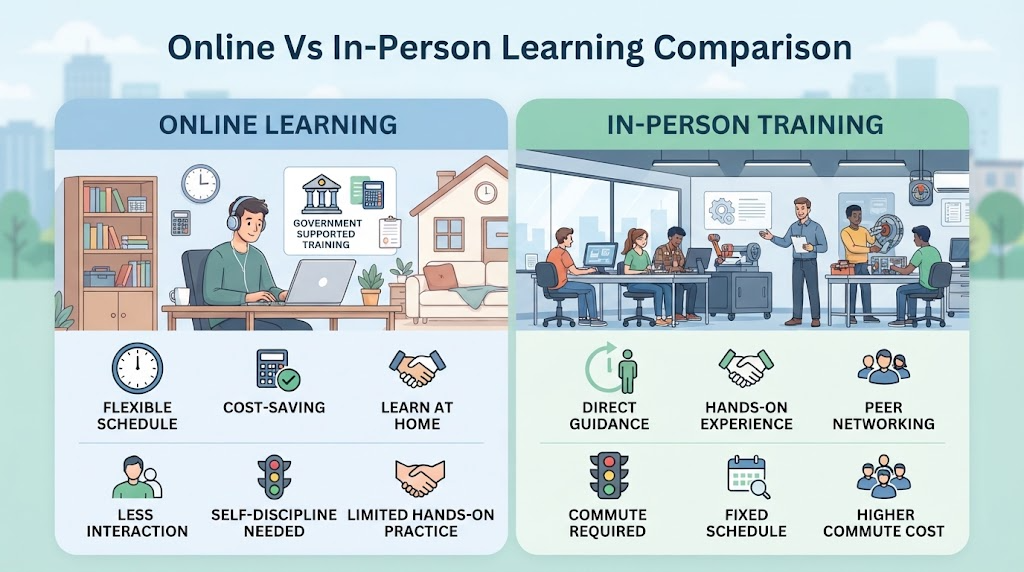
Analysis of Advantages and Limitations of Government-Funded Offline (On-Site Practical Training) Classes
If the spatiotemporal freedom of online remote classes is attractive, offline (on-site practical training) education, where you attend the academy in person to learn, remains an irreplaceable choice for those who value definitive outcomes and immersion. Especially if your goal is to learn skills directly with your hands or achieve direct connection to employment, you need to deeply understand the structure of on-site practical training.
We will soberly compare the vivid advantages and unavoidable limitations of offline collective education.
- 3 Powerful Advantages of Government-Funded Offline On-Site Practical Training Classes
Vivid sense of the field and immediate feedback: When you get stuck or an error occurs during practice, you can immediately ask a professional instructor watching nearby and receive feedback, making the problem-solving speed very fast.
Optimized practice environment and equipment setup: Practical infrastructure that is burdensome for individuals to obtain—such as high-performance PCs, professional design software, and the latest construction equipment—is perfectly equipped, maximizing learning efficiency.
Networking with peers and sharing employment information: It is advantageous to form study groups with fellow students struggling and studying together, or to obtain practical job information through the academy’s own cooperative corporate linkages and employment support programs.
- Limitations and Burdens of Offline Classes Requiring Thorough Preparation
Just as on-site practical training education has clear advantages, the constraints you must accept are also distinct.
Strict restriction of time and place: Since you must attend at set times without tardiness or early leaves, attendance itself comes across as a major pressure for office workers or those with busy personal schedules.
Consumption of commuting time and incidental expenses: Incidental expenditures such as daily round-trip transportation costs and meal expenses occur, and the physical burden consumed in travel time is substantial.
Stress due to learning progress gaps: Since instructors adjust the overall progress according to the proficiency differences of students, you may occasionally experience difficulty keeping up because the progress feels too fast or tedious.
- Practical Tips to Maximize the Effectiveness of Offline Education
To fully make the benefits of on-site practical training your own, an active attitude is essential.
Rather than relying only on what is taught during class time, you must develop a habit of strictly reviewing the practical contents learned that day by utilizing break times or self-study hours.
You must actively ask questions to the instructor and interact with peers to leave behind human and technical assets that can be used directly in the field beyond simple course completion.
In the next chapter, we will present a customized selection guide on whether you should choose online or offline methods most wisely according to your disposition and occupational characteristics.

Wise Selection Guide According to Your Disposition and Occupation (IT/Office vs. Technology/Practical Work)
When applying for government-funded education, the correct answer to the worry of “Should I do it online or offline?” is actually already laid out within your [learning disposition] and [characteristics of the job you want to learn]. Rather than blindly following courses that others take, you must choose a method that precisely fits your job goals and disposition to maximize your employment success rate without dropping out midway.
We will point out the smartest selection criteria according to your disposition and job field.
- IT, Programming, and Office Administration Fields: The Crossroads of “Online” and “Offline”
Knowledge- and office-centric jobs such as digital, coding, tax accounting, and marketing have divided options depending on the learner’s disposition.
Choose [Online Remote] if you fit this description: Advantageous for self-directed learners who are already working or balancing other work, possess basic computer proficiency, prefer studying calmly at their own pace, and like repetitive learning.
Choose [Offline On-Site] if you fit this description: Academy collective education is much safer if you have weak willpower and tend to procrastinate on your own, or if you are the type who gets frustrated and cannot progress if you do not receive immediate feedback the moment you get stuck on coding errors or accounting journal entries.
- Technology, Practical Work, and Design Fields (Construction, Confectionery and Baking, Video Editing, Etc.): Overwhelming “Offline” Advantage
Practical-centric courses that require handling equipment directly or acquiring a sense by watching with your eyes have relatively clear choices.
Why offline collective education is essential: Proper practice is only possible when professional equipment and software that are difficult for individuals to set up at home—such as high-performance editing equipment, welding devices, and baking ovens—are fully set up. There are major limitations to learning an instructor’s hand movements and detailed know-how from beyond a screen.
Exceptional cases: Limited to the stage of acquiring theory-centric prior knowledge or preparing for certificate written exams, you can consider a method of first building basics through online remote learning and then linking only the practical stage offline.
- Customized Strategy for Work-Study Balancers vs. Full-Time Job Seekers
Employed workers and career-transition job seekers: It is wise to pursue skill upgrades without career interruptions by combining online remote courses that can utilize weekday evenings or weekends, or evening/weekend offline courses.
Full-time job seekers (applicants): If you can invest your entire day, selecting an offline full-time bootcamp-type course with thorough attendance management and solid employment-linked programs to increase immersion is the shortcut to fast employment.
In the next chapter, we will look at common checkpoints from attendance management to training allowance receipt that you must never miss while receiving government-funded education, regardless of the course delivery method.
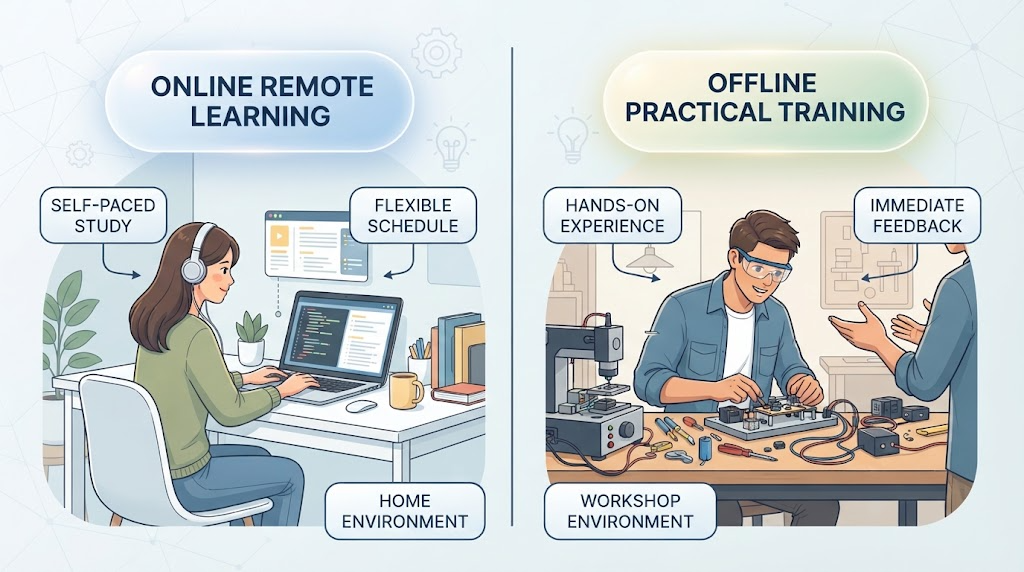
From Attendance Management to Training Allowances: Online and Offline Common Checkpoints
Whether you take government-funded education online or through offline on-site practical training, there are core rules that you must never miss in order to successfully complete the training course and fully enjoy the benefits supported by the state. These are “attendance management” and “training allowance (stipend) payment criteria.”
We point out the common checkpoints that all government-funded trainees must thoroughly understand, regardless of the difference in methods.
- Understanding the Lifeblood of Government-Funded Education: Thorough Electronic Attendance Systems
All training taken with the National Tomorrow Learning Card is subject to strict attendance management in accordance with Ministry of Employment and Labor regulations.
Offline classes: You must complete attendance checks according to the entrance and exit times using a beacon terminal installed at the academy entrance, fingerprint recognition, or the HRD-Net attendance app.
Online remote classes: You must fill the progress rate to 100% within the designated course period to be recognized as attendance, and you must be careful because dishonest methods—such as simply logging in or using macro programs—can be grounds for expulsion.
- The Threshold of Course Completion: Maintaining an Attendance Rate of 80% or Higher
To successfully finish government-funded training and hold a certificate or completion document in your hands, you must exceed set standards.
Official completion is recognized only if you attend 80% or more of the total training days, and failing to meet this standard may result in disadvantages such as being processed for withdrawal (expulsion) and deductions from your Tomorrow Learning Card support limit.
If unavoidable sick leaves or family events occur, you must submit supporting documents to the academy or training institution to request excused absence (attendance recognition) processing.
- Perfect Check on Training Allowance (Stipend) Payment Conditions You Will Regret Missing
In the case of job seekers who meet the conditions or specific employed worker courses, you can receive a handy training allowance every month depending on your attendance rate.
Payment criteria: Generally, training allowances are paid only when the unit period (based on one month) attendance rate achieves 80% or higher, and it may be differentially reduced by day according to the number of tardiness, early leaves, or leaving early instances.
Caution against fraudulent receipt: If you attempt to receive allowances through dishonest methods such as proxy attendance or false attendance checks, not only will the full amount be subject to recovery, but future government-funded benefits may be permanently restricted, so you must participate transparently.
In the next chapter, we will comprehensively summarize the core contents of this article and deliver a concluding message on how to wisely choose a learning method that suits you to achieve employment success and competency reinforcement.

Conclusion: Increasing Employment Success Rate with a Learning Method Tailored to You
So far, we have examined everything from the first dilemma you face after issuing your National Tomorrow Learning Card, the pros and cons of online remote classes with attractive spatiotemporal freedom and offline on-site practical training with a vivid sense of the field as its weapon, wise selection guides according to your disposition and job, to common checkpoints for attendance and training allowances that you must never miss.
Government-funded education is far beyond simply a free opportunity to learn skills; it is a very precious investment in redesigning your career and life direction.
Put it into practice starting today: Rather than blindly chasing courses that others say are good, objectively check your current learning disposition (self-directed type vs. close-management type), job goals (IT/office vs. technology/practical work), and daily routine patterns.
Whether it is the flexibility of online or the immersion of offline, if you choose a learning method that perfectly fits you and complete it to the end along with thorough attendance management, it will become your most powerful weapon to achieve your desired goals.
Small courage and wise choices come together to achieve employment success and career leaps. We hope you will find the government-funded course most suitable for you starting today and take a vigorous first step!
Korean version: 한국어로 읽기