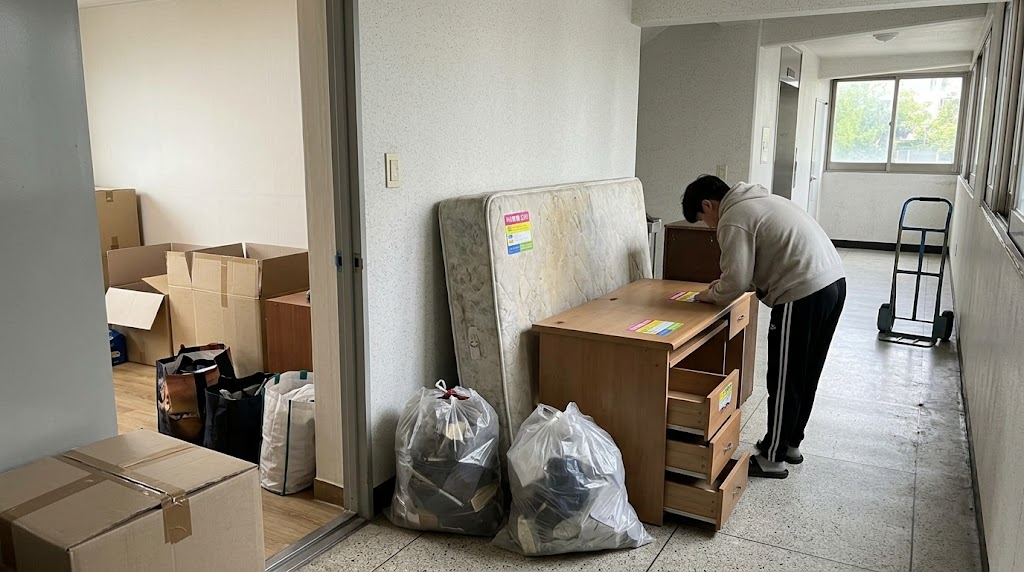
Moving Waste, Where Should You Start? (How to Classify Disposal Items)
When getting moving estimates and organizing your belongings, piles of items will come out that make you wonder, “How should I throw this away?” If you blindly put them out in the apartment collection area, not only can collection be refused, but you may also be subject to fines for illegal dumping (up to 1,000,000 KRW or less).
The very first thing you need to do is classify the waste into bulky household waste, free collection home appliances, non-flammable waste (When preparing to move, belongings that usually stayed out of sight inevitably pour out. When trying to clear out old mattresses, creaky desks, and broken small appliances all at once, you may feel at a loss about what to discard first.
The key to moving waste disposal is accurately dividing them by “disposal standards by item” before putting them out blindly. This is because if you fail to match the standards or dispose of them using the wrong method, collection may be refused or fines may be imposed.
- Three Major Waste Classification Standards at a Glance
First, organize your movement by dividing your belongings into three categories.
| Classification | Major Target Items | Disposal Method | Fee Incurred |
|---|---|---|---|
| Bulky Household Waste | Beds, wardrobes, sofas, desks, dining tables, etc. | Report to the management office or attach local government stickers | Paid (varies by item) |
| Waste Home Appliances | Refrigerators, washing machines, TVs, microwaves, etc. | Free collection reservation system or dedicated small appliance collection bins | Free |
| Non-flammable Waste | Broken ceramics/glass, flowerpots, tiles, bricks, etc. | Special standard bags (PP woven bags/gunny sacks) | Paid (bag purchase cost) |
- Essential Cost-Saving Tip: Actively Utilize Free Collection of Waste Home Appliances
Before purchasing bulky waste stickers for home appliances, you must first check whether they are eligible for “e-Circulation Governance (Free Visiting Collection Service for Waste Home Appliances).” Because they collect them for free without local government fees, you can greatly save on moving costs.
- Items eligible for single collection: Large home appliances such as refrigerators, washing machines, air conditioners, TVs, microwaves, dishwashers, etc.
- Bundled disposal of small appliances: Hair dryers, rice cookers, fans, vacuum cleaners, etc., must be gathered in quantities of 5 or more to qualify for visiting collection. If you have fewer than 5, you can dispose of them without additional cost in the “dedicated small waste home appliance collection bins” provided in the apartment complex.
- Precautions: Home appliances whose original form has been damaged (disassembled motors, missing parts, etc.) may be refused free collection, so they must be disposed of in their original intact condition.
- Special Volume-Rate Bags (PP Woven Bags) Are Essential for ‘Non-Burnable Trash’
Items that come out surprisingly often when moving are broken dishware, flowerpots, ceramics, and interior renovation debris.
- These non-flammable wastes are not collected if put into standard general volume-rate plastic bags, and they tear the bags, causing a risk of injury to sanitation workers.
- You must purchase non-flammable volume-rate woven bags (special standard bags) at a nearby community service center or designated retailer (convenience stores, supermarkets) and place the waste inside for disposal. Since sales locations differ by local government, it is recommended to verify the sales locations with the management office or community service center in advance.
When packing, deciding on “what to throw away” first and labeling each item makes moving-day ladder truck movement and disposal at collection zones much easier.
You can continue writing the article with the next step:
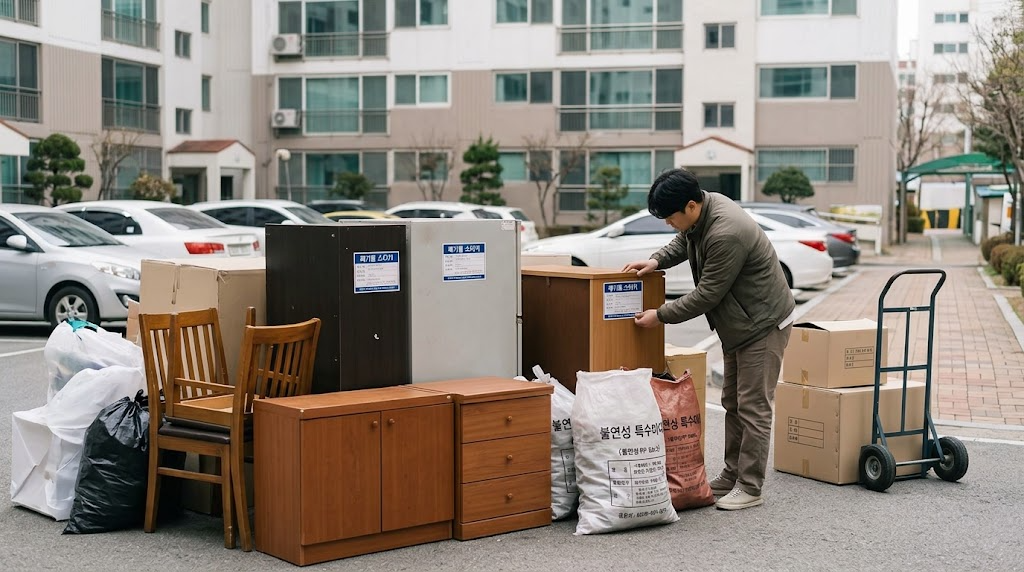
Apartment Management Office Reporting Procedures and Advance Checklist
A### Apartment Management Office Reporting Procedures and Advance Checklist
Once you have classified the moving waste disposal items, the next step is advance coordination with your apartment management office. Unlike detached houses or villas, apartments have complex-specific self-governing rules and dedicated collection systems, so disposing of waste without going through these can lead not only to friction with neighbors on moving day but also to unnecessary additional costs.
Here are the core procedures and checklist to check by visiting or calling the management office 2 to 3 days before moving.
- Check the Waste Settlement System by Complex (Core)
How large waste disposal fees are settled in each apartment largely falls into two methods.
- Combined management fee billing method:
A method where you report the specifications and quantities of items to discard (bed frames, mattresses, 3-seater sofas, etc.) to the management office verbally or in writing, and pay the fee determined by the complex’s regulations added to that month’s management fee or via cash/bank transfer during the moving-day interim management fee settlement. In this case, it is very convenient because there is no need to purchase district office stickers separately.
- Resident direct reporting method:
A complex where the management office does not handle waste fee collection on your behalf, and instead instructs residents to directly obtain and attach stickers via the local government website, dedicated app, or convenience store.
TIP: Simply calling the management office once and asking, “Are moving waste disposal fees settled through the management fee, or do I need to purchase stickers directly?” can prevent duplicate spending or wasted trips.
- Identify Moving-Day Traffic Flow and Designated Staging Locations
Moving day is extremely congested, with moving trucks, ladder trucks, and waste collection trucks tangled in a single space.
- Advance confirmation of disposal locations:
You must determine the designated location in advance—whether a bulky waste area is separately set aside on one side of the recycling sorting area, or if items should be gathered in a specific area of the ground-level parking lot where vehicle access is easy.
- Separation from the ladder truck work flow:
Placing bulky furniture directly below the ladder truck poses a significant safety hazard and blocks the loading flow of belongings. Waste must be immediately moved and staged at the designated collection area so that it does not overlap with the moving-out traffic flow.
- Pre-Move Administrative Checklist
These are items to handle together at the management office while processing the waste report.
| Check Item | Key Verification Details | Remarks |
|---|---|---|
| Elevator Use and Wall Padding Protection | If ladder trucks cannot be used, reserve E/V, check usage fees, and check the schedule for installing interior wall padding | Fees vary by complex |
| Interim Management Fee Settlement | Pay on moving-day morning after reading meters (electricity, water, gas) | Immediate settlement on the morning of moving day |
| Long-Term Repair Reserve Fund Refund | In the case of tenants, receive the refund statement for the long-term repair reserve fund paid on behalf during the residency period | For claiming from the landlord (property owner) |
| Vehicle Registration Cancellation | Request deletion of household vehicle license plate numbers registered for complex access | Includes return of access cards |
Completing the report to the management office and agreeing on the staging location the day before moving allows waste transport and ladder truck unloading operations to proceed smoothly and without bottlenecks on moving day.
You can continue the blog post with the next step:
Waste Sticker Issuance & Attachment Complete Guide
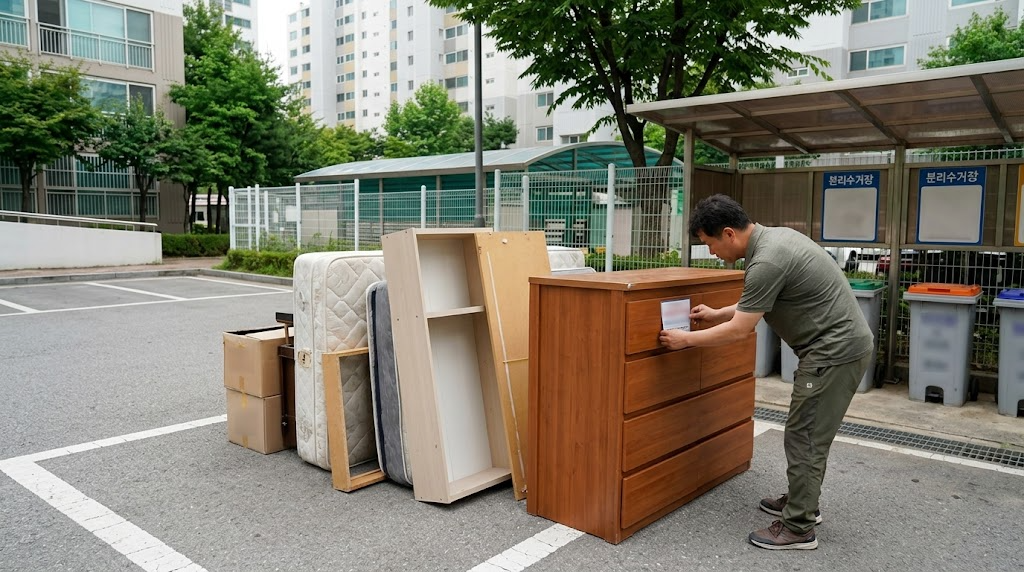
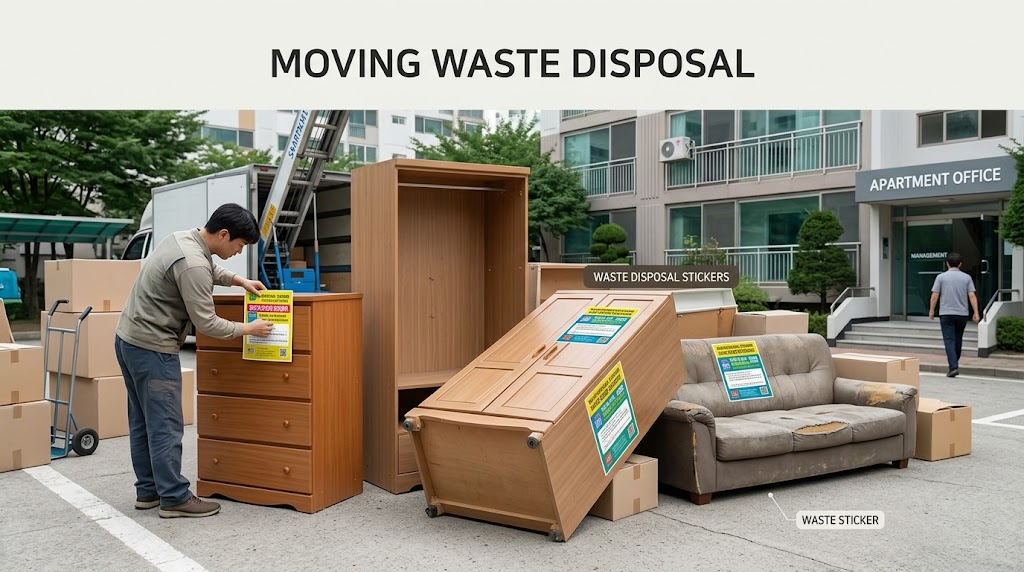
If the apartment management office does not handle waste fee collection on your behalf or instructs you to use the local government direct disposal method, you must directly obtain and attach a large-scale waste sticker (disposal certificate) suitable for the specifications.
Issuance methods are largely divided into two types: offline purchase and online/mobile application. You can proceed by choosing the most convenient method according to your moving-day schedule.
- Comparison of Procedures by Issuance Method
| Classification | Application Place | Features and Tips |
|---|---|---|
| Offline Issuance | Jurisdictional community service center, designated convenience stores/supermarkets | Advantageous when you do not have a printer or need urgent same-day processing because you receive physical stickers immediately to attach right away. Taking photos of furniture specifications (e.g., 3-drawer chest, 4-person dining table, etc.) in advance makes it easy to purchase stickers with the right fee amount. |
| Local Government Website | Jurisdictional city/county/district office large-scale waste disposal page | Select items, pay by credit card, and print out the ‘payment certificate.’ If printing on paper is difficult, writing the disposal number, items, and address clearly with a marker on blank paper and attaching it is also accepted. |
| Mobile App | Local government-affiliated shared apps such as ‘Bbaegi’, ‘Yeogiro’, etc. | When you take and upload photos of items to discard using a smartphone, AI automatically determines the specifications and fees; after paying in-app, you just write down the issuance number on a note and attach it to finish. Large furniture transport agency service (paid) options are also supported. |
- 3 Tips to Note When Attaching Stickers
Even if you paid fees and bought stickers, if attachment management is neglected, collection can be omitted or loss incidents may occur.
- Securing against rain and wind:
Non-laminated paper certificates or plain notes can get soaked in the rain, causing the handwriting to smudge, or can be torn off by the wind. Securely fastening them by thoroughly taping all four sides with clear packaging tape is safe.
- Taking a ‘disposal verification photo’ before leaving:
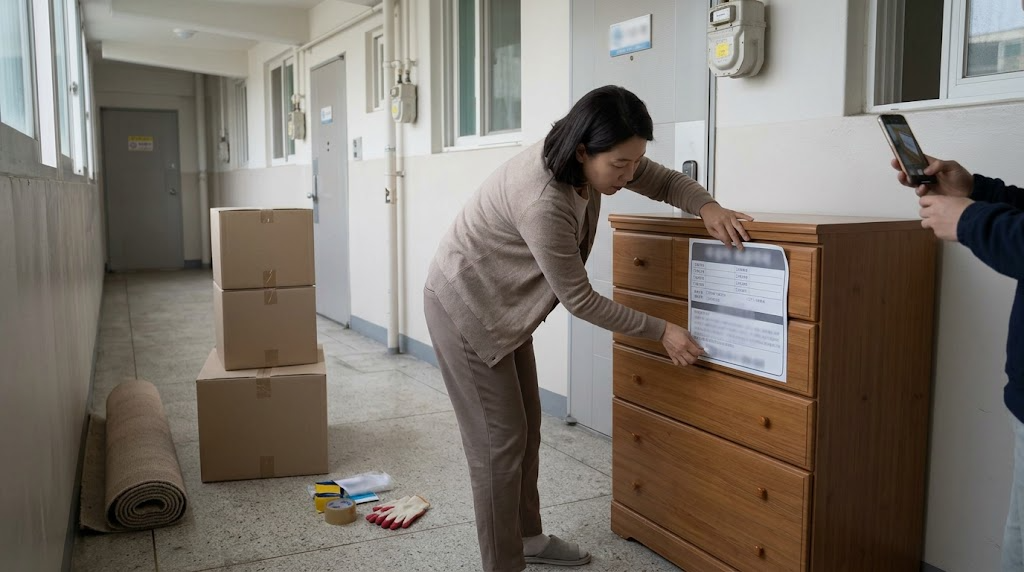
After attachment, take a photo with a smartphone so that the sticker’s receipt number and the entire discarded item appear in one frame. In the event of sticker theft or loss, this serves as the sole evidence to prove normal payment and disposal to the local government collection team.
- Selecting a highly visible front top position:
Attaching the sticker to the front center or upper area—rather than the sides or bottom of the furniture—so that collection drivers can identify it immediately when stepping out of their vehicle is the way to prevent collection omissions.
You can complete the blog post with the next step:
Moving-Day On-Site Disposal Manual and Precautions
On moving day, packing and unloading belongings alone is overwhelming. However, if you handle waste disposal carelessly, you may suffer the embarrassment of receiving a late call from the management office or having a collection refusal sticker attached.
Here are step-by-step disposal tips and essential precautions that can be applied right on site on moving day.
- Coordinating Disposal Times and Collection Schedules
Timing the disposal:
It is generally best to move waste immediately during the morning hours when the moving-out process begins in earnest. If you try to discard everything at once after all belongings are moved out, the ladder truck or elevator movement routes are prone to getting tangled.
Checking local government collection days:
Most local governments and collection contractors visit on specific days by zone (e.g., 3 times a week, night to early morning collection). Waste must be put out at the designated location in advance—either the evening before collection day or the morning of the day—to be loaded onto collection trucks without delay.
- Safe Disposal Tips for Furniture and Large Waste
Putting out bulky furniture as-is may cause safety accidents due to damage or take up excessive staging space.
Removing protruding hardware and hazard factors:
Fragile parts such as glass doors, mirrors, and drawer handles should be taped in a cross (+) pattern or wrapped with newspaper for cushioning. Protruding screws or hinges must be hammered down or wrapped with tape to prevent injury to collection workers.
Taping furniture doors:
For wardrobes, chest of drawers, shoe racks, etc., securely fasten doors with paper tape or packaging tape to prevent doors from opening during transport and causing safety accidents.
Reducing volume (whether to disassemble):
Disassemble flat-pack furniture (such as IKEA) only to the minimum extent necessary for easy carrying; breaking it into pieces that are too small may classify it as waste wood and alter the collection method, so maintaining the basic form is advantageous for smooth collection.
- Taking On-Site Verification Photos to Prevent Misunderstandings of Illegal Dumping
The most frequent dispute occurring at moving sites is abandonment caused by sticker theft or sanitation workers not noticing the payment.
- Wide overall shot: Take 1 photo capturing the entire background showing the waste placed in the apartment’s designated disposal location.
- Close-up detail shot: Take 1 photo so that the physical sticker attached to the front of the furniture or the handwritten report certificate receipt number written largely and clearly is clearly visible.
- Keeping the photos: Keep the photos in your smartphone album until moving settlements are completed and collection is finalized (usually takes 2 to 3 days). Even if you receive a verification call from the management office or district office, a single photo will complete your proof.
This is the final step toward completing the entire post:
Writing the epilogue (wrap-up summary and comprehensive table)
Receiving 5 final SEO title suggestions for Naver Blog search traffic
Korean version: 한국어로 읽기