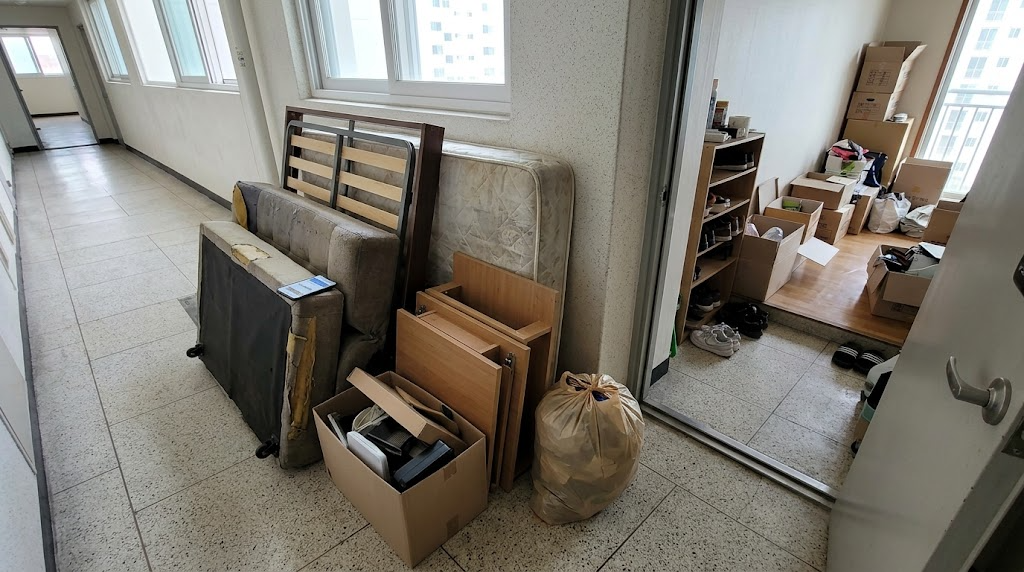
What Items Qualify as ‘Bulky Waste’? (How to Classify Disposal Items)
When moving or doing a deep clean, there is a dilemma you encounter first. That is the worry of “Should this go into a standard volume-rate garbage bag, or should I attach a sticker and put it out?”
Forcibly stuffing it into a standard garbage bag may lead to collection refusal or fines, while conversely, there is no need to pay fees unnecessarily for items that can be discarded free of charge.
Before submitting a disposal application to the district office, we clearly organize the easily confused bulky waste standards and item classification methods.
- Basic Definition: Household items of a size difficult to fit into a volume-rate bag
In principle, bulky waste refers to household furniture, home appliances, and miscellaneous sundries that are difficult to fit or tie up in standard volume-rate bags (usually maximum 75L–100L).
- Furniture: Wardrobes, bed mattresses, frames, sofas, chests of drawers, dinWhen organizing the house or preparing to move, awkwardly sized items that do not fit into standard volume-rate bags pour out. Leaving them outside your home recklessly can result in fines for illegal dumping (up to 1 million KRW or less), making accurate classification essential.
Here are clear standards and classification methods by item for bulky waste, which is easily confused with regular trash, recyclables, and waste home appliances.
- Basic Criteria for Determining Bulky Waste
The fundamental principle is “household waste of a size that does not fit into a volume-rate bag.” Generally, items that cannot be tied up when put into the largest standard volume-rate bag (75L–100L) or cannot fit without disassembly apply.
- Furniture: Wardrobes, bed mattresses, frames, sofas, chests of drawers, desks, dining tables, chairs, dressing tables, etc.
- Kitchen & Household Goods: Bicycles, strollers, kickboards, travel suitcases, mirrors, drying racks, portable dining tables, etc.
- Interior & Bedding: Roll screens, blinds, thick cotton quilts, electric mats, picnic mats, rugs, etc.
- Other Non-Crushable Items: Ceramic jars, flowerpots (soil removal required), toilet seat covers, etc.
- Guide to Easily Confused Items
| Classification | Applicable Items | Correct Disposal Method |
|---|---|---|
| Bulky Waste (Sticker required) | Furniture, suitcases, bicycles, mattresses, cotton quilts, jade heating mats | Dispose with sticker attached after applying through competent district office/community service center |
| Free Collection Eligible (Waste home appliances) | Refrigerators, washing machines, air conditioners, TVs, microwave ovens, vacuum cleaners | Free when applying via ‘E-Circulation Governance (Free Visiting Collection for Waste Home Appliances)’ |
| Non-Combustible Volume-Rate Bag (Sack) | Broken glass, tiles, ceramics, small amounts of bricks, porcelain bowls | Dispose after purchasing special standard sacks (non-combustible) at marts or convenience stores |
| Standard Volume-Rate Bag | Thin comforters, pillow stuffing, cushions, stuffed toys, shoes, rubber gloves | Compress and dispose so that the standard bag can be completely tied up |
- 3 Tips You Must Check Before Disposal
- Do Not Pay to Dispose of Home Appliances
Not only large home appliances like refrigerators and washing machines, but also small home appliances—when bundled in groups of 5 or more—can be collected directly and free of charge by a technician visiting your home through the ‘Free Visiting Collection Service for Waste Home Appliances (1599-0903).’ In the case of apartments, if there is a dedicated collection bin for small home appliances, immediate free disposal is possible regardless of quantity.
- Differences in Regulations and Fees by Local Government
Bulky waste fees and detailed regulations vary according to local government ordinances. For example, travel suitcases are charged differentially from 2,000 KRW to 5,000 KRW depending on size (inches), and disassembled plywood or lumber may be assessed by weight or volume in bundled units.
- Accurate Entry of Dimensions Is Essential
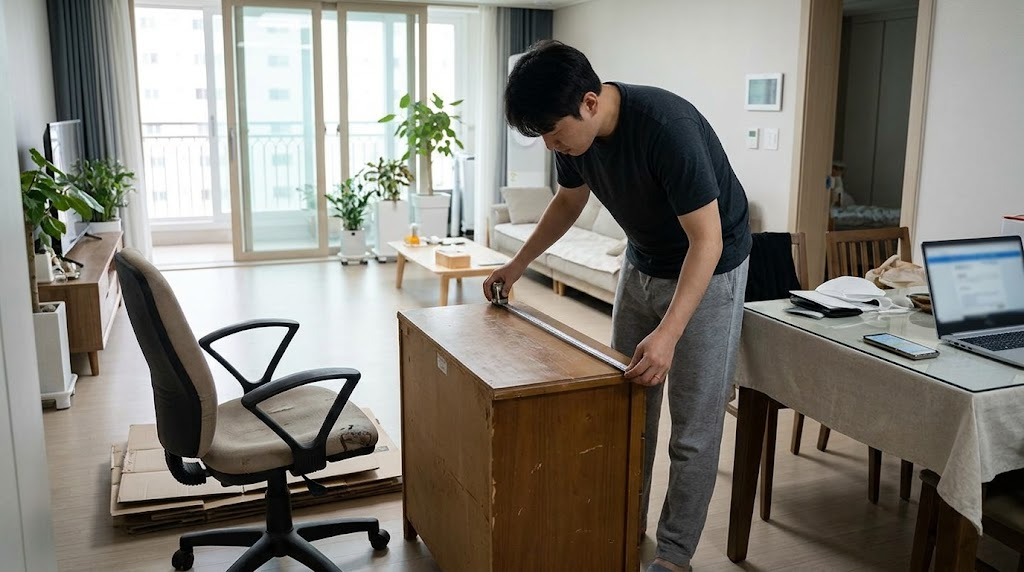
When applying online or via mobile apps (such as Bbegi, Yeogiro, etc.), if you arbitrarily enter smaller dimensions, on-site collection personnel may refuse collection (attaching a non-collection sticker) after inspecting the sticker; therefore, you must measure actual dimensions and declare the accurate item.
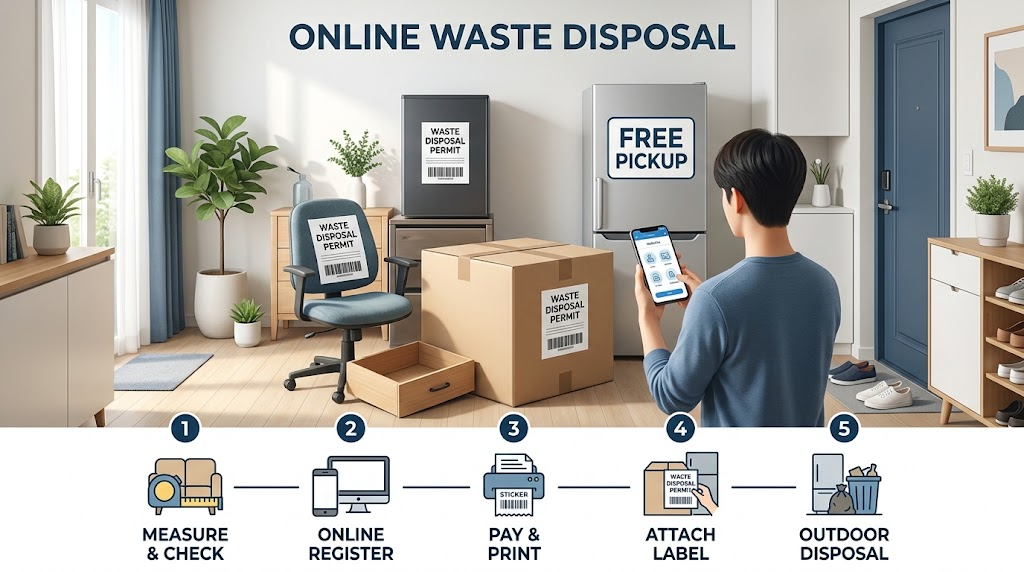
District Office Website Online Application Procedure in 5 Steps (A to Z)
Without needing to visit during community service center operating hours or walking around to buy stickers at convenience stores, using the district office website allows you to complete waste disposal applications 24/7 in 5 minutes via PC or smartphone.
For first-timers, here is a detailed guide through the 5 steps of the online application procedure so you can follow along easily without getting lost.
STEP 1. Access Competent District Office Website and Navigate Menu
Access the official website of the competent autonomous district of your residence (e.g., Gangnam-gu Office, Songpa-gu Office, Suwon City Hall, etc.).
Search for ‘Bulky Waste’ or ‘Bulky Waste Disposal Application’ in the frequently used services section on the main page or in the search bar.
Depending on the local government, some run their own integrated intake systems while others link to private partner platforms (Bbegi, Yeogiro, etc.), so please proceed according to the on-screen instructions.
STEP 2. Identity Verification and Basic Discharger Information Entry
Perform simple identity verification to receive collection status updates and check payment details.
Identity Verification: You can apply conveniently as a non-member via mobile phone identity verification or simple authentication (Kakao, PASS, etc.).
Discharger Information: Enter your name and contact number (for receiving collection notification text messages).
Designating Disposal Location:
Accurately enter the parcel number or street name address.
The detailed location note field is key. (E.g., “Next to the recycling area of Building 101, OO Apartment”, “Behind the parking lot pillar on the 1st floor of OO Villa”) You must write a specific location so the collection technician can find it at a glance to prevent non-collection issues.
STEP 3. Search Disposal Items and Select Dimensions & Quantity
This is the step to accurately match the name and size of the item you wish to discard.
Enter the item name (e.g., desk, mattress, chest of drawers, chair, etc.) in the search bar.
Check Specification Options: Even for the same item, fees vary depending on size.
Ex) Chest of drawers: 3 tiers or fewer vs 5 tiers or more
Ex) Desk: 1-person desk (no drawers) vs double-pedestal desk (2 or more drawers)
If you arbitrarily select smaller dimensions or specifications, a collection refusal sticker citing ‘unpaid fee difference’ may be attached on-site; therefore, it is safe to check approximate dimensions (width × length × height) with a tape measure before selecting.
Select the desired disposal date on the calendar. (Usually, collection dates can be selected 1 to 3 days after the application date)
STEP 4. Fee Payment
Check the total fee for the selected items and proceed with payment.
Payment Methods: Credit card, real-time bank transfer, virtual account deposit, and simple payment methods (Naver Pay, Kakao Pay, etc.) are supported.
Once payment is normally completed, an ‘Application Receipt Number’ will immediately be displayed on the screen, and an informational text message will be sent.
STEP 5. Print Payment Certificate or ‘Handwrite and Attach’ (OK Without a Printer!)
After payment is complete, the most common question asked is “What should I do if I don’t have a printer at home?” This is the core 5-step online application guide that allows you to complete civil applications and support program filings in 10 minutes from home without visiting the district office.
Step 1: Access Competent District Office Website and Integrated Search
Check Jurisdiction of Resident Registration Address: For subsidies, welfare services, and regional specialty programs, you must use the district office website with jurisdiction over your residence listed on your resident registration certificate.
Enter Search Term: Search for ‘OO District Office’ on portal sites, proceed to the official website, and enter the name of the program you wish to apply for (e.g., Youth Allowance, Childbirth Subsidies, Early Scrap of Aging Diesel Vehicles, etc.) in the top search bar.
Direct Menu Navigation: In addition to searching, you can check ongoing application announcements directly via the ‘Civil Petitions/Applications’ or ‘Field-Specific Information (Welfare, Economy, Transportation)’ tabs in the top menu.
Step 2: Identity Verification and Login (Utilizing Simple Authentication)
Select Simple Authentication: Without the process of copying separate Joint Certificates (formerly accredited certificates), you can log in within seconds just with mobile app confirmation by using private simple authentications such as KakaoTalk, Naver, Toss, PASS, and Shinhan Certificate.
When Applying as a Corporation or Agent: Mobile phone authentication in one’s own name is standard; in the case of agent applications, additional registration of relationship verification documents such as a power of attorney and certificate of family relations may be required.
Step 3: Check Application Eligibility Requirements and Complete Forms
Cross-check Announcement Eligibility Requirements: First review mandatory qualification criteria such as income standards (median income ratio), residency period requirements (e.g., continuous residence in the competent district for 6 months or more), and age restrictions.
Fill in Personal Information and Application Details: Enter your name, resident registration number, actual residence address, and contact information. For civil petitions intended to receive refunds or subsidies, accurately entering an account number under your own name is essential to prevent disbursement errors.
Step 4: Upload Required Document Files (PDF/JPG)
Advance Preparation of Submission Documents: Prepare mandatory attached documents specified in the announcement, such as resident registration certificate, health insurance payment confirmation, certificate of income amount, and business registration certificate.
Adhere to File Format and Size Limits: Register original PDF files issued by Gov24 or Hometax, or scanned JPG/PNG images. Since district office systems have file size limits per file (typically within 5MB to 10MB), compress files before attaching if they exceed the size limit.
Step 5: Final Submission and Confirmation of ‘Receipt Number’
Final Check of Entered Information: Verify whether details entered and attached files are missing, then click the [Apply/Submit] button.
Keep Application Details: Take a screenshot or write down the receipt number displayed on the screen after successful submission.
Check Progress Status: In the ‘My Page > Civil Petition Application Details’ or ‘Online Application Result Inquiry’ menu on the website, you can check statuses in real time such as ‘Application Completed → Department Review in Progress → Approved/Processing Completed’; if supplementary documents are needed, a request notification (SMS) will be sent.
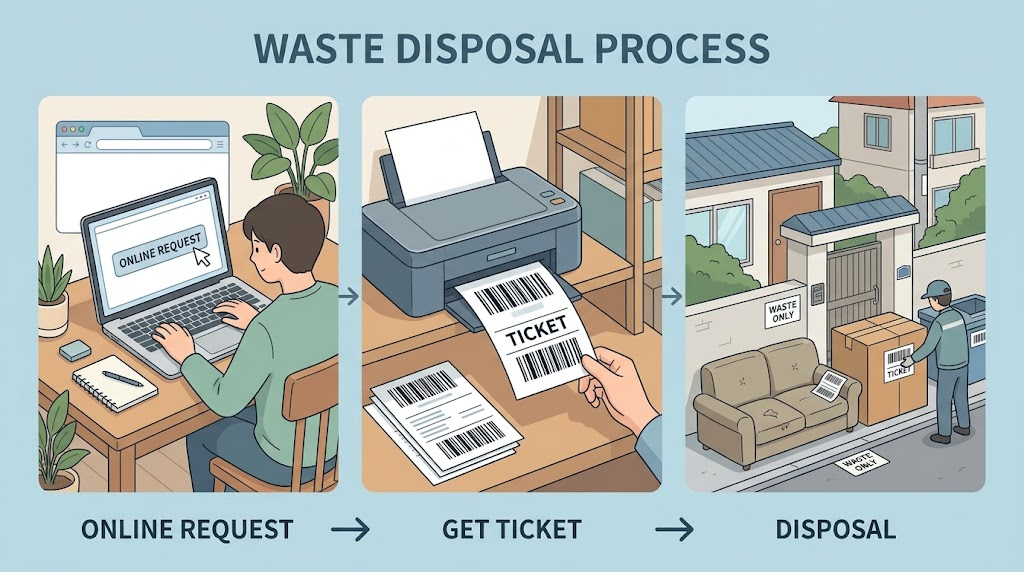
Important Precautions & Fine Prevention Tips When Disposing of Waste
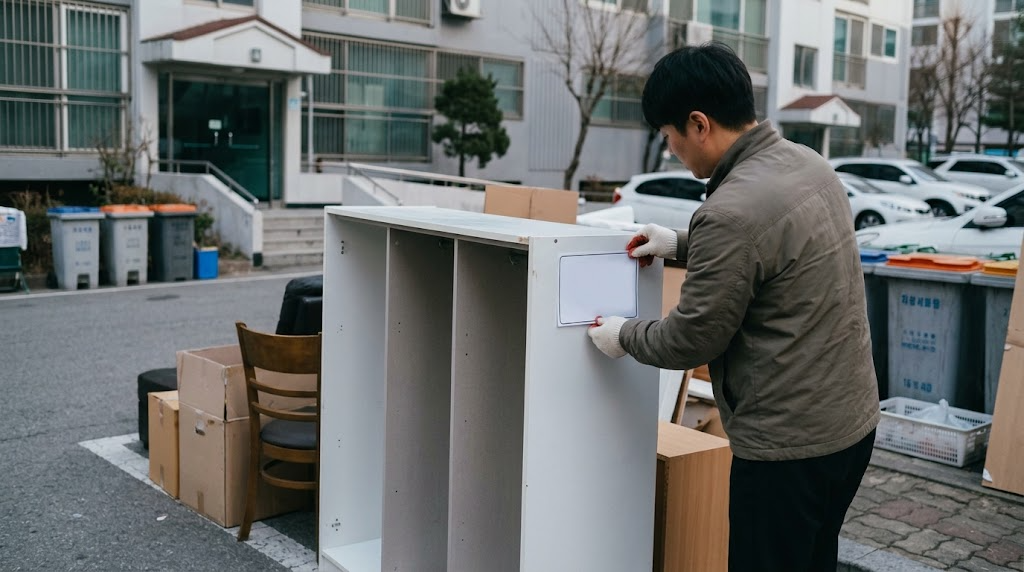
Disposing of bulky waste does not end simply by completing online registration and fee payment. If you do not put it out accurately at the designated time and location, or if you dispose of items different from the declared details, you may face not only ‘collection refusal’ but also be unintentionally regarded as engaging in ‘illegal dumping’ and receive a fine disposition.
Here are the essential precautions and cancellation/refund tips to avoid unnecessary fines and ensure collection in one go.
- Compliance with Disposal Date, Time, and Location
Adhering to Disposal Hours: Considering pedestrian inconvenience and urban aesthetics during the daytime, most local governments require disposal in principle after sunset on the day prior to the disposal date (usually between 18:00–20:00 and midnight). Putting items out in advance in the middle of the day can obstruct pedestrian traffic and trigger illegal dumping.
Selecting Locations Accessible by Collection Vehicles:
Apartments: Designated bulky waste collection areas within the complex
Detached houses, multi-family homes, and villas: Roadside locations easily accessible by collection vehicles (1-ton trucks, etc.), such as in front of one’s house, a corner of the building’s first-floor parking lot, or in front of the main gate
If placed under stairs, deep within narrow alleys, or in front of someone else’s private property, collection technicians may not identify them, leading to delayed collection.
- Top 3 Mistakes That Trigger ‘Illegal Dumping Fines (Up to 1 Million KRW)’
Disposing of Specifications Different from Declared Details (Underpayment of Difference):
For example, paying the fee for a 3-tier chest of drawers for a 5-tier chest of drawers, or declaring a 4-person dining table as a 2-person table. When collection companies scan the barcode, they attach a ‘Collection Ineligible Sticker’ due to specification mismatches, and leaving it unattended makes it subject to illegal dumping penalties.
Prohibition of ‘Sneak-In’ Disposal:
Placing undeclared cushions, seat pads, or trash on top of a sofa when discarding it can be caught as illegal dumping. In principle, one approved sticker applies per disposal item.
Sticker Loss or Damage:
If the sticker or written note with the receipt number is blown away by rain or wind, it is mistaken for undeclared dumped waste. It must be firmly affixed on all sides with transparent packaging tape so it does not fall off.
Fine Imposition Standards (Enforcement Decree of the Wastes Control Act)
Easy-to-Find Practical Law Information
Failing to use standard volume-rate bags or disposing without attaching bulky waste stickers results in a fine of 100,000 KRW to 200,000 KRW, and illegal disposal using transport equipment such as vehicles or handcarts may result in a fine of up to 500,000 KRW to 1,000,000 KRW or less.
- Understand Change, Cancellation, and Refund Regulations
Gangnam-gu Resource Circulation Integrated Portal – Gangnam-gu Office
Cancellation Window:
If you change your mind after submitting the disposal application and decide to give away or reuse the item, you must submit a ‘Cancellation and Refund Application’ on the district office website before the scheduled collection date (before the collection personnel visits).
Gangnam-gu Resource Circulation Integrated Portal – Gangnam-gu Office
No Cancellation After Collection:
Waste that has already been collected on-site is strictly non-refundable in the system.
Gangnam-gu Resource Circulation Integrated Portal – Gangnam-gu Office
Refund Processing Time: For credit card payments, authorization is canceled within approximately 3 to 5 business days depending on the card issuer, and for bank transfers, the refund is deposited after verifying the refund bank account.
Next Steps to Complete the Blog Post:
Draft the blog epilogue and concluding paragraph
Create a summary infographic box to insert at the top of the post
Korean version: 한국어로 읽기