Prologue: The Employment Cheat Key Amid Spec Competition, Why Government-Funded Certifications Are Trending
These days, opening job postings often starts with a sigh. Not only has the upward leveling of basic specs like GPAs and language scores become the norm, but even entry-level job postings invariably include conditions such as ‘Preferred experience in related work’ and ‘Proficiency in practical tools.’
Moving away from the culture where companies hire entry-level workers and teach them step-by-step from the basics, the trend of preferring ready-to-deploy talent who can be put into real work from day one on the job has firmly taken root.
Amid these changes in the job market, job seekers encounter two main walls.
- Absence of Practical Knowledge and Objective Proof
It is difficult to prove actual working-level processes solely with rote-memorization certifications or major coursework. Project experience directly related to practical work or job-certified qualifications have become essential.
- Snowballing Job Preparation Costs
Tuition fees at private vocational institutes range from hundreds of thousands of KRW per subject to several million KRW in the case of development, data, and engineering fields. When textbook costs and examination fees are added, job preparation itself becomes a significant financial burden.
The powerful solution that resolves these two worries at once is the ‘Government-Funded Certification Course.’
If government support in the past stayed at simple basic training, today’s vocational training system is thoroughly reorganized around promising occupations with high hiring demand. The government not only alleviates financial risks by covering a significant portion (or all) of the training costs, but the curriculum itself is also designed to complete both certification acquisition and practical projects simultaneously.
In other words, government-funded certifications are known as the most reliable employment cheat key that minimizes job search expenses while quickly securing the ‘verified practical specs’ required by companies.
Then, how should you utilize this powerful system supported by the government to choose the promising certification that fits you perfectly? In the next section, we will take a step-by-step look at the support benefits and issuance criteria of the ‘Tomorrow Learning Card,’ which is the core engine of government support.
Please select the next task to proceed:
Section 2: Writing basic concepts of the Tomorrow Learning Card
Section 3: Writing TOP 4 government-funded certifications for promising occupations

The Core of the Government Support System, Grasping the Basic Concept of the Tomorrow Learning Card
The very first key you must hold in your hand to acquire certifications and build job competencies through government support is the ‘Tomorrow Learning Card.’
As a kind of ‘government-supported vocational training voucher,’ it is a key system widely available to any citizen seeking to develop their own job competencies—ranging from job seekers to current employees and career-switch preparation seekers. Here are 3 basic structural aspects you must know before actively registering for courses.
- Support Targets and Limits: Basic 3 million KRW per person, up to 5 million KRW supported
The Tomorrow Learning Card can be applied for not only by job seekers preparing for employment, but also by company employees needing competency development, self-employed individuals, and persons in special types of employment.
Support validity period: Can be used for 5 years from the date of issuance
Basic support limit: Account issued with 3 million KRW per person
Additional support benefits: An additional 1 million to 2 million KRW is supported depending on income level (basic livelihood recipients, near-poverty groups, etc.), employment type, or participation in specific employment support programs, expanding the limit up to 5 million KRW.
※ Check for Excluded Targets from Support
Public officials, private school faculty and staff, university (graduate) students with more than 2 years of remaining coursework until graduation, self-employed individuals with annual sales of 400 million KRW or more, and workers under age 45 at large corporations with a monthly wage of 3 million KRW or more are excluded from issuance, so prior confirmation is required. (Typically, 3rd and 4th-year university students and prospective graduates are eligible for issuance)
- The Principle of the Self-Pay Ratio for Training Costs: “The Employment Rate by Occupation Determines Out-of-Pocket Expenses”
Many people ask, “Is government support unconditionally 100% free?” To start with the conclusion, your out-of-pocket expenses (self-pay ratio) are set differently depending on the nature of the course and the employment rate of the occupation.
General Training Courses: General job duty courses that are not National Key and Strategic Industry Occupations incur out-of-pocket expenses of around 15% to 55% of the tuition, depending on the average employment rate of each occupation. (Promising occupations with higher employment rates receive higher government support ratios, reducing the individual’s burden.)
Fully Government-Funded (0 KRW Out-of-Pocket) Courses: In the case of National Key and Strategic Industry Occupation Training (Gukgi) or K-Digital Training (KDT) courses, where human resource development is urgent at the national level, you can take them completely free of charge even if the training costs reach millions or tens of millions of KRW. When conditions are met, you can also receive additional monthly training incentives (meal allowances, transportation expenses, etc.), making them highly popular among job seekers.
- Application and Search Platform: Finish Everything with ‘Goyong24 (HRD-Net)’
Employment support services that were previously dispersed across multiple sites, such as the Vocational Training Portal (HRD-Net) and Worknet, have been unified into ‘Goyong24.’
- Online Card Issuance: Access the Goyong24 portal or mobile app → Simple authentication login → ‘Apply for Tomorrow Learning Card Issuance’ (Watching the advance training guide video is mandatory)
- Receive Physical Card: Receive by mail or visit a bank in the form of a debit card/credit card from NongHyup or Shinhan Bank
- Course Search and Enrollment Application: After searching for the desired certification or region in the Goyong24 training course search bar, thoroughly compare training schedules, out-of-pocket expenses, student reviews, and employment rates to proceed with online course enrollment.
Now that you have received your card, you need to choose “which certification course to take to lead directly to passing document screening and landing a job.” In the next section, we will take a concrete look at the TOP 4 government-funded certifications for promising occupations that have the sturdiest demand in the job market.
Please select the next task to proceed:
Section 3: Detailed writing on the TOP 4 promising certifications
Organize infographic/diagram ideas for the blog body
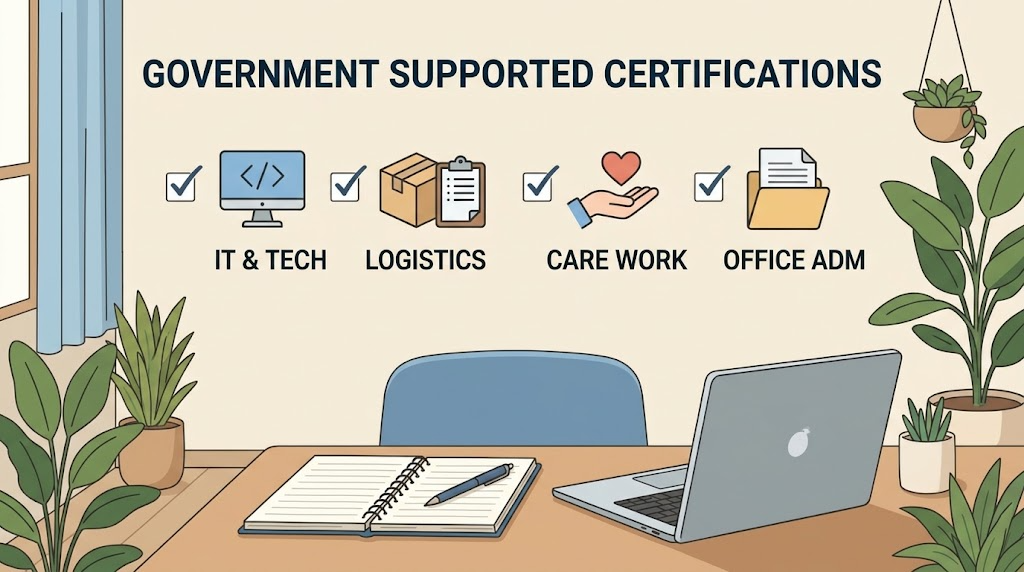
TOP 4 Government-Funded Certifications in Promising Occupations Verified by Employment Rate and Hiring Demand
While there are thousands of types of government-funded courses, not all certifications carry the same employment impact. Rather than approaching them simply because they are “easy to obtain,” you need to select certifications that are repeatedly specified as preferred qualifications in corporate job postings.
Here is a summary of the TOP 4 government-funded certifications for promising occupations, selected based on actual Ministry of Employment and Labor vocational training data and demand from major recruiting platforms.
① IT, Data, and Software Field
Recommended Certifications: Engineer/Industrial Engineer Information Processing, SQLD (SQL Developer), Advanced Data Analytics Semi-Professional
- Market Demand and Characteristics:
As digital transformation (DX) and AI technology adoption accelerate, demand for developers and data-handling talent remains robust across all industries. In particular, when non-majors enter the IT industry, the Engineer Information Processing serves as a fundamental gateway proving minimum major knowledge.
- Key Strength of Government Support:
Beyond simple preparation for written exams, you can attend 6-month intensive bootcamps linked with K-Digital Training (KDT) or National Key and Strategic Industry Occupation Training. Training costs reaching millions of KRW are supported entirely for free (0 KRW out-of-pocket), and the biggest weapon is that you can complete both certification acquisition and practical portfolio (team project) development at once.
② Logistics, Distribution, and Trade Field
Recommended Certifications: Certified Logistics Manager, Distribution Manager Level 2, Certified International Trade Specialist
- Market Demand and Characteristics:
Due to the expansion of e-commerce platforms and the reorganization of global supply chains (SCM), the market value of professionals who can coordinate logistics center operations, inventory management, and import/export customs clearance has risen.
- Key Strengths of Government Funding:
Certified Logistics Managers and Certified International Trade Specialists have a high drop-out rate during self-study due to the difficulty of legal regulations and practical terms. Enrolling in a government-funded package course allows you to organize theory while simultaneously practicing working-level tools such as trade ERP software, duty drawback practices, and bonded warehouse management, significantly improving your competitiveness in document screening and interviews.
③ Office, Accounting, and Taxation Fields
Recommended Certifications: Computerized Tax Accounting Level 2 / Computerized Accounting Level 1, FAT/TAT, ERP Information Manager, Computer Specialist in Spreadsheet & Database Level 1
- Market Demand and Characteristics:
Regardless of business sector or corporate scale, management support, finance, accounting, and HR departments are representative job functions where recruitment takes place on an ongoing basis. In the hiring market, the practical combination most favored by companies is the ‘Computerized Accounting Level 1 + Computerized Tax Accounting Level 2 + Computer Specialist Level 1’ skill tree.
- Key Strengths of Government Funding:
Because you can practice directly at the institute using the official practical software of the Korean Association of Certified Public Tax Accountants (such as KcLep), even non-majors can achieve a short-term pass within 2 to 3 months. With high course completion and certification acquisition rates, it is an occupational field where employment linkage occurs very actively.
④ Safety, Environment, and Technical Specialized Fields
Recommended Certifications: Industrial Safety Engineer / Industrial Safety Industrial Engineer, Fire Fighting Facilities Engineer, Craftsman Hazardous Material / Industrial Engineer Hazardous Material
- Market Demand and Characteristics:
Following the enforcement of the Serious Accidents Punishment Act, the appointment of statutory safety managers has become mandatory not only in construction, manufacturing, and plants, but also in large logistics centers and IT IDC centers. Due to a shortage of qualified personnel, it is a prime field where even entry-level certificate holders are immediately given interview opportunities, making certifications exceptionally powerful.
- Key Strengths of Government Funding:
Engineer and Industrial Engineer examinations carry a large proportion of practical tests in both work-type and written-response formats for the second round. Through government-funded courses, you can receive systematic training in field equipment practice and past exam reconstruction mock tests, drastically shortening the preparation period.
| Occupational Field | Representative Government-Funded Certifications | Main Recommended Targets | Average Government Support Type |
|---|---|---|---|
| IT · Data | Engineer Information Processing, SQLD, Advanced Data Analytics Semi-Professional | Non-majors preparing for a career change to development/data job roles | KDT / National Key (0 KRW out-of-pocket possible) |
| Logistics · Trade | Certified Logistics Manager, Distribution Manager Level 2, Certified International Trade Specialist | Candidates seeking employment in retail/e-commerce SCM | General occupations (approx. 20–40% out-of-pocket) |
| Office · Accounting | Computerized Tax Accounting Level 2, Computerized Accounting Level 1, Computer Specialist Level 1 | Humanities graduates and entry-level job seekers in office/accounting | General occupations (short-term completion in 2–3 months) |
| Safety · Facilities | Industrial Safety Engineer, Fire Fighting Facilities Engineer, Craftsman Hazardous Material | Engineering job seekers and candidates seeking a switch to technical roles | Online/offline blended training |
Please select the content to follow next:

3 Practical Criteria for Choosing a Government-Funded Institute and Course Without Failure
Even if you have decided on your desired certification, the outcome upon completion will vary entirely depending on which educational institution (academy) course you take. This is because a government-funded course is a long-term commitment that requires immersing yourself for 6 to 8 hours a day, ranging from at least 1 to 2 months to as long as 6 months or more.
Without being swayed by the fancy marketing copy of institutes, here are 3 verified selection criteria that will allow you to achieve both practical skills and employment simultaneously.
- Verification of Public Indicators on Goyong24 (HRD-Net): ‘Employment Rate’, ‘Completion Rate’, ‘Certification Grade’
Instead of relying on reviews on institute promotional pages, you must first check the objective data officially compiled by the Ministry of Employment and Labor. Make sure to check the following 3 items on the Goyong24 detailed page.
Employment rate for the previous round: This is the proportion of graduates from that course who were actually employed in the same occupation. It is safer to prioritize institutions that are 10% to 15% or more higher than the national average employment rate.
Completion rate and drop-out rate: If the completion rate is excessively low, there is a high possibility of failure in curriculum difficulty adjustment, insufficient instructional capability of the teaching staff, or negligence in student management.
Training institution certification grade (3-year / 5-year Excellent Training Institution): This is a grade granted by the Korea Skills Quality Authority under the Ministry of Employment and Labor through a comprehensive evaluation of facilities, instructor competence, and administrative capabilities. Places marked with the ‘Excellent Training Institution’ badge are those where the basic infrastructure and management have been stably verified.
- Confirming the Reality of the ‘Employment Support System’ Beyond Certification Acquisition
The difference between an institute that simply helps solve past written and practical exam questions and an institute that takes responsibility through to employment hinges on the ‘post-completion employment linkage program.’ You should ask specific questions about the following points during course counseling.
Presence of dedicated career counselors (employment support team) on site: Does it include 1:1 resume and self-introduction essay editing, and mock interview coaching during the training period?
Practical portfolios and project deliverables: In fields like IT, design, and trade in particular, is it a curriculum capable of generating portfolio deliverables to showcase to interviewers in addition to certificates?
Partner corporate network: Check whether they offer direct matching opportunities, such as recommended hiring by affiliated partner companies or corporate information sessions, tailored to the time of completion.
- Comparing the Value of ‘Courses Incurring Self-Pay’ Over the Temptation of ‘0 KRW Out-of-Pocket’
When choosing government support, many people tend to insist only on “unconditionally fully free (0 KRW out-of-pocket).” While there are indeed many high-quality courses that offer full support along with training incentives like KDT or National Key and Strategic Industry Occupations, depending on the situation, general job courses that incur a slight out-of-pocket expense can be far more effective.
Advantages of self-pay courses: Because trainees pay a certain cost directly (around 100,000 to 300,000 KRW), the students’ learning motivation and attendance rates are much higher, creating a well-formed study atmosphere.
Time efficiency: For job seekers who find a 6-month full-time National Key course burdensome, a smart strategy is to save time costs through a short-term self-pay course (such as night or weekend classes) of 2 to 3 months that quickly focuses only on the core essentials of the certification.
💡 Practical Tip from an Active Blogger: Request the ‘Instructor Profile’ Separately During Academy Consultations
Often, only the name of the lead instructor is indicated on Goyong24. When visiting the institute or consulting over the phone, definitely ask “how many years of field experience the instructor assigned to my class has” and “how many consecutive terms they have taught that course.” An instructor’s teaching ability and passion for feedback determine 80% of course satisfaction.
Please select the content to follow next:
Section 5: Writing risks to note when using government support
Sections 5–6 and post conclusion

3 Risks You Must Watch Out for When Obtaining a Government-Funded Certification
While government support is an appreciated system that drastically cuts job preparation costs, the management and regulations applied to trainees are also extremely strict given that national finances are invested.
If you start with a casual mindset of “should I just apply since it’s free?” and drop out halfway or violate regulations, you may suffer serious disadvantages, such as being unable to use the card when you truly need it. Here are 3 key risks and penalty regulations that you must familiarize yourself with before starting coursework.
- ‘Grant Deduction Penalty’ Incurred Upon Dropping Out or Failing to Complete
If you drop out of the course halfway (midway withdrawal) because it does not suit your aptitude or due to personal circumstances and fail to complete it to the end, a penalty amount will be deducted from your Tomorrow Learning Card support limit in accordance with Ministry of Employment and Labor regulations.
1st midway drop-out/non-completion: 200,000 KRW deducted from the account support limit
2nd midway drop-out/non-completion: 500,000 KRW deducted from the account support limit
3 or more midway drop-outs/non-completions: 1,000,000 KRW deducted from the account support limit and card usage restricted for a certain period
Since hundreds of thousands of KRW are shaved off directly from the total support limit of 3 million to 5 million KRW, an unfortunate situation may arise where you must pay more of your own money due to insufficient subsidy when taking core practical training you truly want next time. Therefore, you must thoroughly coordinate your schedule and the difficulty of the curriculum before applying.
(※ However, penalties are waived if you succeed in securing regular employment during the course and are processed as an early employment completer, or if legitimate reasons such as unavoidable illness or accidents are recognized.)
- ‘Failure to Complete’ and ‘Full Forfeiture of Training Allowance’ for Attendance Rates Under 80%
The most fundamental ironclad rule of government-funded training is attendance management. Check-ins and check-outs using fingerprint recognition, QR codes, beacons, and other methods are thoroughly recorded.
80% Unit Period Attendance Rate Criterion: An official certificate of completion is issued only if the attendance rate is 80% or higher out of total training days.
Non-payment of Training Incentives: Training incentives worth up to hundreds of thousands of KRW per month (meal allowances, transportation fees, etc.) provided in K-Digital Training or National Key and Strategic Industry Occupations are disbursed only when fulfilling an attendance rate of 80% or more per unit period.
Cumulative Tardiness, Early Departures, and Outings: Accumulating 3 instances is treated as 1 day of absence, making frequent tardiness or early departures a critical reason for absence as well.
No matter how good your test scores are, if your attendance rate does not exceed 80%, it will be processed as non-completion, and the subsidy deduction penalty mentioned in Item 1 will be applied as is.
- The Risk of Disconnect from Practical Work Ending Up as a ‘Mere Certification Collector’
The pitfall job seekers must guard against most is the illusion that ‘acquiring certifications = employment success.’
In the actual job market, one of the candidate types corporate hiring managers avoid most is ‘an applicant who has many certifications but cannot properly explain anything about related projects or practical experience.’ Passively following an academy curriculum just to barely pass the exam score might clear document screening, but your true limits will be exposed immediately in an interview.
Record assignments solved during the course: Practical exercises, debugging/troubleshooting processes, and mini-projects handled during the training must be continuously archived on GitHub, Notion, personal tech blogs, and other platforms.
Translate into practical business language: What interviewers want to hear is not simply “I have this certification,” but “What actual data/financial statements/blueprints did you personally handle at the academy while preparing for this certification?”
An attitude of utilizing the government-funded course not just as an ‘academy to obtain certifications,’ but as a ‘field where you extract portfolios and practical interview stories,’ is essential.
Please select the next task to complete the posting:
Section 6: Writing epilogue and concluding remarks
Recommending 5 Naver SEO title candidates for the entire post

Epilogue: Guidance on Choosing an Occupation Suited to Your Aptitude and Application Shortcuts
Job preparation often feels bleak, like pouring water into a bottomless pit. However, if you smartly utilize the government’s vocational training support system, you can relieve the burden of millions of KRW in private educational expenses and rapidly emerge as a talent equipped with practical competencies.
To enjoy the benefits of the government support system 200%, the final core point to remember is ‘not to blindly follow along just because others say it is promising.’
- 3-Step Self-Check for Selecting an Occupation Without Failure
Before enrolling in a course, make sure to ask yourself the following 3 questions.
- Is it a field that matches my aptitude and work inclination?
If you enjoy logical thinking and problem solving, IT and data are advantageous; if you are good with numbers and have a meticulous personality, office work and accounting are advantageous; if you have strengths in on-site activity and regulatory compliance, the safety and technical fields are advantageous.
- Can you handle the barriers to entry demanded by the job market?
Even as a non-major, you need to check whether you have the stamina and focus prepared to endure 3 to 6 months of intensive training.
- Do you have the confidence to proactively build a portfolio after the training ends?
It is difficult to gain competitiveness with a passive attitude of merely keeping up with the academy curriculum.
- Tomorrow Learning Card Application Shortcuts and Next Steps
While you hesitate, recruitment quotas for prime training courses for the second half of the year and the first half of next year fill up quickly. If you have not yet received your card, start the application procedure right now.
Application Platform: Goyong24 Official Portal (mobile app supported)
Application Sequence:
Access Goyong24 and log in with simple authentication
[Vocational Competency Development] → [Tomorrow Learning Card] → [Application for Issuance]
Watch the basic information video (about 2 minutes) and fill out the application form
After receiving the card, search for desired certification courses and apply for enrollment
💡 Concluding the Post
Acquiring a certification is not the finish line of the long marathon called job hunting, but the most solid starting line to confidently prove your practical potential to interviewers. Based on the promising certifications by occupational field and course selection criteria summarized today, we hope you find prime government-funded courses that will give your career solid wings. We cheer on the challenges of everyone preparing for employment!
Next steps for complete blog publication preparation:
Recommend 5 SEO title candidates for top Naver exposure
Draft hashtags and summary card news copy for insertion into the blog body
Korean version: 한국어로 읽기