National Tomorrow Learning Card Basic Concepts and Support Limits (3 Million ~ 5 Million KRW)
If you are considering finding a job, changing careers, or strengthening your competencies in your current role, the primary government support system you should check first is the National Tomorrow Learning Card. It is a core vocational training system that significantly reduces the burden of costs and lowers the threshold for self-development.
What is the National Tomorrow Learning Card?
The National Tomorrow Learning Card is a system where the government supports training costs so that anyone who is a South Korean citizen wanting to develop their vocational skills on their own—including job seekers looking for work, current employees preparing for a career change, and self-employed individuals—can receive benefits.
In the past, cards for the unemployed and employed were separated, but now they are integrated so that you can use a single card effectively for 5 years.
- Support Period: 5 years from the date of issuance
- Eligible Recipients: Any South Korean citizen can apply (excluding public officials, private school faculty, certain high-income self-employed individuals, and high school/university students not graduating soon, etc.)
Basic Support Limit: 3 Million KRW per person
Once the card is issued, a basic account limit of 3 million KRW is granted. When you take a suitable training course recognized by the Ministry of Employment and Labor, you receive government funding support within this limit.
- Self-Payment: Depending on the employment rate of the training course, a certain percentage (0% to 55%) of self-payment may occur.
- Full Free Courses: Future-promising field courses such as National Strategic Industry-Targeted Training or K-Digital Training (KDT) can be taken 100% free of charge without self-payment within the account limit.
Additional Support Recipients up to 5 Million KRW
Even if you exhaust the basic 3 million KRW, if you meet specific income criteria or vulnerable group requirements, an additional 1 million to 2 million KRW is supported, expanding the limit up to a total of 5 million KRW.
| Additional Support Type | Targets and Requirements | Additional Support Amount | Final Support Limit |
|---|---|---|---|
| 1 Million KRW Additional Support | Non-regular workers such as fixed-term, short-time, and dispatched workers, employees of priority support companies, workers in employment crisis areas, etc. | +1 Million KRW | Total 4 Million KRW |
| 2 Million KRW Additional Support | National Employment Support System Type I participants, vulnerable groups (basic livelihood recipients, next-to-bottom income bracket, etc.) | +2 Million KRW | Total 5 Million KRW |
Usage Tip: Since the balance remains even if you do not use up the limit all at once during the 5 years after issuance, it is recommended to utilize it systematically according to your career plan, from obtaining short-term certifications to long-term professional education.

Application and Card Issuance Procedures for the National Tomorrow Learning Card via HRD-Net
Training Course Details > Training Course Information | HRD-Net – Employment24
You can easily apply online for the National Tomorrow Learning Card anytime and anywhere through the official website or mobile app of Employment24 (Vocational Training Portal HRD-Net) without directly visiting an employment center offline.
Employment Policy Details_System Guide | Employment Policy List | Policy/System | Customer Center>
To proceed smoothly with the application, it is convenient to prepare certificates (joint certificate, financial certificate, simplified authentication, etc.) and a linked account with an affiliated card company (Shinhan or Nonghyup) in advance.
Employment Policy Details_System Guide | Employment Policy List | Policy/System | Customer Center>
[Step 1] Preliminary Preparation: Worknet Job Search Registration (For Unemployed Persons)
Target:
Job seekers in an unemployed (job-seeking) state who are not currently subscribed to employment insurance.
Training Course Details > Training Course Information | HRD-Net – Employment24
Method:
You must register your resume on Worknet and complete the job application status before applying for the card. (Employed persons, self-employed persons, special-type labor workers, etc. are generally exempt from job search registration.)
Employment24
+ 1
[Step 2] Logging into Employment24 (HRD-Net) and Watching the System Guide Video
Employment24
Employment24 or HRD-Net homepage
Access and log in.
Fast Campus Customer Center
+ 1
- Before entering the application menu for the National Tomorrow Learning Card, watching the ‘Support System Guide Video’ is mandatory.
- The video is about 10 to 15 minutes long and covers support limits, attendance criteria, penalty regulations, etc. You must watch it to the end and pass a confirmation quiz before proceeding to the next step.
Employment Policy Details_System Guide | Employment Policy List | Policy/System | Customer Center>
[Step 3] Filling Out the Card Issuance Application Form and Selecting an Affiliate
Entering Applicant Information:
Accurately select the support target type (unemployed person, worker, self-employed person, etc.) according to your current status.
Fast Campus Customer Center
+ 1
Selecting an Affiliated Card Company:
Card Company: Choose between Shinhan Card or NH Nonghyup Card
Card Type: Choose a check card or credit card with no annual fee burden
Receipt Method: Choose between mail delivery to home/work or direct pickup at a designated bank branch
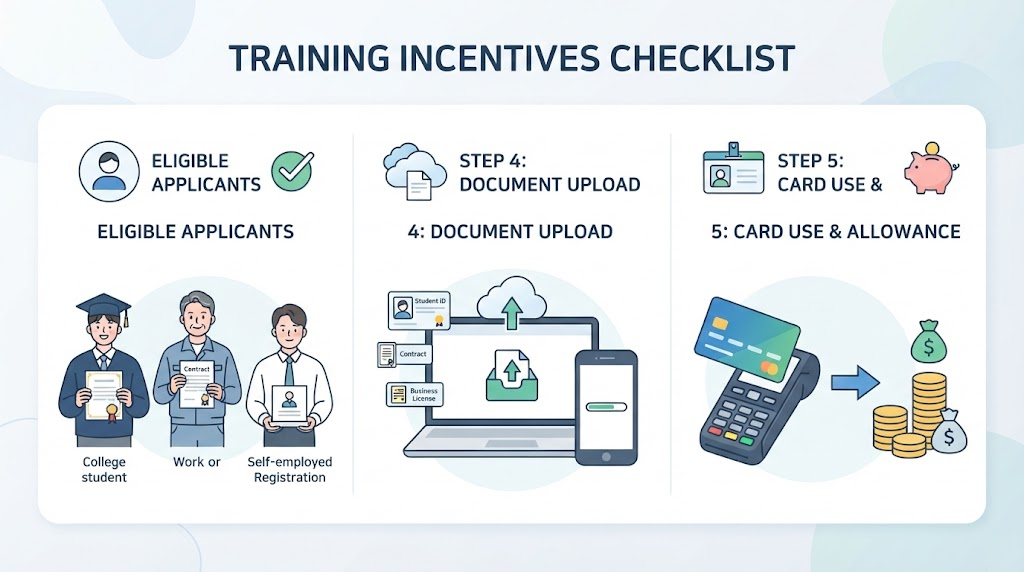
[Step 4] Attaching Supporting Documents for Eligibility (Applicable Persons Only)
While regular workers or job seekers are automatically verified through electronic data linkage, the following applicants must upload relevant supporting documents as files (images or PDF):
University/Graduate Students:
Expected Graduation Certificate (proof of remaining study years until graduation)
Employment24
Non-regular Workers: Copy of employment contract
Self-employed and Special-type/Freelancer Workers: Income and employment proof documents such as a business registration certificate, consignment contract, etc.
[Step 5] Review by the Competent Employment Center and Receipt of Physical Card
Review Period: Once the application form is submitted, the competent employment center for your residence reviews the eligibility requirements, which typically takes about 3 to 7 business days.
Card Receipt and Usage:
After receiving the approval completion notification talk (text message), you can receive the physical card via mail delivery or by visiting a bank, and use it immediately for online and offline course registration and payment.
Employment24
Training Course Search to Course Registration and Self-Payment Method
If your card has been successfully issued, it is now time to find the vocational training course that suits you best and proceed with course registration. Since application methods and procedures vary slightly depending on the total hours and nature of the course you wish to take, follow the steps below carefully.
[Step 1] Searching for Customized Training Courses on HRD-Net (Employment24)
- Access the Vocational Training Portal HRD-Net (or Employment24) homepage and go to the ‘Training Course’ menu.
- Enter keywords for the field you want to learn (e.g., computerized accounting, barista, video editing, Python, etc.) or the name of the certification you wish to acquire in the search bar.
- You can narrow down the list of available courses by setting conditions suitable for you using the detailed search filters.
- Region/Training Region: Select the district/neighborhood unit near your residence available for commuting
- Training Type: Select National Tomorrow Learning Card general course, K-Digital Training (KDT), etc.
- Opening Date and Time Slot: Coordinate schedules such as weekday classes, night classes, weekend classes, weekday-only classes, etc.
[Step 2] Checking Detailed Curriculum and Viewing Self-Payment Amounts
Once you find a training course you like, you should carefully review the details on its detail page.
- Checking Self-Payment Amount: Clicking the ‘View Self-Payment Amount’ button on the page allows you to accurately preview the actual out-of-pocket amount you need to pay according to your current employment status and support type (general job seeker, employee, National Employment Support System participant, etc.).
- Training Institution Evaluation and Employment Rate: It is recommended to check whether there is an Employment and Labor Ministry-certified excellent training institution mark, and whether the employment rates and reviews of graduates are favorable.
- Schedules and Supplies: Check the total training days, daily class hours, attendance management methods, etc.
[Step 3] Proceeding with Course Registration by Course Type
National Tomorrow Learning Cards have different application paths depending on the total training hours.
| Classification | Courses under 140 Hours (Short-term Courses) | Courses of 140 Hours or More (Long-term Courses) |
|---|---|---|
| Course Characteristics | Short-term certifications, practical single-subject courses, weekend/night hobby/practical courses | KDT, National Strategic Industry-Targeted Training (National), 3 to 6-month employment-specialized courses |
| Application Method | HRD-Net online immediate course registration available | Online application + Competent employment center training consultation required |
| Procedure Summary | Wait for training institution guidance after completing application directly on the portal | Employment center consultation and training plan approval required after online application |
Tip: Popular government-supported courses often have quotas that fill up quickly or involve self-selection interviews and level tests. It is much safer to contact the training institution (academy) directly before or after applying on HRD-Net to inquire in advance about remaining quotas and registration procedures.
[Step 4] Paying the Self-Payment Amount with the National Tomorrow Learning Card
Once course approval is finally completed, finish payment and registration according to the training institution’s guidance.
- Must pay with the Tomorrow Learning Card: If it is a course where a self-payment amount occurs, you must pay with the National Tomorrow Learning Card (check or credit card) issued to you in order for the government support benefit to be normally applied. (Cannot be changed after pre-paying with a personal card)
- Full Government Support Courses (0 KRW Self-Payment): For courses with a 0 KRW self-payment such as K-Digital Training or national strategic industry courses, there is no separate payment procedure, but you must bring your physical card on the first day of class and register your attendance tag on the academy terminal to complete the final course registration.

Training Allowance Eligibility Requirements (Unemployed Persons, National Employment Support System Linkage, etc.)
Just because you take a course with the National Tomorrow Learning Card does not mean that training allowances are automatically paid to all trainees. Since the training allowance is intended to subsidize minimum transportation and meal expenses for job seekers and vulnerable groups who find it difficult to focus on job hunting and vocational training due to livelihood burdens, both clear course requirements and individual qualification requirements must be met.
- Mandatory Course Requirement: Total training hours of 140 hours or more
Before checking individual status or income criteria, the education course you are taking must satisfy the following conditions.
- Total training hours of 140 hours or more: Short-term special lectures or single-subject courses of a hobby/general nature (under 140 hours) are excluded from allowance payment targets, and you must participate in long-term collective (offline) and mixed training courses of 140 hours or more.
- Exclusion of remote (internet) training: 100% non-face-to-face remote courses taken only at home via PC or mobile do not meet the purpose of supporting transportation and meal expenses according to attendance, so training allowances are not paid.
- Eligibility Requirements by Status (Who Can Receive It?)
While taking a long-term course of 140 hours or more, you must fall under one of the following detailed types to apply for the allowance.
① General Job Seekers (Unemployed Persons)
- Job seekers in an unemployed state who are not currently subscribed to employment insurance.
- Precautions: Training allowances are not redundantly paid during the period of receiving unemployment benefits (job-seeking benefits) after retirement. (Training allowances are normally paid starting from the attendance days after the unemployment benefit receiving period has completely ended.)
② National Employment Support System Participants
- National Employment Support System Type I Participants: You can jointly receive the Tomorrow Learning Card training allowance separately from the monthly job-seeking promotion allowance, which provides a very significant livelihood support effect.
- National Employment Support System Type II Participants: Eligible if you are a low-income or specific-class, youth, or middle-aged/senior participant completing training according to a employment support program.
③ Ultra-Short-Time Workers Under 15 Hours per Week
- Even if you are an employment insurance subscriber, short-term part-time workers whose monthly scheduled working hours are under 60 hours (an average of under 15 hours per week) can receive allowances comparable to unemployed persons.
④ Earned Income Tax Credit (EITC) Recipients
- Even if you are an employed worker or self-employed person, if you have a history of receiving the Earned Income Tax Credit under the Special Tax Treatment Control Act, you are exceptionally included in the training allowance payment targets when taking a training course of 140 hours or more.
⑤ Self-Employed Employment Insurance Subscribers
- Small business owners who hold a business registration certificate and faithfully pay premiums while subscribed to ‘Employment Insurance for the Self-Employed’ are also eligible.
[Summary] Quick Glance at Eligibility
| Classification | Training Allowance Eligibility | Key Checklist |
|---|---|---|
| General Unemployed Job Seekers | Eligible | Worknet job search registration completed and not receiving unemployment benefits |
| Unemployment Benefit Recipients | Not Eligible (While Receiving) | Payments begin from the day after the unemployment benefit receiving period ends |
| National Employment Support System Participants | Eligible | Joint receipt available if requirements are met for both Type I and Type II |
| General Workers (15 Hours or More per Week) | Not Eligible (In Principle) | However, exceptions are allowed if there is a history of receiving the Earned Income Tax Credit |
| Short-Term Part-Time Workers (Under 15 Hours per Week) | Eligible | Proof of working under 15 hours per week on the employment contract is required |
| Trainees in Short-Term Courses Under 140 Hours | Not Eligible | All excluded regardless of personal status due to failing course criteria |

Training Allowance Payment Criteria (Attendance Rate of 80% or Higher, Courses of 140 Hours or More, etc.) and Maximum Monthly Payment Amount
Even if you meet the training allowance eligibility requirements, you must strictly achieve the attendance rate and class day criteria set during the training period to actually receive the money. Here is a summary of how the allowance is calculated, reduction criteria, and the maximum monthly receivable amount.
- Core Payment Criteria: Mandatory Attendance Rate of 80% or Higher per Unit Period
Training allowances are settled not on a calendar month basis (from the 1st to the end of the month), but on a ‘unit period (1 month)’ basis that breaks off month by month starting from the date the education began.
- Securing an Attendance Rate of 80% or Higher: Allowances are paid only when you attend 80% or more of the total scheduled training days in that unit period.
- Full Non-Payment if Below 80%: If the attendance rate drops to 79.9% or lower, unfortunately, the training allowance for that 1-month period is processed as 0 KRW (no payment at all), making attendance management more important than anything else.
- Caution Regarding Tardiness, Early Leaves, and Out-of-Office: Tardiness, early leaves, and out-of-office are converted into 1 absence upon accumulating 3 occurrences and reflected in the attendance rate. If you leave early or are tardy without filling at least half of the daily class hours, it is treated as an absence for that day, so caution is required.
- Maximum Monthly Payment Amount by Course Type
Training allowances are subject to a maximum monthly support limit depending on the nature of the course and system revisions.
| Training Course and Participation Type | Maximum Monthly Payment Amount | Key Calculation Method and Characteristics |
|---|---|---|
| General Vocational Training of 140 Hours or More | Up to 200,000 KRW per month | • Calculated on a daily basis based on actual days attended (daily unit price × days attended)
• Paid upon meeting requirements such as being unemployed or a low-income worker |
| Specialized Training Courses (KDT, etc.) | 200,000 KRW or more per month | • New technology and digital practical courses such as K-Digital Training (KDT)
• Additional benefits available when linked with regional special training allowances, etc. |
Note: Since it is calculated on a daily basis according to the days attended, the payment amount may decrease in months with fewer actual attendance days due to weekday public holidays or the academy’s own closing days.
- Synergy Effects when Linked with the National Employment Support System
If a participant in the National Employment Support System takes a Tomorrow Learning Card course of 140 hours or more together, they can experience overlapping government support funds.
- National Employment Support System Type I: You can receive the job-seeking promotion allowance paid monthly (up to 500,000 KRW per month, etc.) alongside the Tomorrow Learning Card training allowance, which is very useful for stabilizing livelihood.
- National Employment Support System Type II: You can continue stable job-seeking activities by linking the training allowance according to the requirements for youth and low-income participants.
- Training Allowance Payment Timing and Deposit Method
- Payment Timing: After the unit period ends, if the training institution electronically reports attendance records to the Ministry of Employment and Labor, it is typically deposited within about 10 to 20 days from the end date of the unit period after review.
- Deposit Account: It is deposited directly by the competent employment center into the affiliated account (Shinhan Bank or Nonghyup Bank) linked in your name at the time of card issuance. (Cannot be received in an account under another person’s name)

Exclusions for Non-Payment and Ineligibility of Training Allowances and Precautions When Applying
The National Tomorrow Learning Card training allowance is a valuable support fund that helps the livelihoods of job seekers and trainees, but minor carelessness or regulatory violations can lead to exclusion or cancellation of payments. Check the reasons for non-payment and important precautions you must know when applying so you do not unfairly miss out on receiving benefits.
- Exclusion Targets Where Training Allowances Are Not Paid at All
If you fall under the following situations, you cannot receive training allowances even if you take a long-term course of 140 hours or more.
Unemployment Benefit (Job-Seeking Benefit) Receiving Period: While receiving unemployment benefits after retirement, the state does not pay training allowances to prevent double support. (However, training allowance reception is possible upon normal attendance starting from the day after the unemployment benefit receiving period ends.)
When Paying the Full Training Cost with Your Personal Card: For a course with self-payment, if you paid with a regular credit or check card instead of the Tomorrow Learning Card or used a card under another person’s name, both government support and training allowance linkage are invalidated.
Failure to Achieve an Attendance Rate of 80%: As emphasized earlier, if the attendance rate does not reach 80% during a unit period, the training allowance for that month is processed as 0 KRW.
Voluntary Dropout or Expulsion from Training: If you do not finish the course to the end and voluntarily quit or are expelled due to insufficient attendance, you may face restrictions not only on remaining period allowances but also on future card usage.
- Precautions to Keep in Mind When Applying for and Receiving Allowances
- Accurate Attendance Check (QR Code and Beacon):
At the start and end of class, you must successfully complete your attendance check using your own smartphone (HRD-Net attendance management app) through the terminal inside the academy.
If you forget and miss the attendance check, it is processed as an absence, which can reduce or cancel your allowance, so building a habit of checking daily is necessary.
- Verifying Matching Account Information in Your Name:
The account where allowances are deposited must strictly be the affiliated account in your name (Shinhan or Nonghyup) registered at the time of card issuance.
If your account number has changed or deposits are blocked due to reasons such as seizure, you must immediately contact the employment center to apply for an account change.
- Checking Early Employment Allowances Upon Getting a Job or Starting a Business:
If you get a job (or start a business) during training or right after completion, you must report this to the employment center.
Since training schedules may be partially adjusted or remaining allowance calculation methods may change due to early employment, it is safest to follow the guidance of the competent employment center or training institution.
Korean version: 한국어로 읽기