Why is a thorough preliminary check necessary before applying for government-funded training?
Government-funded training is an extremely useful system where the government covers a significant portion of the costs to enhance citizens’ job competencies and assist with employment or career changes. However, just because the benefits are large doesn’t mean you should blindly click the application button without sufficient preliminary review, as you may experience unexpected financial losses or administrative restrictions.
For successful vocational training and efficient cost management, let’s take a detailed look at why a thorough preliminary check is absolutely necessary before applying.
- The volatility of the ‘out-of-pocket tuition fee’ that varies depending on individual conditions
Many people mistakenly believe that government-funded training is unconditionally 100% free. However, out-of-pocket fees are set wildly differently depending on the nature of the course, employment rates by job category, and the applicant’s personal employment status or support target type (general job seekers, current employees, National Employment Support System participants, etc.).
If you do not accurately identify your exact support type in advance and check the actual burden amount through HRD-Net, you may end up in an embarrassing situation where you have to pay a much larger out-of-pocket fee than expected.
- Managing the National Tomorrow Learning Card account limit and validity period
The National Tomorrow Learning Card basically grants a certain amount of support limit (usually 3 million KRW) and must be used within its validity period. If you do not choose a training course carefully and give up midway, or make a forced course change because it doesn’t match your aptitude, your precious card account balance may be reduced or you may face disadvantages in future training support.
It is essential to check your remaining account balance in advance and whether you are eligible for additional support (non-regular workers, vulnerable groups, etc.).
- Easy to miss synergy with upper-level linkage systems (such as the National Employment Support System)
If you are unemployed or from a low-income bracket, applying for higher-level support systems like the ‘National Employment Support System’ first and then linking government-funded training is the most advantageous way to drastically lower or exempt out-of-pocket fees and even receive monthly job-seeking promotion allowances.
If you apply for the Tomorrow Learning Card alone without knowing this prior relationship or linkage structure of the systems in advance, it can lead to economic loss by missing out on additional livelihood support benefits that you could have received.
- Preventing penalties for violating attendance and completion criteria
For government-funded courses, normal completion is recognized only when attending 80% or more of the total training days. If you fail to meet this and are expelled or processed as non-completion, part or all of the government funds received may be claimed from you.
Also, if you do not familiarize yourself in advance with the training allowance payment conditions or the account limit reduction penalty regulations imposed in case of dropping out mid-course, you will pay a heavy price if you fail to participate faithfully.
Closing advice: The more thoroughly you prepare and plan for government-funded training, the lower your cost burden and the more maximized your benefits will be. We hope you will step by step check the checklist items below before applying to find the optimal training path most advantageous to you.

Stage 1: Check National Tomorrow Learning Card issuance eligibility and limit balance
Before full-scale government-funded training begins, the very first gate to pass through is accurately understanding the issuance eligibility and current account limit/balance status of the ‘National Tomorrow Learning Card’, which is the core means of vocational training.
Even if you already have a card, if you do not properly check the remaining balance or validity period, hitches can occur during the course application stage, so let’s look at the core points that need meticulous checking.
- Basic understanding of National Tomorrow Learning Card issuance eligibility
The National Tomorrow Learning Card is a system that supports any Korean citizen in receiving vocational training with a low entry barrier, but there are some excluded targets.
Most job seekers, current employees, and college students (expected graduates) are included as issuance targets, excluding incumbent public officials, private school teachers, self-employed individuals with annual sales above a certain amount, high-income special-type contract workers, and elderly individuals aged 75 or older.
You must first check through HRD-Net (Employment 24) whether your application for card issuance will go smoothly according to your current employment status and identity.
- Checking the basic 3 million KRW limit and individual additional support funds
When you are issued the card, a basic training support limit of 3 million KRW is granted to your account. However, depending on your individual employment and income situation, the limit can be increased up to 4 million KRW to 5 million KRW.
For example, if you belong to vulnerable groups such as basic livelihood recipients or next-lower-income brackets, non-regular workers such as fixed-term, part-time, or dispatched workers, and participants in the National Employment Support System, you can secure additional support funds, giving you the leeway to significantly lower the out-of-pocket burden for high-cost professional technical education courses or take them for 0 KRW.
- Checking real-time balance and validity period via HRD-Net (Employment 24) My Page
If you have a history of being issued and using a card in the past, you must check the exact balance remaining in your account and the card’s validity period.
After logging into the official Employment 24 (HRD-Net) website and accessing the ‘My Page > Tomorrow Learning Card’ menu, you can check the currently usable remaining limit and card expiration date in real-time.
If the balance is less than the training fee for the course you want to take, additional out-of-pocket costs may occur, so you must coordinate your budget in advance.
- Applying in advance considering the card issuance period
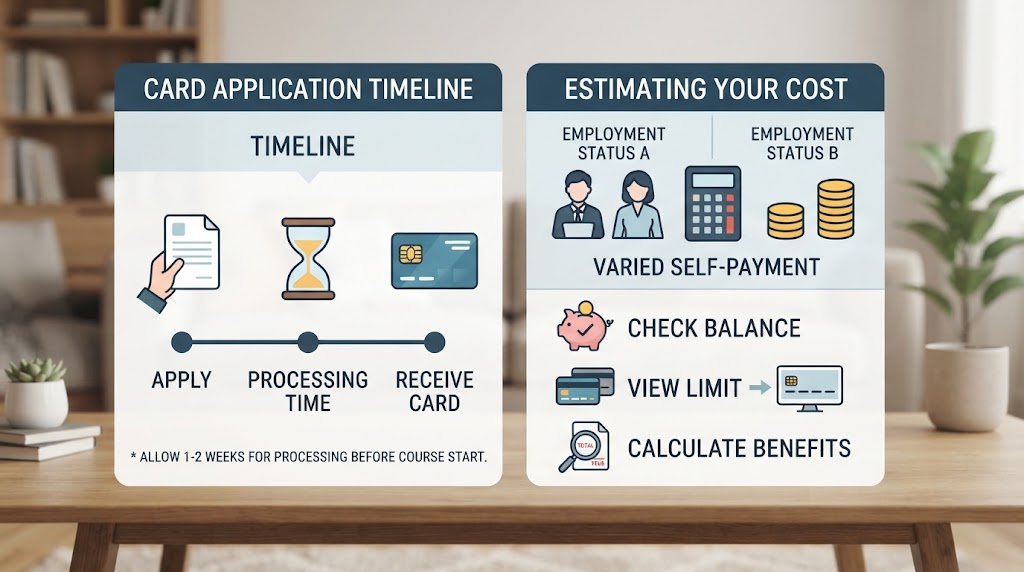
If you do not yet have a card or need reissuance, administrative time of typically about 1 week to 2 weeks occurs from application to physical card receipt.
If you urgently apply for a card according to the opening date of the educational course you want to take, issuance delays may cause you to miss the course application period, so it is safe to complete the issuance procedure at least a month before the education starts.
Closing advice: The National Tomorrow Learning Card is a reliable primary asset supporting your career growth. We hope you check your balance and limit through My Page before applying and prepare to draw out the maximum support benefits that suit you.
Stage 2: Individually inquiring about actual ‘out-of-pocket tuition fees’ by support target type
One of the common mistakes made by many trainees when applying for government-funded training is prematurely judging costs by trusting only the ‘basic amount’ or ‘average tuition fee’ written on promotional pages or information booklets.
Even if you take the same training course, the actual out-of-pocket fee you have to pay varies widely depending on your employment status and support target type. Let’s look at how to check the exact burden amount applicable to you and plan your budget.
- Why you shouldn’t blindly trust the basic amount on promotional pages
The tuition fees displayed on information pages of academies or training institutions are often based on general job seekers or discounted amounts applying specific support targets.
Since the government-funded support rate calculated by the Ministry of Employment and Labor differs depending on your current employment insurance subscription history, income level, and job seeker status (general job seeker, current employee, National Employment Support System participant, etc.), you must directly check the actual out-of-pocket amount applicable to you individually for an accurate understanding.
- Utilizing ‘View out-of-pocket amount’ after logging into HRD-Net (Employment 24)
The most accurate and surest way to check your personal burden is to use the official vocational training portal, HRD-Net (Employment 24).
After searching for the course you wish to take and accessing its detail page, do not just look at the simply marked amount, but make sure to click the ‘View out-of-pocket amount’ button while logged in with your own account ID.
Simultaneously with logging in, the system digitally links the user’s current employment status and identity to calculate the exact personal burden amount in real-time.
- Differences in burden rate structures by major support target types
Depending on the Ministry of Employment and Labor standards, the perceived cost varies significantly by support target type.
* National Employment Support System Type I and vulnerable groups: The out-of-pocket burden rate for general courses is drastically reduced, or there is a great benefit of being able to receive KDT (K-Digital Training) and national strategic industry courses completely free (0 KRW).
* National Employment Support System Type II participants: A reduced burden rate compared to general job seekers is applied, easing the financial burden.
* General job seekers and current employees: A standard out-of-pocket fee of a certain percentage may occur depending on the employment rate by job category or company size (whether it is a priority support target company, etc.), making prior comparison essential.
- Checking textbook costs and incidental expenses (practical training fees, etc.) separately
In addition to the out-of-pocket fee for the tuition itself, textbook costs, material costs, and equipment practical training fees may be charged separately depending on the training course.
You must finally confirm through training institution counseling whether there are additional incidental expenses incurred besides the training fee on HRD-Net to prevent unexpected expenditures.
Closing advice: Out-of-pocket fees can be drastically reduced or exempted depending on how you combine your personal status and the system. Before clicking the application button, make sure to directly check your actual burden amount while logged in and build your budget wisely.

Stage 3: Reviewing prior linkage with upper-level systems (such as the National Employment Support System)
One of the hidden cheat codes that most dramatically lowers the cost burden when applying for government-funded training is applying for higher-level support systems like the ‘National Employment Support System’ beforehand before independently applying for the Tomorrow Learning Card.
Depending on how you set up the priority relationship of the systems, out-of-pocket fee exemption benefits as well as living expense support during the training period can completely change, so it must be reviewed.
- Difference between applying for the Tomorrow Learning Card alone vs. prior linkage with the National Employment Support System
If a job seeker who is unemployed or meets income and asset requirements directly gets the Tomorrow Learning Card issued alone and takes a general educational course, a certain percentage of out-of-pocket fees may occur depending on the job category.
On the other hand, if you get participation approval for the ‘National Employment Support System’ first and then link government-funded training, you will receive much more advantageous benefits, such as a drastically lowered out-of-pocket rate or a full exemption, even while taking the exact same class.
- Customized cost reduction effects by National Employment Support System Type I and II
You must actively utilize the type-specific benefits divided according to the participant’s income level and age.
* National Employment Support System Type I: Provides comprehensive employment support services to low-income individuals and job seekers, and provides ‘job-seeking promotion allowances’ stably of 500,000 KRW every month for up to several months while participating in vocational training. This can perfectly bridge the gap in living expenses as well as reduce the burden of educational costs.
* National Employment Support System Type II: Targets youth, middle-aged and older adults, and low-income individuals, and drastically lowers the perceived cost burden through linked benefits of a separate training participation support allowance that eases the burden of living expenses when participating in vocational training.
- Maximizing out-of-pocket fee exemption and reduction through upper-level system linkage
Participants in the National Employment Support System are assigned a higher national support rate than when classified as general job seekers on the vocational training portal.
Therefore, it acts as the surest breakwater to minimize or eliminate out-of-pocket fees when taking general practical courses or license acquisition courses that incur somewhat of a cost.
- The priority application order of the system that must be strictly followed
What you need to be careful about is that it is difficult to retroactively apply the National Employment Support System after you have already registered for or started taking a government-funded training course.
If you plan to receive education, the correct order is to visit the Employment Welfare Plus Center with jurisdiction over your place of residence or apply online (Employment 24) at least several weeks before registering with the training institution to have your eligibility to participate in the National Employment Support System reviewed first.
Closing advice: If you want to save money, before worrying about “what education to take,” the right order is to first check “am I eligible for the National Employment Support System?” Wisely prioritize the upper-level linkage system in advance to maximize your economic benefits.
Stage 4: Comparing the availability of fully government-funded courses (KDT & National Strategic Industry Courses)
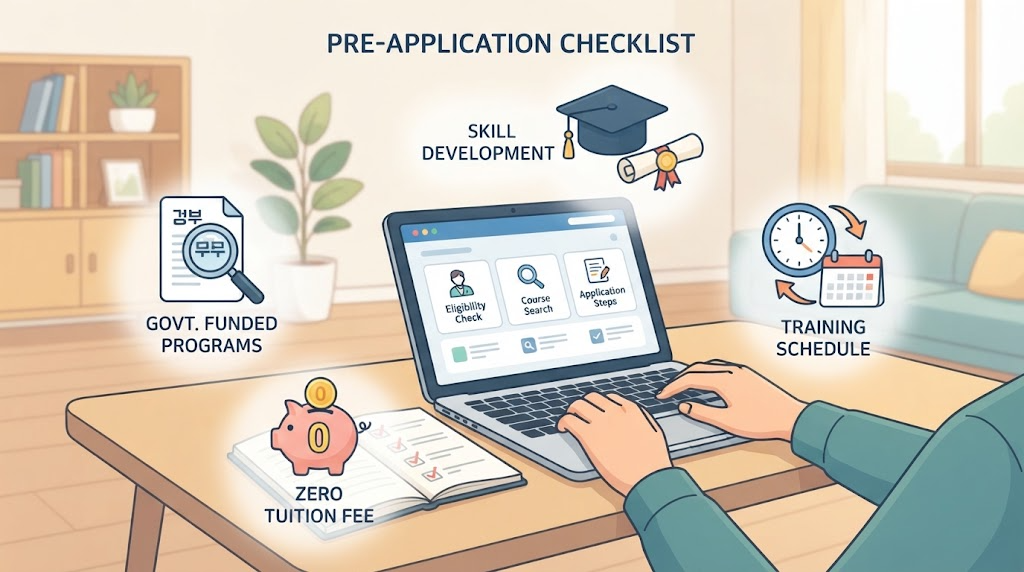
The surest and most powerful way to fundamentally block financial burdens while receiving government-funded training is to select a government-led core talent cultivation course operated entirely at 0 KRW out-of-pocket, meaning 100% government funding.
Since not all courses are paid or incur out-of-pocket expenses, comparing and screening in advance whether your desired career field falls under a fully free support course is the core of cost reduction.
- Actively utilizing K-Digital Training (KDT) courses
K-Digital Training (KDT) is a high-intensity bootcamp program fully supported by the government to intensively cultivate practical talents in cutting-edge and digital new technology fields such as Artificial Intelligence (AI), Big Data, Cloud Computing, FinTech, and Smart Logistics.
This course not only grants a full tuition exemption benefit (0 KRW out-of-pocket fee) but also provides separate special allowances in addition to the training allowances paid monthly depending on the course, making it the most preferred path for job seekers wishing to enter IT and digital jobs.
- Comparing National Key and Strategic Industry Training (National Strategic Industry) courses
National Key and Strategic Industry Training is a long-term educational course that trains professional technicians in industrial fields essential for enhancing national competitiveness or experiencing severe labor shortages, such as manufacturing, IT, construction, machinery, design, and electronic technology.
You can learn professional skills solidly from the basic stage without separate out-of-pocket fees, making it very advantageous for non-majors or students preparing to learn new skills and transition to stable technical and professional jobs.
- Core comparison criteria that must be examined when selecting a fully free course
Rather than blindly registering just because the cost is 0 KRW, you can reduce failures by meticulously comparing the criteria below as much as you invest your precious time.
* Actual employment rate and partner company pool: Check through the HRD-Net detail page how solid the graduates’ actual employment rates and linked partner companies are for the institution.
* Practical-oriented curriculum and portfolio weight: Check whether it moves away from theory-oriented classes to cover technology stacks actually used in companies, and whether the weight of team projects that can be utilized as a portfolio is high.
* Preparation for preliminary selection tests (coding tests, interviews, etc.): Most popular KDT or national strategic industry courses go through a separate selection process before opening, so you can increase your acceptance rate by checking recruitment notices in advance and thoroughly preparing the basics.
- Thorough cost-comparison analysis with general paid courses
If the job you desire falls under a general license acquisition course or short-term practical course and incurs a certain percentage of out-of-pocket fees, it is wise to first find out whether a similar KDT or national strategic industry alternative course exists.
If there is a place opened as a fully government-funded course despite having the same or similar curriculum, you can completely eliminate the cost burden, so the habit of listing and comparing courses from various academies before applying is essential.
Closing advice: Simply utilizing the 100% government-funded system with 0 KRW out-of-pocket completely relieves you of worries about education costs. We hope you carefully compare whether there are cutting-edge and strategic industry courses matching your career goals to capture both economic advantages and employment competitiveness.

Stage 5: Familiarizing with attendance regulations (80% or more) and mid-course drop-out penalties
Even if you significantly reduce out-of-pocket fees or register for a course entirely for free through government-funded training, neglecting attendance management or dropping out midway during the training course operation period can lead to unexpected financial losses or powerful institutional penalties.
Let’s look at the core attendance regulations and precautions regarding mid-course drop-outs that you must familiarize yourself with to successfully complete training and prevent unnecessary cost losses.
- The absoluteness of attending 80% or more of total training days
Since government-funded training is operated with national budgets, the completion criteria are very strict.
Most training courses require mandatory attendance of 80% or more of the total training days to be recognized for normal completion. If the attendance rate drops below 80% and you are expelled or processed as non-completion, you may suffer major disadvantages, such as part or all of the government support funds received from the state being claimed back from you or your Tomorrow Learning Card account limit being deducted.
- Management of training allowance entitlement and unit-period attendance rates
The training allowance (or monthly support fund) paid upon course completion is also directly linked to the attendance rate.
The allowance for that month is normally paid only when the attendance rate per monthly unit period achieves 80% or more, and if the attendance rate falls short of the standard, not even 1 KRW of allowance is paid, making daily attendance management a financial defense measure.
- Utilizing the HRD-Net attendance management app and tips to prevent omissions
You must prevent unfair situations where you study diligently but forget to check smartphone attendance and are processed as absent.
You must cultivate the habit of turning on your smartphone’s location and Bluetooth permissions at the start and end of class, pressing the attendance check button normally via the terminal or beacon inside the academy, and checking with your own eyes to see if the phrase “Attendance Completed” pops up on the screen.
Also, being late, leaving early, or going out is converted to 1 day of absence upon accumulating 3 times, and if you leave early without fulfilling 50% of the daily training hours, the entire day is treated as an absence, so caution is required.
- Fatal penalties imposed upon mid-course quitting (mid-course dropout) and coping methods
If you fail to finish the education until the end due to personal circumstances and drop out arbitrarily midway, your use of the National Tomorrow Learning Card itself takes a big hit.
If you are arbitrarily expelled without a justifiable reason, a certain amount (200,000 KRW for the 1st time, 500,000 KRW for the 2nd time, etc.) is deducted from your card account balance as a penalty, and if you quit midway 3 times or more, card issuance and government funding itself are restricted for a certain period.
When you cannot continue taking classes due to unavoidable reasons such as illness, accident, or job change, do not leave it unattended, but immediately notify the training institution and the jurisdiction employment center, then submit related evidentiary documents such as a medical certificate to process it as ‘course withdrawal (justifiable reason)’ to minimize penalties.
Closing advice: The government-funded system becomes a powerful weapon that allows you to capture both economic benefits and career growth only when you choose wisely, attend faithfully, and complete the course. We hope you achieve successful education completion through thorough preliminary checks and meticulous attendance management.
Conclusion: Starting government-funded education wisely under the conditions most advantageous to you
So far, we have looked step by step at the core checklist items that must be checked before applying for government-funded training and realistic ways to drastically reduce costs.
The government-funded system is a precious opportunity where the more actively you dig into it and the more wisely you utilize it, the more you can significantly relieve your financial burden and create a powerful stepping stone for your career growth.
Recalling the core contents once again is as follows:
- Checking Tomorrow Learning Card balance and additional support limit: Grasp in advance your current account status and potential for additional support according to non-regular worker or vulnerable group status.
- Directly inquiring about individual actual ‘out-of-pocket fees’: Do not trust only the basic amount on promotional pages, but log into HRD-Net to check the exact burden amount matching your identity.
- Prioritizing upper-level linkage systems (such as the National Employment Support System): If you are unemployed or from a low-income bracket, link upper-level systems first rather than independently applying for the Tomorrow Learning Card to maximize allowances and exemption benefits.
- Actively attacking fully government-funded courses (KDT & National Strategic Industry Courses): Prioritize comparing and screening 0 KRW out-of-pocket courses in cutting-edge digital and strategic industry fields.
- Strictly complying with attendance management and completion criteria: Prevent cost losses and penalties through attendance of 80% or more of total training days and unit-period attendance rate management.
Anyone can enjoy the benefits of government-funded support, but making them entirely your own depends on thorough preliminary preparation and meticulous access to information.
Based on the checklist and cost reduction strategies checked today, we hope that instead of making a hasty application, you will find the optimal training path that is most advantageous and suitable for you, and wide open the doors to successful employment and career transition.
Korean version: 한국어로 읽기