Introduction: Why Should We Pay Attention to ‘Youth Housing Support’ Right Now?
Amid soaring monthly rent and jeonse (lump-sum deposit) prices, as well as a continuous high-interest rate trend, housing costs are one of the greatest economic burdens for young people who are preparing for independence or already living on their own. With a significant portion of their monthly salary going straight toward rent and maintenance fees, it is the bitter self-portrait of today’s youth that they can barely manage basic living expenses, let alone save money.
However, if you turn your eyes just a little bit, you can find that the government and local authorities are implementing much more diverse and practical support policies than expected to help young people stabilize their housing. The problem is that countless young people miss out on the benefits they rightfully deserve every year simply because they do not even know such systems exist, or because they find them bothersome due to complex terminology and seemingly strict conditions.
“Support funds that you fail to receive because you don’t know about them—now is the time to claim them as your own right.”
Youth housing support projects go beyond simply adding a few coins of financial aid; they are the strongest safety net helping young people who have taken their first steps into society start building assets and escape housing insecurity.
In particular, as the eligibility requirements have been partially relaxed or new customized benefits have been added this year, if you were previously eliminated for failing to meet the conditions or postponed your application, now is the golden time to meticulously review your conditions and benefits once again.
In this article, we will easily and clearly organize everything from the conditions of representative housing support benefits that young people can most usefully utilize to application tips that are easy to miss, so please read until the end and make sure to secure your precious benefits.

Representative Youth Housing Support Programs at a Glance
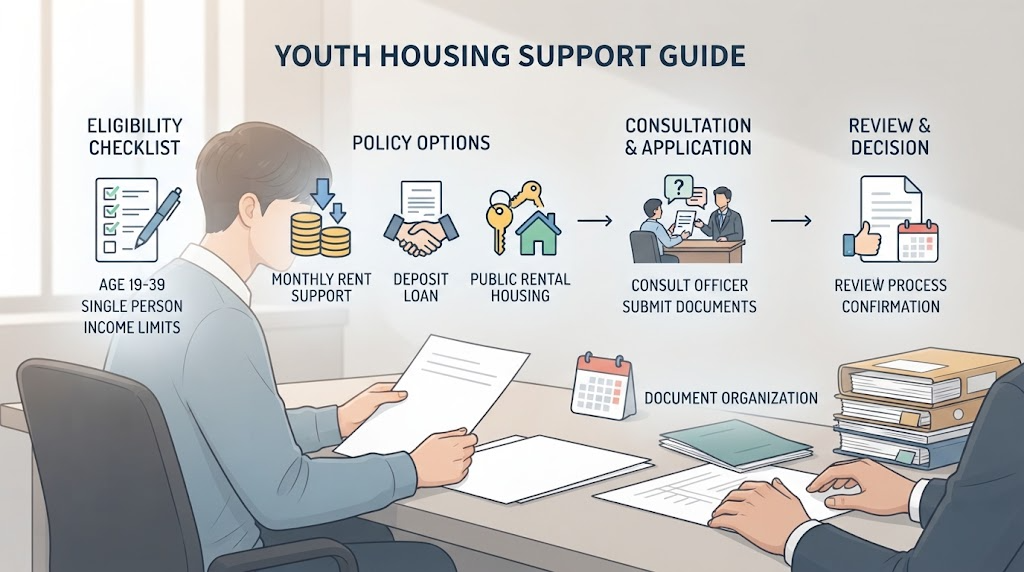
Governments and local authorities operate various forms of support policies to stabilize housing for young people. It is important to first grasp the core details of which benefits suit you best. Let us look at 3 representative housing support programs.
- Housing Stability Monthly Rent Support (Special Youth Rent Support): Receive Maximum Monthly Rent Support
Support Target: Homeless young people living separately from their parents (Aged 19 to 34 or younger)
Income and Property Criteria: Must meet the median income and property criteria of the youth household and the original household (including parents).
Support Details: You can receive monthly rent support in cash of up to 200,000 won per month for up to 12 months (not a total of 240,000 won, but a total of 2.4 million won for 1 year at up to 200,000 won per month).
Recommended For: Independent youth for whom fixed monthly rent expenses are the greatest burden
- Youth Jeonse and Monthly Rent Deposit Loan (Beontimmok, etc.): Securing Funds at Low Interest Rates
Support Target: Homeless household heads with a combined annual couple income below a certain amount (Youth aged 19 to 34 or younger)
Support Details: Through representative products of the Housing and Urban Fund such as the ‘Youth-Only Beontimmok Jeonse Fund Loan’, you can receive jeonse deposit loans at much lower interest rates than commercial banks. The loan limit and preferential interest rate benefits are significantly greater compared to regular products.
Recommended For: Those who lack lump-sum funds ahead of a jeonse contract or find high-interest commercial loans burdensome
- Public Rental Housing and Youth Purchased Rental: Securing Affordable Housing Spaces Compared to Market Prices
Support Target: College students, job seekers, and homeless youth aged 19 to 39 or younger
Support Details: Housing purchased or constructed by public institutions such as LH and SH, leased so that residents can live for the longest possible period at 30 to 50% of market prices (or conditions cheaper than surrounding market prices).
Recommended For: Those looking for a stable nest where they can live for a long time without worrying about rent increases
💡 Core Summary:
If you want to save on housing expenses you spend every month right now, it is best to first look into ‘Youth Monthly Rent Support’; if you need a deposit or loan for the house you are moving into, look into ‘Youth Jeonse and Monthly Rent Deposit Loan’; and if you want to lower the cost burden of the residence itself, it is recommended to look into ‘Youth Purchased Rental Housing’ first.
Checklist for Support Conditions & Eligibility Requirements That Fit Me
The various youth housing support projects we looked at earlier—”Can I really receive them too?” is the point where curiosity peaks the most. Government subsidies are not paid out simply by applying; strict age, income, and household criteria must be met.
Let’s carefully examine each core item so as not to get confused by complex conditions.
- Checking Age and Homeless Standards
Age Criteria: Most youth support projects base their standards on ages 19 to 34 or younger. However, since some local government ordinances or specific purchased rental housing apply an extension up to age 39, you must first check whether your age falls within that range.
Homeless Status: Support recipients must strictly be homeless individuals who do not own a home. If you own a home under your name, you are principally excluded from the target. (However, if you reside in a house owned by your parents, exceptions may apply depending on household separation status, etc.)
- Income and Property Criteria (Original Household vs. Youth Household)
This is the trickiest section where the highest number of applicants get eliminated. The criteria for assessing income differ depending on the nature of the support project.
Youth Independent Household Income: If you are living completely separated from your parents in terms of household registration, the screening is based solely on the income and property of the applicant (or spouse).
Original Household (Including Parents) Combined Income: In particular, projects like the Special Youth Rent Support screen by combining not only the youth’s own income and property, but also those of their parents (based on the original household). Even if your own income is low, you might unfortunately be eliminated if your parents’ assets or property exceed the threshold, so you must carefully check the detailed criteria in the announcement notice.
Checking Standard Median Income: Since allowable income brackets for each project are usually set, such as 60% to 100% or less of the standard median income, it is a good idea to gauge your household’s income level in advance through recent health insurance payment confirmation documents and the like.
- Checking Household Composition and Duplicate Support Restrictions
Whether Household Separation is Mandatory: In the case of jeonse loans or monthly rent support, requirements are often met only when your address on the resident registration is separately divided from your parents and registered as an independent household head (or household member).
Prohibition of Duplicate Benefits: Cash-related welfare benefits associated with housing provided by the national or local governments are mostly unable to be received in duplicate. For example, if you are already receiving local government-led rent support or are receiving other similar housing allowances, caution is needed as duplicate applications may be restricted.
💡 Checklist Summary Tip:
Before preparing documents in earnest, check these three things first: ① whether your age fits the support bracket, ② whether homelessness and household separation on resident registration are accurately completed, and ③ whether the income of you and your parents falls within the standard line. Clearly grasping just these conditions can reduce wasted effort.

Application Methods and Essential Required Documents Guide
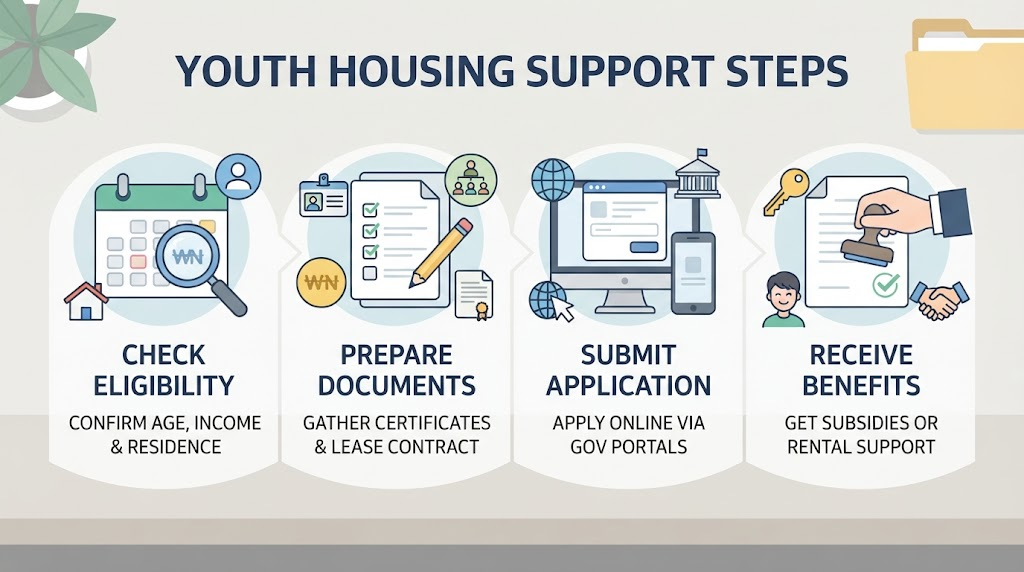
If you have meticulously checked the support conditions and fall under the target group, it is now time to actually proceed with the application. No matter how good the benefit is, if you miss the timing or omit documents, it becomes useless, so you must accurately understand the application pathways and preparation items.
- Where to Apply? (Online and Offline Application Methods)
Most youth housing support projects can be conveniently submitted online, and for those unfamiliar with using digital devices, offline visits and submissions are also operated in parallel.
Online Application (Highly Recommended)
Bokjiro Portal and App: Integrated applications and qualification inquiries for central government welfare projects such as Special Youth Rent Support are available.
Housing and Urban Fund Portal or Fund Consignee Bank Website: Used when applying for housing financial products such as the Beontimmok Jeonse Fund Loan.
Gov.kr and Respective Local Government Websites: Mainly utilized when applying for local government-specific youth housing support funds or lease deposit interest support projects.
Offline Visit Application
If online application is difficult or additional confirmation is needed, you can visit and apply at the local eup, myeon, or dong administrative welfare center (community center) with jurisdiction over your resident registration address. (In the case of jeonse loans, visiting a designated consignee bank branch is required)
- List of Essential Documents to Prepare in Advance
When preparing documents hastily during the application process, there are many cases where deadlines are missed or documents are omitted. Although they vary slightly by project, it is best to prepare the core documents commonly required in advance.
ID and Basic Certification Documents: Resident registration copy (extract), family relationship certificate (for checking household separation status and relationship with parents)
Housing-Related Documents:
Lease Agreement (including fixed date): Essential to prove the fact of the jeonse or monthly rent contract.
Monthly Rent Payment Confirmation (or Receipt): In the case of monthly rent support projects, bank transaction history and the like proving that monthly rent has been paid normally for a certain recent period are required.
Income and Property Proof Documents:
Health insurance premium payment confirmation and qualification confirmation (serves as the basis for calculating income level)
Local tax itemized taxation certificate (for checking property ownership status)
Copy of Bankbook under Applicant’s Name: Account where the support funds will be deposited
- Things to Keep in Mind When Applying
Checking Deadlines and Budget Depletion: Since some local government support projects or policies in the form of first-come, first-served reception may experience early budget depletion, you must move quickly as soon as the announcement notice goes up.
Validity Period of Documents: Since all supporting documents are often recognized only as originals issued within the last 1 month based on the application date, be careful not to get them issued too far in advance.
💡 Document Preparation Tip:
If you download documents that can be issued online in advance via Gov.kr or Bokjiro (such as resident registration copies, health insurance payment confirmation, etc.) in PDF file format ahead of time, you can complete your application quickly and smoothly on the application page.
Frequent Mistakes and Precautions When Applying
Even if you prepare documents meticulously and apply for a youth housing support project, situations can arise where a single minor mistake leads to exclusion from target selection or a reduction in support funds. To prevent unfortunate disqualification, let’s look at the 4 most common mistakes applicants make.
- Omission of Original Household (Parents) Income and Property Criteria
Common Mistake: The case where youth themselves reside independently and apply without checking their parents’ income or property, thinking, “As long as my own income fits the criteria, it should be fine.”
Precautions: Some welfare projects, such as Special Youth Rent Support, screen by combining not only the youth themselves but also the income and property of their parents (the original household). Before applying, you must check your parents’ health insurance premium assessment amounts or property taxes to verify whether they fall within the threshold.
- Omission of Lease Agreement Fixed Date and Delay in Moving-In Report (Transfer Report)
Common Mistake: The case where the contract was successfully completed, but you fail to receive a ‘fixed date’ via the community center or internet registry office, or delay filing the ‘moving-in report’ (transfer report) after moving.
Precautions: Most housing support projects require proof that you actually reside in the housing concerned according to resident registration, and obtaining a fixed date is mandatory to secure the legal effect (such as counter-claim validity) of the lease contract. A habit of getting the moving-in report and fixed date immediately upon contract conclusion is necessary.
- Early Budget Depletion and Miscalculation of Deadlines
Common Mistake: The case where you put things off thinking, “There is still a month left in the application period, so I can take my time,” only for the budget to deplete early and reception to close.
Precautions: Youth housing support projects operated with independent local government budgets or policies in the form of first-come, first-served support often close earlier than the announcement period once the budget is exhausted. Applying hastily as soon as the announcement pops up is the safest method.
- Exceeding Document Validity Periods and Errors in Entry Items
Common Mistake: Submitting resident registration copies or family relationship certificates issued previously as-is, or incorrectly entering account numbers or personal details within the application form.
Precautions: All supporting documents are generally recognized only when they are originals issued within the last 1 month based on the application date. In addition, if the account number under your name or contact information where support funds will be deposited is entered incorrectly, screening may be delayed or you may receive disadvantages in selection, so you must review it at least twice before final submission.
💡 Precautions Summary Tip:
It is easy to let your guard down thinking, “Surely I wouldn’t make a mistake like this,” but more point deductions occur than expected in income calculation criteria or document validity periods (within 1 month). Reading through the [Excluded Targets and Precautions] part of the announcement notice at least once before pressing the apply button can prevent most mistakes.

Conclusion: The Fastest Way to Protect Your Benefits
Up to this point, we have meticulously examined everything from representative youth housing support projects to conditions, application methods, and easy-to-miss mistakes.
The burden of housing costs is not resolved by suffering alone and agonizing over it. Government and local government support systems are a solid safety net that our society extends to young people, as well as a rightful privilege that should be enjoyed. However, no matter how good a policy is, if you do not look it up yourself and take action, those benefits will never enter your bank account.
“In an era where information becomes an asset, today’s small interest determines next year’s housing stability.”
Log on right now to the youth support announcements of the local government where you live, or to the Bokjiro and Subsidy 24 (Bojogeum24) portals. Even if the eligibility conditions seem a bit disappointing or complicated, checking them directly and bumping into them will itself become the wisest and fastest first step toward housing independence. We cheer for you to make the most of your precious benefits without missing out!
Korean version: 한국어로 읽기