
Basic Indicators to Look at First in a Government-Funded Training Curriculum
When looking into government-funded courses, many people’s attention is first caught by flashy academy websites or phrases guaranteeing employment. However, since you have to invest your own time for 8 hours a day over several months, carefully examining the implementation plan (detailed curriculum schedule) is the safest starting point rather than relying on promotional academy slogans.
Here is a summary of 3 key basic indicators you must check when reviewing a curriculum.
① Checking the Golden Ratio of ‘Theory vs. Practice’ Relative to Total Training Hours
Government-funded courses usually take as little as 3 months (approx.### Basic Indicators to Look at First in a Government-Funded Training Curriculum
When choosing a government-funded course, cross-checking quantified operational data and curriculum time allocation before flashy promotional copy is essential to prevent dropping out midway or failing to find employment. The key indicators that should be checked immediately on HRD-Net and at training institution information sessions are as follows.
- HRD-Net Public Disclosure Indicators: 3 Core Figures
Check the history of each session of the relevant course on the Vocational Training Portal (HRD-Net) to verify the following three figures first.
- Completion Rate (80% or higher recommended)
- A high number of dropouts indicates a lack of instructor leadership, failure to adjust learning difficulty, or inadequate student management.
- Same-Field Employment Rate (60–70% or higher recommended)
- Since simple employment rate figures can create an illusion, you must check whether the proportion represents an exact match between the training field (IT, design, accounting, etc.) and the actual job duties at the workplace.
- Course Review Ratings and Satisfaction Reviews
- Check qualitative evaluations from actual students regarding the instructor’s Q&A response speed, practical training equipment specifications, and the intensity of project feedback right before completion.
- Proportion of Practice and Project Time
Theory-centered lectures result in low portfolio completeness, making it difficult to transition into practical employment.
| Category | Ideal Composition Ratio | Checkpoints |
|---|---|---|
| Basic Theory | 20–30% of total time | Lowering entry barriers for non-majors and acquiring basic grammar/concepts |
| Unit Practice | 30–40% of total time | Carrying out weekly assignments and mastering practical tools and libraries |
| Final Project | 30–40% of total time | Corporate-linked projects, producing GitHub/portfolio deliverables |
Caution criterion: Courses where practical training and projects account for less than 50% of the total training time run a high risk of ending up as simple cramming education.
- Market Currency of the Tech Stack in the Curriculum
Check whether outdated technologies or non-mainstream frameworks that conflict with hiring market demands are included.
- Comparison with Wanted and Jobkorea job postings: Check whether the essential stacks required in entry-level job postings for the target role (e.g., Java Spring Boot vs. Node.js, React vs. Vue, cloud environments, etc.) are included in the curriculum’s core modules.
- Whether tools are merely listed: If too many tools and languages are listed in a short-term course, there is a high probability that they will be covered superficially without in-depth learning.
- Incumbent Mentoring and Portfolio Review Sessions
You must check whether the latter half of the curriculum is merely labeled as an ‘autonomous project,’ or if code review and portfolio critique schedules are specifically specified.
- Participation of external working professionals and mentoring frequency
- Whether practical job-search support programs, such as mock interviews and resume editing, are organized

Comparing Portfolio Deliverable Completeness and Project Operating Methods
The success or failure of government-funded training is determined not by a certificate of completion, but by what kind of deliverables you create during the final month. When hiring managers skim through hundreds of applications, the first thing they filter out is the ‘mass-produced academy portfolio.’
Even if it simply says ‘project progress’ in the curriculum, the quality of the deliverables differs completely depending on the actual operating method. Here are the key differences you must compare during academy counseling or before taking classes.
① Mass-Produced Tutorials vs. Problem-Solving-Oriented Projects
Deliverables made by just copying code displayed on the screen by an instructor during class or slightly modifying basic templates are not competitive in the market.
- Forms to avoid: Projects that directly copy online lecture examples, such as building message boards or clone-coding basic shopping mall UIs
- Competitive forms: Projects that reflect service planning to solve actual user inconveniences, external public data API integration, and contemplation of performance optimization (loading speed improvement, traffic distribution testing, etc.)
- Checkpoint: Check whether the ‘topic planning and requirements definition drafting’ phase is independently scheduled in the latter half of the curriculum.
② Collaboration Methods: Simple Role Division vs. Practical Workflow
One of the competencies companies expect from entry-level workers is collaboration skills. You need to check within what kind of development and collaboration culture the project is carried out.
| Comparison Item | Typical Academy Method | Practical-Oriented Method |
|---|---|---|
| Version Control and Collaboration | Sharing compressed files (ZIP), file transfers via messenger | Git/GitHub branch strategies, issue- and PR-based code reviews |
| Planning and Schedule Management | Verbal meetings, self-paced progress | Sprint-unit management using Jira, Notion, Trello |
| Deployment Environment | Demonstrating execution in local environments (Localhost) | **Cloud (AWS, Vercel, etc.)**-utilized actual live deployment |
Inspection tip: Be sure to ask whether they provide guidance so that actual commercial cloud deployment is completed during the project period, allowing you to list a publicly accessible URL in your portfolio.
③ Mentoring Frequency and Feedback Participation
The project period must not become an unattended period where students merely gather for self-study. It is necessary to confirm whether a professional feedback structure is established.
- Presence of a dedicated instructor: Check whether an instructor resides on-site even during the project period to support Q&A and troubleshooting.
- Incumbent code reviews/critiques: Check whether sessions where external working professionals participate to provide feedback during midterm reviews and final presentations are officially assigned in the curriculum.
- Guidance on recording troubleshooting: Check whether guidance on writing a ‘development journal (retrospective)’ that organizes the process of solving errors when they occur is included.
④ Requesting to View Actual Portfolios of Previous Graduates
The surest verification method during counseling is to request: “Can I see the final portfolio links of 2–3 outstanding graduates from the immediately preceding batch?”
- If the academy is reluctant to disclose deliverables or only shows materials from several years ago, operational management is likely inadequate.
- By directly checking GitHub commit records, planning document details, and whether the actual web/app service operates in the disclosed portfolios, you can immediately judge the academy’s true educational standard.

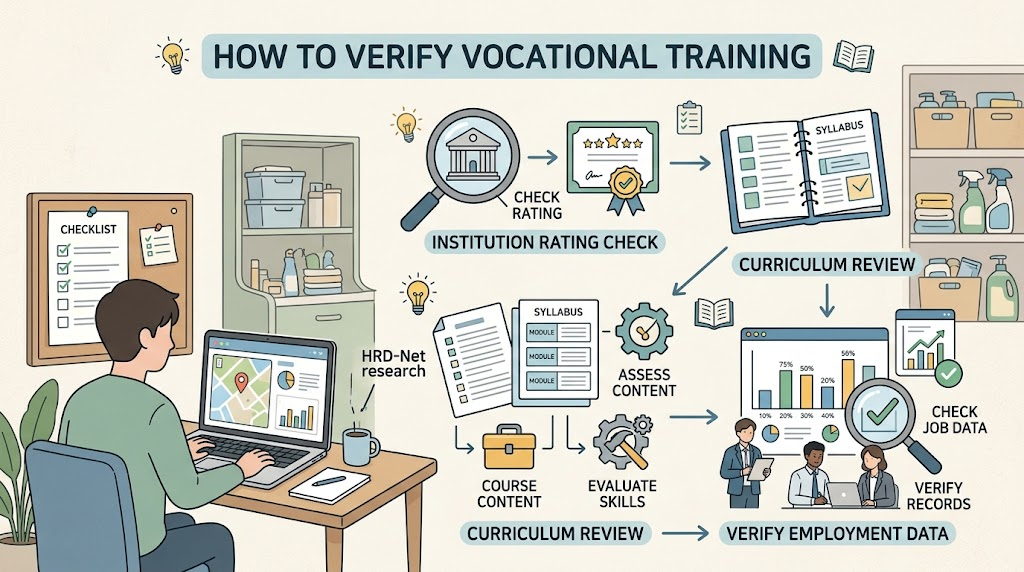
Objective Verification with HRD-Net (Vocational Training Portal) Data
Flashy employment success stories shared in academy counseling offices may be a very small number of stories selected for marketing purposes. On the other hand, data compiled on the Ministry of Employment and Labor’s Vocational Training Portal (HRD-Net, currently linked to Employment24) consists of objective administrative records registered in the national computer network.
Before making a final decision on course registration, here is a summary of the 4-step fact-checking criteria you must go through on HRD-Net.
① Checking the Institution Evaluation Grade (Accreditation Grade) Badge
The Korea Skills Quality Authority comprehensively evaluates training institutions’ employment rates, facilities, instructor competence, completion rates, and other factors every year to award accreditation grades.
- 3-Year Accreditation / 5-Year Accreditation (Best Training Institution): Institutions with long-term operating performance and verified employment achievements. There is a high probability that their curriculum fulfillment rates and student management systems are stable.
- 1-Year Accreditation: These may be newly established institutions or places whose evaluation scores barely met the baseline.
- Accreditation suspended/failed institutions: These must be filtered out as they cannot open government-funded courses or have major disqualifying factors.
② Filtering Out Illusions in Publicly Disclosed Employment Rates (Checking the Same-Field Employment Rate)
The ‘90% employment rate’ number written on academy posters requires examining the details.
| Checklist Item | Watch out## Objective Verification with HRD-Net (Vocational Training Portal) Data
There are many cases where people register rashly relying solely on the ‘90% employment rate’ figure in academy promotional copy, only to be disappointed. To check the actual competitiveness of a training course without being swayed by promotional reviews, you must directly verify the public data disclosed by HRD-Net, the Ministry of Employment and Labor’s vocational training portal.
4 Core Indicators That Must Be Cross-Checked
| Verification Item | Core Criteria to Check | Warning Signs to Watch Out For |
|---|---|---|
| Employment Rate Calculation Method | Actual employment rate based on employment insurance enrollment and same-field employment ratio | Inflated figures including short-term part-timers and simple proof-of-employment submitters |
| Review Ratings & Comments | Specific curriculum and instructor evaluations by students within the past 1–2 years | Mentions of instructor replacement issues, repeated facility complaints, overly short blanket praise posts |
| Dropout Rate | Percentage of students who abandon the course (whether kept under 10%) | Mass departures early in the course, high dropout rate exceeding 20% |
| Institution Accreditation Grade | Ministry of Employment and Labor evaluation results (whether it is a 3-year or 5-year accredited best institution) | Short-term accreditation under 1 year, suspended accreditation, or new entrant institutions |
3 Practical Steps to Look Up HRD-Net Data
- Accessing Course Detail Information
Search for the desired training field (e.g., web development, video editing) or the academy name in the HRD-Net search bar, then click [View Details] for the relevant course.
- Checking Employment Rate and Employment Retention Rate
Check the employment rate based on employment insurance enrollment compared to the total number of graduates of that training institution. Courses with a higher employment retention rate—where employment status is maintained even 6 months after completion—have higher practical job suitability.
- Filtering Satisfaction and Course Reviews
Sort ratings and open-ended reviews that can only be written by actual graduates by newest first. Focus on honest remarks regarding the condition of training equipment, support from assistant instructors, and the quality of project feedback.
Rather than relying on fragmentary figures from promotional blogs or homepages, cross-referencing the trio of employment rate, dropout rate, and accreditation evaluation grade recorded in the government system is the surest way to avoid wasting your government-funded training card.

Training Institution Support Infrastructure and Post-Management System
No matter how solid the curriculum is and how excellent the instructors are,Sub-heading: Training Institution Support Infrastructure and Post-Management System
The outcomes of vocational training are determined not only by the quality of lectures during training hours, but also by the institution’s physical and administrative infrastructure supporting them, as well as the systematic post-management that follows completion. The core components of the full-cycle support system designed to help trainees complete their competencies without dropping out midway and settle into practical work are as follows.
- Field-Customized Educational and Administrative Support Infrastructure
This is the foundational facility to maximize trainee immersion and secure operational efficiency.
- Building the latest practical environment and hardware: Supporting software licenses actually used in industrial fields, high-spec PC labs, the latest equipment, and cloud practice environments to minimize technological gaps with actual practice.
- Integrated Learning Management System (LMS): Unifying attendance checks, lecture material access, assignment submission and feedback, and real-time Q&A to guarantee continuity of non-face-to-face and face-to-face training.
- Dedicated administrative and grievance counseling desk: Handling and guiding complex procedures such as training allowance applications, National Tomorrow Learning Card administrative processing, and attendance verification, while preventing academic dropouts through 1:1 in-depth counseling.
- Step-by-Step Employment Linkage and Career Post-Management System
This is a systematic follow-up process to bear practical career fruit rather than ending with simple completion.
- 1:1 portfolio and job application document clinic: Structuring practical project deliverables to meet industry standards right before and after completion, and conducting tailored cover letter editing and mock interviews (personality and technical).
- Corporate network-based hiring matching: Providing opportunities for regular employment recommendations, institution-exclusive recruitment briefings, and undisclosed position referrals through industry-academia cooperation with partner company pools.
- 6-month to 1-year tracking management after completion:
- Unemployed individuals: Providing regular employment information updates, tailored job posting curation, re-counseling, and supplementary learning opportunities.
- Employed individuals: Checking initial job adaptation status, providing career development mentoring, and guiding advanced/incumbent job enhancement courses when necessary.
Infrastructure and Management Process at a Glance
| Stage | Main Support Infrastructure | Post-Management and Support Activities |
|---|---|---|
| During Training | Latest practice labs, LMS, dedicated administrative managers | Regular academic achievement assessments, 1:1 grievance counseling, attendance care |
| At Completion | Career support center, mock interview spaces | Verifying portfolio completeness, completing tailored resumes |
| After Completion (Follow-up) | Industry-academia cooperation recruitment network, alumni community | 6 months of intensive job placement, retention monitoring, job difficulty counseling |
Korean version: 한국어로 읽기