Prologue: Act Two of Life Starting After Retirement, Why You Should Check Local Government Benefits First
This is a draft prologue written in a friendly, conversational tone with great readability so Naver blog readers can comfortably relate.
Prologue: Act Two of Life Starting After Retirement, Why You Should Check Local Government Benefits First
Facing retirement after leaving behind the workplace where you ran fiercely all your life.
For the first few days, it feels like a sweet vacation, but once the regular commute routine disappears, emptiness often creeps into a corner of your heart.
“The day suddenly feels so long, what on earth should I do to spend my time starting today?”
“Where can my career and experience find value now?”
Retirement is not a period, but a new starting line called ‘Act Two of Life.’ However, if you let time pass vaguely without preparation, physical vitality as well as social bonds can easily weaken quickly.
At this point, the most dependable starting point is the senior welfare system of the ‘local government (city, county, district)’ where we live.
When people think of government welfare, they often only think of central government support like the Basic Pension. However, the real core benefits experienced in daily life are all gathered at your neighborhood district office, community service center, and local welfare center.
Neighborhood-tailored accessibility: Immediate participation available at walking-distance welfare centers and sports centers near your home
Low entry barrier: Support ranging from social service-type jobs utilizing past experience to hobby and digital courses for free or at minimal cost
Connecting with new neighbors: Natural network formation with peers who share the same concerns and prepare for a new start
Local welfare benefits that so many people miss out on simply because they don’t know—from now on, let’s look closely one by one at what jobs and leisure support are prepared.

[Job Sector] Local Government Senior Job Support Utilizing Experience and Expertise
This is a body text draft written with key summaries and comparative structures so Naver blog readers can grasp information at a glance and choose the type that suits them.
[Job Sector] Local Government Senior Job Support Utilizing Experience and Expertise
The purpose of seeking a job after retirement is a bit different from before. That is because, along with earning a living, ‘maintaining a healthy daily rhythm,’ ‘a sense of achievement,’ and ‘continuous connection with society’ become bigger reasons.
Many people wonder, “Aren’t senior jobs only neighborhood environment cleaning?” but local government job support projects are much more systematic and diverse than you might think.
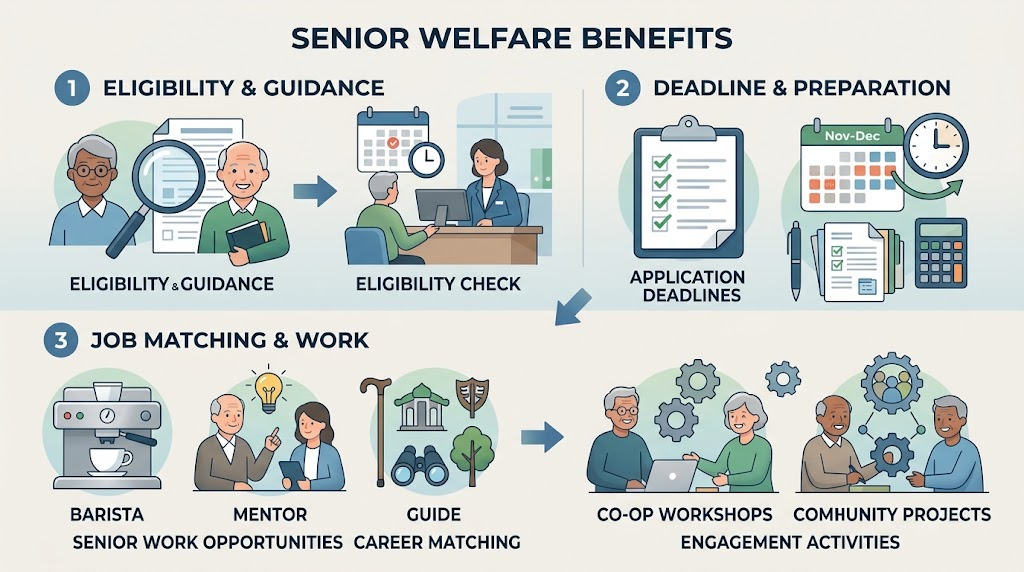
- ‘Three Major Job Types’ tailored to my physical strength and career
Senior job projects operated by the government and local authorities are largely divided into three types. The key is to choose according to your health condition, previous work experience, and desired hours of activity.
| Classification | Public Activity Type | Social Service Type | Market-Oriented Project Group |
|---|---|---|---|
| Eligibility | Basic Pension recipients aged 65 or older | Aged 65 or older (Aged 60 or older for some projects) | Persons aged 60 or older wishing to participate in projects |
| Main Tasks | School commute traffic safety, public facility volunteering | Administrative support at daycare centers/welfare centers, financial assistants | Silver cafe baristas, parcel delivery, manufacturing and sales |
| Working Style | 30 hours per month (2–3 times a week, 3 hours per session) | 60 hours per month (around 15 hours per week) | Flexible working hours based on employment contract |
| Activity Allowance / Pay | Around 290,000 KRW per month (activity allowance) | Mid-to-late 700,000 KRW range per month (including weekly holiday allowance, etc.) | Minimum wage or higher + distribution of business profits |
- Public Activity Type: Suitable for those who want to build regular daily habits and earn pocket money with an activity level similar to a light walk.
- Social Service Type: The most popular type recently. You receive stable pay while working as support staff at welfare centers or public institutions by utilizing practical experience in administrative, educational, or financial fields.
- Market-Oriented Project Group: You can gain a sense of achievement by operating actual stores alongside colleagues, such as silver cafes, collaborative workshops, and senior convenience stores run by senior clubs and related organizations.
- ‘New Middle-Aged (5060) Career-Type Jobs’ you shouldn’t miss
If you are a retiree in your 50s to early 60s who is not yet 65, you should pay attention to each local government’s 50 Plus Foundation or Life Second Act Support Center.
- Matching retired professionals: Utilizing careers of retired civil servants, financial workers, researchers, teachers, and more to provide management consulting and mentoring support for local small and medium enterprises and social enterprises
- Locally specialized activities: Participating in professional projects linked with the local government’s unique resources, such as forest commentators, cultural heritage docents, and village media activists
💡 Application Tips
- Regular recruitment season: Intensive collective recruitment for participants of the following year takes place every year from late November to mid-December. Applying during this period offers the highest chance of being assigned to your desired role.
- Frequent replenishment: Whenever vacancies occur or new project groups are established, recruitment notices are posted frequently throughout the year, so it is a good idea to bookmark the websites of the ‘Senior Club’ or ‘Senior Welfare Center’ with jurisdiction over your residence.
[Leisure & Culture Sector] Learning and Hobby Support Programs That Replenish Vitality
This is a body text draft summarizing key lecture benefits and public facility discount information so Naver blog readers can read comfortably and immediately search for local neighborhood institutions.
[Leisure & Culture Sector] Learning and Hobby Support Programs That Replenish Vitality
The change most felt after retirement is the ‘free time’ given every day. Leisure without hobbies and learning can easily lead to boredom, but taking good advantage of local government cultural and leisure programs allows you to fill your daily life richly at a low cost.
If you are wondering “I don’t know where or what to learn,” checking just 3 public infrastructures near your home is sufficient.
- Comprehensive Senior Welfare Centers & Lifelong Learning Centers: Practical places of learning
Comprehensive Senior Welfare Centers and Lifelong Learning Centers located in each city, county, and district operate customized courses for seniors quarterly. Tuition is free or around 10,000 to 20,000 KRW per month, presenting very little burden.
Smartphone & digital competency enhancement: Digital education directly applicable to everyday life, such as mobile banking, train ticket booking, kiosk ordering, and SNS usage
Culture & arts practice: Calligraphy, brush lettering, acoustic guitar, ukulele, choir, line dance, etc.
Liberal arts and foreign languages: Senior basic English and Japanese, humanities special lectures, practical everyday law, and asset management common sense
Usage tip: Popular courses often close on the very first day of registration, so it is recommended to check course announcements in advance on the welfare center website or bulletin board in the month preceding each quarter’s start (around February, May, August, and November).
- Public Sports Facility Discounts: Taking care of physical fitness and health
Consistent exercise is the foundation of a vibrant retirement. Ward sports centers, national sports centers, and public swimming pools operated by local governments offer wide discount benefits for seniors.
Discount benefits: 50% discount on lessons and open access fees for seniors aged 65 or older for swimming, fitness gym, badminton, table tennis, etc. (differs from 30% to 50% depending on local government ordinances)
Senior-specialized exercise classes: Age-tailored programs operated with low joint strain, such as aquarobics, silver yoga, and stretching classes
Discounts are applied immediately upon registration simply by presenting an ID card, so try utilizing your neighborhood’s public sports facilities first instead of expensive private gyms.
- 50 Plus Centers: Supporting communities and club activities
If you wish to take a step further from learning and socialize with people sharing similar interests, 50 Plus Centers or Life Second Act Support Centers in each region are recommended.
Club incubating: Forming small groups for reading, photography, video editing, musical instruments, etc. provides free rental of activity spaces (meeting rooms) and a modest activity subsidy
Connection to social contribution: Developing talents built through club activities into talent donations, such as volunteering at local children’s centers or performing at public festivals
Please select the next task:
Write section 4 on Health and Living Support body text
Write application guide and epilogue to complete the entire article

[Health & Living Support] Specialized Local Government Welfare Services That Save Money When Checked Thoroughly
This is a body text draft neatly summarizing core benefits so Naver blog readers can directly save expenses and apply them to health management in real life.
[Health & Living Support] Specialized Local Government Welfare Services That Save Money When Checked Thoroughly
As one ages, the budget categories that take up the largest proportion of spending are precisely ‘medical and health expenses’ and ‘transportation costs.’
Many people delay health care until visiting a hospital or pay out-of-pocket for expensive checkups, but utilizing public health centers and community service centers under your jurisdiction can greatly reduce household expenditures.
- Public Health Center-Linked Medical & Health Care: From prevention to precise screening
Neighborhood public health centers function beyond simple clinics as customized health management centers for seniors.
Dementia Relief Center free screening: 1:1 Cognitive Impairment Screening Test (CIST) is conducted completely free for seniors aged 60 or older, and checkup costs at affiliated hospitals are supported if detailed examinations are needed
Intensive chronic illness management: Blood sugar and blood pressure monitor rentals for hypertension and diabetes patients, plus 1:1 customized diet and exercise coaching by dietitians and nurses
Oral and eye care support: Providing vouchers for scaling, fluoride application, and senior eye checkups (early detection of cataracts, glaucoma, etc.) for those aged 65 or older depending on local government ordinances
Essential vaccinations: Free vaccination for influenza (flu) and pneumococcal infections, as well as full or partial subsidies for expensive shingles vaccination costs for seniors aged 65 or older in some local governments
- Local Transportation and Mobility Support: Relieving outing burdens
Convenient mobility is essential to actively continue leisure and social activities after retirement.
Senior public transportation support: In addition to free subway rides in the Seoul Metropolitan Area, multiple local governments provide city bus and village bus fare support within quarterly or annual limits via cash refunds or dedicated cards
Filial Piety Taxi / 100-Won Taxi: Operating inexpensive call-taxi voucher systems for seniors in town, township, and rural neighborhood areas with vulnerable public transportation access
Senior driver license voluntary surrender incentives: One-time payment of local currency or transportation cards worth 100,000 to 300,000 KRW upon voluntary surrender of driver’s licenses for those aged 65 or 70 or older
- Relief Care & Daily Living Convenience: A dependable daily safety net
There are also diverse community-level supports you can apply for when spending extended time alone or when health is a concern.
Customized Senior Care Service: Life support workers visit 1–2 times a week, make welfare calls, accompany to hospitals, and provide housekeeping support for elderly living alone or with mobility difficulties
Emergency Safety and Relief Service: Installing indoor fire and gas detection sensors, activity sensors, and emergency call buttons that automatically connect to 119 when emergencies occur
Senior fall prevention safety equipment support: Supporting residential environment improvement projects such as installing non-slip mats and bathroom grab bars inside homes
Verification tip: Health and living support programs vary slightly in eligible age (age 60 vs age 65) and benefit scope depending on local government budgets and ordinances. Therefore, it is advisable to visit the relevant public health center website or make a quick phone call to the welfare team at your community service center to check the latest support items in your area of residence.
Shall we proceed to the final steps next?
Write section 5 ‘Application Guide’ and section 6 ‘Epilogue’
Receive recommendations for high-exposure Naver search SEO titles and tags for posting
[Application Guide] 3-Step Method to Apply Without Missing Out
This is a body text draft outlining step-by-step action guidelines and practical tips so Naver blog readers can put them into practice immediately after reading.
[Application Guide] 3-Step Method to Apply Without Missing Out
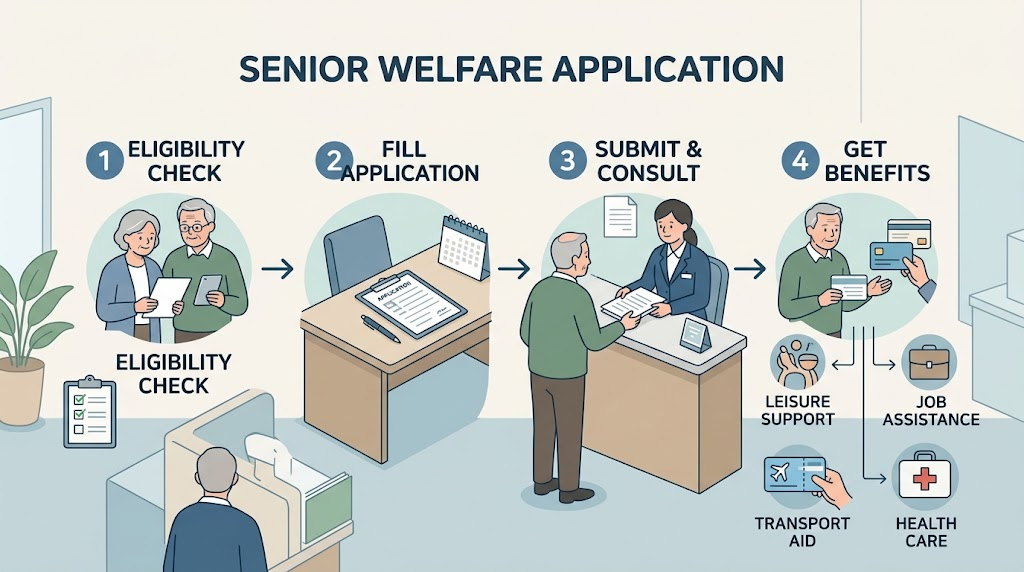
No matter how great local government welfare benefits are, if you do not “look into and apply for them yourself,” you are prone to missing them even if a budget is available. This is because the fundamental principle of welfare services is ‘application-based support.’
If you hesitated due to complicated documents or procedures, just follow the 3-step order below.
Step 1: Check your customized benefits at a glance online via ‘Gov24 (Subsidy24)’
First and foremost, you need to objectively understand what benefits you are eligible to receive. Without needing to visit individual ministry websites one by one, using Gov24’s ‘Subsidy24’ service solves this all at once.
- How to use: Access the Gov24 website or mobile app ➔ Log in with simple authentication ➔ Click the ‘Subsidy24’ menu ➔ Check ‘My Benefits’
- Key advantage: The system automatically matches age on the resident registration, household characteristics, and income bracket to pull a tailored list of central government subsidies as well as specialized local government welfare (transportation costs, vaccinations, leisure programs, etc.) in your area of residence.
- What if handling digital devices is difficult? Bring your ID card, visit a nearby community service center, and request, *”Please print out my Subsidy24 list,”* and they will immediately print a paper list of benefits available to you right at the counter.
Step 2: Directly connect with your neighborhood community service center and specialized operating agencies
If you have finished checking online or have a clear project you want to participate in right away, check specific application requirements through an institutional visit or telephone consultation.
- Dong Community Service Center (Administrative Welfare Center) Customized Welfare Team:
- Oversees overall administrative and livelihood support, including the Basic Pension, Customized Senior Care Service, transportation fare support, and license surrender incentives.
- Local Government Senior Clubs & Comprehensive Senior Welfare Centers:
- Key hubs for applying to jobs and lifelong education courses. Registering as a job-seeking member at a Senior Club within your residential district lets you receive text alerts whenever new project groups are formed.
- Public Health Centers & Dementia Relief Centers:
- Rental of chronic illness management devices, free cognitive screening tests, and vaccine vouchers fall under public health centers, so inquiring directly with the relevant department is the fastest approach.
Step 3: Keep track of ‘November–December regular intensive recruitment’ and quarterly notices
Senior welfare programs, especially jobs and popular welfare center classes, move according to budget execution cycles. Therefore, matching ‘timing’ is the secret to increasing your chances of selection.
| Classification | Main Recruitment Period | Remarks |
|---|---|---|
| Senior Job Regular Recruitment | Late November ~ Mid-December each year | Collective application for next year’s project participants (Senior clubs, welfare centers, community service centers) |
| Frequent Job Replenishment | Frequently throughout the year (Frequent in March~April in the first half) | Preferential selection of waitlisted candidates or additional notices when dropouts occur |
| Welfare Center & Lifelong Learning Center Courses | Month prior to each quarter (February, May, August, November) | Essential to check application start dates as popular courses fill on a first-come, first-served basis |
Practical tip: Browsing the ‘District News / Announcements & Public Notices’ section of your district office website about once a month, or adding the KakaoTalk Plus Friend channel of the welfare center you plan to use, enables you to receive recruitment notices in real time without missing them.
Please select the final step for post completion:

Epilogue: A Vibrant Retirement Life Built with Small Steps
This is an epilogue draft neatly wrapping up the article’s core with a warm message of support for Naver blog readers.
Epilogue: A Vibrant Retirement Life Built with Small Steps
Life after retirement is like a blank sheet of white drawing paper where nothing is written.
At first, it may feel overwhelming and cautious wondering what to fill it with, but instead of grand plans, just taking one small step to open the door of your local welfare center can completely transform your daily life.
1 hour of working up a sweat at the public sports center in front of your home
Laughter shared with a neighboring peer during a smartphone class at the welfare center
Modest jobs lending strength to the local community with your experience and age-won wisdom
When these small daily routines accumulate, retirement becomes not a disconnection, but the most vibrant turning point to meet a wider world.
The local government benefits introduced today are a rightful entitlement created through the taxes and hard work citizens have faithfully built over a lifetime. Rather than postponing by thinking “I’ll look into it later,” why not take your ID card this week and make a light, stroll-like visit to a nearby community service center or senior welfare center?
We sincerely support your shining Act Two of Life.
Shall we continue with the next steps to prepare for posting?
Receive recommendations for high-exposure Naver search SEO titles and hashtags
Combine the entire body text into one complete version
Korean version: 한국어로 읽기