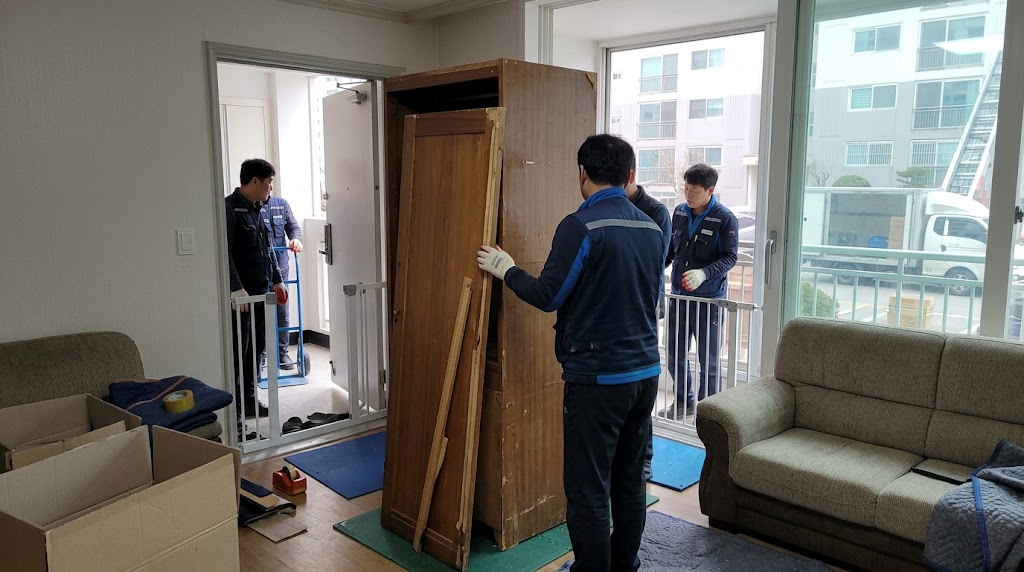
Prologue: “Can I Just Ask Them to Carry Discarded Furniture Downstairs?”
Prologue: “Can I Just Ask Them to Carry Discarded Furniture Downstairs?”
When preparing for a move, you end up sorting through your belongings.
From an old sofa and a worn-out mattress to a squeaky cabinet.
You make up your mind: “I won’t use these in the new house anyway, so let’s throw them all away this time!”
But then, a thought suddenly crosses your mind:
“The movers will be bringing everything down using a ladder truck or the elevator anyway,
so wouldn’t it be fine to just ask them to carry a few discarded pieces down to the 1st-floor recycling area?”
Since you are not taking them to the new house and only asking to leave them on the “1st-floor ground,”
many people think it won’t cost extra money or cause any big issues.
However, what is the reality?
In fact, on moving day, the most common moment where raised voices or heated arguments occur on site is precisely this issue of “carrying discarded furniture.”
“You didn’t mention throwing away such large furniture when getting the estimate.”
“This has to be disassembled to go down, so you need to pay an extra fee.”
“We can only bring it down to the 1st-floor entrance; we cannot move it all the way over to that garbage disposal area.”
Moving day is a race against the clock where every single minute and second counts.
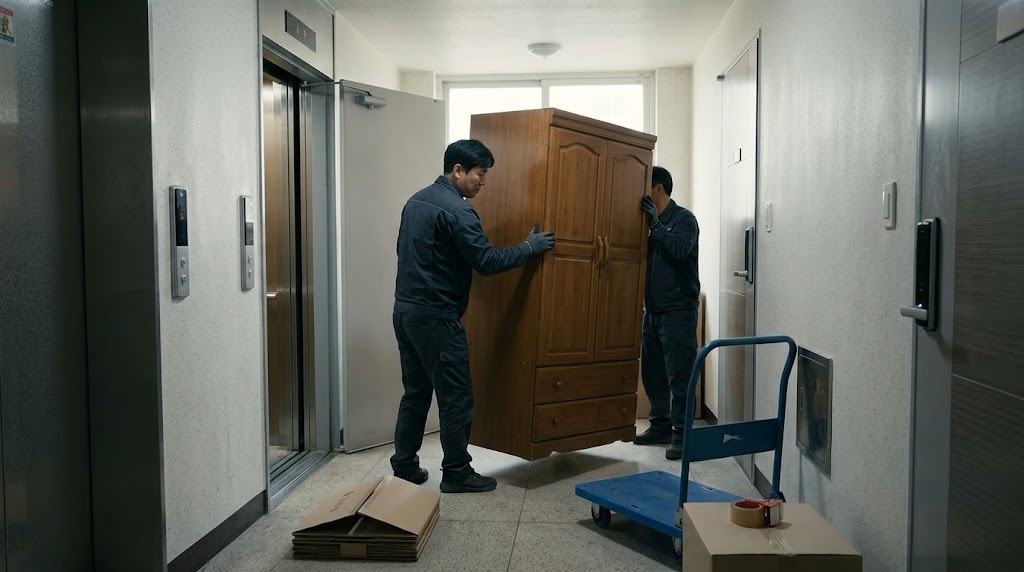
Even in the process of bringing down a seemingly simple wardrobe or sofa, numerous variables are hidden, such as disassembly labor, the ladder truck movement path, travel distance, and risk of damage.
On moving day, when everyone should start off in high spirits,
in order not to get exhausted by unexpected extra fee invoices or arguments with the movers,
you must know in advance how to request and check on “unloading discarded furniture.”
Then, what should you verify and firmly establish right from the estimate stage?
From now on, let’s go over the practical tips one by one so you won’t face any awkward situations on site.
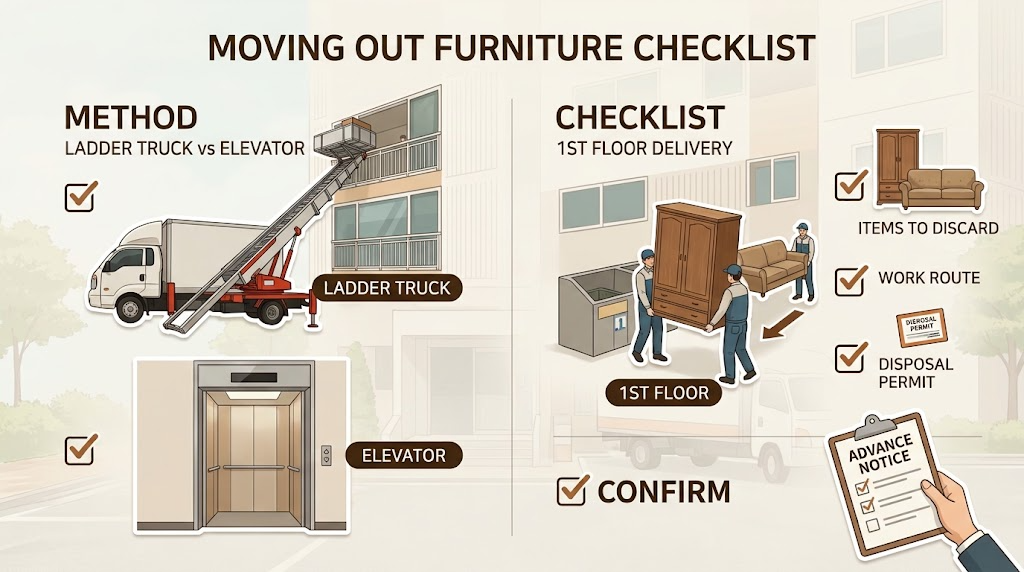
Essential Items to Disclose in Advance During the Estimate Stage
Essential Items to Disclose in Advance During the Estimate Stage: 3 Principles to Prevent Arguments on Moving Day
The moment the words “Weren’t you supposed to bring this down?” come out on moving day, the upper hand has already shifted to the on-site movers. When pressed for time, whatever price they quote tends to become the going rate.
Therefore, carrying discarded furniture must absolutely be completely agreed upon during the on-site visit estimate stage. Here are the 3 essential checklist items you must clearly address instead of letting things slide with a vague verbal mention.
- Listing the ‘Exact Quantity’ and ‘Disassembly Difficulty’ of Discarded Items
If you simply generalize by saying, “I have a few pieces of furniture to throw away,” friction will arise on site 100% of the time. This is because the work difficulty varies completely depending on the item.
Large furniture requiring disassembly and reassembly: Sliding built-in wardrobes, family-size bed frames, bunk beds, etc., require disassembling doors or frames one by one before they can go outside, significantly increasing work time.
Special furniture of heavy weight and large volume: Marble/solid wood dining tables, recliner sofas, stone beds, etc., are high-weight items that require 2 to 3 adult men to handle simultaneously.
When the estimate manager visits, you must point out each discarded item directly by hand and clearly communicate: “This 3-tier chest of drawers, queen bed frame, and 4-person fabric sofa are items to be discarded on the 1st floor without taking them to the new house.”
- Checking the Unloading Method and Movement Path in Advance (Ladder Truck vs. Elevator)
Depending on the method used to bring down the discarded furniture, the center’s work plan and personnel allocation change completely.
When working with a ladder truck: If the unloading sequence between the items loaded onto the truck and the discarded items left on the 1st-floor ground gets tangled, the workflow stops. You must coordinate the flow in advance on whether to bring down the discarded furniture first or last.
When working with an elevator: The available elevator time (time reserved with the management office) is fixed, and if you cannot finish bringing down the main moving items because of moving bulky discarded items, additional usage fees may occur or issues may arise from overlapping with the next household.### Essential Items to Disclose in Advance During the Estimate Stage
Items not clearly disclosed in advance when sending an estimate become the main cause of later disputes over additional costs or schedule delays. Here are 5 core disclosure items that must be shared in writing before signing a contract.
- Estimate Validity Period and Material/Labor Cost Fluctuation Conditions
Specifying the validity period: The validity period is usually set within 14 to 30 days from the estimate calculation date.
Fluctuation clause: Clearly state in advance that re-estimation may occur due to sharp rises in material unit prices, exchange rate fluctuations, fuel cost increases, etc., after the validity period expires.
- Scope of Work and Free Revision Standards
Specifying work limits: Accurately define the work details and deliverable specifications included in the base estimate.
Scope/number of revisions: Specify the number of free feedback sessions supported (e.g., standard 2 rounds) and standards (limited to simple text/style edits), and guide that a separate work effort will be calculated for full revisions such as structural changes.
- Items Incurring Additional Costs (Making Exclusions Transparent)
Indicating excluded items: Separate items not included in the base estimate (whether VAT is excluded, equipment rental fees, special delivery fees, waste disposal fees, license purchase costs, etc.) into distinct line items.
Unexpected on-site variables: Disclose actual expense conditions that may be billed additionally depending on on-site situations, such as on-site measurement errors, hidden defect repairs, parking/hoisting fees, etc.
- Payment Terms and Late Interest Regulations
Phased installment payment criteria: Clarify the payment ratio for the contract deposit (down payment), interim payment, and balance, along with each billing point (completion of inspection, completion of delivery, etc.).
Delay clause: Specify the authority to halt work and the late interest rate standards in case of delayed payment.
- Schedule Changes and Work Cancellation (Penalty) Regulations
Delays attributable to the customer: Inform that if feedback is delayed, data is not provided, or on-site turnover is delayed, the overall delivery schedule may be pushed back.
Mid-term termination standards: Specify the penalty according to the progress rate and the settlement standard for already invested work hours in case of cancellation due to a customer’s simple change of mind after work begins.
Would you like me to draft a practical main text draft for a Naver blog using these disclosure items?
Yes
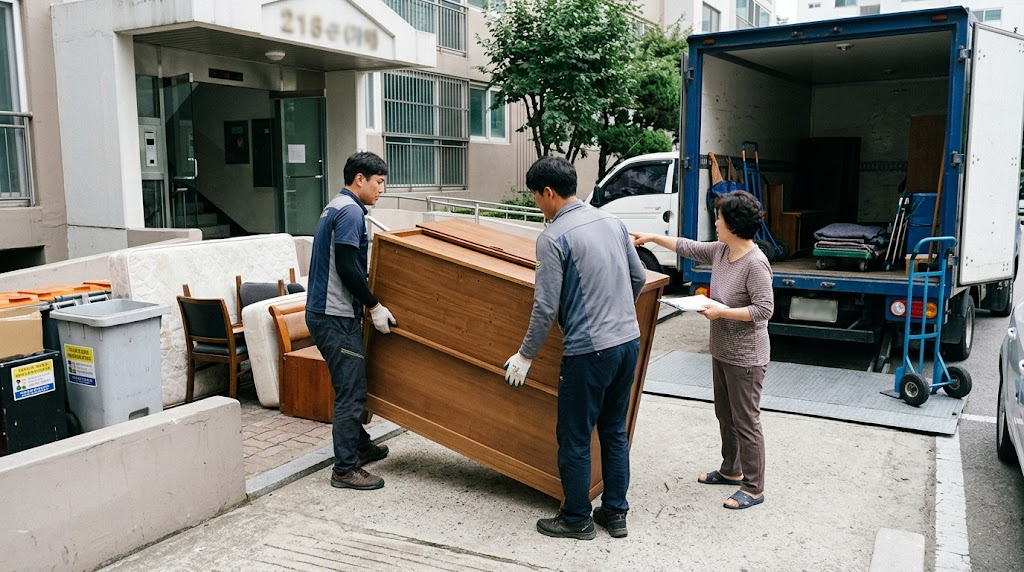
Additional Costs and Work Conditions Checklist
Additional Costs and Work Conditions Checklist: Practical Standards to Prevent Moving-Day “Extra Fee Demands”
It is easy to think, “Huh? Isn’t it just dropping it down on the ground?”, but from the moving company’s perspective, 1st-floor unloading clearly counts as “additional labor input.”
To coordinate cleanly without unnecessary friction with the movers on site, you need to know exactly under what conditions additional charges occur.
- Simple Unloading vs. Disassembly/Dismantling Work
This is the most common point where additional costs (labor fees) are charged.
- Simple unloading (no additional fee or minimal level):
Items such as chests of drawers, nightstands, and small bookcases that do not require disassembly and can be loaded onto a dolly (cart) or carried directly by two people are easy to include in the basic workflow.
- Items requiring disassembly (additional labor fee may occur):
Sliding built-in wardrobes, large solid wood bed frames, large full-wall bookcases, bunker beds, etc., must have their doors and screws undone and dismantled one by one before they can go outside. In this process, more than 30 minutes to 1 hour of extra labor and time are required, so typically a separate disassembly fee of around 30,000 to 50,000 KRW per item may be requested.
💡 Practical blog tip:
If you have disassembly tools at home and can disassemble them yourself, loosen the screws the day before the move and bundle them into “simple parts.” This is the surest way to save on extra disassembly fees on moving day.
- Movement Path and Distance Limits: “1st-Floor Piloti vs. Recycling Area”
The part where interpretations diverge the most between consumers and moving companies is precisely the “end point of 1st-floor unloading.”
| Category | Work Details | Additional Cost |
|---|---|---|
| Basic Unloading | Placing directly beneath the ladder truck, at the apartment 1st-floor shared entrance, or in an empty space in the piloti parking lot | Free or included in the base rate upon prior agreement |
| Additional Hauling | Moving to a designated recycling area or waste collection point within the complex that is 50–100m away on the 1st floor | Additional charges may occur depending on distance and slope |
If the complex is large and the distance between the ladder truck work location and the bulky waste discharge area is far or has slopes, the movers have to make multiple round trips with handcarts.
Therefore, at the time of the estimate, you must firmly specify whether the condition is “just bring it down to the 1st-floor entrance and we will move it” or “moving it together all the way to the designated disposal area of the complex.”
- Wallpaper/Flooring Damage and Damage Exemption Scope During Work
Handling discarded furniture roughly just because it will be thrown away can lead to unexpected ambushes. These are precisely dents in the wallpaper or wooden floor of the old house, and damage to the elevator protective padding.
- Even if scratches or breaks do not matter for the discarded furniture itself, accidents frequently occur where doorframes or wallpaper get scraped while passing through narrow hallways or front doors.
- Particularly when moving out of a jeonse or monthly rental, damage to wallpaper or floors directly leads to disputes over restoration costs.
Do not assume “it’s discarded stuff anyway, so it can be handled roughly,” and you must request that they move it safely with floor protective mats (cushioning materials) laid down even when moving out discarded furniture.
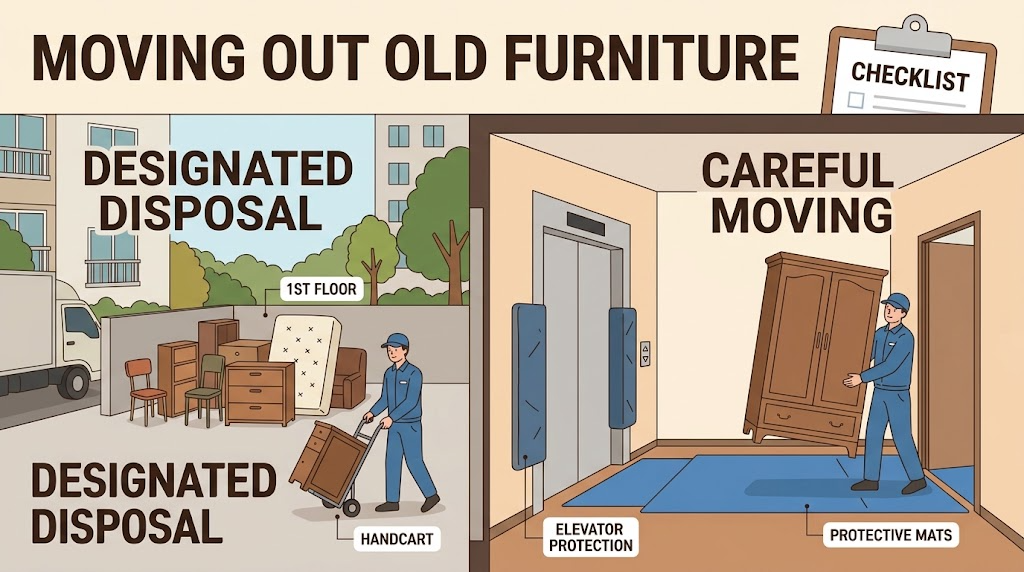
Bulky Waste Sticker and Disposal Report Timing
Bulky Waste Sticker and Disposal Report Timing: Practical Tips to Avoid Fines for Illegal Dumping
Safely bringing the furniture down to the 1st floor does not mean it is over.
Leaving furniture neglected on the 1st-floor ground without a sticker or registration number will not only cause complaints from the apartment management office, but could also result in a fine of up to 1,000,000 KRW for illegal dumping from the local municipality.
When and how should you report it to finish the disposal process cleanly without flustering on moving day?
- When Is the Best Time to Report Disposal? (Day before moving recommended!)
To give the conclusion first, finishing the application in advance in the afternoon of the day before moving (D-1) is the safest.
- Why doing it on moving day is too late:
On moving day, there is a mountain of things to take care of, including packing belongings, settling remaining balances, settling management fees, and transferring internet services. Amid the rush, there is no leisure at all to measure furniture dimensions and visit a community center or make payments via an app.
- Problems that occur when applying too early:
If you report several days ahead of the scheduled disposal date, the collection company vehicle might visit first while the furniture is still inside the house, resulting in a wasted trip recorded as “item not present.”
Therefore, after checking the specifications of the furniture (width × length × height, number of drawer compartments, etc.) the day before moving, setting the disposal date to ‘moving day’ and applying in advance is the cleanest approach.
- Community Center Sticker vs. Mobile Disposal Application, Which Is More Convenient?
There is no need to visit a community center or designated convenience store in person to buy paper stickers as in the past. Nowadays, it takes just 3 minutes with a smartphone.
| Category | Application Method | Pros/Cons and Recommended Situation |
|---|---|---|
| Mobile App
(Bbaegi, Yeogiro, etc.) |
Install app and take photos of discarded furniture → AI item recognition and card payment | [Highly Recommended] Fee is automatically calculated just by taking a photo, and real-time collection status can be checked |
| Competent District Office Website | Select items and make payment on the local government bulky waste online registration site | If you have a printer, you can print the payment certificate; if not, just write down the ‘registration number’ and attach it |
| Offline Sticker | Purchase paper stickers at the local community center or designated convenience store | When using an app is cumbersome, or when on-site inquiry is needed because of non-standard special waste |
- When There Is No Physical Sticker: Useful Tip for ‘Attaching Registration Number’
When reporting online or via an app, you don’t need to worry if you don’t have a printer at home.
Even without printing the payment certificate, you just need to take measures so the local government collection driver can verify it.
📝 Super Simple Registration Number Attachment Method:
Write boldly with a permanent marker on an A4 sheet or noticeable paper.
[ Bulky Waste Disposal Report Completed / Registration Number: XXXXXXXX / Discharger Name / Item ]
If you seal and attach it thoroughly up to the edges with clear tape so it won’t get wet in the rain or blown away by the wind, it will be collected normally.
- Checking Disposal Locations for Apartments vs. Villas/Single-Family Houses
You must also check in advance where the furniture should be placed so you can request the exact unloading spot from the movers.
- Apartments: Ask the management office in advance for the location of the “designated bulky waste collection area.” (It is often next to the regular recycling area, but some places designate a separate open space.)
- Villas/Residential Areas: You should place it down in a designated disposal area that does not block road traffic, such as a corner of your building’s parking lot or beside the front gate of your home, so the collection truck can easily load it.
Epilogue and One-Line Summary
Epilogue and One-Line Summary: Completing a Moving Day that Starts with Smiles
Moving day is busy for both body and mind, making it easy for a minor misunderstanding to turn into major stress.
In particular, the work of bringing discarded furniture down to the 1st floor is neither a “service taken for granted” nor an “impossible request that can never be done.” The key is to discuss and put it in writing in advance during the “estimate stage,” not on “moving day.”
As long as mutual agreement is cleanly made in advance, the movers can also calculate their movement path beforehand and work much more smoothly, and we can head to our new home lightheartedly without unnecessary arguments over extra charges on site.
📌 3-Line Summary of Today’s Post Essentials!
- Confirm in advance during the estimate stage: Be sure to write down the quantity of discarded items, whether disassembly is needed, and the unloading location in the contract’s notes section
- Clarify cost criteria: Coordinate in advance whether it is simple unloading or if additional costs will occur for on-site disassembly labor or long-distance hauling (to the recycling area)
- Complete disposal reporting on D-1: After reporting via a mobile app (Bbaegi/Yeogiro) or the district office website the day before moving, firmly attach the registration number to the furniture on moving day
Emptying out furniture that holds fond memories over a long time and moving with a lighter heart,
we hope you wrap up pleasantly without any friction using the checklist organized today.
If you have any questions about disposing of discarded furniture while preparing for your move, or have your own useful tips, please feel free to leave them in the comments anytime!
If today’s post was helpful, don’t forget to like (❤️) and follow.
We will return next time with more informative and practical everyday tips. Thank you!
Korean version: 한국어로 읽기