
Actual Penalties to Bear When Dropping Out of Government-Funded Training
This is a main body draft written so that blog readers can easily understand information with high readability and raise awareness.
- Actual Penalties to Bear When Dropping Out of Government-Funded Training
“The class is much harder than I thought. Can’t I just stop going starting tomorrow?”
“Since it’s free training, I won’t lose anything even if I quit, right?”
While taking government-funded courses, moments come when you consider dropping out due to unexpected difficulty or circumstances. However, because the Tomorrow Learning Card (Naeil Baeum Card) is strictly a system supported by the national budget, arbitrarily abandoning course attendance without a justifiable reason leads to administrative and financial disadvantages heavier than you might think.
Here is a summary of the 3 key penalties that do not simply end with “not attending classes.”
① Deduction of Tomorrow Learning Card Support Limit (Reduction of up to 1 million KRW)
When dropping out (or dismissal/non-completion due to an attendance rate below 80%) occurs, you do not pay cash as a fine, but a penalty amount is forcibly deducted from the remaining government support limit in your account.
- 1st drop-out: 200,000 KRW deducted from the support limit (40,000 KRW for some courses such as online remote training)
- 2nd drop-out: 500,000 KRW deducted from the support limit (100,000 KRW for remote training)
- 3 or more drop-outs: 1,000,000 KRW deducted from the support limit (200,000 KRW for remote training)
💡 Things to Watch Out For
Amounts once deducted from the basic 3 million KRW limit will not be restored. When there is a specialized technical course you genuinely want to learn later on, a situation may arise where you have to cover hundreds of thousands of KRW out of your own pocket due to an insufficient remaining limit.
② Card Suspension and Restrictions on New Course Registration
When the number of drop-outs accumulates, it does not end simply with a limit deduction.
- Account use suspension: Upon 2 or more drop-outs, use of the Tomorrow Learning Card itself is suspended for a certain period (usually 60 days), making it impossible to register for any other government-funded course.
- Loss of opportunities for special courses such as K-Digital Training (KDT): In the case of KDT bootcamps, where a ‘fully funded once in a lifetime’ benefit is given, dropping out during the course will cause you to lose eligibility for re-participation or cause your remaining voucher to expire, leaving you unable to enjoy the 100% free benefit ever again.
- Increase in out-of-pocket payment ratio: If habitual non-completion accumulates, the government support rate drops when applying for future training, and you may receive a penalty where your self-pay ratio increases by 20% or more.
③ Loss of Already Paid Out-of-Pocket Expenses & Training Incentives
- Non-refundable out-of-pocket expenses: If you enrolled after paying a portion of out-of-pocket expenses during a regular government-funded course, once the course progress exceeds a certain level, the paid tuition will not be refunded entirely or mostly.
- Suspension of monthly training incentives: The training incentive (up to around 200,000 KRW) received monthly while participating in long-term courses of 140 hours or more is immediately suspended starting from the unit period you dropped out. While you do not have to vomit back (refund) incentives from periods of regular attendance that were already paid, the incentive for the current month with insufficient attendance days will be processed as 0 KRW.
📌 Summary Comparison
| Classification | Upon 1st Drop-out | Upon 2nd Drop-out | Upon 3 or More Drop-outs |
|---|---|---|---|
| Account Limit Deduction | 200,000 KRW reduction | 500,000 KRW reduction | 1,000,000 KRW reduction |
| Card Usage Restriction | Immediately reusable (however, identical course not allowed) | Card usage suspended for 60 days | Card usage suspended for 60 days |
| Future Self-Pay Ratio | No change | Additional 20% surcharge on out-of-pocket expenses | Additional 20% surcharge on out-of-pocket expenses |
As such, dropping out mid-course due to a simple change of mind becomes a significant shackle throughout the entire remainder of your job preparation period.
Therefore, before clicking the drop-out button, you should first check whether you correspond to a ‘justifiable reason eligible for penalty exemption.’

Justifiable Reasons for Penalty Exemption When “Forced to Quit Inevitably”
Unavoidable situations beyond one’s own control may arise, such as sudden employment, unexpected illness or accidents, or caring for a family member.
The Ministry of Employment and Labor does not apply penalties unconditionally even to these situations. If it falls under a legally recognized ‘justifiable reason’ and you can verify this with objective documents, normal mid-course withdrawal processing is possible without a deduction from the support fund limit.
① Representative Legally Recognized Reasons and Required Supporting Documents
Here is a list of the most frequently recognized reasons and the key supporting documentation that must be submitted to the competent Employment Center.
Early employment and entrepreneurship:
Condition: Employed as regular or contract staff during the training period, or obtaining a job enrolled in employment insurance with contractual working hours of 15 hours or more per week (60 hours or more per month).
Supporting documents: Certificate of employment, copy of employment contract, confirmation of 4 major social insurance coverage (In case of entrepreneurship: business registration certificate and proof of revenue).
Outpatient treatment and hospitalization due to illness or injury:
Condition: Rather than a simple cold or mild sprain, the doctor’s clear medical opinion stating that “continuous training attendance is impossible for the next O weeks (normally 4 weeks or more)” must be specified.
Supporting documents: Doctor’s medical certificate or medical opinion (must include phrasing to the effect of ‘unable to attend training’), hospitalization confirmation, medical record.
Family care and support:
Condition: In cases where you must personally take full charge of regular caregiving due to a severe illness of a cohabiting family member such as a parent, spouse, or child.
Supporting documents: Certificate of family relations, resident registration certificate, patient’s medical certificate (including opinion on the need for regular caregiving).
Relocation of residence (moving):
Condition: When the one-way commuting time to the academy increases to 1 hour and 30 minutes or more based on public transportation due to transfer of oneself or spouse, or whole-household relocation.
Supporting documents: Resident registration certificate/abstract (address transfer history), screenshot of public transit route search and transit time.
Pregnancy, childbirth, and military service obligation:
Supporting documents: Confirmation of pregnancy, birth certificate, notice of draft (enlistment notice).
⚠️ Representative Unrecognized Reasons That Are Strictly Not Approved
Reasons such as the following are administratively regarded as a simple change of mind and become subject to full penalties.
“The instructor’s lecture skills or the curriculum fall short of expectations.”
“I am a non-major, and the class pace is too fast to keep up.”
“Another government-funded course looks better, so I want to switch over.”
“I want to focus on preparing for personal certification exams or civil service exams.”
📌 Administrative Procedures You Must Go Through Before Dropping Out
Even if the reason is clear, accumulating absences without prior consultation will lead to processing as ‘unauthorized departure (dismissal)’, making it difficult to receive exemption benefits.
- Notify the head instructor/administrative office immediately upon occurrence of the reason:
Before absence days accumulate, notify the academy’s administrative office of the situation and convey your intention to drop out.
- Review and issuance of supporting documents:
Check the document forms required by the competent Employment Center through the academy’s administrative team and obtain medical certificates, employment certificates, etc.
- Fill out the course withdrawal form and submit documents:
State the justifiable reason on the course withdrawal application form provided at the academy and submit it with supporting documents attached.
- Confirm final approval from the Employment Center:
After the training institution submits a mid-course drop-out report to the HRD-Net system, it goes through a review by the officer in charge at the Employment Center, and final processing of ‘drop-out due to a justifiable reason’ is completed.
💡 Key Check
The date of issuance of the medical certificate must be ‘before the actual absence begins’ or at least ‘immediately after the absence occurs’ for retroactive recognition to be easy. A medical certificate obtained belatedly after the attendance rate has already fallen short due to long-term absence carries a very high risk of being rejected by the Employment Center.
Shall I continue writing the next table of contents section as well?
Write body text for No. 3 ‘Selection Criteria for Courses Without Dropping Out’
Write a 16:9 image prompt matching the paragraphs written so far

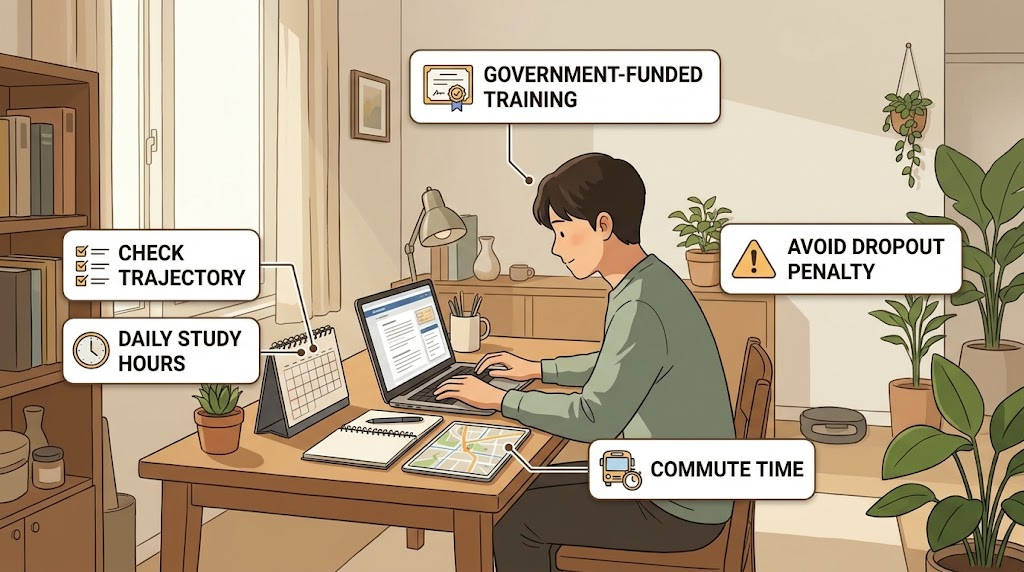
Check Before Taking Courses! Course Selection Criteria to Reduce the Drop-Out Rate to 0%
The moment you think “Since it’s free, I’ll just try taking it and quit if it doesn’t work out,” the deduction of your Tomorrow Learning Card limit and the loss of opportunity costs have virtually already begun.
Dropping out of government-funded training occurs mostly not because of a lack of willpower, but from the gap between one’s current competency and the realistic difficulty of the course. Before pressing the course registration button, you must verify the following 3 filtering criteria during HRD-Net and institutional counseling sessions.
① HRD-Net Numerical Analysis: Look at the ‘Completion Rate’ and ‘Employment Rate’, Not Star Ratings
The majority of trainees make decisions by only looking at flashy employment reviews on the institution’s promotional page or star ratings in the high 4-point range. However, the real key data within the disclosed indicators of Employment24 (HRD-Net), where blind evaluations are reflected, is separate.
- Whether the completion rate (finish rate) is 80% or higher:
This is the ratio of final completers compared to starting personnel. A course where the completion rate drops below 70% means that 3 or more out of 10 people dropped out midway. There is a very high probability that the curriculum is overly packed, that instructor feedback is absent, or that there is progress pressure that non-majors find difficult to keep up with.
- Filtering low star rating (1–2 points) course reviews:
When looking at course reviews, you must sort and read them in order of low ratings rather than latest or highest ratings. Repeated complaints such as “The instructor changed,” “Jumped straight into projects without basic explanations,” and “Self-study time is half the class” are direct causes that lead to dropping out.
- Check the field-matched employment rate:
Do not be dazzled by simple employment rate figures, and verify whether completers found employment in the relevant training field (field matching rate). You need to filter out figures that lump together simple office work or part-time employment forms.
② Realistic Calculation of Daily Learning Density and Self-Directed Time
In particular, K-Digital Training (KDT) or long-term IT/design bootcamps have ‘8 hours of classes, 5 days a week’ as standard specifications.
- Whether review time outside of class can be secured:
If you take 8 hours of lectures a day, for a non-major, at least 2 to 3 hours of review time are additionally needed every day to digest the coding or tool practice learned that day. If the round-trip commuting time is 2 hours or more, or if you must work part-time concurrently, it leads to giving up along with a slump in the 2nd to 3rd month due to physical and temporal limitations.
- Feeling the difficulty of prerequisite learning (Pre-Course):
Do not trust phrases like “Non-majors welcome, beginners get hired in 6 months.” Before classes start, listen to 10 to 20 hours of basic syntax lectures in advance on YouTube or Inflearn, and first test your own aptitude to see “if you can endure studying this for 10 hours a day for 6 months.”
③ Strict Attendance Management Regulations: The Weight of ‘80% Attendance Rate per Unit Period’
Course completion and payment of training incentives in government-funded training are automatically tallied solely through the attendance system (HRD-Net Beacon/QR).
- Tardiness/Early Departure 3 times = 1 cumulative absence formula:
Being late by even 1 minute is marked as tardiness, and accumulating 3 instances of tardiness, early departure, or going out during class is automatically converted to 1 day of absence.
- The trap of an attendance rate below 80% per unit period:
The moment the attendance rate falls below 80% not only for the overall period but also for each ‘unit period (usually 1 month)’ calculated monthly, the training incentive for that month becomes 0 KRW. If absences continue, it is processed as ‘ex officio dismissal (forced expulsion)’ regardless of one’s intention, and penalties are imposed.
- Because the recognized scope of excused absences (official absence) such as personal family events, hospital visits, and reserve forces training is strict depending on the institution, you must review your personal schedule for the next 6 months before taking courses.
📌 Final Checklist Before Course Selection
| Check Item | Passing Criteria | Self-Diagnosis |
|---|---|---|
| Completion Rate | Previous cohort completion rate of 80% or higher based on HRD-Net | [ ] |
| Commuting Time | Within 1 hour one-way via public transit (conserving stamina) | [ ] |
| Basic Aptitude | Whether you have completed 10 hours or more of basic introductory lectures | [ ] |
| Securing Time | Whether 2 additional hours of daily study are possible outside of 40 hours of classes weekly | [ ] |
| Attendance Stability | Ability to fix schedule from 9:00 AM to 6:00 PM on weekdays for the next 6 months | [ ] |
Please select the content to follow next:

The Last Safety Net Before Starting: The ‘Golden Time’ for Course Cancellation
Even after completing course registration and with the start date approaching, if you lack confidence in the course or unexpected personal circumstances arise, there is no need to force yourself to sit in class on the first day.
Government-funded training provides a legal safety net (golden time) just before classes start and in the early stage of the course, where you receive no penalty at all or can minimize it. If you miss the window, you must fully bear disadvantages such as a reduction in support limits and card suspension, so you must know the exact baseline cancellation timing.
① The Safest Choice: Cancellation Before Course Start (0% Penalty)
If you cancel by the day before the training start date, no administrative or financial disadvantages will occur.
- No support limit deduction: The Tomorrow Learning Card limit (3 million to 5 million KRW) is completely preserved without losing even a single won.
- Course count not deducted: Because no history of taking a government-funded course remains, you can immediately apply for another course of interest later.
- 100% full refund of out-of-pocket expenses: The self-pay amount you paid is also fully refunded.
- Online processing method: Access My Page on the Vocational Training Portal (Employment24 / HRD-Net) ➔ Look up course registration history ➔ Click the [Cancel Course Registration] button and then notify the relevant academy’s administrative office by phone to confirm cancellation.
② Timing That Is Still Not Too Late Even After Start: ‘Early Drop-Out’ Regulations Immediately After Course Starts
If you attended the first class and found it to be a level that is impossible to follow, or if the instructors and environment differ significantly from what was guided, do not let absences accumulate; go through the early drop-out procedure immediately.
- Cancellation within a certain proportion of total training hours:
- In the case of short-term courses or standard account-system courses, if you go through the formal drop-out procedure usually before 1/2 of the total training hours or in the early stage of the course (usually before 1/3 of the class days in the first unit period elapse), you can receive a partial refund of out-of-pocket expenses for the remaining days.
- In particular, fully funded bootcamps such as K-Digital Training (KDT) typically have a safety net where, if you clearly state your intention to drop out within 7 business days after the course starts (or at a point less than 10% of total class days), you can defend against the worst risk of ‘complete expiration of the once-in-a-lifetime free voucher’ and be exempted from or minimize remaining limit penalties.
- Consequences when the golden time has passed:
The moment you exceed this baseline number of days by even a single day, it is deemed full attendance, and subsequent departures are processed without exception as ‘drop-out due to simple change of mind (limit reduced by 200,000 to 1,000,000 KRW)’.
③ Essential Action Guidelines When Dropping Out: “Never Go Ghost (MIA)”
The most dangerous response is cutting off contact with the academy and waiting for natural dismissal through unauthorized absences.
- Unauthorized absence leads to ‘dismissal (forced expulsion)’:
If unauthorized absences occur for 3 to 5 consecutive days or more, it is processed as ‘ex officio dismissal’ under the authority of the institution. In this case, opportunities for relief via exemption consultations or early cancellation disappear entirely.
- Be sure to confirm written/electronic registration:
The intention to drop out must be communicated by phone or in person to the academy’s general administrative team (operations office), not the instructor in charge, and you must verify that the academy properly registered the ‘drop-out processing’ on the HRD-Net administrative network to conclude all procedures safely.
📌 Summary of Penalties and Actions by Cancellation Timing
| Cancellation Timing | Account Limit Deduction | Card Suspension Status | Refund of Out-of-Pocket Expenses | Recommended Action |
|---|---|---|---|---|
| Up to the day before course start | None (0 KRW) | None | 100% full refund | Direct cancellation on Employment24 system |
| Early stage after course start (within regulated timing) | Exemption or reduction possible | Differentiated by reason | Refunded after pro-rata calculation | Visit administrative office and fill out course withdrawal form |
| Drop-out after exceeding baseline timing | 200,000 to 1,000,000 KRW reduction | Suspended from 2nd time | Non-refundable | Review justifiable reasons before absences accumulate |
Please select the next step to complete the entire blog post:
Korean version: 한국어로 읽기