Prologue: The First Support System to Look Into When Parents’ Mobility Becomes Difficult
One day when you drop by your parents’ home, there comes a moment when you encounter a sight of them that is different from usual.
They struggle and groan for a long time holding onto the wall because they cannot get up from the floor with their own strength, or they cannot even take a step on the usual neighborhood walking route due to aching knees and back. Seeing each and every minor daily motion become overwhelming, anxiety and worry suddenly start in their children’s hearts.
“Can I fully take care of my parents while juggling work life and child-rearing?”
“If I hire a caregiver, how should I handle the burden of monthly caregiving costs?”
In the face of such feeling at a loss, if you try to shoulder the burden of family caregiving alone, even the caregiver’s daily life cannot help but collapse quickly. The national welfare system that you must check and apply for first at this very moment is the ‘Long-Term Care Insurance for the Elderly’.
How is it different from Health Insurance?
If we examine the monthly health insurance bill closely, we can see that along with general ‘Health Insurance Contributions’, the ‘Long-Term Care Insurance Contributions’ item is billed together separately. The two systems have clear differences in purpose and support methods.
National Health Insurance: A system that relieves hospital medical fees, examination fees, medication fees, etc., to ‘treat’ illness or injury itself
Long-Term Care Insurance for the Elderly: A system that directly provides physical activity and housework care services to ‘those who find it difficult to maintain daily life alone even after treatment is finished’ due to old age or geriatric diseases
In other words, it is not a stage of being hospitalized and receiving treatment, but a safety net where the state supports a significant portion of the costs when care such as meal preparation, washing up, and accompanying outings is desperately needed because mobility is difficult at home after discharge.
Core support scope that relieves the limits of family caregiving
When recognized as an eligible person for Long-Term Care Insurance for the Elderly and granted a care grade, you can receive support from the state for approximately 85% to 100% of the benefit costs. In the case of general beneficiaries, the co-payment is only around 15%, significantly lowering the burden of private caregiving that reaches millions of won every month.
- In-home benefits (in-home care support): From ‘visiting care’ where a professional care worker regularly visits the home to assist with meals, change body position, clean, do laundry, and accompany to the hospital, to ‘visiting bath’ using a vehicle, and use of ‘day and night care (daycare center)’ that cares for seniors during the daytime are available.
- Institutional benefits (nursing facility admission support): When in-home care is impossible due to extreme difficulty in mobility or severe dementia, benefits are supported so that one can enter a professional nursing facility (nursing home) and receive 24-hour care.
- Welfare equipment support: Electric beds, wheelchairs, adult walkers (silver cars), bedsore prevention mattresses, and more, which are essential for seniors with limited mobility, can be rented or purchased at a low co-payment within an annual limit of 1.6 million won.
Even while parents’ physical changes progress gradually, they often intensify in an instant due to a fall accident or a sudden decline in energy. Rather than delaying and saying “let’s watch a bit longer,” right now, when discomfort in daily life has been sensed, is the most appropriate timing to carefully examine the application eligibility and grade criteria.

Application Eligibility Requirements: Who Can Apply?
Anyone who is a National Health Insurance insured person, a dependent, or a Medical Care Assistance recipient can go through the application process for Long-Term Care Insurance for the Elderly. However, one does not become eligible simply because of advanced age, and must satisfy the legally prescribed age requirements and health status (geriatric diseases and daily living disability) criteria.
The most core criteria are divided based on the age of 65.
- Age 65 or older: Regardless of the underlying disease, ‘ability to perform daily living activities’ is the key
In the case of seniors aged 65 or older, they are not constrained by the type of disease or diagnosis name.
Whatever the cause—advanced age, chronic arthritis, spinal stenosis, fall fracture, etc.—if it is judged that “it is difficult to fully perform daily life alone for 6 months or longer,” they can apply.
- Eating: Is the help of another person needed to hold a spoon or prepare a meal table?
- Washing up and bathing: Is it difficult to go to the toilet or wash the body alone?
- Transferring and changing position: Is support or an assistive device essential when getting up from the room floor or walking indoors and outdoors?
- Excretion: Is danger involved in the process of going to and from the toilet, taking down clothes, and cleaning up?
If one is in a condition requiring continuous care in basic activities (ADL, Activities of Daily Living) such as the above, anyone is granted eligibility to apply.
- Under age 65: Diagnosis of a statutory ‘geriatric disease’ is a mandatory condition
Even if under age 65 (presenile period), applying is possible, but the requirements are much stricter. It is not possible simply for the reason of having mobility difficulties, and it must be proven that one has been diagnosed with a statutory geriatric disease stipulated in the Enforcement Decree of the Act on Long-Term Care Insurance for the Elderly (Article 2).
The following Korean Standard Classification of Diseases (KCD) code must be stated on the medical diagnosis or doctor’s written opinion issued by a hospital or clinic for application eligibility to be recognized.
| Disease Category | Representative Diseases and Korean Standard Classification of Diseases (KCD) Codes |
|---|---|
| Dementia | Alzheimer’s disease dementia (F00, G30), vascular dementia (F01), other dementias (F02, F03) |
| Cerebrovascular disease | Cerebral hemorrhage (I60–I62), cerebral infarction (I63), stroke (I64), sequelae of stroke (I69, U23.4) |
| Parkinson’s and degenerative | Parkinson’s disease (G20), secondary parkinsonism (G21–G22), tremor (R25.1), basal ganglia diseases (G23) |
Points to note
For those under the age of 65, conditions where mobility is impossible due to aftereffects/disabilities from traffic accidents, general joint diseases, terminal cancer, etc., are excluded from the application scope of Long-Term Care Insurance for the Elderly. In this case, rather than long-term care insurance, you must separately check the Ministry of Health and Welfare’s ‘Activity Support Service for Persons with Disabilities’ or local government care services.
When is the ‘right time to apply’ for our parents?
Many caregivers often postpone applying, saying, “They are not at the point of being bedridden yet,” or “Still, they can walk a little if supported.”
However, Long-Term Care Insurance for the Elderly is not a system solely for seniors lying completely bedridden in bed. The original purpose of the system is to intervene preemptively from the initial stage when accident risks are detected—such as being anxious about going out the door without support or turning on the gas stove and forgetting it due to early dementia symptoms—to maintain remaining physical functions.
If parents have been continuously unable to resolve meals, washing up, or going out without their children’s help for 6 months or longer, you should prepare to apply without hesitation.
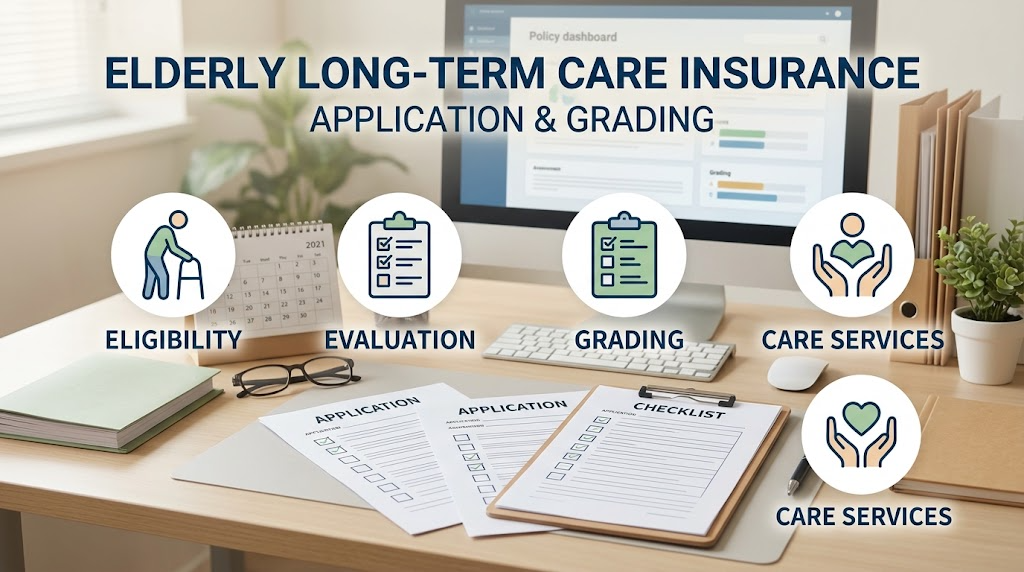
Grade Determination Criteria and Recognition Scores at a Glance (Key Summary Table)
For Long-Term Care Insurance for the Elderly, after an application is received, the ‘Long-Term Care Recognition Score’ is calculated through an on-site visit investigation by National Health Insurance Service staff and verification of a doctor’s written opinion. Afterward, through final deliberation by the Grade Determination Committee composed of doctors, nurses, social workers, etc., it is determined into a total of 6 levels, from Grade 1 to Grade 5, and the Cognitive Support Grade.
The higher the score, the more severe the condition requiring more help from others, and the monthly usable limit amount and types of services (in-home benefits, institutional benefits) vary depending on the grade.
Summary table of scores and determination criteria by long-term care grade
| Grade Category | Recognition Score Criteria | Mental and Physical Condition and Daily Living Performance Ability | Main Recommended Services |
|---|---|---|---|
| Grade 1 | 95 points or higher | A person who entirely requires other people’s help in daily living (completely bedridden state) | Institutional benefits (nursing home), in-home benefits (visiting care, etc.) |
| Grade 2 | 75 points or higher and less than 95 points | A person who requires other people’s help for a substantial portion of daily living (wheelchair dependence, severe paralysis) | Institutional benefits (nursing home), in-home benefits |
| Grade 3 | 60 points or higher and less than 75 points | A person who partially requires other people’s help in daily living (can walk indoors when supported) | In-home benefits (day and night care, visiting care) |
| Grade 4 | 51 points or higher and less than 60 points | A person who requires other people’s help for a certain portion of daily living (limited mobility, using a cane/walker) | In-home benefits (visiting care, welfare equipment rental) |
| Grade 5 | 45 points or higher and less than 51 points | A dementia patient (based on the Enforcement Decree of the Act on Long-Term Care Insurance for the Elderly) whose main cause is cognitive decline | In-home benefits (cognitive activity-type visiting care, day and night care) |
| Cognitive Support Grade | Less than 45 points | A person whose physical function is good, but who has dementia and needs prevention of cognitive decline worsening | In-home benefits (centered on day and night care) |
Detailed analysis of condition by grade
- Grade 1 (95 points or higher) & Grade 2 (75 points to less than 95 points): Severe and completely incapacitated states
- Physical condition: A condition where changing body position (rolling over) alone is difficult, or the entire process of getting up from bed and moving to a wheelchair must be completely assisted by another person. Close-contact care by a caregiver 24 hours a day is essential for meals, handling bowel and bladder movements, getting dressed, etc.
- Benefit application: For Grades 1 and 2, admission to facilities such as nursing homes (institutional benefits) is permitted immediately without separate proof of reasons.
- Grade 3 (60 points to less than 75 points) & Grade 4 (51 points to less than 60 points): Moderate walking and daily living limitations
- Physical condition: A stage where one can barely walk short distances relying on a cane or walker (adult walking frame), but going out alone, preparing meals, and bathing are impossible.
- Benefit application: Basically, in-home benefits (visiting care, day and night care) are applied. In principle, admission to a nursing home is restricted, but if there are unavoidable reasons why family cannot care for them or if there are severe dementia behavioral disorders, approval for facility admission can be obtained through a separate review.
- Grade 5 (45 points to less than 51 points) & Cognitive Support Grade (less than 45 points): Dementia-specialized grades
- Physical condition: On the outside, there may seem to be no problem with physical walking or limb movement. However, it is a state of great daily threat due to cognitive disorders, such as being unable to recognize time or place, wandering or getting lost, aggression, and leaving the gas stove on.
- Benefit application: Brain cognitive rehabilitation programs are supported through ‘cognitive activity-type visiting care’ by care workers who have completed specialized cognitive training education, or daycare centers (day and night care).
Points to remember
The recognition score is not simply determined by a single disease diagnosis from a hospital; it is derived through a computer assessment algorithm after Corporation staff enter the 52 items of the visit investigation form into the computer system. Therefore, the core gateway that decides the actual score is precisely the subsequent ‘on-site physical investigation of the Corporation staff’s visit investigation’.

The Corporation Staff’s ‘Visit Investigation’ Items and On-Site Evaluation Know-How
When you submit a long-term care recognition application, within a few days, an investigator belonging to the National Health Insurance Service (a licensed nurse or social worker) personally visits the home or nursing facility where the senior is staying.
It is no exaggeration to say that more than 80% of the grade score is decided right at this ‘visit investigation’ site. Many guardians are bewildered after failing (out-of-grade) or receiving a lower grade because they could not sufficiently convey the usual condition and received a score lower than the actual state.
You must familiarize yourself in advance with the structure of the investigation items and on-site evaluation know-how to receive an accurate determination.
- Core of the visit investigation: 52 survey items across 5 areas
Based on the standardized ‘Long-Term Care Recognition Survey Form’, Corporation staff evaluate the senior’s physical and cognitive status from various angles. Rather than simply asking “Where does it hurt?”, they request direct demonstrations or ask questions item by item.
- Physical function (12 items): Assessment of ability to perform activities of daily living (ADL)
Taking off and putting on clothes, washing face, brushing teeth, eating, changing posture (turning over), sitting up, transferring, coming out of the room, using the toilet and controlling excretion, etc.
- Cognitive function (7 items): Assessment of orientation and short-term memory
Short-term memory disorder (remembering words heard just a moment ago), knowing today’s date and season, identifying the current location, recognizing one’s own age and date of birth, etc.
- Behavioral changes (14 items): Verification of behavioral and psychological symptoms of dementia (BPSD) appearing in dementia, etc.
Delusions (suspecting someone stole belongings), auditory/visual hallucinations, wandering, sleep disorders, repetitive questions or actions, aggression or abusive language, etc.
- Nursing care (9 items): Need for medical care
Tracheostomy tube care, aspiration (suction), tube feeding (nasogastric tube), pressure sore treatment, catheter (urinary catheter) care, etc.
- Rehabilitation area (10 items): Joint limitation and motor function
Movable range (mobility) of shoulders, elbows, wrists, hips, knees, and ankles, and presence of paralysis
- 3 practical tips for the visit investigation that guardians must know
A visit investigation usually ends shortly, in around 30 minutes to 1 hour. Because there are frequent cases where the senior’s usual vulnerable condition is not fully revealed during this short time, advance preparation by the guardian is essential.
① Carefully observe and intervene in the senior’s ‘exaggerated independent actions’ in advance
This part is precisely the most common mistake that occurs. When an unfamiliar guest (the investigator) visits, seniors, out of pride, squeeze out every ounce of their remaining strength to jump up even though they cannot usually walk, or answer, “I go to the toilet well by myself and prepare all my meals to eat.”
Response method: Do not interrupt the senior’s answer when the investigator asks, but after the answer is finished, the guardian next to them must supplement the testimony with specific daily facts, such as “Usually, because of fall risks, they cannot go to the toilet alone, and there have been several times when they held onto the wall and collapsed.”
② Jot down notes on your usual caregiving log or fall/accident records
When the investigator visits, there are many cases where people are so nervous that they cannot logically explain the difficulties they usually experienced.
If you simply write down by date on a calendar or notebook the fall experiences that occurred in the last 1–2 months, the number of bowel/urinary accidents on clothes, episodes of burning pots by not turning off the gas stove fire, the number of times pacing without sleeping at night, etc., and show them to the investigator, they are greatly recognized as objective evidence.
③ Explain based on the senior’s ‘worst condition day’
Dementia or degenerative diseases have severe fluctuations depending on condition. Yesterday they could not even use a spoon, but on the day of the visit investigation, they might answer very well with an exceptionally clear mind.
You must clearly point out to the investigator that “Today is a day when their condition is exceptionally good, and 4 to 5 days out of a week they cannot come out of bed by themselves” to prevent distorted score calculation.
- Timing of doctor’s written opinion issuance and submission notes
When the visit investigation is completed, the Corporation investigator issues a document with the ‘Doctor’s Written Opinion Issuance Number’ written on it.
Issuance deadline: Usually within 1 to 2 weeks from the date of receiving guidance after the investigation, you must receive the written opinion from a designated hospital or clinic and have it electronically submitted (registered directly by the hospital) to the Corporation. (If not submitted within the deadline, grade determination is held in abeyance)
Hospital selection tip: It is advantageous to have it issued by a regular hospital/clinic or primary care physician who has treated the senior’s medical history and usual mobility condition for a long time. The senior’s physical limitation status and the necessity of assistance must be reflected in detail so that no disadvantage is incurred during the calculation of recognition scores. If dementia-related items are suspected, a written opinion from a neurologist or neuropsychiatrist specialist is required.
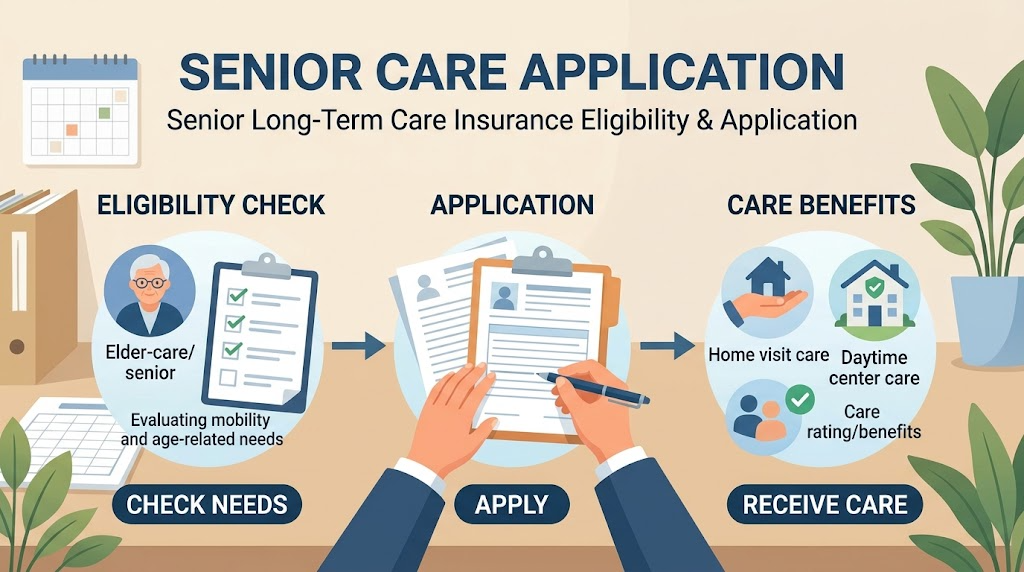
Comparison of Benefit Advantages Receivable After Grade Determination
When a long-term care grade (Grades 1 to 5 and Cognitive Support Grade) is determined, you receive the ‘Long-Term Care Recognition Certificate’ and ‘Individual Long-Term Care Use Plan’ from the National Health Insurance Service.
From this point on, substantial state support benefits are applied, and the benefits are largely divided into three pillars: in-home benefits, institutional benefits, and welfare equipment support. Because the types of services and monthly usable limits that can be supported vary depending on the grade, it is important to select the optimal method tailored to each family’s caregiving situation.
- In-home benefits (in-home care support)
This is a method of receiving necessary caregiving support while the senior continues to stay in the home where they have lived. Within the ‘monthly limit amount (national subsidy + co-payment)’ determined each month by grade, you can freely combine and use services.
- General eligible person co-payment: 15% of the total service cost (85% state support)
(6% to 9% for reduction recipients, free for Basic Livelihood Security recipients)
| Service Name | Key Support Details | Suitable Subjects |
|---|---|---|
| Visiting care | A professional care worker visits the home to support physical activities (meal and washing assistance, position changes), daily housework (cleaning, cooking, laundry), and accompanying outings (hospital treatment) | Seniors for whom a family caregiving void occurs during the daytime |
| Day and night care (daycare center) | Called a kindergarten for seniors, providing meals, cognitive rehabilitation programs, health checks, physical therapy, etc., by moving to the center via a transport (pick-up) vehicle | When physical activity is possible to some extent or when social interaction for dementia seniors is needed |
| Visiting bath | Two care workers provide a full-body bath and hygiene care for seniors using a mobile bath vehicle or the bathtub in the home (supported once a week) | Bedridden and severe seniors who have extreme mobility difficulties, making it difficult to bathe them alone at home |
| Visiting nursing | According to a doctor’s order, a nurse or dental hygienist visits the home to provide pressure sore treatment, medication guidance, basic health counseling, and oral hygiene care | When professional medical treatment such as chronic disease management or pressure sores is required |
Monthly limit utilization tip
The higher the grade (moving toward Grades 1 and 2), the larger the monthly limit amount that can be spent each month. For example, you can use only visiting care for 3 to 4 hours a day, or design a combination by slightly reducing the visiting care hours and sending them to a day and night care center 2 to 3 times a week instead.
- Institutional benefits (support for admission to professional nursing facilities)
This is a method of being admitted to a nursing home or a group home for the elderly equipped with professional care personnel, physical therapy rooms, etc., when close care is utterly impossible at home.
- Admission eligibility criteria:
- Grades 1 to 2: Immediate admission possible without separate screening
- Grades 3 to 5: In principle, only in-home benefits are possible, but admission is possible only after obtaining approval for a change to ‘institutional benefit recognition’ from the Corporation by explaining difficulties in family caregiving (absence of cohabiting family, illness, job, etc.) or serious dementia behavioral problems (wandering, violence, etc.)
- Co-payment structure:
- You pay 20% of the Corporation benefit cost out of pocket.
- Points to note: Non-benefit items such as food material costs (meals), premium room usage fees (room difference for 1- to 2-person rooms), and hair styling/cutting fees are 100% borne by the individual, so the actual nursing home costs billed each month are usually formed around the 700,000 to 900,000 won range (general standard, varies by local government and facility).
- Welfare equipment support (annual limit of 1.6 million won)
This is a system that supports the affordable use of essential safety equipment to prevent falls and physical injuries for both seniors with limited mobility and the family members caring for them.
- Support limit: Supported within a limit of 1.6 million won per year per recipient (based on Corporation-borne amount)
- Co-payment: Usable by paying only 15% based on general standards
- Item categories:
- Rental items: High-cost equipment such as electric beds, manual wheelchairs, mobile bathtubs, and wandering detectors (GPS)
- Purchase items: Consumable equipment such as adult walkers (silver cars), bedsore prevention mattresses and cushions, non-slip mats and socks, bath chairs, portable toilets, and posture-changing aids
Even before starting visiting care or using a center, applying for and preparing welfare equipment (walker, safety grab bars, bed, etc.) immediately upon receiving grade determination to reduce the risk of falls in the house right away is the basic tip for safely setting up the caregiving environment.
Drafting of the post has entered its latter half. Please select the next item to proceed with:

Comprehensive Guide to Senior Long-Term Care Insurance Application Methods and Required Documents
The application procedure for senior long-term care insurance may look complicated, but if you clearly know only the core workflow and essential documents, you can easily apply online or via mobile app in just 10 minutes.
From the scope of individuals eligible to apply to required documents and actual application channels, we outline them step by step.
- Who Can Apply? (Applicant Eligibility)
The long-term care recognition application can be filed not only by the senior personally but also by family members or a representative on their behalf.
- Individual: The senior seeking long-term care recognition
- Family and Relatives: Spouse, lineal ascendants/descendants, spouses of lineal descendants, siblings, etc.
- Interested Parties: Guardian, public official dedicated to social welfare (requires senior’s consent), or a person designated by the mayor, county governor, or district head
In practice, the vast majority of applications are filed by adult children, daughters-in-law, or sons-in-law as representatives on behalf of parents who face difficulties in mobility or expressing their intent.
- Checklist of Essential Documents to Prepare
There are slight differences in the documents to prepare depending on the applicant’s age and application method.
| Target Category | Essential Submission Documents | Remarks and Cautions |
|---|---|---|
| Common Documents | ① Long-Term Care Recognition Application Form
② Copies of applicant and representative ID cards |
Downloadable from the Corporation website form repository (directly entered on web screen during online application) |
| Age 65 or older | Submit common documents only first | The doctor’s written opinion is submitted according to Corporation guidance following the visit investigation, not at the time of application |
| Under age 65 | Common documents + doctor’s written opinion or medical certificate | At the time of application, simultaneously attaching a medical certificate stating the **statutory geriatric disease classification code (KCD)** is mandatory |
| When applying via representative | Representative’s ID card, family relation certificate | For family relationship verification (can be replaced by a resident registration certificate if registered together on the resident registration certificate) |
- 3 Ways to Apply for Senior Long-Term Care Insurance
You can apply by selecting the most convenient channel. For working children, mobile app or internet application is recommended.
① Mobile App Application (Most recommended convenient method)
- Install and log in to the National Health Insurance Service official app ‘The건강보험’ on a smartphone (Simple Certificate, Joint Certificate)
- Bottom menu ➔ [Civil Petitions Here] ➔ [Long-Term Care Insurance] ➔ Select [Long-Term Care Recognition Application]
- Enter the senior’s basic personal information, actual residential address (location where the visit investigation will occur), and representative information, then submit with electronic signature
② Internet (PC) Website Application
- Access the ‘National Health Insurance Service Senior Long-Term Care Insurance Website’ and log in with Joint/Financial/Simple Certificate
- Top menu ➔ [Civil Petition Counseling Room] ➔ [Long-Term Care Application] ➔ Click [Recognition Application] menu
- Complete online application according to the application form format, attach required documents (copy of ID card, etc.), and complete submission
③ Offline Application (Visiting Corporation branch, mail, fax)
- Utilized when internet use is difficult or submitting documents online is cumbersome
- Personally visit each branch (Senior Long-Term Care Insurance Operation Center) of the National Health Insurance Service nationwide for in-person application at the counter
- Alternatively, print the application form from the Corporation website, fill it out by hand, and send it by fax (FAX) or registered mail to the competent branch
(※ When sending by fax, you must call the corresponding branch after transmission to verify receipt to prevent omissions.)
- Summary Timeline of Entire Post-Application Process
- Application Receipt: Corporation electronic system registration (immediately assigned to competent branch upon receipt)
- Visit Investigation Scheduling: Within 2 to 5 days after receipt, the investigator calls the guardian to confirm the home visit date and time
- Visit Investigation Conducted: Corporation staff visits the senior’s residence to conduct on-site evaluation across 52 items
- Doctor’s Written Opinion Issuance and Submission: Register written opinion at hospital after receiving issuance request letter (usually within 1 to 2 weeks)
- Grade Determination Committee Deliberation: Final grade decided at committee meetings held regularly every month
- Result Notification: Receive ‘Long-Term Care Recognition Certificate’ by mail or mobile notification talk within approximately 30 days from application date
Because it usually takes about one month (approx. 30 days) from application until the actual grade is issued and services can be used, it is advisable to apply well in advance before facing hospital discharge or before caregiving becomes urgent.
Epilogue: Summary Checklist Before Applying for a Care Grade
Parents’ aging and deteriorating health arrive without notice one day, and caregiving is a long battle difficult to endure through family devotion alone.
Long-Term Care Insurance for the Elderly is a reliable social safety net established so the state can share the burden of family caregiving that is overwhelming to bear alone. Rather than enduring while thinking “it should be fine for now,” actively utilizing the system when small voids and inconveniences arise in daily life is the wisest way to protect parents’ dignified old age and the entire family’s daily life.
Before submitting the application, make a final check to ensure nothing is missed through the core 5 checklist items below.
Final Checklist Before Applying for Senior Long-Term Care Insurance
[ ] 1. Check whether age and disease requirements are met
Have you verified whether they are aged 65 or older, and if under age 65, whether statutory geriatric disease codes (KCD) such as dementia (F00–F03, G30), cerebrovascular diseases (I60–I69), or Parkinson’s disease (G20) are clearly stated on the medical diagnosis?
[ ] 2. Review the necessity of continuous care for 6 months or longer
Rather than a temporary fracture or a simple post-surgery recovery period, are they in a condition continuously requiring assistance from others for at least 6 months in basic daily living activities such as eating, washing, walking, and excretion?
[ ] 3. Prepare daily records (notes) in preparation for the visit investigation
To prepare for cases where the senior answers that they are fine in front of the investigator out of pride, have you jotted down specific incidents and frequencies over the last 1–2 months, such as fall experiences, bowel/urinary accidents, burning pots, and nighttime wandering?
[ ] 4. Secure a guardian’s presence schedule on the day of the visit investigation
So the senior does not greet the investigator alone, have you arranged a schedule allowing a family member or guardian who knows the senior’s usual condition and fluctuations best to personally attend on-site?
[ ] 5. Identify the hospital for doctor’s written opinion issuance
To submit the issuance request immediately after the visit investigation, has a regular hospital/clinic or neurology attending physician who knows the senior’s chronic disease history and physical mobility limitations well been decided?
From application submission to final grade determination, it typically takes about 30 days (1 month).
If you rush only after the parents’ caregiving burden has mounted up to your chin, the one-month evaluation period can feel long and painful. If your parents’ mobility has started to become difficult, please begin the application process right now through the ‘The건강보험’ mobile app or a National Health Insurance Service branch.
Drafting of the entire main body is complete. Please select the necessary additional tasks before publishing:
Extract posting SEO optimization titles and main/sub keywords
Create 16:9 image generation prompts to insert in the middle of the body
Korean version: 한국어로 읽기