Waste Wood: Does the Disposal Method Differ Depending on Its Condition?
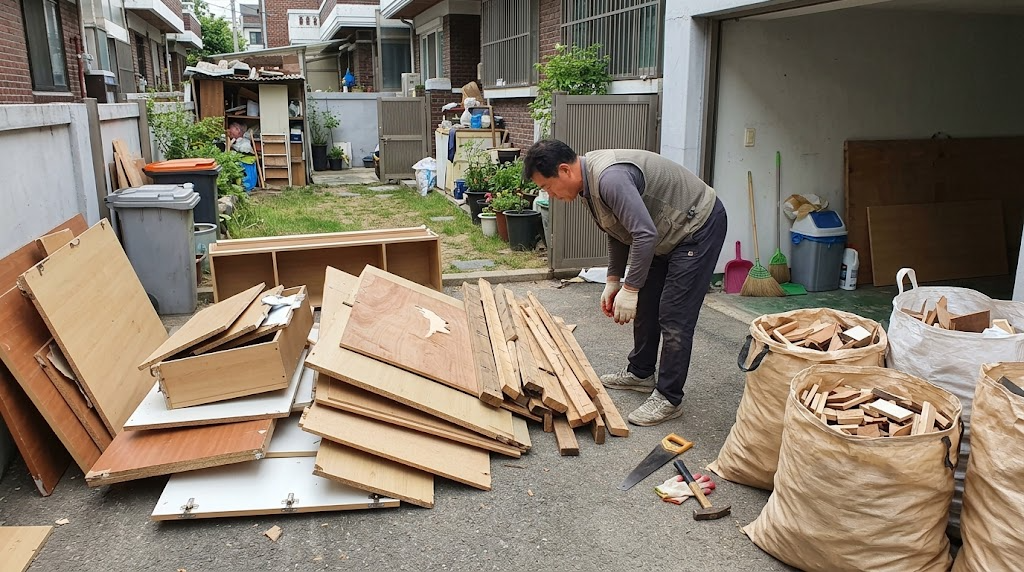
Wooden panels and square lumber left behind after finishing DIY home remodeling or clearing out old furniture. At first glance, they might all look like the same wood, but depending on the processing state of the wood and attached foreign materials, recyclability, disposal methods, and collection fees vary completely.
If you dispose of them without properly knowing the classification criteria, collection may be refused or you could be subject to fines, so check the 3 types below before discarding.
- Pure Wood (Solid Wood, Square Lumber, etc.)
Natural wood that has not been treated with paint or chemical coatings at all.
- Characteristics: Pure wood free of adhesives or preservative treatments
- Disposal Method: When disposed of as municipal bulky waste, the fee is the cheapest; or if it is in sound condition, it is the easiest material to dispose of for free via woodworking workshops, Carrot Market giveaways, etc. When chopped finely, it is also utilized as firewood for wood-burning stoves.
- Processed Engineered Wood (MDF, PB, Plywood)
The type that accounts for the majority of furniture scraps generated from households.
- Characteristics: Materials made by compressing sawdust or thin wood veneers with synthetic resin (glue) and covering them with decorative film or foil (sink countertops, built-in wardrobe doors, chest-of-drawers panels, etc.)
- Disposal Method: Due to adhesives and coating films, recycling (composting or pure wood chips) is difficult, and they are classified as bulky waste for incineration.
- Precautions: Never snap them to fit into standard volume-rate garbage bags or burn them; you must report them under municipal bulky waste items (furniture parts, etc.) or dispose of them inPP woven waste bags.
- Preserved Wood and Hazardous Chemical-Coated Wood
Decking lumber, exterior cladding materials heavily coated with oil-based paint or lacquer.
- Characteristics: Wood impregnated with chemicals (preservatives) to prevent decay, or coated on the surface with heavy metal-based finishes
- Disposal Method: Because it bears the nature of designated waste that cannot be incinerated in standard facilities, small quantities must be disposed of in non-combustible volume-rate woven sacks (special designated bags), or special handling is required when reporting as bulky waste. Never burn it as camping firewood or kindling. (Risk of toxic gas emissions)
| Wood Classification | Key Examples | Recommended Disposal Channel | Recyclability / Giveaway Potential |
|---|---|---|---|
| Pure Wood | Solid natural wood, unpainted lumber, pure boards | Bulky waste sticker / Woven bag | Possible (Woodworking shops, DIY giveaways) |
| Processed Engineered Wood | MDF, PB, colored plywood, foil-laminated panels | Bulky waste sticker / Waste collection app | Not possible (Subject to incineration disposal) |
| Preserved / Hazardous Coated | Outdoor decking, painted wood | Non-combustible woven sack / Specialized collection | Not possible (Contains chemical substances) |
One-Line Pro Tip
Regardless of the wood type, make sure to separate metal hardware such as hinges, handles, and nails before disposal. Just removing the hardware drops the chances of collection refusal to 0% and allows you to accurately register the bulky waste item size.
4 Core Disposal Routes to Save Disposal Costs
Calling just any service without a plan for heavy and bulky waste wood can lead to freight and labor charges that far exceed the value of the items. On the other hand, choosing the right disposal route for your situation can resolve the issue neatly for the price of a few cups of coffee, or even for 0 KRW.
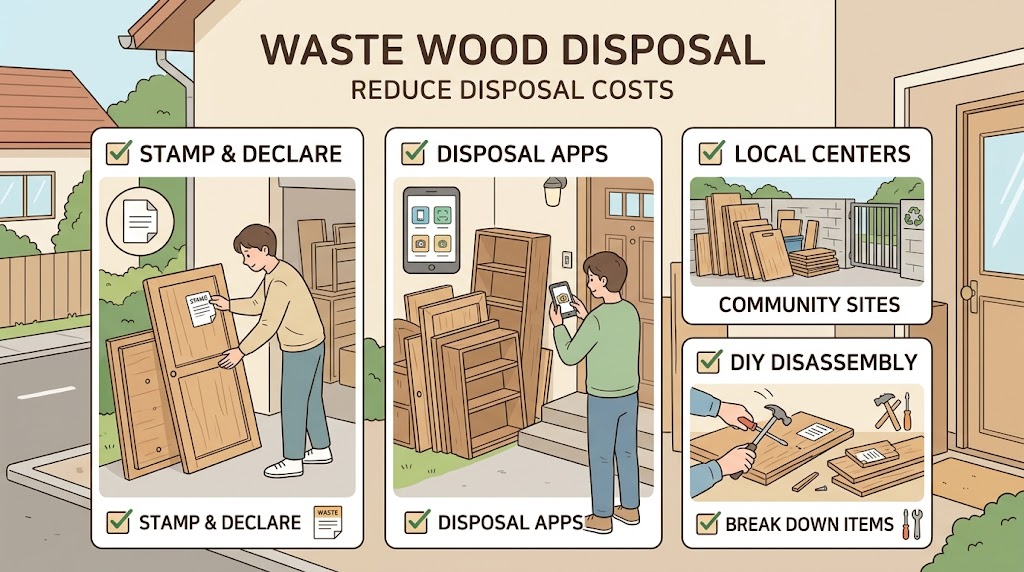
Here are the 4 key cost-saving disposal routes you can choose based on the amount of waste wood and your transport conditions.
- Municipal Bulky Waste Stickers and Simple Online Reporting
This is the most standard and safe disposal method based on fixed pricing.
- Cost Level: Around 2,000 KRW to 10,000 KRW per item/size
- Suitable Case: When you can carry standardized individual wood pieces—such as door panels, dining table tops, or shelves—outside the home (to the designated disposal location) yourself
- Usage Tips:
- Obtain and attach a sticker issued through your district office/community service center website or designated volume-rate bag retail outlets.
- If there is no separate “Waste Wood” category on the rate chart, you can report it under similar categories such as “Wood Products (Shelves, Panels)” or “Discarded Furniture Parts.” Since each local government has detailed pricing tiers for individual wood pieces, there is no need to worry about being overcharged.
- Requesting Carry-Down / Pickup via Dedicated Waste Collection Apps (Bbegi, Yeogiro, etc.)
This method is optimized for heavy solid wood tabletops or large cabinet frames that are difficult to lift alone.
- Cost Level: Disposal fee + transport fee (a separate handling labor charge applies in addition to the municipal disposal fee)
- Suitable Case: When taking items down to the designated outdoor disposal spot seems impossible, such as in buildings without an elevator or in single-person households with women or elderly individuals
- Usage Tips:
- By uploading photos through the app, you can pay the disposal fee and request the “Carry-Down (on-site pickup)” service, where movers carry the items from inside your home down to the designated disposal spot.
- Because prices are set through platform-partnered rates, you can save substantially on handling and labor fees compared to hiring private ladder trucks or freight services.
- Using “Non-Combustible Volume-Rate Woven Sacks (Special Designated Bags)” for Small Scraps
This is most suitable for small-volume wood remnants such as splintered plywood, scrap lumber pieces, and broken chair legs.
- Cost Level: Around 2,000 KRW to 5,000 KRW per sack (based on 20L to 50L)
- Suitable Case: Wood scraps that are small in size, but would tear regular trash bags or violate disposal regulations if put inside standard plastic garbage bags
- Usage Tips:
- Purchase a “non-combustible woven sack (special-specification volume-rate bag)” at a community service center or designated supermarket, and fill it with wood reduced in size through sawing or disassembly.
- Rather than attaching bulky waste stickers to each item individually, filling a single 50L woven sack to the brim with finely broken-up wood and discarding it is far cheaper in terms of cost. (However, beware of exceeding the weight limit specified in the disposal regulations)
- Discharging in Large Volumes (Remodeling / Demolition): Direct 1-Ton Truck Hire vs. Direct Delivery to Waste Collection Sites
This route is for when an entire room has been gutted or interior demolition yields truckload quantities of wood.
- Cost Level:
- 1-ton waste collection truck: Around 300,000 KRW to 500,000 KRW (varies depending on whether labor/loading fees are included)
- Direct delivery to municipal waste treatment plants (sanitary landfills, etc.): Around 50,000 KRW to 100,000 KRW per ton
- Cost-Saving Tips:
- When hiring a 1-ton collection truck dedicated to wood, strictly separate pure wood from mixed waste (mixed with plastic, styrofoam) to avoid mixed-waste surcharges.
- If you have a vehicle (SUV, truck, etc.), obtaining a disposal confirmation certificate through the community service center and directly hauling it to a nearby municipal resource recovery facility or collection site via “self-delivery” is by far the cheapest option.
| Disposal Route | Recommended Target | Cost Burden | Labor Intensity (Transport/Disassembly) |
|---|---|---|---|
| Bulky Waste Sticker | Single-item wood, when self-transport is possible | Very Low | Moderate (Must carry out to designated spot) |
| Dedicated Waste App | When too heavy to move outside the home | Moderate | None (Handled by movers) |
| Non-Combustible Volume-Rate Woven Sack | Finely broken scraps, small amounts of wood | Lowest (Cost of bag) | High (Requires sawing/cutting) |
| Professional Truck / Self-Delivery | Large demolition wood over 1 ton | High to Moderate | High (Loading and hauling) |
Practical Disassembly & Volume Reduction Know-How to Cut Costs in Half
In reality, 80% of waste wood collection costs stem from “volume (space)” and “labor costs.” If you discard items as fully assembled furniture, they occupy entire loading spaces in trucks, causing fees to skyrocket; however, simply loosening joint points and stacking them flat slashes the disposal rate.
Here are 3-step practical volume-reduction tips to save at least 50% or more on costs at home without professional tools.
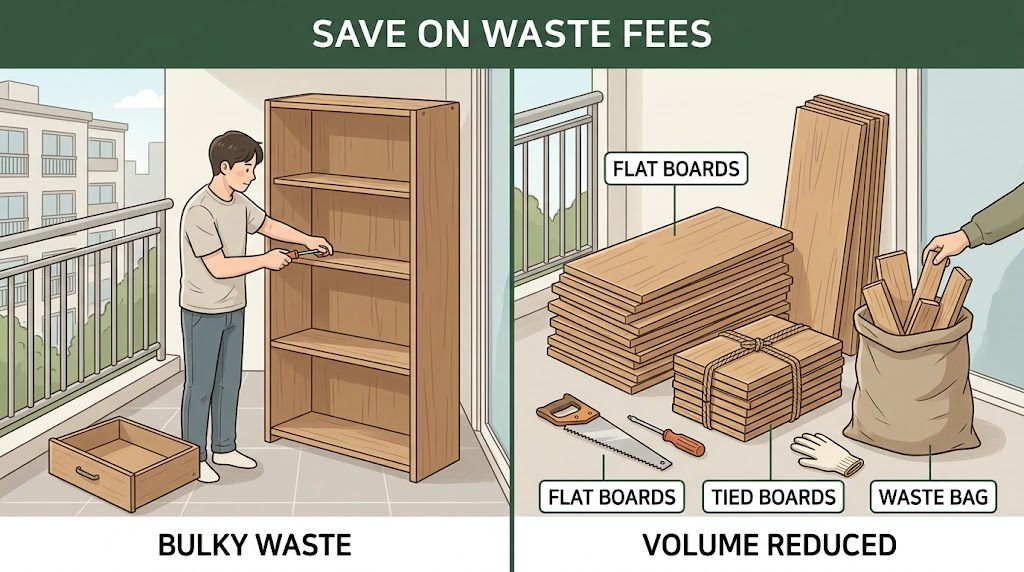
- From “3D” to “Flat”: Reducing Bulk (Volume)
Most bulky waste sticker fees and freight loading rates are priced based on the combined volume of width, length, and height.
Separating Panels:
Chests of drawers, bookshelves, and storage cabinets look massive on the outside, but once disassembled, they amount to nothing more than a few thin boards. Loosening joint screws with an electric screwdriver (or a Phillips screwdriver) and laying them flat as planar boards reduces the volume to one-fifth.
Using a Folding Hand Saw:
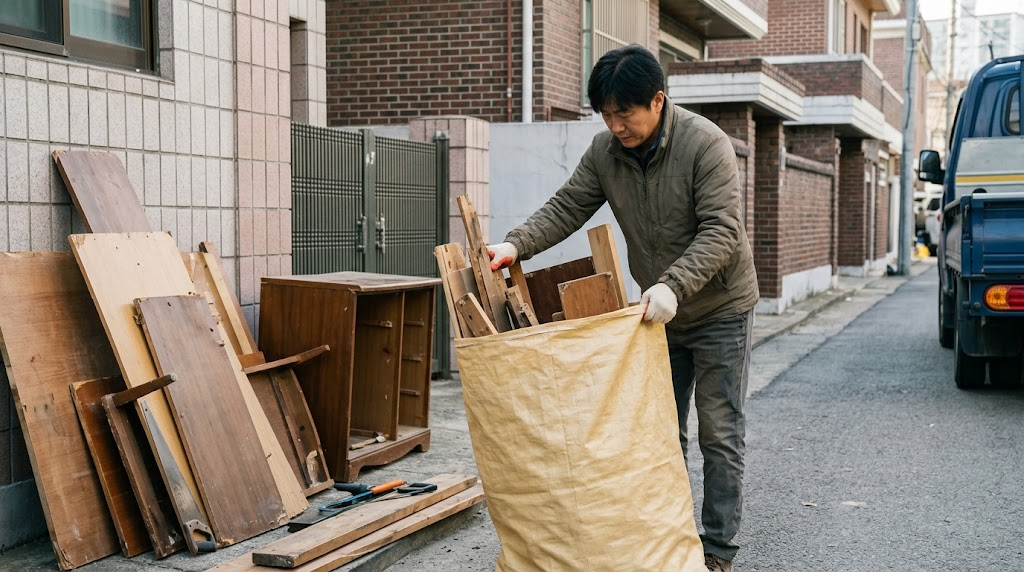
For long lumber slats or bed ribs, cutting them just once or twice into 50–60cm increments with a multi-purpose folding hand saw drastically reduces bulk, allowing them to fit economically into a single non-combustible volume-rate woven sack instead of requiring a bulky waste sticker.
Know-how: Stacking them as boards and binding them tightly with twine or tape allows them to be classified by some local governments as “1 bundle of wood boards” rather than multiple individual items, saving sticker costs.
- Separating Hardware and Foreign Materials: Avoiding “Mixed Waste” Surcharges
When hiring private companies for waste wood disposal or using professional collection services, the primary culprit behind cost surges is metallic foreign objects.
Removing Hinges, Rails, and Handles:
Use a screwdriver to detach all hinges, drawer slide rails, metal handles, and corner connection brackets.
Pulling Nails and Staple Pins:
Pry out thin staple gun pins embedded in back panels or protruding nails using the claw end of a hammer (pry bar) or cutting pliers.
Effect: If metal hardware is mixed in, treatment centers classify it as “mixed waste” due to concerns over damaging shredder blades, driving processing unit rates up by 1.5 to 2 times. Separating hardware to dispose of it as scrap metal and leaving only pure wood qualifies you for the lowest wood processing rates.
- Shortening Transport Routes: Eliminating In-Home Pickup Labor Costs
The most regrettable charge on a waste wood disposal estimate is the “transport fee (lifting fee).”
Fitting Elevator Entry Dimensions:
To avoid paying for ladder trucks (at least 80,000 to 150,000 KRW), prior disassembly to dimensions that fit inside an elevator is essential.
Direct Transport to the 1st Floor Designated Spot:
The moment a collection technician steps inside your home to load and carry items down via elevator, labor costs (call-out fees and staircase/elevator transport fees) of at least 30,000 to 50,000 KRW or more are added. Simply laying wood on a wheeled hand cart (dolly) or a thick blanket and rolling/carrying it down to the designated 1st-floor disposal location yourself wipes out all incidental expenses, reducing everything outside the pure collection sticker fee to 0 KRW.
Safety Checkpoints (Essential)
- Always wear coated work gloves before disassembly work. (Prevents splinters and nail punctures)
- Spread ample unused cardboard boxes or blankets on the floor to prevent denting flooring surfaces.
- Wrap already removed nails and screws in empty milk cartons or tape to dispose of them safely.

Cases Where Free Collection or Giveaways Are Possible
Just because it is waste wood does not mean you must unconditionally pay money to dispose of it. While it may be troublesome trash to you, it serves as excellent free raw material for DIY hobbyists, woodworking workshops, or neighbors tending kitchen gardens.
If the dimensions and storage condition of the wood are good, check these 3 giveaway channels that allow you to clear it cleanly for a “0 KRW cost” without spending on disposal fees.
- Free Giveaways of DIY Materials via Karrot and Secondhand Platforms
Solid wood table tops, thick board panels for shelves, log slices, and the like see surprisingly high demand on secondhand platforms.
- High-Demand Items:
Solid natural wood without paint or film coverings, glued-laminated timber (birch, cypress, merbau, etc.), and clean scrap lumber materials
- Tips for Writing a Giveaway Post:
- Accurately list detailed dimensions (width x length x thickness in cm).
- Setting the condition “For those who can load and pick up by car directly (non-face-to-face pickup in front of the door)” allows someone to pick it up from your doorstep without you having to carry it outside with difficulty.
- Precautions: Low-cost plywood that is split or warped on the surface, or MDF panels that have swollen from absorbing moisture, will rarely result in completed transactions if posted for giveaways, so handing them over directly for municipal disposal is the way to save time.
- Material Donations to Neighborhood Woodworking Workshops and Craft Academies
This is a method of inquiring with local private woodworking shops or hobby woodworking institutes.
- Usage Areas:
Woodworking shops constantly need scrap wood for student practice pieces and crafting small props (cutting boards, coasters, small stands).
- Conditions for Giveaway Eligibility:
Hardwoods (walnut, oak, ash, etc.) or glued-laminated timber of uniform dimensions are preferred, and they must be in clean condition without embedded nails or staples. To prevent damage to woodworking saw blades, they only accept wood free of foreign materials.
- Giveaways for Camping Firewood and Garden Stakes
Long lumber sticks or pieces of solid logs are popular among outdoor enthusiasts.
- Firewood for Camping / Wood Stoves:
Only “pure natural wood completely untreated with chemicals” is acceptable.
(※ Caution: Plywood/MDF/PB containing adhesives, preservative-treated wood, and wood coated with varnish or paint produce Class 1 carcinogens and deadly toxic fumes when burned, so they must never be given away as firewood.)
- Stakes for Kitchen Gardens and Flowerbeds:
Thin lumber pieces around 1m in length are usefully utilized on weekend farms or kitchen gardens as support stakes for chili peppers and tomatoes, making them great to dispose of via giveaways to local farming or gardening communities.
| Giveaway Route | Target Wood | Transaction Condition Tips | Precautions |
|---|---|---|---|
| Karrot / Secondhand Trading | Solid wood, thick shelves, laminated lumber | Set to “Non-face-to-face doorstep pickup” | Exclude MDF and swollen foil-laminated wood |
| Nearby Woodworking Workshop | Hardwood boards, solid wood scraps | Call ahead before visiting and dropping off | Complete removal of nails and staple pins required |
| Camper / Kitchen Garden Giveaway | Square lumber, unprocessed log segments | Camping cafes / local communities | Painted and treated wood strictly prohibited |
Shall I write the final ‘Epilogue (Conclusion & Checklist Summary)’ as well?
Korean version: 한국어로 읽기