Long-Term Care Insurance for the Elderly Grade Assessment, Basic Procedures at a Glance
Long-term care insurance for the elderly is a social insurance system that provides long-term care benefits, such as physical activity and household activity support, to senior citizens who have difficulty performing daily activities on their own due to advanced age or geriatric diseases. To enter a nursing home or use visiting care services with government subsidies (up to 85% to 100%), one must first be assigned a ‘Long-Term Care Grade’ by the National Health Insurance Service.
- Application Eligibility Criteria
Applicants are largely divided into two categories depending on age and health status.
Seniors aged 65 and older: Those who require long-term care due to significant mobility difficulties or challenges in performing daily living activities (eligible to apply regardless of the disease type)
Individuals under age 65: Those who have difficulty performing daily living activities due to ‘geriatric diseases’ prescribed by law, such as dementia, cerebrovascular diseases (cerebral infarction, cerebral hemorrhage, etc.), or Parkinson’s disease
※ For individuals under age 65, simple fractures or general diseases are not recognized, and the geriatric disease classification code must be specified on the diagnosis certificate.
- Grade System (Grade 1 to Cognitive Support Grade)
Based on assessment scores, the system is divided into a total of 6 levels, from Grade 1 to Cognitive Support Grade. Available services (home care benefits/facility benefits) and monthly limit amounts vary depending on the grade.
Grade 1 (95 points or higher): A person who entirely requires assistance from another person in daily living (most severe)
Grade 2 (75 points or higher to less than 95 points): A person who requires substantial assistance from another person in daily living
Grade 3 (60 points or higher to less than 75 points): A person who partially requires assistance from another person in daily living
Grade 4 (51 points or higher to less than 60 points): A person who requires assistance from another person for a certain portion of daily living
Grade 5 (45 points or higher to less than 51 points): A person with dementia who has confirmed cognitive decline
Cognitive Support Grade (less than 45 points): Seniors with mild dementia who can use cognitive deterioration prevention programs such as day and night care services
- Overall Progress Flow from Application to Assessment (5 Steps)
It usually takes about 3 to 4 weeks (within 30 days at maximum) from application until the final results are released.
- Application Submission:
Submit the Long-Term Care Recognition Application by visiting a National Health Insurance Service branch (Long-Term Care Insurance Operational Center), or via mail, fax, or internet (Long-Term Care Insurance website/mobile app).
- On-Site Visit Investigation by Service Staff:
Professional investigators, such as nurses and social workers affiliated with the Service, visit the senior’s residence (home, hospital, etc.) in person to conduct a face-to-face assessment of physical and cognitive functions based on the 52-item ‘Long-Term Care Recognition Survey Table’.
- Submission of Doctor’s Opinion:
Submit the doctor’s opinion issued by a designated hospital or clinic to the Service within the period notified by the Service. (Recently, this is often transmitted directly from hospitals to the Service via electronic doctor’s opinions.)
- Deliberation by the Grade Assessment Committee:
Based on the visit investigation result scores and the doctor’s opinion, the ‘Long-Term Care Grade Assessment Committee’, composed of private experts such as doctors, nurses, and social workers, deliberates and decides on the final grade.
- Notification of Results and Service Utilization:
The Long-Term Care Recognition Certificate, Individual Long-Term Care Use Plan, and Welfare Equipment Benefit Confirmation are delivered to the applicant, who can then use services after signing a contract with a care center according to the grade.

List of Essential Documents to Prepare Before Applying
Because elderly individuals often have difficulty applying for Long-Term Care Insurance directly in person, a high percentage of applications are carried out by family members or representatives on their behalf. If documents are missing during the submission stage, the schedule for the on-site investigation by Service staff may be delayed, so it is advisable to check and prepare the necessary documents in advance before applying.
- Common Essential Documents
These are core documents that must be submitted basically, regardless of the applicant category.
Long-Term Care Recognition Application (Mandatory):
Download it from the National Health Insurance Service Long-Term Care Insurance website (Form Archive) or use the form provided when visiting a branch.
Accurately fill in applicant information, representative information, application reason, postal delivery address, etc.
Identification Card:
When the elderly person applies directly: Copy of their own ID card (Resident Registration Card, driver’s license, passport, etc.)
When a representative applies: Original ID card of the representative (when visiting) or copy (when submitting via fax/mail)
- Additional Documents for Application by Representative
Documents proving the relationship are required depending on whether the representative is a family member, a legal representative, etc.
When a family member or relative is the representative:
Family Relation Certificate or Resident Registration Certificate: Official document that can prove the relationship between the senior citizen and the representative (recommended to be issued within the last 3 months)
Power of Attorney: Signature or seal of the senior citizen (applicant) affixed to the ‘Power of Attorney’ section within the Long-Term Care Recognition Application form
When an interested party (guardian, etc.) or a dedicated social welfare public official is the representative:
Guardian verification documents or documents proving representation authority
When applied by a public official, a consent form from the individual or family
- Additional Documents for Applicants Under Age 65
For those under 65, the Service must verify whether they have a geriatric disease via documentation in advance, so diagnostic proof documents must be submitted together with the application.
Doctor’s Opinion or Diagnosis Certificate (Disease code must be specified):
Diagnosis certificate or opinion letter stating the disease code (KCD code) of a geriatric disease specified in the Enforcement Decree of the Long-Term Care Insurance Act (Alzheimer’s disease, cerebral infarction, cerebral hemorrhage, Parkinson’s disease, sequelae of cerebrovascular diseases, etc.)
For individuals under 65, without submitting a diagnosis certificate, the initial### 2. List of Essential Documents to Prepare Before Applying
In Long-Term Care Insurance, even a single missing document can cause submission delays or requests for supplementation. In particular, since it is difficult for most seniors to visit in person, meticulously preparing the necessary supporting documents in advance when applying via a representative is the key factor.
- How to Fill Out the Long-Term Care Recognition Application
This is a standard form that can be downloaded from National Health Insurance Service branches or the Long-Term Care Insurance website (Form Archive).
Applicant (Beneficiary) Personal Information: You must accurately write not only the senior’s registered address on the resident register but also their actual residence (current living address). This is because the on-site visit investigation by Service staff is assigned to the actual residence.
Representative Information: Enter the applicant representative’s relationship (family, relative, etc.), contact information, and address. It is convenient to designate the representative’s number as the recipient number for progress notification text messages (SMS).
Postal Delivery Address Selection: Clearly choose whether future grade assessment result documents (such as the Long-Term Care Recognition Certificate) will be received at the senior’s home or at the guardian’s address.
- Checking IDs and Power of Attorney for Principal and Representative
The scope of verification documents differs depending on the entity applying.
When the senior citizen applies directly in person: 1 copy of their ID card (Resident Registration Card, driver’s license, passport, etc.)
When a family member or relative applies on their behalf:
Copy of the senior citizen’s ID card
Copy of the representative’s ID card
Signature/seal on the representative delegation section within the application form
When an interested party (guardian, etc.) applies on their behalf:
Copy of the senior citizen’s ID card
Copy of the representative’s ID card
Documents proving legal authority, such as a guardian certificate
- Additional Supporting Documents by Situation
Depending on the subject’s age, household type, and health status, there are additional documents that must be submitted together.
Applicants under age 65 (Verification of geriatric disease mandatory):
Original diagnosis certificate or opinion: Must be a document marked with the disease classification code (KCD code). The application will be accepted only if statutory geriatric disease codes such as dementia (F00-F03, G30), cerebrovascular disease (I60-I69), or Parkinson’s disease (G20–G22) are specified.
When a family member whose address on the resident register is separated applies on their behalf:
Family Relation Certificate: Required to prove the family relationship (lineal descendant, spouse, etc.) between the senior citizen and the applying representative. (Mandatorily requested when households are separated on the resident registration certificate)
Basic Livelihood Security recipients or Medical Benefit recipients:
Even if separate certificates are not submitted, verification is possible through joint use of administrative information; however, advance checking is necessary because prior long-term care benefit use applications and admission approval procedures must be linked with the competent City/Gun/Gu District Office.
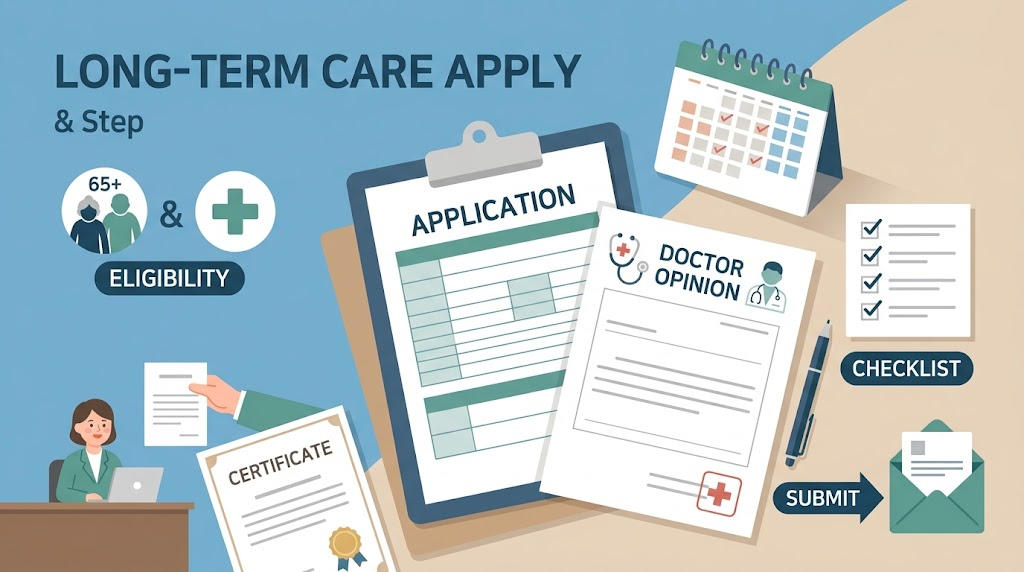
Core of Grade Assessment 1. What Is Long-Term Care Insurance for the Elderly? (Application Eligibility and Grade System)
- Core of Grade Assessment: What Is Long-Term Care Insurance for the Elderly? (Application Eligibility and Grade System)
Long-Term Care Insurance for the Elderly is a social security system that provides long-term care benefits such as physical activity support, housework assistance, and nursing care to senior citizens who have difficulty carrying out daily life on their own due to advanced age or geriatric diseases.
Simply being of advanced age or being hospitalized does not mean you can unconditionally receive benefits, and you must accurately understand the application eligibility criteria and the grade system centered on physical and cognitive functions specified by the Service to avoid unnecessary rejections or disqualifications.
- Application Eligibility Requirements: Differences Based on Age 65
Eligibility to apply for long-term care recognition is clearly classified according to age on the resident register.
- Seniors aged 65 and older
- Regardless of the type of disease, anyone recognized as having difficulty performing daily life alone for 6 months or longer due to significant mobility difficulties, dementia, etc., can apply.
- Individuals under age 65 (Important Point)
- General diseases (e.g., simple fractures, arthritis, general cancer, etc.) are excluded from application eligibility.
- Must be diagnosed with a ‘geriatric disease’ prescribed in the Enforcement Decree of the Long-Term Care Insurance Act.
- Representative geriatric diseases: Alzheimer’s disease and other dementias (F00-F03, G30), cerebrovascular diseases (cerebral infarction, cerebral hemorrhage, etc., I60-I69), Parkinson’s disease (G20–G22), secondary parkinsonism (G21), etc.
- Grade Assessment Criteria and System by Grade (Grade 1 to Cognitive Support Grade)
The National Health Insurance Service comprehensively evaluates the applicant’s physical function, cognitive function, behavioral changes, etc., to calculate a score, classifying it into a total of 6 grade levels from 95 points or higher to less than 45 points.
| Grade | Assessment Score | Condition Criteria and Recognition Requirements | Main Form of Provided Benefit |
|---|---|---|---|
| Grade 1 | 95 points or higher | State of entirely requiring the assistance of another person in daily living (bedridden patients, etc.) | Home care benefits, facility benefits (nursing homes, etc.) |
| Grade 2 | 75 points or higher ~ Less than 95 points | State of requiring substantial assistance from another person in daily living (wheelchair dependence, etc.) | Home care benefits, facility benefits (nursing homes, etc.) |
| Grade 3 | 60 points or higher ~ Less than 75 points | State of partially requiring assistance from another person in daily living (gait assistance needed, etc.) | Home care benefits (Admission to nursing homes possible upon proving grounds) |
| Grade 4 | 51 points or higher ~ Less than 60 points | State of requiring assistance from another person for a certain portion of daily living | Home care benefits |
| Grade 5 | 45 points or higher ~ Less than 51 points | Senior with dementia (Physical functions are relatively good, but cognitive decline is distinct) | Home care benefits (Cognitive activity-type visiting care, day/night care) |
| Cognitive Support Grade | Less than 45 points | Senior with mild dementia (Good physical functions, need to prevent deterioration of cognitive functions) | Centered on cognitive programs such as day/night care |
- Practical Checkpoints You Must Know for Grade Assessment
- Evaluation Focused on ‘Functional Limitations’ Rather Than Disease Names: The core of the assessment is whether daily living activities (ADL)—such as ‘washing one’s face’, ‘going to the bathroom’, ‘getting up and sitting’, and ‘changing clothes’—can be performed alone, rather than the severity of the disease.
- Restrictions by Benefit Type: For Grades 1 and 2, admission to facilities such as nursing homes (facility benefits) is permitted by default, but for Grades 3 to 5, only ‘home care benefits’ such as visiting care and day/night care are accessible in principle. (Admission to a nursing home for Grades 3 to 5 requires approval by proving unavoidable circumstances, such as cohabiting family members being unable to provide care.)
- Role of the Doctor’s Opinion: After physical and cognitive domain scores are determined, the doctor’s opinion serves as decisive evidence when the final Grade Assessment Committee reviews the permanence of the illness and the feasibility of treatment.
Long-Term Care Recognition Application Procedure at a Glance
Applying for Long-Term Care Insurance grades usually takes about from application submission to receipt of the final grade assessment letter### Long-Term Care Recognition Application Procedure at a Glance
For Long-Term Care Insurance, services do not commence immediately just because an application form has been submitted; rather, the final grade is confirmed after on-site inspections by the Service and rigorous deliberations by an expert committee. The statutory processing deadline is within 30 days from the application date, and the overall procedure proceeds in 5 steps as follows.
Step 1: Submission of Long-Term Care Recognition Application
First, submit the application documents to a branch of the National Health Insurance Service (Long-Term Care Insurance Operational Center at each branch).
Applicant Entity: The senior citizen themselves, family, relative, or legal representative
Submission Methods:
In-Person and Mail/Fax: Submit to the Service branch operational center with jurisdiction over the senior citizen’s actual residence
Online Application: National Health Insurance Service Long-Term Care Insurance website (PC) or ‘The Health Insurance’ mobile app (requires joint certificate / simple authentication of the principal and representative)
Step 2: On-Site Visit Investigation by Service Staff (Face-to-Face Field Evaluation)
Once submission is complete, a specialized investigator affiliated with the Service (nurse, social worker, etc.) coordinates the schedule in advance and visits the place where the senior citizen actually resides (home, hospital, etc.) in person.
Survey Items: Total of 52 detailed evaluation domains
Physical Function: Undressing and dressing, washing face, eating, using the toilet, walking, etc.
Cognitive Function: Recognition of date/location, short-term memory, calculation ability, etc.
Behavioral Changes: Delusions, wandering, aggressiveness, sleep disorders, etc.
Nursing Procedures and Rehabilitation Domain: Bedsores, nasogastric tube (feeding tube), joint limitations, etc.
On-Site Tip: The primary caregiver who knows the senior’s routine condition best must be present to concretely explain the difficulties of caregiving experienced in daily life.
Step 3: Issuance and Submission of Doctor’s Opinion
Once the visit investigation is completed, the Service notifies (via text message/mail) the ‘Doctor’s Opinion Request Form’ according to the senior’s condition.
Submission Deadline: Submit within the deadline designated by the Service (usually within about 7 to 14 days) from the date of notification
Issuing Institution: Hospitals, clinics, or public health centers where the senior citizen was routinely treated (the primary attending physician records the senior citizen’s physical and cognitive decline)
Submission Method: Recently, the majority of medical institutions register it directly to the Service’s computer network from the hospital (electronic doctor’s opinion), so checking whether it is linked with the Service when visiting the hospital is convenient.
Step 4: Deliberation and Resolution by Grade Assessment Committee
The final decision is made based on the ‘Primary Computer Assessment Score’ derived from the visit investigation results and the ‘Doctor’s Opinion’ written by the doctor.
Composition: An independent committee composed of about 15 private experts, including doctors, oriental medicine doctors, nurses, and social workers
Deliberation Content: Comprehensively reviewing not merely the disease name, but the senior citizen’s residual functions, the permanence of the illness, and the need for care by others, to make a final decision among Grade 1 to Grade 5, Cognitive Support Grade, or Out-of-Grade (rejection).
Step 5: Notification of Results and Benefit Contract
Once the grade is confirmed, the final result notice is sent to the applicant (or representative) by mail or electronic document.
3 Types of Received Documents:
Long-Term Care Recognition Certificate: Specifies the finally assigned grade and validity period (initially usually 1 to 2 years)
Individual Long-Term Care Plan: Information on available service types (home care / facility) and monthly limit amounts
Welfare Equipment Benefit Confirmation: Specifies items of welfare equipment that can be rented or purchased, such as electric beds and wheelchairs
Commencement of Use: You can use full-fledged services after signing a service contract with a long-term care institution (visiting care center, day/night care center, nursing home, etc.) using the notice.

Mandatory Submission Documents and How to Fill Them Out (Application Form, ID, etc.)
When proceeding with the application for long-term care recognition, documents must be thoroughly prepared according to the applicant’s age (whether aged 65 or older) and the applying entity (principal or representative) to schedule the visit investigation promptly without submission delays.
- Instructions for Filling Out the Long-Term Care Recognition Application
This is an official form available at National Health Insurance Service branches or downloadable from the form archive on the Long-Term Care Insurance website.
- Applicant (Senior Citizen) Information:
- If the registered address on the resident register differs from the actual residence (current living address), the actual residence must be recorded accurately. This is because the on-site visit investigation by Service staff is assigned to the actual residence.
- Entering Representative Information and Relationship:
- If submitted by a family member, relative, or guardian, enter the representative’s personal information and contact details.
- The phone number to receive processing progress notification texts (SMS) must be set to the representative’s number so as not to miss calls coordinating the investigation schedule.
- Selecting Postal Delivery Address:
- Select the address where original documents, such as the future Long-Term Care Recognition Certificate, will be sent. If a guardian needs to manage the documents directly on behalf of a senior with mobility difficulties, checking the ‘Representative Address’ is safe.
- Signature/Seal in the Power of Attorney Section:
- Sign or affix the seal of the senior citizen (applicant) in the power of attorney section at the bottom of the application. If direct signing is impossible due to dementia or physical paralysis, submit a fingerprint (thumbprint) or attach a note stating the reason for representation.
- ID Cards and Relationship Verification Documents
- When applying directly in person:
- 1 copy of the senior citizen’s own ID card (Resident Registration Card, driver’s license, passport, etc.)
- When applying by proxy through family or relatives:
- 1 copy of the senior citizen’s ID card
- 1 copy of the representative’s ID card
- 1 copy of Family Relation Certificate or Resident Registration Certificate: If the senior citizen and the representative are in separate households on the resident register, this is mandatory to officially verify the family relationship. (Issued within the last 3 months)
- When applying through a legal representative (adult guardian, etc.):
- Copy of the senior citizen’s ID card, copy of the representative’s ID card, copy of the Certificate of Guardian Registration Matters or court judgment
- Mandatory Documents by Target Group Type
| Target Classification | List of Mandatory Submission Documents | Precautions |
|---|---|---|
| General seniors aged 65 or older | Long-Term Care Recognition Application, copy of ID card, Family Relation Certificate (when applying by proxy) | Do not submit the doctor’s opinion in advance at the time of application; submit it following the Service’s instructions after the on-site investigation |
| Under 65 years old (Patients with geriatric diseases) | Long-Term Care Recognition Application, copy of ID card, medical certificate or doctor’s opinion stating the geriatric disease code | Application completed only when statutory geriatric disease codes such as dementia (F00-F03, G30), cerebrovascular disease (I60-I69), or Parkinson’s (G20) are specified |
| Basic Livelihood Security recipients / Medical Benefit recipients | Same as general submission documents + prior liaison with the competent Eup/Myeon/Dong community service center (social welfare officer) | Advance verification required as benefit use approval from the competent local government must be undergone separately after grade assessment |
- Document Submission Channels
- In-person visit to the Service, mail/fax: Long-Term Care Insurance Operational Center at the National Health Insurance Service branch having jurisdiction over the senior citizen’s actual residence
- Mobile and Internet:
- The Health Insurance mobile app (Civil Petitions Here > Long-Term Care > Long-Term Care Recognition Application)
- Long-Term Care Insurance website (Civil Consultation Room > Long-Term Care Application)
- When submitting online, simple authentication or joint certificate login for the senior citizen and representative is required, and supporting documents can be attached as photographed files (JPG, PDF).
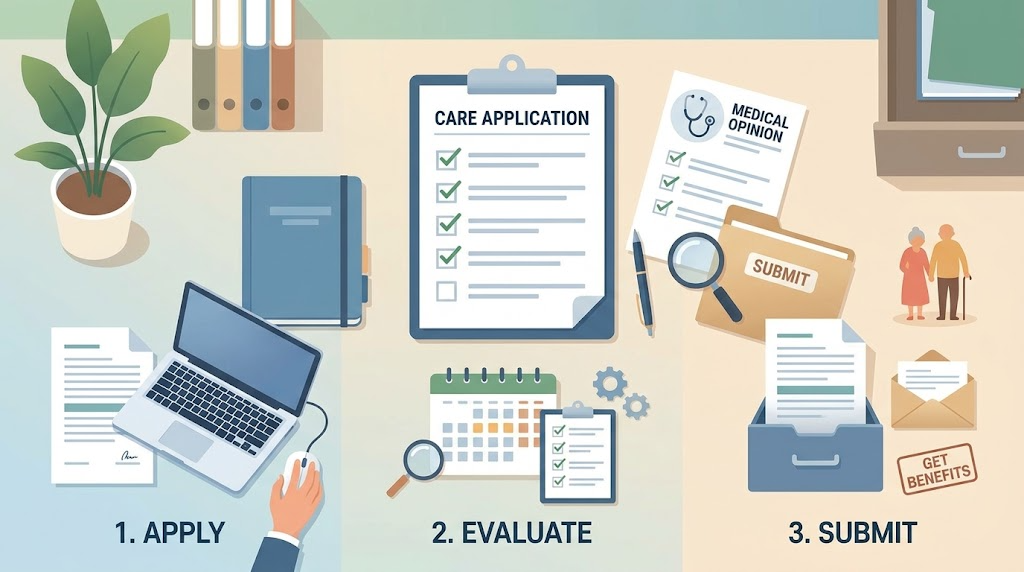
Doctor’s Opinion Issuance Criteria and Submission Deadlines (Differences Before and After On-Site Investigation)
In the Long-Term Care Insurance recognition process, the doctor’s opinion is a core document that medically verifies the applicant’s physical and mental status. The issuance criteria and timing of submission clearly differ in nature and procedure based on the on-site investigation by the National Health Insurance Service.
- Doctor’s Opinion Issuance Criteria
- Issuing entity: Issued by a medical doctor or oriental medicine doctor under the Medical Service Act.
- Issuance qualifications and medical records:
- In principle, it is easiest to have it issued by the primary care physician who has continuously treated the applicant.
- When issued by a hospital visited for the first time, additional tests (cognitive assessment, X-ray, blood tests, etc.) may be required to evaluate mobility status and cognitive function (dementia, etc.).
- Dementia-related domains (Applies to Grade 5 and Cognitive Support Grade):
- For subjects with cognitive impairment or suspected dementia, the opinion must be issued by a medical doctor or oriental medicine doctor who has completed ‘Dementia Specialized Training’ for Grade 5 or Cognitive Support Grade screening to be possible.
- Differences in Submission Deadlines and Procedures Before and After On-Site Investigation
| Classification | Submission Before On-Site Investigation | Submission After On-Site Investigation (General) |
|---|---|---|
| Applicable Target | Applicants under age 65 with geriatric diseases | General applicants aged 65 or older |
| Issuance Form | Medical institution’s own form or Service standard form used as it is prior to separate form notification | Mandatory to bring the ‘Doctor’s Opinion Request Form’ issued by the Service |
| Submission Deadline | Submitted concurrently upon filing the Long-Term Care Recognition Application | Submission deadline stated on the request form notified by the Service (typically within about 7 to 14 days after investigation) |
| Issuance Cost | May be prior to application of Service co-payments, requiring verification of full out-of-pocket payment and subsequent settlement | Co-payment rate (general 20%, reduction target 10% or exempt) applied immediately upon presentation of request form |
- Detailed Core Differences Before and After On-Site Investigation
- Submission before on-site investigation (Mandatory for under 65):
- Applicants under age 65 must prove they suffer from a ‘geriatric disease’ under the Long-Term Care Insurance Act, such as cerebrovascular disease, Parkinson’s disease, or dementia, for the Service staff’s on-site investigation to begin.
- If the opinion is not submitted in advance, an on-site investigation schedule will not be assigned.
- Submission after on-site investigation (General for 65 and older):
- For those aged 65 and older, the Service staff’s field visit investigation proceeds first simply upon filing the recognition application.
- After the staff evaluates 52 items (physical function, cognitive status, behavioral changes, etc.) on site, they issue a ‘Doctor’s Opinion Request Form’.
- You must visit a hospital by the submission deadline specified on the request form, have the opinion issued, and submit it to the Service (the hospital can directly register it electronically) to be submitted for deliberation by the Grade Assessment Committee.
- Failure to submit within the deadline may result in exclusion from grade assessment deliberation or dismissal.

Practical Tips You Must Know When Getting a Doctor’s Opinion Issued
The grade assessment for long-term care insurance for the elderly is determined through the organic combination of the National Health Insurance Service staff’s on-site visit assessment score and the contents of the doctor’s opinion. Preparing the following practical tips in advance before visiting the hospital can prevent unnecessary return visits or issuance delays.
- Visit the Hospital of the Attending Physician Who Routinely Treated the Patient as Top Priority
Importance of medical records: It must be a hospital with treatment records over recent months so the doctor can accurately record the senior’s activities of daily living (ADL) execution ability and chronic disease history.
Caution when using a first-visit hospital: At a hospital visited for the first time, to accurately determine the condition, additional tests such as cognitive screening tests (CIST, etc.), joint range of motion measurements, and radiological examinations may be requested, making same-day issuance difficult or incurring additional costs.
- If Dementia or Cognitive Symptoms Exist, Verify in Advance Whether the Doctor Has Completed Specialized Training
Requirements for Grade 5 and Cognitive Support Grade: To receive Grade 5 or Cognitive Support Grade due to dementia-related symptoms, the opinion (including supplementary documentation for dementia) must be prepared by a medical doctor or oriental medicine doctor who has completed the dementia specialized training of the National Health Insurance Service.
Advance inquiry is essential: It is safe to call the hospital reception desk or the neurology/psychiatry department in advance to check and make an appointment by asking, “Is there a trained medical staff member who can issue a dementia specialized opinion for long-term care?”
- Bring the ‘Doctor’s Opinion Request Form’ to Receive Co-payment Benefits
You must submit the issuance request form provided by the Service after the on-site visit assessment to the hospital for the Service’s coverage to be applied.
Co-payment rates: General beneficiaries pay 20%, reduction targets pay 10%, and Basic Livelihood Security recipients are exempt (0%). If issued upon personal request without a request form, the entire amount is non-### Practical Tips You Must Know When Getting a Doctor’s Opinion Issued
In the grade assessment for long-term care insurance for the elderly, the doctor’s opinion serves as key evidence alongside the results of the Service staff’s on-site visit assessment when the Grade Assessment Committee decides the final grade. Simply taking care of a few things before and after the hospital visit can reduce wasted trips and accurately reflect the senior’s actual condition.
- Visit the Hospital of the Attending Physician You Regularly Attend First
Importance of medical records: It is most advantageous to visit the attending physician in internal medicine, neurology, orthopedics, etc., who has provided continuous treatment over recent months.
Limitations of a first-visit hospital: When visiting a hospital seeing the senior for the first time, it is difficult for the doctor to determine daily living performance ability or cognitive changes, potentially increasing time and costs due to re-conducting basic blood tests, X-rays, cognitive evaluations, etc.
- If Dementia Symptoms Exist, Verify Whether the Doctor Is a ‘Dementia Specialized Training Completed Doctor’
To qualify for Grade 5 or Cognitive Support Grade due to dementia, an opinion written by a ‘medical doctor or oriental medicine doctor who completed dementia specialized training’ (including supplementary documentation for dementia opinions) is required, rather than a general doctor’s opinion.
Before visiting, it is safe to verify by phone whether the corresponding medical personnel completed the dementia specialized training and make an appointment through the relevant hospital or the National Health Insurance Service customer center (or the Long-Term Care Insurance website).
- Make Concrete Notes of Routine Symptoms and ‘Inconvenience Cases’ in Daily Life to Bring Along
In the examination room, it is very common for seniors to answer much more vigorously than usual, saying “I can do everything by myself,” out of nervousness or pride.
An accompanying guardian must write down actual daily life difficulties as concrete episodes and hand them to the doctor so they can be reflected in the opinion without omission.
Physical function: “Barely moves to the bathroom by leaning against the wall and cannot pull down pants alone”
Cognitive and behavioral changes: “3 instances of turning on the gas stove and forgetting about it”, “wandering all night due to reversed day and night”, “repeating the same question more than 10 times a day over the past week”
- Request ‘Direct Internet Transmission to the Service’ at the Hospital Administration Office
There is no need to pick up a paper opinion in person and submit it to the National Health Insurance Service branch via fax, mail, or in-person visit.
When making payment at the administration desk after the consultation, simply requesting “Please register it electronically (internet transmission) to the National Health Insurance Service Long-Term Care Information System” allows the hospital to transmit the opinion directly to the Service’s computer network, preventing the risk of lost documents or deadline delays.
Once transmission is complete, you can immediately check whether the opinion was normally received on the National Health Insurance Service website or mobile app (The Health Insurance).
- Bring the Service’s ‘Request Form’ to Receive Cost Reductions
General applicants aged 65 or older must bring the ‘Doctor’s Opinion Request Form’ received right after the Service’s on-site visit assessment to the hospital.
If visiting without the request form, medical expenses and opinion issuance costs may be billed entirely out of pocket (100%); however, submitting the request form applies National Health Insurance Service coverage, requiring payment of only the patient’s co-payment rate (general 20%, reduction target 10%, or exempt).
Tips to Prepare for the On-Site Visit Assessment and How to Check Final Grade Assessment Results
The on-site visit assessment by National Health Insurance Service staff conducted after applying for long-term care recognition is a core procedure that directly verifies the senior’s actual care needs on site. Tips for preparing on the day and how to check the final grade results after the assessment are as follows.
- Practical Preparation Tips for the Day of the On-Site Visit Assessment
Service staff directly question and observe the senior’s condition based on 52 survey items (physical function, cognitive function, behavioral changes, nursing procedures, rehabilitation domain, etc.).
Guardian (primary caregiver) attendance mandatory:
When the senior is assessed alone, there are many cases where they answer in an excessively robust manner compared to reality out of nervousness or pride before an unfamiliar investigator, saying “I prepare meals and wash myself alone.”
The guardian who assists most closely in daily life must be present together to objectively explain what kind of help is actually needed.
Prepare notes of concrete examples based on ‘regular bad days’:
The senior’s condition on the day of the visit may temporarily be good. It is advantageous to write down problem situations occurring normally as specific anecdotes and hand them to the investigator.
Examples: “Can stand up alone, but faces fall risks more than twice a day”, “3 incidents of burning pots after failing to turn off the gas stove”, “wandering symptoms of trying to leave the house at dawn due to reversed day and night”, etc.
Present medications and assistive devices on site:
Showing in advance currently used medical supplies and assistive devices—such as prescriptions (medicine envelopes), walking sticks, wheelchairs, adult diapers, and non-slip mats—is useful to substantiate actual functional decline.
Avoid unreasonable acting or exaggeration:
Overly exaggerated behavior can lower credibility if discrepancies are confirmed during the investigator’s physical movement evaluation (raising arms, standing up, walking, etc.). Calmly and specifically pointing out areas where ‘continuous assistance from others is required’ because the senior cannot manage alone in daily life is the most effective approach.
- How to Check Final Grade Assessment Results
Once the on-site investigation results and the medical institution’s doctor’s opinion are gathered by the Service, the final grade is determined usually within 30 days from the application date through deliberation by the Grade Assessment Committee established in each Si/Gun/Gu.
Real-time inquiry online and via mobile app (Fastest method):
PC: Access the Long-Term Care Insurance website → Log in with Joint Certificate / Financial Certificate / Simple Authentication → Civil Petitions > Long-Term Care Recognition Application Result Inquiry
Mobile: Access The Health Insurance app → Log in → Long-Term Care > Recognition Application Result Inquiry
Since it is registered in the computer system right after committee deliberation before paper mail arrives, you can check the results fastest.
Receiving paper mail:
Once final grade assessment is completed, the Service sends 3 official result notification documents via registered mail to the beneficiary’s registered address on the resident register.
Long-Term Care Recognition Certificate: Specifies the final recognized grade (Grades 1 to 5, Cognitive Support Grade) and recognition validity period
Standard Long-Term Care Plan: Guide to appropriate benefit types (visiting care, day and night care, etc.) usable within the monthly limit amount
Welfare Equipment Benefit Confirmation: List of welfare equipment items available for rental or purchase
After receiving the mail, based on the recognition certificate and the utilization plan, you can conclude a benefit contract with a home long-term care institution or nursing facility and commence full-scale services.
Korean version: 한국어로 읽기