Key Concepts of Beotimmok Jeonse Loan Refinancing (Switching)
When using a variable-rate jeonse loan from a commercial bank, the interest burden leaving your account each month inevitably grows during periods of interest rate hikes. In such times, a useful alternative is refinancing (switching to) the Beotimmok Jeonse Loan, a government fund-supported product.
Beotimmok refinancing refers to a system that converts general jeonse loans from Tier 1 and Tier 2 financial institutions into the Housing and Urban Guarantee Corporation (HUG) / Housing and Urban Fund’s low-interest Beotimmok Jeonse Loan. It is available not only when finding a new home and moving, but also when remaining in your current residence and simply replacing only the loan with a lower interest rate.
- Scope of Loans Eligible for Refinancing
Loans in use: Pure jeonse loans handled by Tier 1 financial institutions (Kookmin, Shinhan, Hana, Woori, NH Nonghyup, etc.) and Tier 2 financial institutions
Exclusions: Credit loans, overdraft accounts (minus accounts), general loans secured by jeonse deposits, and other products that are not secured by a jeonse guarantee certificate with a clearly defined purpose
- Eligible Timing for Refinancing Application
Refinancing cannot be applied for at any arbitrary time without restrictions; specific eligible application periods are set according to bank and fund regulations.
Maintaining the same residence (refinancing while residing): When converting while maintaining an existing jeonse contract, a minimum of 3 to 6 months must generally elapse from the execution date of the existing jeonse loan to be eligible for review.
Contract renewal period (refinancing with increase): When renewing a lease agreement where the deposit is increased or when maturity arrives, application is typically made within 3 months before or after the renewal contract commencement date.
Moving period (refinancing with new contract): When moving to another residence, repaying the existing loan, and converting to Beotimmok, the application is made 1 to 2 months prior to the balance payment date, identical to the general new jeonse loan procedure.
- Basic Principles for Refinancing Eligibility
Refinancing within the remaining balance of the existing loan: The limit that can be converted to Beotimmok is determined based on the lesser of Beotimmok’s own maximum limit relative to the deposit and the remaining balance of the existing loan (excluding renewal contracts with deposit increases).
Direct repayment method: Upon refinancing approval, the loan proceeds are not deposited into the borrower’s bank account; instead, the newly handling bank directly wires the funds to the existing lending bank to fully repay the existing loan in full on the same day.

Refinancing Application Eligibility and Essential Checklist
Because the Beotimmok Jeonse Loan refinancing is a government policy financial product with interest rates substantially lower than commercial bank loans, it must strictly satisfy the basic eligibility criteria of the Housing and Urban Fund. The following 4 key requirements must be checked before applying.
- Homeless (Non-Homeowner) Requirement
- Target: As of the loan application date, all household members including the household head must be homeless (non-homeowners).
- Household head requirement: Household head aged 19 or older (whether a single-person household head is eligible depends on the age requirements of the youth/general product type).
- Precaution: If parents living in the same household own a home, household separation on the resident registration certificate must precede the application for non-homeowner eligibility to be recognized.
- Income Requirement (Based on Combined Married Income)
The combined total income of the applicant and spouse (based on the earned income withholding tax receipt or income certificate) must be at or below the threshold.
- General Beotimmok: Combined annual income of married couple at or below 50 million KRW
- Newlywed households: Combined annual income of married couple at or below 75 million KRW
- Multi-child / 2-child households: Combined annual income of married couple at or below 60 million KRW
- Youth-exclusive Beotimmok: Single or combined annual income of married couple at or below 50 million KRW
- Asset Requirement (Net Asset Value)
- Asset standard: The combined net asset value of the loan applicant and spouse must be at or below the average value of the 3rd quintile among the 5 income quintiles. (Typically confirmed in the mid-to-high 300 million KRW range according to publicly announced annual standards)
- Calculation items: Based on net assets calculated by summing real estate, financial assets (savings, stocks), automobile values, etc., and subtracting general debt and financial liabilities.
- Target Housing Requirements
The target property for refinancing (the house currently resided in or planned to move to) must also satisfy area and deposit criteria.
| Classification | Exclusive Residential Area | Upper Limit of Lease Deposit |
|---|---|---|
| Capital Area (Seoul, Gyeonggi, Incheon) | Exclusive area of 85㎡ or less (100㎡ or less in eup/myeon areas) | 300 million KRW or less (400 million KRW or less for newlywed households) |
| Non-Capital Area | Exclusive area of 85㎡ or less (100㎡ or less in eup/myeon areas) | 200 million KRW or less (300 million KRW or less for newlywed households) |
| Youth-Exclusive (Single) | Exclusive area of 85㎡ or less | 300 million KRW or less |
- Usage on Building Register: Only residential housing (apartments, row houses, multi-family houses, detached houses, multi-household houses) and residential officetels are eligible, and neighborhood living facilities or unauthorized (illegal) buildings cannot be refinanced.
- Credit Rating and Duplicate Loan Restrictions
- Credit requirements: There must be no records of delinquency, subrogation/advance payment, bankruptcy, financial disorder, etc., under the Credit Information Management Regulations of the Korea Credit Information Services.
- Prohibition of fund duplication: If a spouse is separately using a Housing and Urban Fund loan (Didimdol, existing Beotimmok, etc.) or a Korea Housing Finance Corporation (HF) jeonse fund guarantee loan, overlapping use is restricted.
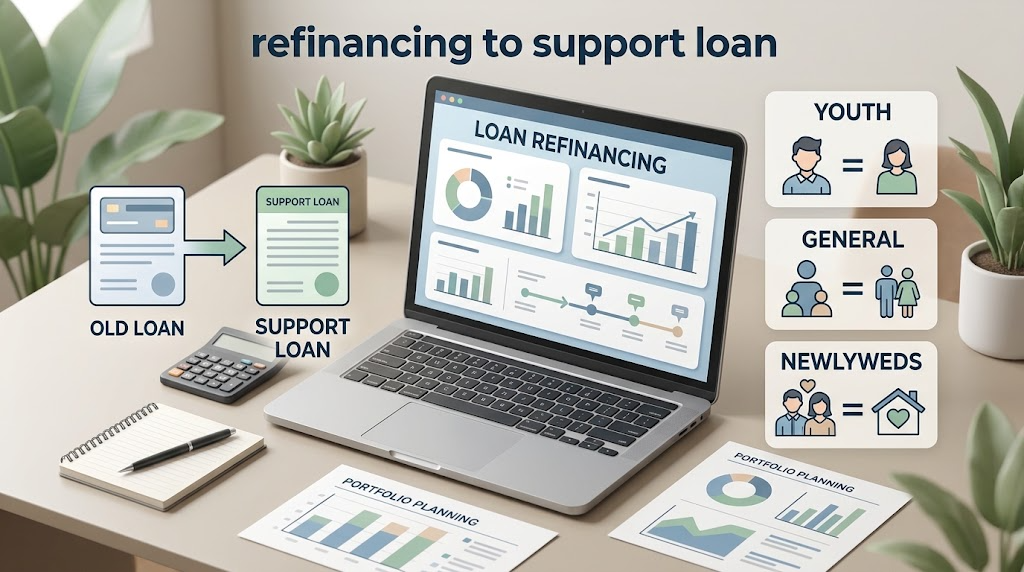
Comparison of Beotimmok Refinancing Products by Type (Youth vs. General/Newlyweds)
For the Beotimmok Jeonse Loan refinancing, the applicable product type varies depending on your age, marital status, and household members. Because the loan limit and interest rate benefits differ significantly depending on which type you select, you must first check the product most advantageous to your conditions.
- Comparison of Requirements and Limits by Core Product
| Classification | Youth-Exclusive Beotimmok | General Beotimmok | Newlywed-Exclusive Beotimmok |
|---|---|---|---|
| Target Age/Conditions | Ages 19 to 34 (including single-person household heads) | Household head aged 19 or older | Within 7 years of marriage or prospective newlyweds marrying within 3 months |
| Income Requirement | Combined annual income of couple (single) of 50 million KRW or less | Combined annual income of couple of 50 million KRW or less (60 million KRW for 2 or more children) | Combined annual income of couple of 75 million KRW or less |
| Target Deposit | 300 million KRW or less | Capital area 300 million / Non-capital area 200 million KRW or less | Capital area 400 million / Non-capital area 300 million KRW or less |
| Maximum Loan Limit | Up to 200 million KRW (within 80% of deposit) | Capital area up to 120 million KRW / Non-capital area 80 million KRW (with 2 or more children: Capital area 300 million / Non-capital area 200 million) | Capital area up to 300 million KRW / Non-capital area 200 million KRW (within 80% of deposit) |
| Basic Interest Rate (Variable) | Around 1.8% to 2.7% per annum | Around 2.4% to 3.3% per annum | Around 1.5% to 2.7% per annum |
- Key Points When Refinancing by Product
- Youth-Exclusive Beotimmok (Advantageous for Young Professionals and Single-Person Households)
- This is the product that should be reviewed with the highest priority if you are a young adult aged 34 or younger.
- Single-person household heads can also apply, and because ultra-low interest rates in the 1% to 2% per annum range apply within the maximum limit of 200 million KRW, it offers the largest interest savings compared to commercial bank loans.
- If military service was completed, the upper age limit is extended by the period of service (up to age 39).
- General Beotimmok (Single/General Households Exceeding Youth Age)
- Targets single-person household heads aged 35 or older or general households that do not meet newlywed requirements.
- The basic limit is relatively low at 120 million KRW for the capital area, but for multi-child (2 or more children) households, the loan limit is raised up to 300 million KRW for the capital area and 200 million KRW for non-capital areas, with the income threshold relaxed to 60 million KRW.
- Newlywed-Exclusive Beotimmok (Top Priority Option for Married Households)
- Applies to couples within 7 years of their marriage registration date or prospective newlyweds planning to marry within 3 months.
- Offers the widest income cap at 75 million KRW combined for the couple, and the limit supports up to 300 million KRW (within 80% of the deposit) based on the capital area.
- In particular, exceptional preferential interest rates starting from the mid-1% range per annum by income bracket are applied, making it an unconditional first priority to consider if you meet the newlywed requirements.
Tips for Applying Limits during Refinancing:
Even if the “maximum loan limit” for each product above is approved, the actual refinancable amount is restricted to within the remaining balance of the existing loan. However, if the deposit increases due to a lease contract renewal, additional limit evaluation is possible within the scope of the increase.

Loan Limit and Applied Interest Rate Calculation Method
The most important consideration when executing a Beotimmok jeonse loan refinancing is “how much can I actually refinance, and at what percentage will the final interest rate be determined?” The maximum limit under fund regulations and the actual approved limit use different calculation methods, and interest reduction benefits can be maximized only by thoroughly checking various preferential interest rates.
- Actual Refinancing Limit Calculation Formula (Minimum of 3 Criteria)
The fund refinancing loan limit is calculated across the following 3 items and finalized as the lowest amount (MIN).
- Existing loan balance: Principal balance of the commercial bank jeonse loan currently in use
- Deposit proportional limit: Within a maximum of 70% to 80% of the lease deposit (80% for youth and newlywed households, 70% for general)
- Fund maximum limit by product: Youth up to 200 million KRW / General capital area 120 million KRW / Newlywed couples capital area 300 million KRW, etc.
Precautions:
When performing a simple refinance in the same house without contract renewal, obtaining an additional loan exceeding the existing loan balance is not allowed. However, in the case of a renewal contract where the deposit increases, additional limit evaluation may proceed concurrently within the scope of the increased amount.
- Base Interest Rate Structure by Income Bracket
Beotimmok jeonse loans apply differential interest rates depending on the couple’s combined annual income and the size of the lease deposit.
| Couple Combined Annual Income Bracket | General Beotimmok | Youth-Exclusive Beotimmok | Newlywed-Exclusive Beotimmok |
|---|---|---|---|
| 20 million KRW or less | 2.4% per annum | 1.8% per annum | 1.5% per annum |
| Over 20 million KRW ~ 40 million KRW or less | 2.7% per annum | 2.1% per annum | 1.8% per annum |
| Over 40 million KRW ~ 60 million KRW or less | 3.0% per annum | 2.4% per annum | 2.1% per annum |
| Over 60 million KRW ~ 75 million KRW or less | Not applicable (General excluded) | 2.7% per annum (When applicable over 50 million) | 2.4% ~ 2.7% per annum |
(※ Variable interest rate applied based on Ministry of Land, Infrastructure and Transport notifications)
- Preferential Interest Rate Items You Lose Out on if Missed
The final executed interest rate is finalized by subtracting eligible combinable preferential interest rate items from the base interest rate (provided that the final interest rate cannot fall below the minimum floor).
- Execution of real estate electronic contract: 0.1%p reduction per annum (when using the Ministry of Land, Infrastructure and Transport Real Estate Electronic Contract System)
- Preferential treatment for housing subscription (comprehensive) savings subscribers:
- Subscription period of 5 years or longer & 60 or more installment payments: 0.3%p per annum
- Subscription period of 10 years or longer & 120 or more installment payments: 0.4%p per annum
- Subscription period of 15 years or longer & 180 or more installment payments: 0.5%p per annum
- Preferential treatment for multi-child and vulnerable households (check items that cannot be duplicated):
- Multi-child households 0.7%p per annum / 2-child households 0.5%p per annum / 1-child households 0.3%p per annum
- Single-parent households 1.0%p per annum / Multicultural, disabled, and elderly households 0.2%p per annum
- Youth preferential treatment: Additional 0.3%p per annum preferential treatment according to conditions such as single-person household heads aged 19 to 24 or youth employed at small and medium-sized enterprises
- Example of Monthly Interest Reduction Simulation When Refinancing
Here is the tangible difference when refinancing an existing commercial bank jeonse loan of 150 million KRW (interest rate of 4.8% per annum) into a Youth Beotimmok loan (2.1% per annum after applying preferential interest rates).
- Existing bank jeonse loan (4.8% per annum): Monthly interest approx. 600,000 KRW (7.2 million KRW per year)
- Youth Beotimmok refinancing (2.1% per annum): Monthly interest approx. 262,500 KRW (3.15 million KRW per year)
- Monthly savings: Saving approx. 337,500 KRW every month (approx. 4.05 million KRW saved per year)
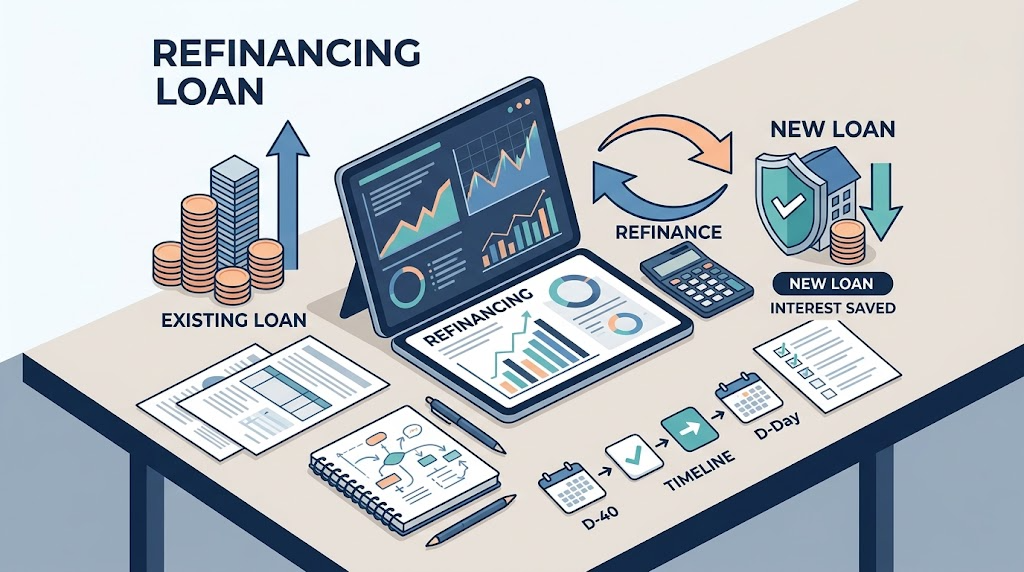
Step-by-Step Refinancing Procedure and Mandatory Preparation Documents
Unlike regular new loans, refinancing a Beotimmok jeonse loan proceeds in conjunction with verifying the loan balance at the existing bank and same-day repayment procedures. To prevent the process from getting complicated, you must thoroughly prepare in advance with step-by-step procedures aligned with the timeline and documents.
- 4-Step Refinancing Process
- Step 1: Check existing loan details and initial consultation (D-40 ~ D-30)
- Visit the bank where you are currently using the loan or check by phone regarding the principal loan balance, applied interest rate, and exemption from early repayment fees.
- Visit a branch of a Beotimmok-handling trustee bank (Woori, Kookmin, Shinhan, Hana, Nonghyup) for a primary consultation on refinancing availability and guarantee institution (HUG/HF) restrictions.
- Step 2: Gigeum e-Deundeun online preliminary asset review (D-30 ~ D-20)
- Submit a loan application on the Housing and Urban Fund Gigeum e-Deundeun website or mobile app.
- After consenting to the provision of personal and financial information for all household members, the asset and income preliminary screening proceeds via public MyData, and the qualification determination is usually completed within 3 to 5 business days.
- Step 3: Visit trustee bank and submit official documents (D-20 ~ D-10)
- After receiving the qualified preliminary screening decision, visit the designated trustee bank branch with all required documents.
- Complete the subject property screening, review of income verification documents, guarantee application with the guarantee institution, and pledge creation (or transfer of claims) procedures.
- Step 4: Loan execution and full repayment of existing loan on the same day (D-Day)
- On the day of loan approval, the newly handling bank directly deposits the refinancing loan funds into the virtual account (or repayment account) of the existing lending bank to repay the existing loan in full.
- When the existing loan repayment receipt and certificate of full debt payoff are issued, the refinancing process is finalized.
- Checklist of Mandatory Documents by Step
All issued documents must be issued within the last 1 month as of the application date, and printed with all 13 digits of the resident registration number displayed.
| Classification | List of Mandatory Preparation Documents | Issuing Agency |
|---|---|---|
| Identity Verification and Target Housing | • Original lease agreement with fixed date granted (or electronic contract)
• Receipt for payment of 5% or more of the lease deposit • Certificate of all registered matters of the leased residential building (certified copy of real estate registry) |
Community center / Internet registry office |
| Personal Information and Household Verification | • Resident registration certificate (including address history for the last 5 years)
• Abstract of resident registration (including military service record, if applicable to youth) • Family relation certificate (detailed) • Marriage relation certificate (detailed, if applicable to newlywed households) |
Government24 / Electronic Family Relationship Registration System |
| Proof of Income (Self and Spouse) | • Wage earners: Certificate of employment, earned income withholding tax receipt (last 2 years)
• Business owners: Business registration certificate, income amount certificate (last 2 years) • Non-income earners: Certificate of facts (no report on record), certificate of eligibility for national health insurance |
National Tax Service Hometax / National Health Insurance Service |
| Mandatory Documents Dedicated to Refinancing | • Financial transaction confirmation (indicating existing loan balance and collateral information)
• Loan handling confirmation or certificate of debt for existing jeonse loan • Virtual account confirmation for existing loan principal and interest repayment |
Bank of existing loan |
Practical tips for document preparation:
The ‘Certificate of Financial Transactions’ and ‘Certificate of Debt’ can be issued at branches of the existing lending bank or via internet banking. When issuing, set the stated purpose to ‘For submission to public institutions’ or ‘For refinancing loan’, and verify that the current balance and guarantee certificate collateral details (HF or HUG) are accurately printed to prevent rejection.

Points of Caution to Check Before Switching (Q&A)
If you proceed rashly by only looking at the surface interest rate, you may suffer unexpected setbacks due to early repayment fees or guarantee institution approval rejections. Here is a compilation of the most frequently asked key questions and cautions encountered during the actual refinancing process in Q&A format.
Q1. Is it beneficial even after factoring in incidental costs (early repayment fees, etc.) incurred during refinancing?
A. In most cases, it is far more beneficial even after accounting for fees, but calculating the remaining loan period is essential.
Early repayment fee: Existing commercial bank jeonse loans typically incur an early repayment fee of roughly 0.5%–1.5% (sliding scale applied) when repaid within 3 years of execution. (However, many banks waive this within 1 to 3 months before loan maturity)
Stamp duty and guarantee fees: For loan amounts exceeding 50 million KRW, stamp duty (borne 50% each by the bank and customer) and Housing & Urban Guarantee Corporation (HUG) or Korea Housing Finance Corporation (HF) guarantee fees are newly assessed.
Break-even point check: Comparing total fees (e.g., 500,000 to 1,500,000 KRW) against annual interest saved by converting to Beotimmok (typically 2,000,000 to 4,000,000 KRW), maintaining the loan for more than 3 to 5 months after refinancing usually yields interest savings that exceed the fees.
Q2. Can I switch guarantee institutions between HUG (Housing & Urban Guarantee Corporation) and HF (Korea Housing Finance Corporation)?
A. In principle, it is possible, but screening criteria differ completely between guarantee institutions, requiring caution.
HF guarantee (income-based): Determines the loan limit centered on the applicant’s income and credit score. Passing the screening is smooth if your personal proof of income is clear and you meet non-homeowner requirements.
HUG guarantee (property-based): Intensively screens the publicly announced price and prior-ranking claim (collateral mortgage) ratio of the leased property rather than the borrower’s income. Because the recognized ratio of publicly announced prices (such as the 126% rule) has recently tightened to prevent jeonse fraud, even for a house that previously obtained a HUG guarantee, there is a risk that the guarantee limit may decrease or be denied during refinancing due to declines in current published land prices.
Recommended action: You must re-verify whether the current residence satisfies the HUG guarantee limit in advance through the Safe Jeonse App or bank consultations.
Q3. Is the landlord’s consent required when refinancing ‘while residing in the same house’ without moving?
A. Depending on the guarantee method, landlord cooperation (such as notification of claim assignment) is essential.
Establishment of pledge or claim assignment notice: When refinancing with Beotimmok, the executing bank sends a ‘Notice of Assignment of Claims for Refund of Lease Deposit’ to the landlord via certified mail in accordance with the regulations of the guarantee institution (HUG, etc.).
Landlord confirmation call: Because the bank or entrusted agency contacts the landlord by phone to verify the jeonse contract details and check whether the notification was received, you must seek the landlord’s understanding in advance regarding potential confirmation contacts due to changing lending institutions (refinancing) to prevent disruptions in the process.
Q4. Can I refinance an amount smaller than the existing loan balance and self-pay the difference?
A. Yes, partial refinancing and self-payment of the difference are possible.
If the Beotimmok screening limit is determined to be less than the existing loan balance or if you wish to pay off a portion with personal funds, normal refinancing is possible if you first pay the shortfall directly (self-pay) from your personal account to the existing loan account on the execution day, and then settle the remaining balance in full using the Beotimmok refinancing loan proceeds.
Korean version: 한국어로 읽기