What Are Government-Funded Vocational Training and Training Allowances?
When learning new skills or preparing for re-employment, one of the biggest obstacles is the burden of ‘living expenses’ and ‘education costs.’ As the job search period lengthens, worries about fixed expenditures inevitably grow. To alleviate these burdens on job seekers and workers, the government operates training allowances alongside government-funded vocational training programs.
- What Is Government-Funded Vocational Training?
Government-funded vocational training is a program where the state supports a significant portion (or all) of the training costs needed for job competency development through the Tomorrow Learning Card (Kookmin Naeil Baeum Card) administered by the Ministry of Employment and Labor.
Eligibility: Most citizens who wish to develop their competencies, including job seekers (unemployed individuals), those seeking job changes, employed workers, and self-employed individuals (excluding certain civil servants, high-income earners at large corporations, etc.)
Support Details: Vocational training cost support for 5 years within a limit of 3 million to 5 million KRW per person
Training Fields: Diverse practice-oriented courses with high employment demand, including IT/coding, data analysis, web design, nursing/cooking/baking & pastry, and machinery/design
Because it provides not just theoretical learning but also field-oriented hands-on training and employment connections, it serves as an essential springboard for those who wish to change career paths or elevate their professional expertise.
- What Is a Training Allowance?
Even if people want to take vocational training, it is often difficult to participate in full-time education due to immediate transportation costs or meal expenses. The subsidy paid to resolve this issue is the training allowance.
Concept: An actual-expense support stipend paid to help secure minimum livelihood stability—such as meal expenses and transportation costs—for trainees who diligently participate in training
Purpose: Motivating trainees to complete the course without giving up midway due to financial hardship and to successfully find employment
Payment Method: Deposited directly into the trainee’s personal account by calculating the attendance rate during each monthly unit period (one month based on the training start date)
One-Line Summary
If government subsidies are a system that opens up ‘learning opportunities (tuition),’ the training allowance is a dependable safety net that protects the ‘minimum environment to focus on learning (transportation and meal costs).’

2026 Training Allowance Basic Eligibility Requirements & Support Amounts
Taking government-funded education does not mean that training allowances are automatically deposited for all trainees. As it is funded by government budgets, you become eligible for payment only when you satisfy set training hour standards and diligent attendance requirements.
- Basic Eligibility Requirements for Training Allowance
To receive a training allowance, you must satisfy both of the following core requirements simultaneously.
- Total Training Hours Requirement: Courses of 140 Hours or More
- The total training hours of the government-funded training course taken must be 140 hours or more.
- Short-term courses (less than 140 total hours) or online-focused short-term education are, in principle, excluded from training allowance payments.
- Unit Period Attendance Rate Requirement: Meet 80% or Higher
- Training is calculated on a monthly basis (Unit period: from the start date to the corresponding date of each month).
- The allowance for that month is paid only when the attendance rate is 80% or higher out of the prescribed training days in the relevant unit period.
- Caution: If the attendance rate falls to 79.9% or below, the allowance for that unit period is completely unpaid (0 KRW).
- Support Amount and Unit Price Structure as of 2026
The training allowance is basically paid on a pro-rata basis in proportion to the number of days participating in training. Subsidies in the nature of meal and transportation expenses are applied differentially depending on daily training hours.
- Daily Payment Unit Rate Standard:
- Training less than 5 hours per day: 2,500 KRW per day (transportation support nature)
- Training 5 hours or more per day: 5,800 KRW per day (transportation 2,500 KRW + meal 3,300 KRW)
- General Course Monthly Maximum Payment Limit:
- When taking general government-funded training (Tomorrow Learning Card general courses), if you attend fully without absences, it is paid for the actual days attended within a monthly maximum limit of 116,000 KRW.
- Additional Support for Special Training Courses (K-Digital Training, etc.)
In addition to general vocational training, if participating in special courses centered around government strategic industries, a separate additional stipend is paid alongside the basic training allowance.
| Classification | Major Target Audience & Courses | Monthly Maximum Support Amount |
|---|---|---|
| General Tomorrow Learning Card Course | General vocational training courses of 140 hours or more in total | Up to 116,000 KRW |
| K-Digital Training (KDT) | Advanced digital training such as AI, big data, and cloud | Up to 316,000 KRW
(Basic allowance 116,000 + Special stipend 200,000) |
| National Strategic Industry (Gukgi) | National strategic fields such as machinery, root industries, and smart factories | Up to 116,000 KRW
(Subject to change depending on category and policy standards) |
Checkpoint
Since the training allowance is calculated based on days attended, days without classes such as public holidays and academy closure days are excluded from the day count calculation. Therefore, in months where prescribed training days are fewer than 20 days, an amount slightly less than the maximum limit may be deposited.
Can I Receive It? Eligible vs. Excluded Recipients Summary
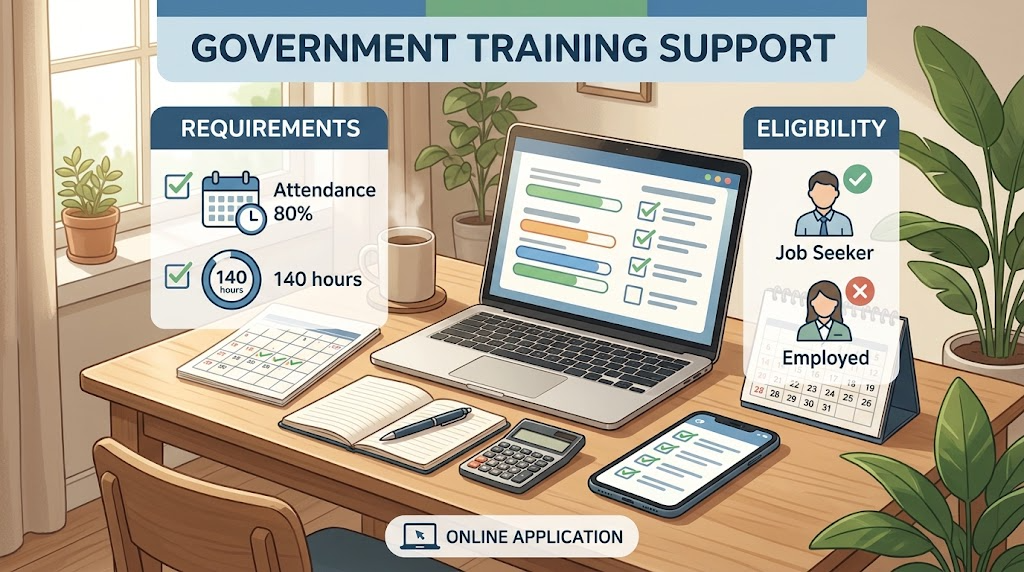
Even if you exceed an 80% attendance rate and participate in a course of 140 hours or more, training allowance paymentEven if you satisfy the total training hours (140 hours or more) and attendance rate (80% or higher) conditions, whether the training allowance is paid depends on an individual’s employment status or receipt of other government subsidies. Before applying, you must check whether you are an eligible recipient or an excluded recipient.
- Training Allowance Eligible Recipients
Basically, it is paid primarily to job seekers who need living expense support because they have no earned income or separate livelihood support.
- Job seekers in unemployed status: Purely unemployed/unhired individuals not enrolled in employment insurance
- National Employment Support Program (Kukchije) participants:
- National Employment Support Program Type I: When receiving the Job Search Promotion Allowance (500,000 KRW or more per month), the Ministry of Employment and Labor basic training allowance may be withheld or adjusted under the principle of preventing duplicate receipt.
- National Employment Support Program Type II: When participating in training, you can receive support by linking the training allowance along with the Training Participation Support Allowance.
- Vulnerable workers with short working hours: Short-time workers working fewer than 15 hours per week (ultra-short-time workers)
- Small-scale self-employed: Small business owners whose annual revenue is below a certain standard (those meeting the Tomorrow Learning Card support criteria)
- Training Allowance Excluded (Non-payment) Targets
If you fall under even one of the conditions below, the training allowance is not paid (0 KRW) even if you diligently attend a course of 140 hours or more with an attendance rate of 80% or higher.
- Recipients of Unemployment Benefits (Job Search Benefits):
- During the period unemployment benefits are paid, livelihood support funds are already provided, making duplicate receipt with the training allowance impossible. (Normal payment is possible starting from the next unit period after the unemployment benefit payment period ends)
- General Employed Workers Enrolled in Employment Insurance:
- General workers enrolled in the four major social insurances (employment insurance) at regular workplaces who generate earned income are, in principle, excluded. (Excluding special cases such as short-time workers working fewer than 15 hours per week)
- Individuals on Leave and Voluntary Career Changers:
- Excluded if taking courses while on paid leave or maintaining an employment relationship.
- Individuals Exceeding Income Thresholds:
- Individuals who fall outside government support requirements, such as high-income professionals and business operators with sales exceeding a certain scale
- Beneficiaries of Similar Government Subsidies During the Same Period:
- Those participating in projects where duplicate receipt with livelihood support allowances (youth allowance, livelihood benefits, etc.) paid by central government ministries or local governments is restricted
- Eligible vs. Excluded Targets Comparison at a Glance
| Classification | Major Target Group | Allowance Payment Status | Notes |
|---|---|---|---|
| Purely Unemployed | Job seekers not enrolled in employment insurance | Paid | Upon satisfying the 80% attendance rate for basic courses of 140 hours or more |
| Unemployment Benefit Recipients | Those currently receiving job search benefits | Not paid | Eligible to receive starting the day after unemployment benefit receipt ends |
| General Employed Workers | Workers enrolled in employment insurance working 15 hours or more per week | Not paid | Training costs for workers are supported, but allowances are excluded |
| Short-Time Workers | Employment insurance subscribers working fewer than 15 hours per week | Paid | Proof of short-time work required |
| National Employment Support Program Type II | Participants in Type 2 of the National Employment Support Program | Paid | Can be received in conjunction with the Training Participation Support Allowance |
Helpful Tip
If you take a government-funded course while receiving unemployment benefits and the expiration date of your unemployment benefits falls within the training period, the allowance may be paid on a pro-rata basis for the remaining days attended after the expiration date, so it is advisable to check with the training institution’s administrative office.

3 Steps for Online Government Subsidy (Tomorrow Learning Card) Application Method
To receive a training allowance while taking the vocational training you want, you must first be issued a Tomorrow Learning Card. Without visiting an Employment Welfare Plus Center in person, you can conveniently apply online from home through the Ministry of Employment and Labor integrated platform.
Here is the application process, which may seem complicated, summarized into 3 key steps.
STEP 1. Access Employment24, Sign Up, and Authenticate Identity
Major Ministry of Employment and Labor services such as the vocational training portal (HRD-Net) and Worknet are integrated into the Employment24 platform.
- Access the Employment24 Website: Search for ‘Employment24’ or ‘HRD-Net’ on portal search engines to access the official site.
- Login and Identity Authentication: Log in after verifying identity via your preferred method among joint certificate, financial certificate, or simple authentication (KakaoTalk, Naver, PASS, etc.).
- Check Job Search Registration (For Unemployed/Job Seekers):
If you wish to receive the training allowance under unemployed status, ‘Job Search Registration’ within Employment24 must be completed before applying for the card. Register your basic resume and self-introduction letter, and obtain a job search verification number.
STEP 2. Online Application for Tomorrow Learning Card Issuance
Once login is complete, navigate to the card issuance menu and fill out the application form following the instructions.
- Navigate to the Issuance Application Menu: Select Vocational Competency Development → Tomorrow Learning Card → Apply for Issuance on the main screen.
- Confirm Basic Information and Eligibility:
Enter name, Resident Registration Number, contact details, actual residential address, etc.
Check the self-diagnosis items to confirm whether you fall under excluded categories (civil servants, private school faculty and staff, large corporation employees with income above a certain threshold, etc.).
- Select Card for Issuance and Designate Delivery Method:
Choose your preferred bank among affiliated financial institutions (Shinhan Card or NH Nonghyup Card).
Designate the card type (check card or credit card) and receiving method (postal delivery or in-person pickup at a designated bank branch).
- Attach Supporting Documents (If Necessary):
Attach scanned copies or photos of documents if separate eligibility verification is required, such as for small business owners (Certificate of Value Added Tax Taxable Standard, etc.) or prospective university graduates (Certificate of Enrollment/Expected Graduation, etc.).
- Watch Video Training: Watch the mandatory informational video of about 10–15 minutes regarding the card’s issuance purpose and usage rules, and submit the confirmation questions.
STEP 3. Explore Training Courses and Apply for Enrollment
While the card issuance review is underway (usually taking 3–7 business days), search for desired training courses in advance and prepare to apply for enrollment.
- Search Training Courses:
Set fields of interest (e.g., web design, big data, baking & pastry, etc.) or residential regions in the Employment24 detailed training search bar.
Essential Check: If you wish to receive the training allowance, you must check courses with ‘total training hours of 140 hours or more’ in the search filter.
- Check Course Application Method:
Short-term courses under 140 hours: You can apply for course enrollment online freely and immediately.
Long-term courses of 140 hours or more: After applying online, training consultation procedures (by phone or in person) with an Employment Center representative may proceed, so check the consultation schedule according to notification messages.
- Pay Out-of-Pocket Expenses and Finalize Registration:
Once enrollment approval is complete, follow the guidance of the academy (training institution) to pay your out-of-pocket expenses (around 0–50% depending on the course) using the issued Tomorrow Learning Card, and finish preparations to join classes on the start date.
Application Tip
Because it takes at least 1 week to 10 days for card issuance review and physical card delivery, it is safe to start applying for the card with plenty of time, at least 2–3 weeks before the start date of your desired training course.

Practical Precautions to Prevent Non-Payment of Allowances
Even if you think you have met the requirements, there are quite a few cases where training allowances are regrettably processed as unpaid if you overlook minor mistakes in attendance management or the characteristics of the settlement system. We have compiled core practical precautions you must be familiar with to avoid unfairly missing out on allowances.
- Attendance Management: Minor ‘Entry/Exit Tagging’ Mistakes Become Absences
The training allowance is calculated on a daily pro-rata basis strictly according to official attendance records registered in the Employment24 (HRD-Net) computer network.
Be Sure to Tag Both Entry and Exit
Upon entering the academy and when leaving after class ends, you must personally register both entry and exit.
Even if you tagged entry, forgetting to tag exit results in an absence on the system or a situation requiring complicated justification procedures.
Cumulative Management of Tardiness, Early Departure, and Temporary Absences (3 Occurrences = 1 Absence)
Tardiness, early departures, and temporary absences are combined, and accumulating 3 occurrences is treated as 1 absence.
If you participate in less than 50% of the total daily training hours, that day itself is immediately treated as an absence rather than tardiness or early departure, so strict compliance with class hours is required.
Immediately Submit Supporting Documents for Official Leaves (Excused Absences)
If an unavoidable absence occurs due to illness, family events (condolences/congratulations), national qualification examinations, reserve forces training, etc., it can be processed as an official leave.
You must submit relevant supporting documents, such as hospital medical certificates/treatment verification forms or exam confirmation slips, to the academy administration office immediately after the absence (at the latest within the prescribed deadline) and obtain approval to protect the 80% attendance rate requirement.
- Settlement Cycle and Deposit Schedule: It Is Not the ‘End of Every Month’
This is where many trainees experience confusion, asking, “A month has passed since I started attending classes, so why hasn’t it been deposited?”
The standard for settlement is the ‘unit period’
The training allowance is not settled on a 1st-to-end-of-the-month basis, but rather in one-month units (unit periods) based on the start date.
(Example: If classes begin on March 15, the 1st round unit period is March 15 to April 14)
Administrative time required until actual deposit
It is not deposited right the next day after the corresponding unit period ends.
Unit period ends ➔ Academy’s final attendance closing and transmission to the competent Employment Center (takes several days) ➔ Attendance/eligibility review and payment approval process by the Employment Center representative.
Usually, it is deposited into the account under your own name registered during application about 2 to 3 weeks (around 15 to 20 days) after the unit period end date based on business days, so you should wait with patience.
- Mandatory Reporting for Duplicate Receipt, Employment, or Part-Time Jobs
If changes occur in your status or income while taking courses, there is a risk that allowance payments will be suspended or clawed back.
Part-time jobs and work activities
If you work 15 hours or more per week during the training period and enroll in the four major social insurances (employment insurance), you will be converted to an employed worker and immediately excluded from training allowance eligibility.
If you must balance a part-time job, you must strictly follow the ultra-short-time work standard of fewer than 15 hours per week, and it is safe to consult with your instructor or the administrative office in advance regarding its feasibility.
Check for conflicts with other government allowances
You must carefully check every unit period whether your receipt period overlaps with National Employment Support Program allowances, local government youth allowances, unemployment benefits, etc.
If duplicate receipt is identified, you may face allowance clawback actions afterward.
Checklist to keep firmly in mind
- Verify completion of QR code/beacon tags every day upon entering and leaving
- Periodically check via the Employment24 app whether the attendance rate for this unit period is maintained at 80% or higher
- Remember that deposits take about 2 to 3 weeks after the unit period ends

Conclusion and Frequently Asked Questions (Q&A)
The government-funded vocational training system is an excellent stepping stone to enhance employment competitiveness, and the training allowance is a valuable benefit that serves as a dependable support during long training periods. As long as you thoroughly satisfy the requirements (courses of 140 hours or more, attendance rate of 80% or higher), you can create an environment where you can fully immerse yourself in training each month.
Lastly, we have compiled and organized the 5 most confusing and frequently asked questions by prospective trainees.
Frequently Asked Questions (FAQ)
Bareun HRD Education Center
Q1. Do I get a training allowance if I take online (internet remote) lectures?
Bareun HRD Education Center
A.
No. Because the purpose of the training allowance is to compensate for transportation and meal expenses incurred by commuting to the academy daily, it is paid solely for offline classroom training (in-person attendance).
100% remote online training courses are not supported with allowances even if total hours exceed 140 hours.
CATIA School
+ 1
Q2. Can I receive the allowance if I work a short-term weekend part-time job during the training period?
A.
It is conditionally possible. In principle, your qualification to receive the allowance is maintained if it is ultra-short-time work of fewer than 15 hours per week (fewer than 60 hours per month).
However, if you are registered as a regular employee under the four major social insurances (employment insurance) or your working hours exceed 15 hours per week, you are classified as an ’employed worker’ and will be excluded from the allowance immediately, so consulting with the academy administration office in advance is recommended.
CATIA School
+ 1
Q3. If I fail to reach an 80% attendance rate, do I get nothing at all for that month, not even for a single day?
A.
Yes, that is correct. If the attendance rate for that unit period (1 month) falls to 79.9% or below, the allowance for that month is completely unpaid (0 KRW), regardless of how many days you attended. If there are unavoidable reasons such as illness or exams, you must submit supporting documents in advance to obtain approval for an excused absence.
CATIA School
Q4. What happens if my unemployment benefit receipt expires in the middle of a course?
A.
During the period of receiving unemployment benefits, training allowances cannot be received concurrently and are treated as unpaid. However, starting the day after the unemployment benefit expiration date, you become included in the eligibility for training allowance payments and can receive a pro-rata calculated amount based on the remaining days attended. After your benefit expires, it is good to confirm the expiration fact with the competent Employment Center and academy.
CATIA School
Q5. When each month is the training allowance deposited into the bank account?
A.
After the unit period (one month based on the start date) ends, the academy’s attendance closing and the competent Employment Center’s approval process take place. Generally, it is deposited sequentially into the bank account registered during the issuance of the Tomorrow Learning Card about 2 to 3 weeks (around 10 to 15 business days) after the unit period end date.
CATIA School
+ 1
Financial worries can be a major burden in the process of preparing for new challenges. We cheer you on to utilize the Tomorrow Learning Card and training allowance system without gaps, ease your cost burden, and achieve your goals of competence enhancement and successful employment.
Korean version: 한국어로 읽기