
Introduction: Overwhelmed by Employment and Job Changes? Let’s Spread Our Wings with Government-Funded Education!
In a rapidly changing job market, searching for a new career or preparing to transition jobs while leveraging your own expertise often feels like an overwhelming challenge that makes your heart drop just thinking about it. Are you hesitating, thinking, “Can I really get hired at the place I want with my current qualifications?” or “I want to learn new skills, but the expensive tuition fees make me hesitant”?
Rather than knocking on the doors of employment and job transitions all on your own while spending massive amounts of cost and time, actively utilizing the ‘government-funded education’ program generously supported by the state can drastically lower your financial burden and provide you with the most certain breakthrough to build practical competencies.
However, once you actually access the Ministry of Employment and Labor’s Employment 24 platform, countless training courses such as IT, design, computerized tax accounting, barista, and K-Digital Training pour out, making it easy to lose your way on which one to pick. If you blindly jump into a course that others say is good without considering your own career goals and employment status, you might end up wasting only your time and energy.
In this article, we will carefully compare the core benefits by type of various government-funded education programs and step-by-step figure out how to smartly find ‘the optimal training course that fits you best’ among numerous lectures. We hope you will spread your wings for a new career wide open with systematic preparation and wise choices!
Step 1: Basic Understanding of the Tomorrow Learning Card and Looking Over Representative Types of Government-Funded Education
Before full-fledgedly starting government-funded education, the first step is to accurately understand the core concepts of the ‘National Tomorrow Learning Card’, which serves as the basis for all government-supported training, and representative training courses. Only when you properly understand the system can you 100% utilize the support benefits given to you.
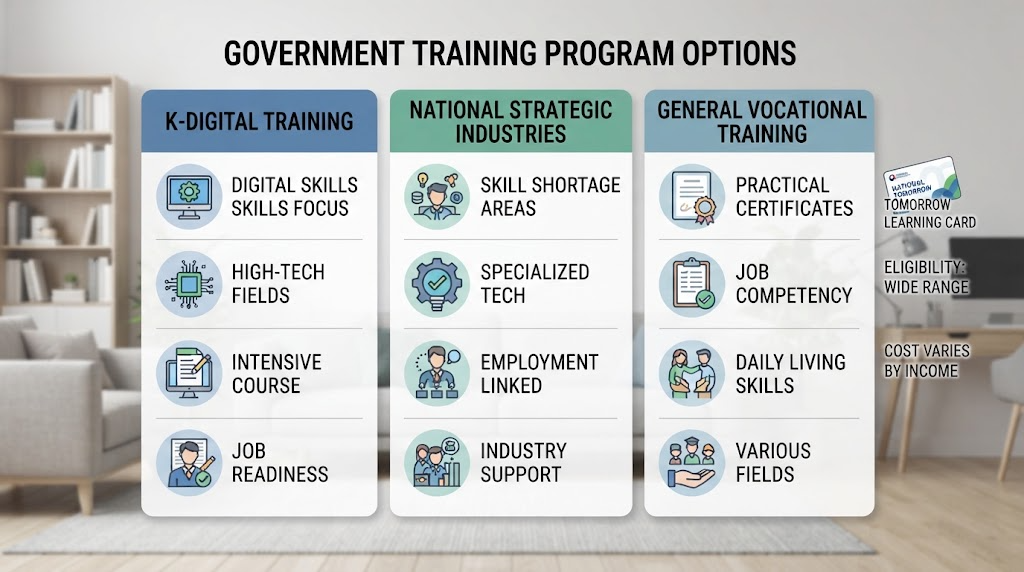
The National Tomorrow Learning Card is a lifelong vocational competency development support system that anyone who is a citizen of the Republic of Korea can apply for, and it is a practical education passport through which you can receive training costs supported by the state ranging from 3 million won to a maximum of 5 million won per individual.
Gukmin naeil baeum-kadeunun daehan minguk gukminiramyeon nuguna cheongcheonghal su inneun…
Target audience and issuance: It can be widely issued regardless of employment status such as the unemployed, employed workers, and self-employed individuals, and differences in the self-pay rate occur depending on the income level.
Representative types of government-funded education:
K-Digital Training: An intensive training course to foster practical talents in cutting-edge industries and digital/new technology fields.
National Key and Strategic Industry Sectors Training: An employment-linked course that fosters professional technical personnel for labor-shortage occupations and strengthening national competitiveness.
General Vocational Training: Various certification and job competency improvement courses closely related to daily life and practical work, such as computerized tax accounting, barista, care worker, and design.
Try selecting what to check next:
Compare core benefits by major training field in Step 2
View know-how on selecting custom courses tailored to you

Step 2: From IT/Development to Certifications, Comparing Core Benefits by Major Training Field
Once you have grasped the basic concepts of the National Tomorrow Learning Card, it is time to narrow down the ‘training field’ that suits your goals and aptitude. The numerous educational courses registered on Employment 24 can be broadly divided into digital fields dealing with future cutting-edge technologies and traditional popular certification fields directly linked to employment and entrepreneurship.
Let’s carefully compare the characteristics and core benefits of representative courses in each field, and check which option is most advantageous for your career roadmap.
Step 1: ‘K-Digital Training’ and ‘K-Digital Foundation Competency Training’, which intensively foster digital and new technology competencies
Target audience and characteristics: A high-end training course centered on full government support (or substantial support) created to foster practical talents in core technology fields of the 4th Industrial Revolution, such as artificial intelligence (AI), big data, cloud computing, and fintech.
Core benefits: Ranging from ‘Foundation Competency Training’, which can be taken even by humanities students or non-majors lacking basic coding knowledge, to ‘K-Digital Training’, where you can experience mentoring from active developers and actual corporate project collaborations. Since the training cost burden is very low or often operated entirely with government funds, it becomes the most powerful weapon for those dreaming of transitioning into the digital field.
Step 2: Cheat keys for employment and entrepreneurship, traditional popular certification and practical job duty courses
Target audience and characteristics: Practical certification and job training courses that can be used immediately in daily work or the job-seeking market, such as computerized tax accounting, care workers, baristas, computer literacy, and interior design.
Core benefits: Boasting solid curriculums verified over a long period, the rate of linking directly to related industry employment, freelance activities, or small business entrepreneurship after completion is very high. A certain percentage of self-pay costs occurs depending on an individual’s income level and employment rate by occupation, but if you want to quickly prove your qualifications through practical certification, it is the most stable choice.
💡 Core tips you must never miss when selecting a field
Harmony between trends and your aptitude: Rather than blindly chasing the trending IT field, considering your usual tendencies, interests, and linkage with existing careers to choose a field where you can sustainably immerse yourself is the shortcut to increasing your completion rate and employment success rate.
Pre-reviewing detailed curriculums: Even for the same certification course, there are differences in the professionalism of instructors or employment support linkage programs depending on the training institution, so it is wise to carefully compare the graduate reviews and curriculums on the training course detail page before deciding.
If you clearly target and comparatively analyze the training field that suits you, you can upgrade your practical competencies most reliably without wasting time and money.

Step 3: Know-How on Choosing Customized Courses Perfectly Suited to Your Employment Status and Goals
To find the optimal course that suits you best among countless government-funded education courses, you should base your decision on ‘your own current employment status and specific career goals’ rather than the flashy promotional slogans of training institutions. If you blindly follow what others say is good and apply, you might end up quitting midway because it does not fit your situation or failing to gain practical benefits.
Let’s learn the customized selection know-how to choose the most advantageous training course according to your individual current situation and make 100% use of the Employment 24 platform.
Step 1: Clearly understand your current employment status and support type
Job seekers (Unemployed): For those whose immediate priority is getting a job, it is advantageous to choose ‘National Key and Strategic Industry Sectors Training’ or courses that include intensive employment programs, which have high employment rates and link directly to job matching after completion.
Employed workers and office workers: For those currently working and seeking a career transition or enhancement of job competencies, you should choose weekend classes, night classes, online/offline blended (hybrid) courses, or short-term job competency improvement courses to balance work and study.
Freelancers and self-employed individuals: Even if you do not belong to a specific company, you can utilize the National Tomorrow Learning Card if you meet certain income criteria, so it is recommended to choose design, marketing, and specialized technical courses that can be immediately deployed in practice to enhance your competitiveness.
Step 2: Utilize Employment 24 platform’s ‘detailed search filters’ by 200%
Rather than simply entering keywords in the training course search box on the Employment 24 homepage, you should actively utilize detailed filters.
Set region and training methods: Clearly check whether you will take offline academy classes near your residence or receive remote (online) training without time and space constraints.
Check self-pay rates and training fees: Pre-simulate the self-pay amounts generated according to your support type and choose a course that fits your budget.
💡 Core tips you must never miss when selecting a customized course
Refer to vivid reviews from graduates: Indirectly experiencing the instructors’ teaching skills, the academy’s facility environment, and the practical effectiveness of actual employment linkage through reviews of graduates who went through the course first significantly reduces the probability of failure.
Utilize pre-consultations at your jurisdiction’s employment center: If you truly cannot get a handle on which course to choose on your own, visiting the employment center under your jurisdiction of residence or receiving a vocational psychological test and one-on-one advice from a professional counselor via phone consultation is also a very wise method.
If you sharply filter training courses tailored to your employment status and clear goals, you can lay the groundwork for certain career growth while spending time and money most efficiently.

Step 4: Practical Tips on Receiving 100% Training Incentives, Attendance Management, and Enrollment
Once you have carefully selected a training course that catches your eye, all that remains is the ‘practical stage’ where you move beyond theoretical preparation to actually apply for enrollment, complete the course safely, and fully reap the benefits. No matter how well you know the government support system, if you miss the enrollment period or neglect attendance management, an unfortunate incident where you do not receive support funds may occur.
Let’s examine step-by-step practical know-how that you must remember for successful course completion and thrifty benefit reception.
Step 1: Completing course registration and self-pay settlement without mistakes
Press the ‘Course Registration’ button for your desired training course through the Employment 24 platform, and check the balance and expiration date of your National Tomorrow Learning Card once again.
The self-pay amount (out-of-pocket cost) incurred according to each individual’s support type must be paid with the issued National Tomorrow Learning Card (credit or check card) in your own name so that government-funded benefits are normally applied, so you must pay special attention not to use other cards.
Step 2: Thorough attendance check management and securing 100% training incentives
Importance of attendance management: For offline classes, you must tag your card on the designated terminal or accurately record entry and exit times with a smartphone app, and for online lectures, you must fulfill the specified progress rate. Normal completion and benefits are granted only when you achieve an overall attendance rate of 80% or higher.
Conditions for receiving training incentives: If you record an attendance rate of 80% or higher while taking long-term training courses of 140 hours or more, ‘training incentives’ for livelihood stability are paid to your bank account every month during the training period, so faithful attendance soon becomes cash-like benefits.
💡 Core tips you must never miss for practical completion
Fast application against capacity closure: Popular training courses close early in capacity, so it is recommended to grasp the opening date and application period in advance and apply with leeway.
Pre-registration of account information: To receive training incentives smoothly without delay, check in advance before the opening day whether the receiving account in your name is correctly registered on Employment 24.
If you solidly familiarize yourself with practical tips ranging from systematic enrollment to faithful attendance management and receiving training incentives, you can surely achieve successful results that minimize cost burdens and maximize career competencies through government-funded education.
Korean version: 한국어로 읽기