
Introduction: Why Waste Disposal Becomes a Headache Amid the Chaos of Moving
As you prepare to move into a new home with an excited heart, packing and coordinating schedules alone can keep your body and mind endlessly busy. However, near the final stages of moving preparation, there is a headache that perplexes us the most: the massive amounts of moving waste and unused large furniture and appliances piled up all over the house.
“Is it awkward to take them to the new house, and I don’t know how to handle just throwing them away…” This is a moment when helplessness comes first. If you blindly put them in standard plastic bags or leave them unattended, you might be mistaken for illegal dumping and face a fine bomb, or you may find yourself in an awkward situation unable to do anything pressed for time on moving day.
To perfectly resolve moving waste disposal that is burdensome to handle on your own, many people look for professional agency companies. However, if you hastily entrust just any company, you may experience significant stress on your precious moving day due to unexpected overcharging or illegal disposal issues.
In this article, we will step by step examine the core checkpoints you must keep in mind when entrusting a moving waste disposal agency. We hope you finish your move cleanly and lightheartedly without stress through thorough advance preparation and wise company selection!
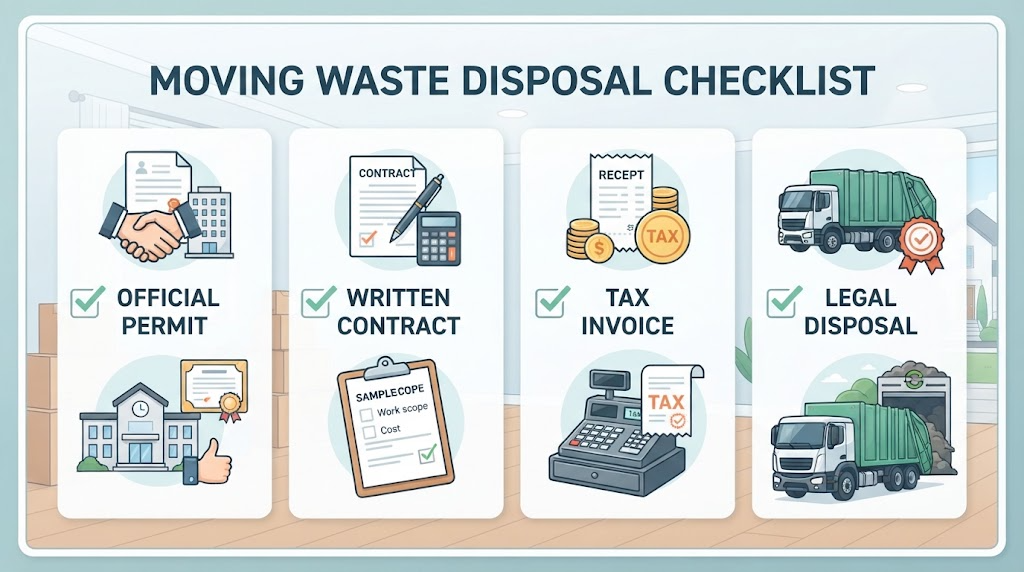
Step 1: ‘Official Licensing Status’ That Must Be Checked Before Selecting a Company
The core requirement that must be checked first and most strictly when entrusting a moving waste disposal agency is the company’s “official licensing status.” When searching on portal sites, countless waste disposal companies put out advertisements, but a considerable number of unlicensed companies without permits from competent authorities are mixed in, requiring special caution.
Let’s look at the fatal problems that can occur when rashly entrusting an agency to an unlicensed company and specific tips for distinguishing safe companies.
Step 1: Fatal Risks and Damage Cases of Unlicensed Companies
Legal responsibility for illegal dumping: There are cases where an unlicensed company secretly dumps waste in deserted places to save costs. In this case, even the generator (homeowner), who is the source of the cause, must share responsibility, so you can be unfairly subjected to fine dispositions or get caught up in legal disputes.
Overcharge bombs and irresponsible disappearance: After enticing you with a low estimate at first, they frequently make all sorts of excuses after loading your luggage to demand exorbitant additional costs or completely cut off contact.
Step 2: Tips to Distinguish and Verify Legitimate Officially Licensed Companies
Checking jurisdictional local government licenses and business registration: Before selecting a company, you must meticulously compare copies of the business registration and license to see if the company has properly acquired a waste collection/transportation business or related legitimate permits.
Issuance of contracts and availability of tax invoices: Legitimate licensed companies transparently draw up official contracts specifying work details and costs, and can issue tax invoices upon request. It is wise to be suspicious of places that induce cash payment by saying, “It will be cheaper if you pay in cash first,” and avoid writing contracts.
To ensure that your moving waste disposal, entrusted with your precious money, is not tainted by illegality or disputes, never neglect checking the first button: “official licensing status.”

Step 2: Transparent Cost Estimation and Overcharge Prevention Through “Visiting Estimates”
Once you have carefully checked the official licensing status and selected a company, the next important step is to estimate accurate and transparent costs through a “visiting estimate.” Since moving waste disposal has many variables depending on field conditions such as the house structure, amount of luggage, and whether a ladder truck is needed, it is difficult to gauge the exact amount solely through phone or photo consultations.
Let’s look at the core tips for visiting estimates that you must go through to prevent overcharging and entrust the agency at a reasonable cost.
Step 1: Recognizing the Limitations of Phone or Online Estimates
If you proceed with a contract believing only words like “it will be about roughly this much,” you are likely to experience failure. This is because if companies cannot see the site directly, they often quote prices with a safety margin considering risks, or show up at the site on moving day demanding additional fees by claiming “the amount is larger than thought” or “work is difficult because there is no elevator.”
Step 2: Utilizing Free Visiting Estimate Services to Confirm Exact Costs
Most competent professional companies provide free visiting estimate services. An expert directly visits the house, meticulously checks the volume and types of waste and the working environment (floor level, alley entry status, ladder truck installation availability, etc.) with their own eyes, and then calculates the final estimate.
During this process, you must check factors that could incur additional costs in advance and thoroughly examine whether there are any hidden costs not specified in the estimate (e.g., waste disposal site intake costs, additional labor costs, etc.).
💡 Core Tips to Perfectly Block Overcharges
Comparing estimates from multiple companies: Rather than trusting just one company’s estimate, it is safer to receive visiting estimates from at least 2 to 3 professional companies and compare costs and service scopes. It is wiser to choose a place where the estimate contents are most transparent and clear rather than unconditionally the cheapest one.
Putting conditions for additional fees in writing: If there are exception clauses where additional costs may occur due to special large furniture or heavy items, these should be specified in writing in the contract or estimate rather than verbally.
Transparent visiting estimates and advance coordination serve as a reliable shield that blows away financial stress on moving day and lets you finish the work most lightheartedly. We hope you make a rational choice through meticulous comparison.
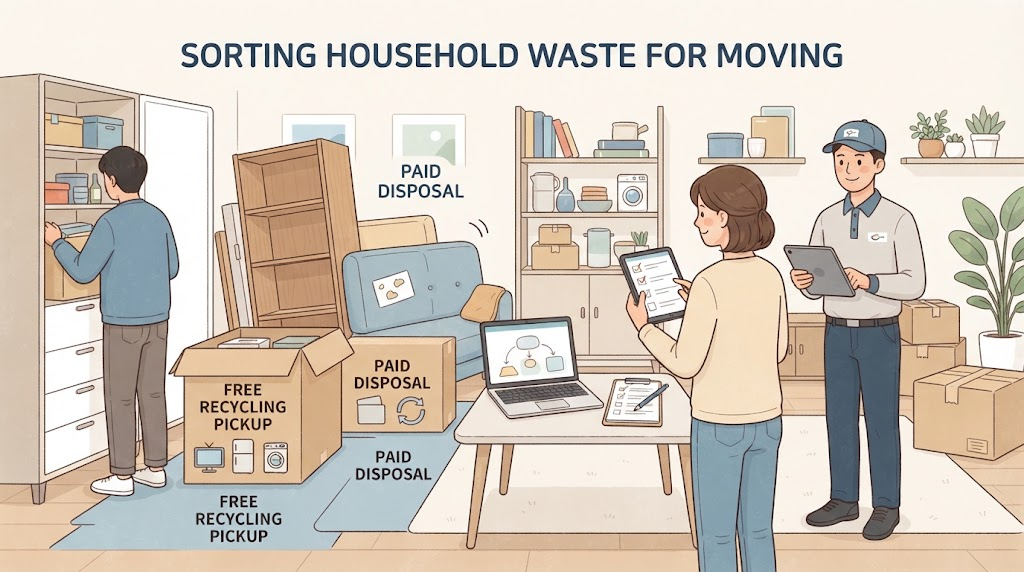
Step 3: Check Waste Separation and Recyclable Items
Once you have checked the approximate cost of the agency through visiting estimates, the next wise thing to do is to pre-classify and check items in the house that are eligible for “free collection” and “recyclable items.” If you blindly hand over all luggage as waste, disposal costs will soar unnecessarily, so whether or not you go through this process can significantly save you moving costs.
Let’s look at specific tips for self-inspection and cost reduction before calling a disposal agency.
Step 1: First Sort Out Items Eligible for Free Visiting Collection Among Large Home Appliances and Furniture
Major large home appliances such as refrigerators, washing machines, air conditioners, and TVs do not need to be paid for and thrown away as waste. This is because if you use “E-Circular Governance” (waste home appliance free visiting collection service) operated by the government, technicians will visit your home directly and collect them for free.
Checking items subject to large waste stickers by local government: Large furniture items such as desks, wardrobes, and sofas must be discharged after paying large waste fees and issuing stickers through autonomous district administrative welfare centers or internet homepages. If you delegate all of this to the agency, additional agency fees may be attached, so it is recommended to compare whether secondhand center purchases or local government disposal is more advantageous.
Step 2: Separate Items with Recycling Value and Utilize Secondhand Transactions
For home appliances, furniture, and clothing that are still usable, try free sharing or low-cost sales through local communities such as Danggeun Market or Junggonara. If your moving schedule is tight, it is much more economical to get a small refund or offset disposal costs through a secondhand purchasing company.
💡 Core Tips to Save on Waste Disposal Costs
Reducing volume through thorough pre-sorting: Most costs paid to the agency are calculated based on the “volume and weight” of the waste. Useless miscellaneous goods and small household waste should be separated and discharged in standard plastic bags in advance, and you should leave only the large luggage and waste that are truly hard to handle for the agency to significantly lower the estimate.
Negotiating the scope of separate discharge: When contracting with the agency, you must draw a clear line on “to what extent we throw away ourselves and which items the agency clears out” to prevent misunderstandings or demands for additional costs at the site.
The small effort of sorting yourself and smartly filtering out recyclable items becomes the surest cheat key to making your moving account ledger much lighter. We hope you prepare for your move economically with meticulous advance checks.

Step 4: Clarify Scope of Work and Limits of Liability (Contract Drafting)
Once you have finished sorting to reduce waste disposal costs, it is time to proceed with the most important step in the final contracting stage with the agency: “clarifying the scope of work and limits of liability.” The biggest reason friction occurs on moving day or during work—such as “this was not supposed to be done in the first place” or “the wallpaper tore, but we cannot compensate you”—is precisely because agreements were made roughly only by word of mouth.
Let’s look at the core checkpoints that must be included in the contract to safely and transparently wrap up the agency service.
Step 1: Specify Specific Scope of Work and Items
Confirming where to clear from and to: You must write down the exact scope of work in sentences in the contract, specifying whether it is clearing all trash in the house or collecting only large furniture and waste in a specific room or veranda.
Checking whether demolition work is included: If built-in closet demolition, veranda structure demolition, interior restoration to original condition, etc. are included, you must make sure to verify whether the amount completely includes loading waste after demolition.
Step 2: Check Liability Regulations for Accidents That May Occur During Work
During the process of lowering heavy furniture using a ladder truck or removing luggage, rare accidents can occur where the living room floor is gouged, or wallpaper, elevators, or public facilities are damaged.
In the case of a legitimately licensed company, they are often enrolled in business liability insurance that guarantees compensation in the event of such accidents. If you clearly record a clause stating “the company will fully compensate if facility damage occurs during work” in the special notes of the contract, you can entrust them with much more peace of mind.
💡 Tips You Must Never Miss When Drafting a Contract
Putting reasons for additional fees in writing in advance: If additional fees may inevitably occur depending on field conditions (e.g., unexpected excess waste volume, extra ladder truck time, etc.), agree in advance in writing on under what conditions and how much will be charged.
Verbal promises are a taboo, leave all contents on receipts or contracts: If you trust only a verbal promise like “I’ll clear out more later as a service,” you are likely to be demanded additional fees on moving day with claims of forgetfulness. If there are service contents promised, it is a wise method to write them down somewhere in the corner of the contract.
Drafting a contract that clarifies the scope of work and limits of liability serves as the most powerful and secure safety device to preemptively block all unnecessary emotional consumption and financial disputes that may occur on moving day.
Korean version: 한국어로 읽기