
Introduction: Waste Left Unattended Until the Night Before Moving—Why Is It Always a Headache?
Even while eagerly anticipating a move to a new home with an excited heart, there is a reason why one corner of your chest feels heavy when moving day approaches right before your eyes. It is precisely because of the large amount of waste and unused large luggage left unattended in every corner of the house that holds us back until the night before the move.
The moving preparation period is unimaginably busy just coordinating schedules with packing and moving companies, settling various utility bills, and preparing for resident registration. Because of this, people put off sorting their belongings, thinking, “I’ll just clear it all out at once later,” and end up facing mountains of piled-up trash late at night before the move, feeling utterly dismayed.
If you blindly stuff things into standard waste bags or leave them unattended in a corner of the balcony, you might get stopped by the management office on moving day or mistaken for illegal dumping, landing you with an unfair fine bomb. Moreover, trying to handle it hurriedly on the moving day leaves you woefully short on time, inevitably leaving you unable to do this or that while burdened with massive stress.
In this article, we will step by step go through a systematic organizing routine that allows you to smartly organize waste that becomes a headache until the night before the move and welcome moving day with the most carefree mind. Complete a stress-free, successful move with meticulous advance planning!
Step 1: Drawing the Line Between What to Throw Away and What to Take (Advance Sorting Routine)
The very first and core gateway to successfully completing moving waste disposal is “drawing a clear line between what to throw away and what to take.” If you start sorting belongings only when moving day arrives, not only will you lack time, but you are also bound to make mistakes such as blindly throwing away useful items or conversely dragging things that should immediately go into the trash can to your new home.
Let’s look step by step at a systematic advance sorting routine that simultaneously saves moving costs and unnecessary waste disposal expenses while maximizing the efficiency of moving preparation.
Step 1: Boldly selecting items not used for over a year
From clothes sitting unworn in the closet for years, small home appliances sleeping in a corner of the kitchen, to dust-covered miscellaneous items, if you keep packing them with the mindset that “I’ll use them someday,” you will only increase your moving costs. Items that your hands have not touched or whose usage frequency has been close to zero over the past year require a resolute decision to boldly empty them out this time.
Step 2: Proceeding with primary classification according to item characteristics
If you handle household items by mixing them all together at once, it will only intensify confusion later. When organizing belongings, it is smooth to divide them into zones by characteristics as follows:
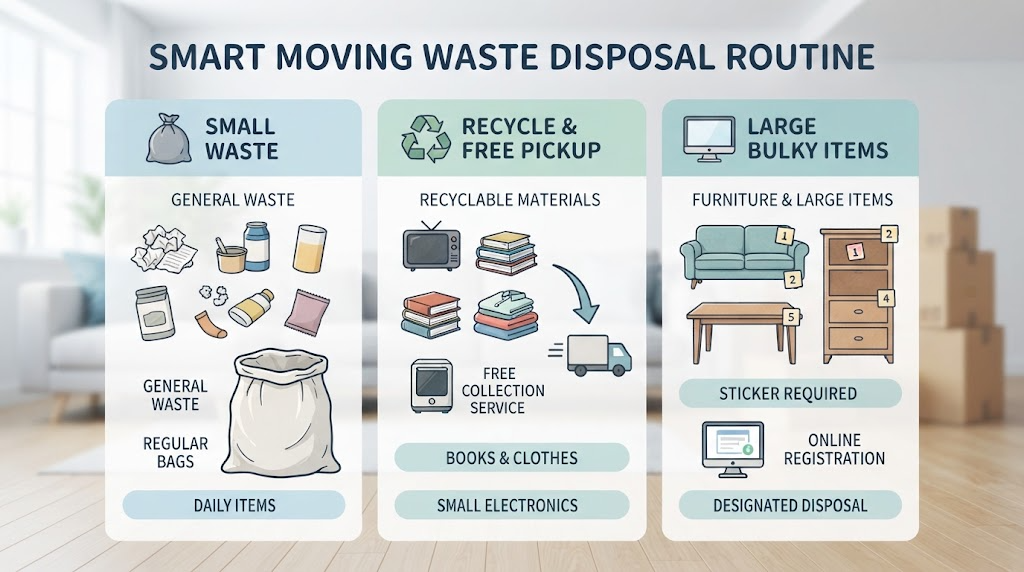
Small household waste: Everyday miscellaneous items and contaminated goods, which are items to be discharged by putting them in designated standard plastic bags.
Recycling and free collection targets: Books, clothing, and large home appliances like refrigerators and washing machines for which free visiting collection can be requested through “E-Circular Governance” or similar services, gathered separately.
Local government sticker targets: Finalizing items categorized as bulk waste—such as furniture (wardrobes, beds, desks, etc.)—that require internet reporting followed by attaching a sticker.
An advance sorting routine goes beyond simply reducing belongings; it is the wisest first step to pre-design the direction of waste disposal you will need to undertake. Start your carefree moving preparation by lightly emptying your space with clear criteria!

Step 2: 200% Utilization of Free Collection Services That Reduce Costs to Zero and Increase Convenience
One of the main culprits that weighs down your wallet the most when moving is heavy, large home appliances and waste disposal costs. However, if you know a little about the system and approach it smartly, you can 200% utilize a win-win free collection service that slashes disposal costs down to “0 won” while completely relieving physical hardship.
Let’s learn in detail how to utilize core free collection services that lightly ease the economic burden of moving preparation and maximize convenience.
Step 1: Actively applying for free visiting collection of large home appliances through “E-Circular Governance”
If you try to dispose of bulky and heavy home appliances such as refrigerators, washing machines, air conditioners, and TVs out of your own pocket, the waste sticker cost alone easily exceeds tens of thousands of won. In such cases, using the “Waste Home Appliance Free Visiting Collection Service (E-Circular Governance)” operated in cooperation with the Ministry of Environment and local governments is the correct answer.
How to apply: You can easily make a reservation via the internet homepage (www.wec.or.kr) or call center, and a dedicated collection technician will directly visit your home to safely collect the home appliances.
Utilization tip: Since reservations can close early coinciding with moving dates, you must book your schedule at least 1 to 2 weeks in advance as soon as your moving date is confirmed to prevent scrambling on moving day.
Step 2: Smartly completing internet issuance and discharge procedures for local government bulk waste stickers
For large furniture items not included in the free collection target—such as wardrobes, beds, mattresses, and desks—you must report the bulk waste fees online through your competent local government (city, county, district office) homepage and be issued a payment certificate (sticker).
Without needing to directly visit the community service center like in the past, you simply enter the items and specifications online, pay by card, and attach the printed report (or a confirmation paper with fee details written on a blank sheet) to place it at the designated location or in front of your house for a neat resolution.
💡 Core Tips You Must Never Miss When Using Free Collection and Discharge
Prohibition of arbitrary discharge and compliance with collection dates: You must be careful because failing to attach a sticker or violating designated discharge days and times can be regarded as illegal dumping, resulting in fines.
Considering donation for reusable items: Utilizing free donations or secondhand trading through Beautiful Store or local government recycling centers for furniture or appliances in good condition is a great way not only to save disposal costs but also to participate in environmental protection.
If you smartly utilize free collection services that boldly wipe away cost burdens and increase convenience, the stress of moving preparation will be cut in half, and your wallet will become much thicker.
Step 3: Building a Safety Net from Selecting an Agency to On-Site Estimates and Contract Drafting
If the volume is too overwhelming to handle on your own, or if packing and moving schedules are tightly intertwined with interior demolition timelines, disposing of all waste by yourself is virtually impossible. In such cases, it is wise to seek help from a professional waste disposal agency, but choosing an agency indiscriminately can leave you bearing the brunt of damages from rip-offs, additional cost demands, or illegal disposal.
Let’s look at the specific steps to select a reliable agency you can trust with peace of mind and build a thorough safety net.
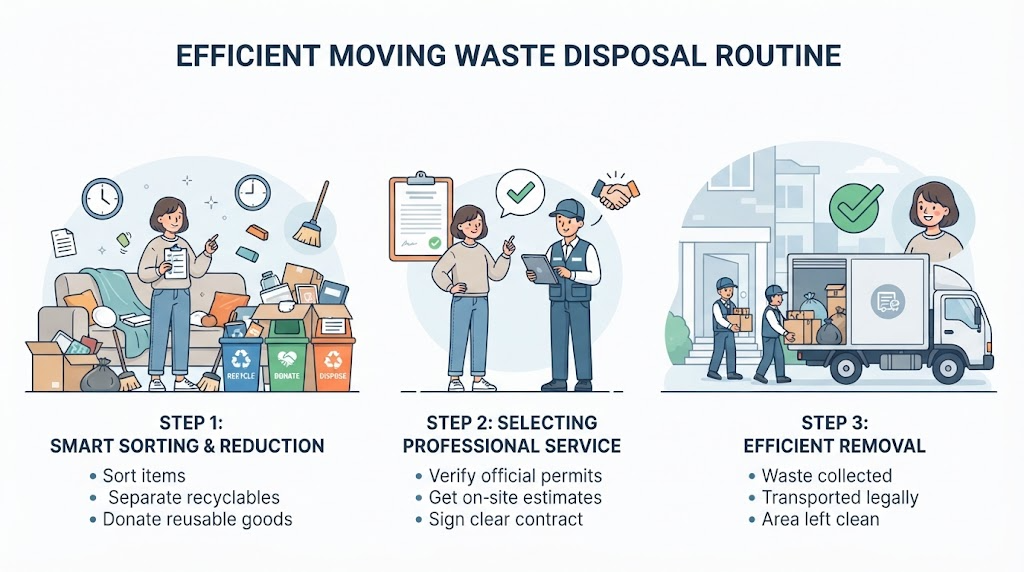
Step 1: Meticulously verifying whether they are an “officially licensed company” by the competent authority
Among companies advertised on the internet or flyers, there are quite a few unlicensed, small-scale operators. If you entrust waste disposal to an unlicensed company and it is handled through illegal dumping or inappropriate methods, the arrow of responsibility may return entirely to you as the homeowner who discharged it.
The first step to safety is to check their business registration and license to ensure they are a company officially authorized for waste collection and transportation by the relevant local government, and to thoroughly examine whether they are registered with government offices.
Step 2: Blocking rip-offs with “on-site estimates” instead of phone estimates
If you roughly ask for estimates just through phone calls or photo exchanges, it is easy for unfair situations to occur where they suddenly change their tune on moving day, making excuses like “now that we’re here, the volume is large,” and demanding additional fees.
You must call the company to your home and receive a “free on-site estimate” that accurately diagnoses the actual amount and volume of waste, as well as the working environment (presence of an elevator, necessity of a ladder truck, etc.).
Step 3: Drafting a “detailed contract” specifying the scope of work and limits of liability
Rather than making rough verbal promises, you must document detailed items to ensure the estimated amount includes collection costs, transportation fees, demolition labor costs, and disposal fees.
You must sign a contract specifying conditions for additional fees that may arise on moving day or limits of liability for damages such as building damage, so you can prevent unnecessary monetary conflicts in advance.
💡 Core Tips You Must Remember When Using an Agency
Getting comparative estimates from multiple companies: It is wise to receive on-site estimates from at least 2 to 3 officially licensed companies, compare service contents and costs reasonably, and then make a final decision.
Thorough advance communication: You must clearly coordinate the list of items to be collected and the work completion time with the company so that the entire moving schedule does not experience disruptions.
If you equip yourself with a solid safety net of thorough advance verification and transparent contract drafting, you can perfectly resolve the disposal of massive moving waste without stress through expert hands.

Step 4: Perfect Finishing on Moving Day and Welcoming a Carefree New Beginning
Through thorough advance sorting, utilization of free collection services, and selection of a reliable professional company, the fateful “moving day” has finally dawned. Since time flies frantically on moving day as packing and moving trucks pull in and belongings are transferred, failing to perfectly wrap up waste disposal can make your steps toward your new home feel heavy.
Let’s look at specific tips to flexibly cope with unexpected variables that may occur on-site on moving day, cleanly conclude all waste organization, and move into your new house with a carefree mind.
Step 1: Final Inspection of the Moving Site and Confirmation of Waste Removal
Look around every nook and cranny of the empty house from which all moving luggage has been removed, and visually check one last time whether there is any residual trash or omitted waste.
If you used a professional agency, meticulously check whether collection was perfectly carried out within the promised scope of work, and whether there is any small trash or bulk waste fragments left unattended in the corner of the balcony or utility room.
Step 2: Smartly Coping with Additional Fees and Unexpected Variables
Even if you completed on-site estimates in advance, unexpected luggage may be added or variables such as extended ladder truck usage time may occur depending on the on-site situation on moving day.
At this time, rather than reacting emotionally, it is wise to calmly negotiate with the company representative based on the contents of the contract written in advance, and settle after confirming clear reasons if additional costs occur.
💡 Core Tips You Must Never Miss for Finishing on Moving Day
Final check of discharge stickers and receipts: Make final checks on whether bulk furniture placed in front of the house with local government stickers attached was cleared away in time for the promised collection time, and keep the discharge confirmation or receipt for a short while in preparation for possible civil complaints.
Management office settlement and final greetings: Inform the management office of your previous residence that waste discharge and utility bill settlements have all been completed normally, and finish your deposit settlement and key return with a carefree mind.
The finishing touch on moving day, welcomed after overcoming the long preparation process and complex waste disposal, is truly the prelude to a new beginning. Put down all your heavy baggage with a meticulous and perfect organizing routine, and start your pleasant leap forward in your new home with a light heart!
Korean version: 한국어로 읽기