Introduction: The Frustrating Situation of Receiving a ‘Rejection Notice’ After Applying for the National Tomorrow Learning Card
When preparing to receive government-supported education to acquire a new certification or transition your career, applying for the ‘National Tomorrow Learning Card’ is the very first step. Thinking that any Korean citizen can easily get it issued, you might click the application button only to unexpectedly receive a ‘rejection (ineligible)’ notice a few days later, which can be quite frustrating.
The main situations where many people feel confused after receiving a rejection notice for the National Tomorrow Learning Card, and the reasons why you should thoroughly check your eligibility in advance to prevent this, are as follows.
Wasted Steps and Time: If you research academies according to the course opening schedule and set up your training plan only to have your card application rejected, you have to sort out your qualifications from scratch or delay your schedule, thereby wasting precious time.
Complex and Strict Exclusion Criteria: Because the National Tomorrow Learning Card is promoted as a ‘support system for everyone’, many people apply without realizing that they fall under legally established support exclusion targets (student status, high-income self-employed individuals, specific occupation groups, etc.).
Variables of Income and Employment Type: Cases of receiving failure notices are frequent because applicants do not accurately understand issuance criteria that subtly vary depending on the scale of their current workplace, monthly wage level, or business registration status.
To prevent the bitter experience of being rejected due to a mismatch with conditions like this, you need the wisdom to carefully examine whether your status and income criteria accurately match the issuance targets before blindly applying. In the next step, we will examine in detail the basic support targets of the National Tomorrow Learning Card and the core criteria of ‘exclusion targets’ whose issuance is absolutely rejected.

What is the National Tomorrow Learning Card? Understanding the Basic Concept of Support Targets
The National Tomorrow Learning Card is a representative government-supported system where any Korean citizen can receive support for vocational skill development, but not everyone can be issued one without exception. Since there are clear support exclusion targets legally defined according to the purpose of the system, employment type, and income level, checking these in advance is very important.
The basic support target concept of the National Tomorrow Learning Card and the core criteria you must know when issuing it are as follows.
- Basic Support Target Concept of the National Tomorrow Learning Card
himz Subsidy Notes
Embracing the General Public: The National Tomorrow Learning Card is issued to most Korean citizens who want employment, job transition, and job competency improvement, such as job seekers, employed workers (employees), self-employed individuals, and special-type labor workers.
Izen Academy Education Group
Support Scale and Period:
It supports a part (or all) of the training fees from a basic 3 million KRW up to a maximum of 5 million KRW per person, and once issued, the account remains valid for 5 years, making it a powerful benefit that allows you to receive systematic vocational training whenever needed.
himz Subsidy Notes
+ 1
- ‘Support Exclusion Targets’ Who Cannot Get It Issued (1st Priority Reason for Rejection)
Due to the nature of the system, specific groups judged to have very high employment stability or relatively low need for national financial support are excluded from issuance targets. Representative exclusion targets are as follows.
Public officials and private school faculty and staff:
Due to their stable employment status, issuance is restricted in principle while they are in active service.
Employment 24
Elderly persons aged 75 or older:
According to the support age upper limit regulations, those aged 75 or older are excluded from issuance targets.
Wanted Customer Center
+ 1
General students not in their expected graduation period:
In the case of high school students or university (graduate) students, if the remaining years of study until graduation exceed 2 years, they cannot be issued one.
(However, students enrolled in their expected graduation year are exceptionally allowed.)
himz Subsidy Notes
High-income wage workers (large enterprise employees): If you are currently employed at a large-scale enterprise, have a monthly wage of 3 million KRW or more, and are under 45 years of age, you are excluded from support targets.
(Those aged 45 or older or employees of small and medium-sized enterprises can be issued regardless of income.)
Employment 24
High-income self-employed individuals and special-type labor workers:
Self-employed individuals who generate annual sales above a certain standard (e.g., annual sales of 400 million KRW or more, or restrictions based on business history and income criteria) or high-income special-type labor workers and corporate representatives may have their issuance rejected.
himz Subsidy Notes
+ 1
Others among livelihood benefit recipients and duplicate supporters of training expenses from other ministries: Duplicate benefits may be restricted if you are a livelihood benefit recipient or are receiving education and training expense support through other laws and systems.
💡 Card Application Tip: If you are not sure whether you ambiguously fall under the issuance exclusion targets, checking your member information and employment insurance history through the Employment 24 (formerly HRD-Net) homepage or checking in advance with the jurisdictional Employment Welfare Plus Center (Ministry of Employment and Labor Customer Center without area code at 1350) before blindly proceeding with the application is the surest way to avoid a rejection notice.
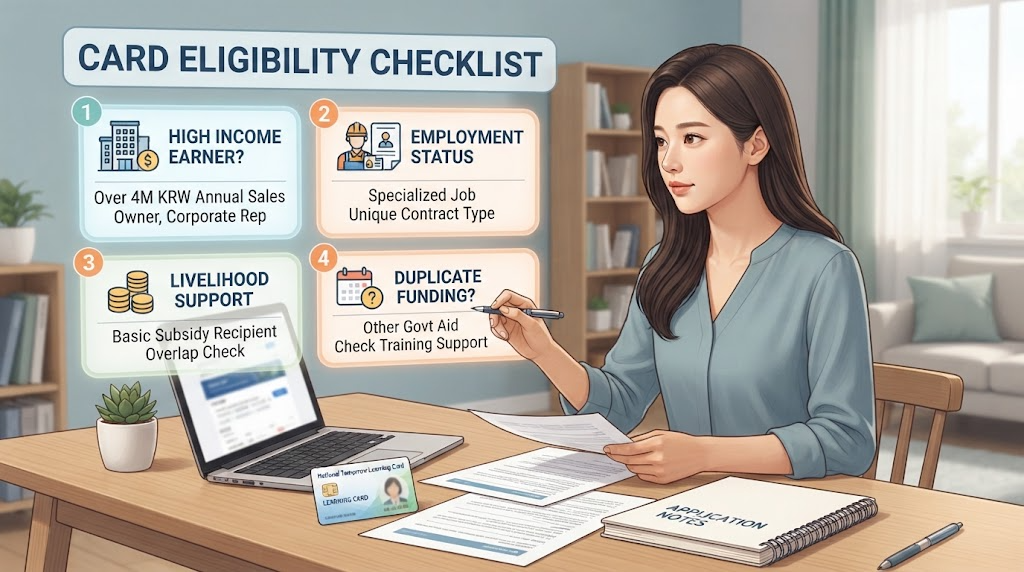
Thoroughly Checking ‘Issuance Exclusion Targets’ (1st Priority Reason for Application Rejection)
The most common reason for receiving a ‘rejection (ineligible)’ notice after applying for the National Tomorrow Learning Card is because you applied without realizing that you fall under the ‘issuance exclusion targets’. Since clear beneficiary criteria are established as it is a government-supported financial project, if you fall under even a single one of the exclusion targets below, your card issuance will be rejected.
The 4 representative issuance exclusion targets that you must check thoroughly before applying are as follows.
- Public Officials and Private School Faculty and Staff
Reason for Exclusion: Public officials (national and local government) and private school faculty and staff belonging to occupational groups whose employment stability and retirement age are legally guaranteed by the state are excluded in principle from National Tomorrow Learning Card support targets.
Check Point: Military personnel, special service public officials, etc. may also have their issuance restricted according to stable employment status criteria, so you must accurately check the affiliation status of the organization where you are currently employed.
- Elderly Persons Aged 75 or Older
Reason for Exclusion: Although the National Tomorrow Learning Card aims to help lifelong vocational skill development, individuals aged 75 or older hit the upper age limit for issuance and have their applications rejected due to the efficient operation of the system and age-based support limits.
Check Point: If you are under 75, you can apply without age restrictions, so you must check in advance whether you fall within the target age based on your date of birth on your resident registration.
- General Students Not in Their Expected Graduation Period (High School and University Students)
Reason for Exclusion: Students currently enrolled in school are generally not eligible for the National Tomorrow Learning Card.
Exception Criteria: Issuance is exceptionally permitted only for final-year students of universities (graduate schools) or 3rd-year high school students (such as vocational classes) whose remaining years of study until graduation are within 2 years.
Check Point: Caution is required because if 1st or 2nd-year university students or enrolled students with a long time remaining until graduation apply in advance for the purpose of job preparation, they will be 100% rejected.
- High-Income Wage Workers and Self-Employed Individuals Above Certain Criteria
Reason for Exclusion: To preferentially support small and medium-sized enterprise (SME) workers and small-scale self-employed individuals, specific groups whose income exceeds certain criteria have restricted issuance.
Representative Criteria:
Employees of large-scale enterprises (large enterprises) who are under 45 years of age and have a monthly wage of 3 million KRW or more.
Self-employed individuals exceeding certain criteria with annual sales of 150 million KRW or more (※ For self-employed individuals, detailed criteria may vary depending on tax base proof, etc.)
Check Point: If you are employed at a large enterprise, are under 45 years of age, and your monthly salary exceeds 3 million KRW, your issuance will be rejected through general methods, so individual inquiry through the Employment Center is required.
💡 Check Tip: Even if you do not fall under the above exclusion targets, computer errors or unqualified judgments may occur in the system depending on your recent employment insurance subscription history or the timing of insured status changes. It is safe to first check your exact employment status and employment insurance history on your Employment 24 (formerly HRD-Net) My Page before applying.

‘Income and Monthly Salary Criteria’ That Employees and Self-Employed Individuals Must Check
The National Tomorrow Learning Card is basically a system encompassing both job seekers and employed workers, but in the case of employed workers (wage workers) and self-employed individuals, issuance availability and support conditions are strictly divided according to income and sales scale. Since you may be excluded from support targets or rejected if your income exceeds certain criteria based on tax or employment insurance declarations, you must definitely check your exact income bracket before applying.
The core income and monthly salary criteria that employed workers and self-employed individuals must check when applying for the card are as follows.
- Wage Workers (Employed Workers): Criteria for Large Enterprises and High-Income Workers
To preferentially support vocational skill development for SME workers and low-income groups, workers working at large enterprises or receiving a salary above a certain level have their issuance restricted according to age conditions.
Core Restriction Criteria: As a large-scale enterprise (large enterprise) worker under 45 years of age, if your monthly wage (before taxes) is 3 million KRW or more, you are excluded from issuance targets.
Exception and Mitigation Conditions:
Large enterprise workers aged 45 or older can be issued the National Tomorrow Learning Card even if their monthly salary exceeds 3 million KRW.
Workers currently employed at small and medium-sized enterprises (priority support target enterprises) are included in issuance targets regardless of age or monthly wage level.
Confirmation Tip: If your monthly wage before taxes hovers around the 3 million KRW line based on your average salary statement or health insurance premium payment details for the recent 3 months, it is safe to go through accurate qualification checks via the Employment 24 system before applying.
- Self-Employed Individuals: Annual Sales and Business Type Criteria
In the case of self-employed individuals, they are not unconditionally excluded simply because they operate a business, but annual sales criteria are applied to focus support mainly on small-scale business owners.
Core Restriction Criteria: Self-employed individuals with annual sales of 150 million KRW or more may have restrictions on being issued the National Tomorrow Learning Card. (※ However, detailed screening criteria may be applied differently depending on the business type, business history, and income amount on the tax base certificate.)
Exceptions:
Small-scale self-employed individuals with annual sales of less than 150 million KRW, sole proprietors, freelancers, etc., can normally apply for issuance.
Even if annual sales exceed the criteria, if it is a special situation such as a suspended or closed business status or a sharp drop in sales, there are cases where you can receive relief through supporting documents.
Confirmation Tip: You should obtain your recent value-added tax tax base certificate or income amount certificate in advance through Hometax to objectively check your annual sales and income scale, which can lower the probability of rejection.
💡 Income Criteria Check Tip: For workers, income criteria are computationally screened based on the monthly remuneration reported by the company and health insurance premium payment amounts every month. Because of this, if there is a month where your monthly salary exceeded 3 million KRW temporarily due to the inclusion of bonuses or allowances, an ineligible judgment may occur during the screening process, so if you are in an occupation with frequent income fluctuations, it is wise to inquire about your qualifications with the jurisdictional employment center in advance.

4 Essential Checkpoints Before Application and Prior Confirmation to Make the Rejection Probability Zero
The 4 essential checkpoints that you must review before applying to completely prevent receiving a ‘rejection (ineligible)’ notice after applying for the National Tomorrow Learning Card and to get approval at once are as follows.
- Prior Membership Registration and Job Seeking Registration Status Check on Employment 24 (Formerly HRD-Net) and WorkNet
Computer Integration Check: Application for the National Tomorrow Learning Card is mainly processed through Employment 24, the integrated portal of the Ministry of Employment and Labor. You must complete membership registration in advance and register a joint certificate (financial certificate) before applying to enable smooth identity verification and information lookup.
Job Seeking Registration Status: Especially when applying for a card as a job seeker status, resume registration and job seeking application must be successfully completed on WorkNet for the card issuance screening to proceed smoothly. Since omission of job seeking registration often leads to delayed screening or rejection, you must definitely check the prior integration status.
- Check Your Exact ‘Employment Insurance Insured Status History’
History Inheritance and Change Check: Immediately after your employment type changes, such as preparing to move jobs after resignation or transitioning from a contract worker to a freelancer, employment insurance status histories on the computer system may not be reflected in real time or errors may occur.
Detailed Inquiry Essential: It is safe to check your employment insurance insured status history statement through the Korea Workers’ Compensation and Welfare Service Employment and Industrial Accident Compensation Insurance Total Service or Employment 24 My Page, check whether the exact code for your current employment status or job seeker status is entered, and then apply.
- Check for ‘Duplicate Benefits’ with Other Government Support Projects
Support Grant Duplicate Restriction: Since the National Tomorrow Learning Card is a training support project funded by national finances, if you are already receiving similar training expense support projects from other laws, local governments, or government ministries (such as specific employment support packages or full national expense encouragement funds from other ministries) at the same time, you may be rejected due to duplicate benefits.
Regulation Check: You must carefully compare in advance whether welfare benefits and training expense support, such as other Ministry of Employment and Labor projects or local government youth allowances, do not conflict.
- Inquire in Advance with the ‘Jurisdictional Employment Center’ for Ambiguous Cases
Overcoming the Limitations of Computer Systems: Individuals whose criteria fall ambiguously, such as those with vague freelance contract types, employment at large enterprise subsidiaries, scheduled return to work during parental leave, or sole proprietors with difficult sales verification, easily end up receiving a rejection notice after waiting a few days relying solely on online computer applications.
Prior Phone Consultation: If you are unsure whether your conditions fall under the issuance exclusion targets, before blindly clicking the application button, calling the jurisdictional Employment Welfare Plus Center (or the Ministry of Employment and Labor Customer Center without area code at 1350) first to inform them of your specific status and income conditions and getting a definitive answer on availability is the surest shortcut.
💡 Checkpoint Tip: Even if you receive an issuance rejection notice, the reason is detailedly guided via Employment 24 notification talk or text message, so you can quickly resolve it by accurately grasping the reason for rejection, supplementing documents, or talking with the employment center person in charge to raise an objection.

Conclusion: Succeeding in National Tomorrow Learning Card Issuance at Once Through Accurate Target Condition Verification
So far, we have examined in detail everything from the reasons why people unexpectedly receive rejection notices when applying for the National Tomorrow Learning Card, the basic support targets of the system, issuance exclusion targets to absolutely avoid (public officials, elderly persons, general students, high-income workers and self-employed individuals), strict income criteria for employed workers and self-employed individuals, to pre-checkpoints that make the probability of rejection zero.
The National Tomorrow Learning Card is a reliable government-supported benefit that serves as a valuable stepping stone for those trying to pioneer new careers and acquire professional certifications. However, since you can wait for screening for days and receive a futile rejection notice if you do not fit the purpose of the system and financial support criteria, the wisdom of thoroughly verifying your conditions before applying is necessary. Lastly, we deliver practical advice that you must remember for successful card issuance and smooth start of government-funded education.
- Thoroughly Compare Your Status and Income Conditions Rather Than Blindly Applying
Before clicking the application button with the vague mindset that ‘it will probably work for me too’, you must carefully examine whether you match your employment type (employed worker, job seeker, freelancer), age, large enterprise employment status and monthly salary level, and self-employed annual sales criteria.
If there are any ambiguous parts, checking in advance through the Employment 24 system or the Ministry of Employment and Labor Customer Center before computer application is the surest prevention method.
- Organize Computer Systems in Advance, Such as Employment Insurance History and Job Seeking Registration
Since most card issuance screenings are automatically linked and processed digitally, you can prevent errors by completing Employment 24 and WorkNet membership registration, completing job application, and accurately checking your employment insurance insured status history in advance.
To prevent disqualifications caused by small document omissions or unreflected change histories, the habit of directly checking your status through My Page before applying is important.
- Achieving the Career Leap You’ve Been Putting Off Using the Card as a Priming Water
If you have finally been issued the National Tomorrow Learning Card through strict qualification verification, now is the time to invest your precious time and passion to build new competencies.
Based on what you checked today, we sincerely cheer for you to successfully finish applying for the card you’ve been putting off all at once, and make a powerful leap toward a more confident and shining tomorrow using reliable government support as a stepping stone!
Korean version: 한국어로 읽기