
Introduction: Why Youth Housing Stability Matters and Overview of Support Policies
Amid soaring housing costs and an unstable real estate market in recent years, housing stability for young adults has become one of the most critical requirements determining successful entry into society and independence, going beyond merely an individual housing issue. For young people starting their independence, such as fresh graduates, college students, and job seekers, the monthly rent and housing deposits they must pay every month inevitably become a significant financial burden.
To alleviate this housing burden and help young adults prepare for their future in a stable environment, the government and local authorities are implementing various housing support policies. From programs that provide a fixed monthly rent subsidy to financial products lending jeonse or monthly rent deposits at low interest rates, and public rental housing where they can live more affordably than market rates, the types and benefits are quite diverse.
However, despite the variety of support systems, due to strict eligibility requirements or complex terminology, many young people who actually need the benefits often struggle by missing application deadlines or failing to find information.
In this article, we will easily and clearly organize everything from the types of major housing support benefits young adults must know to the essential conditions that determine eligibility and application requirements. We hope you will carefully check the benefits that apply to you and wisely save on housing costs.
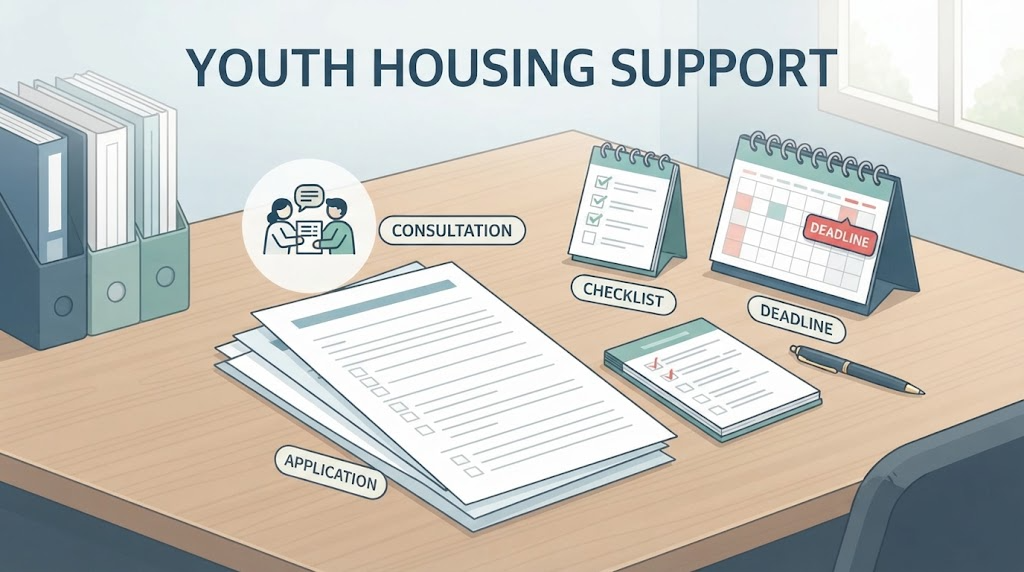
Major Youth Housing Support Benefit Types and Key Details
To ease the housing cost burden on the younger generation, the government and local authorities operate various systems divided largely into three categories: monthly rent support, deposit loans, and public rental housing. Let us take a close look at the key details by type to see which benefit is most advantageous for you.
- Monthly Rent Support: Special Youth Monthly Rent Support
This is a representative government project that subsidizes monthly rent in cash for young people whose biggest burden is the fixed monthly rent payment.
Support Details: You can receive monthly rent support of up to 200,000 won per month for up to 12 months (installments). (Even if you relocate due to vacation periods or military service, support is available even if non-consecutive within the total support period)
Main Target: Homeless young adults living separately from their parents who meet income and property criteria.
Characteristics: Because it is direct cash support for housing costs, it is one of the policies with the highest perceived impact for young professionals and college students.
- Deposit Support: Jeonse and Monthly Rent Loan Products
This is a financial support system designed to help young adults lacking large lump-sum funds borrow jeonse or monthly rent funds at interest rates much more favorable than those of commercial banks.
Beontimmok Jeonse Fund Loan (Exclusive for Youth):
This product lends jeonse deposits at exceptionally low interest rates compared to commercial rates, targeting young people employed in small and medium-sized enterprises (SMEs) or homeless individuals meeting youth-exclusive requirements.
Youth-Exclusive Bonded Monthly Rent Loan:
This is a loan system that simultaneously supports funds needed for both deposits and monthly rent for young adults who need to resolve both deposit and monthly rent at the same time.
Characteristics: It acts as a practical financial safety net that significantly lowers the interest repayment burden for young adults who feel pressured by high commercial interest rates.
- Public Rental Housing: Providing Living Spaces for Housing Stability
These are housing units supplied by the public sector so that people can live stably for a long period at rents cheaper than market rates.
Happy Housing: Mainly targeted at college students, young adults, and newlyweds, supplied in locations close to workplaces or schools, and provided affordably at around 60 to 80 percent of surrounding market rates.
Youth Ansim Housing (Station Area Youth Housing, etc.): Located mainly in station areas convenient for public transportation, offering various community facilities considering young people’s housing preferences and reasonable rents.
Acquired Rental and Jeonse Rental Housing: Housing where the government or local authorities purchase existing houses or contract them on a jeonse basis and re-lease them affordably to young adults.
Characteristics: You can live stably without worrying about moving, and it is a particularly great opportunity to live in downtown areas with excellent residential environments.
💡 Core Summary: Depending on your asset situation and housing type, if you need cash support, consider ‘Special Youth Monthly Rent Support’ first; if you need lump-sum preparation or a loan, consider ‘Youth-Exclusive Beontimmok Loan’; and if stable living space itself is your concern, it is recommended to prioritize ‘Happy Housing and Public Rentals’.

Essential Conditions for Target Recipients and Application Eligibility by Benefit
Youth housing support benefits vary slightly in the qualification requirements they demand (age, income, assets, etc.) depending on the support method.
We organize the core requirements of two representative support programs: ‘Special Youth Monthly Rent Support’ and ‘Youth-Exclusive Beontimmok Jeonse Fund Loan’.
Bokjiro
- Core Eligibility Conditions for Special Youth Monthly Rent Support
As this is a project providing monthly cash support, income and asset criteria are strictly evaluated.
Age and Residency Requirements:
Tistory
Young adults aged 19 to 34 as of the application date (must be homeless individuals living separately from parents)
Bokjiro
Income Criteria (Simultaneous satisfaction for youth household and original household):
Toss Bank
Youth Household (Self + Spouse):
60% or less of the standard median income
Toss Bank
Original Household (Youth + Parents):
100% or less of the standard median income (However, original household evaluation may be excluded under certain exception conditions such as being aged 30 or older or having separate livelihood from parents.)
Toss Bank
+ 1
Asset Criteria:
Toss Bank
Youth Household:
Total asset value of 122 million won or less
Bokjiro
+ 1
Original Household:
Total asset value of 470 million won or less (including general property, automobile value, etc., respectively)
Toss Bank
+ 1
- Core Eligibility Conditions for Youth-Exclusive Beontimmok Jeonse Fund Loan
As a financial product lending lump-sum funds at low interest rates, the homeless household head requirement is key.
Gyeonggi Provincial Government
Age and Household Head Requirements:
Gyeonggi Housing Welfare Portal – Gyeonggi Provincial Government
Homeless household heads aged 19 to 34 intending to lease a house (including prospective household heads)
Gyeonggi Housing Welfare Portal – Gyeonggi Provincial Government
Income Criteria:
Toss Bank
Combined annual income of spouses of 50 million won or less
(Relatively broad range allowed for fresh graduates and newlyweds)
Gyeonggi Housing Welfare Portal – Gyeonggi Provincial Government
Asset Criteria:
Bank Salad
Net asset value of approximately 337 million won to 345 million won or less (Must meet the housing urban fund asset evaluation criteria for the baseline year)
Target Housing Criteria:
Bokjiro
Leased exclusive area of 85 square meters (㎡) or less housing (including residential officetels)
Gyeonggi Housing Welfare Portal – Gyeonggi Provincial Government
Lease deposit of 300 million won or less based on the metropolitan area (regional criteria such as provinces may vary)
💡 Checkpoint: Both government subsidies and loan products share ‘homeless person’ and ‘age criteria’ as common denominators. Before applying, you can prepare much more easily by checking in advance whether your income and assets meet the baseline through the ‘Mock Calculation’ service on Bokjiro or the Housing and Urban Fund portal.
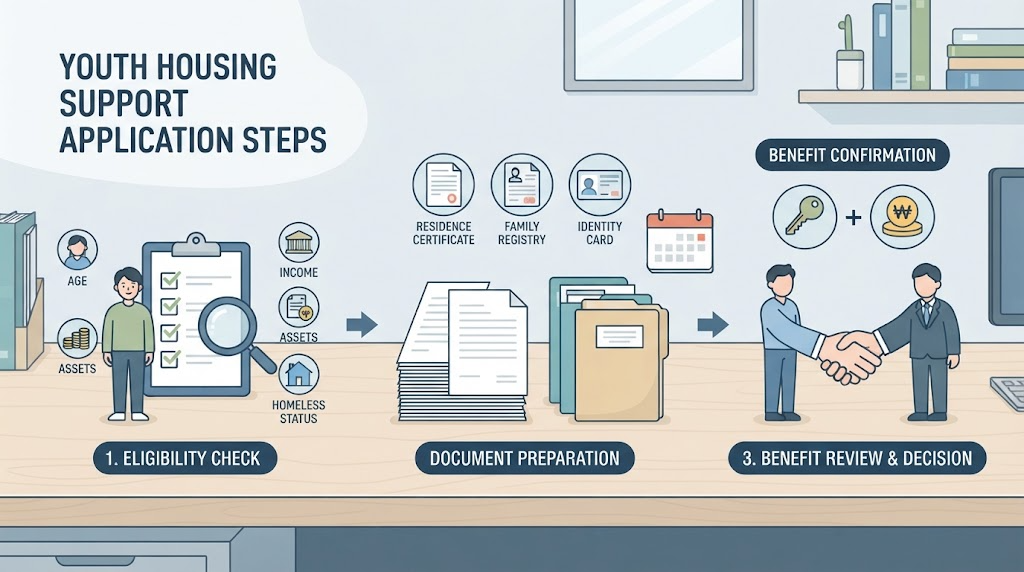
Essential Documents and Preparations to Check Before Applying
To smoothly apply for youth housing support benefits or jeonse fund loans, it is important to carefully prepare your documents in advance. Although the required documents vary slightly depending on the nature of the support program (cash support vs. loan product), we have organized the essential documents that must be commonly prepared.
- Common and Basic Verification Documents
These are the most basic documents to verify your identity, household composition, and whether you are a homeowner.
Resident Registration Copy and Abstract: It is safe to receive them issued so that your address change history for the past 5 years is included, and they must be able to confirm the relationship between the head of household and household members.
Family Relationship Certificate: It is recommended to be issued as a detailed certificate, and it serves as the basis for judging whether you are a household independent from your parents or whether original household evaluation is required.
ID Card: An identification card for identity verification such as a resident registration card or driver’s license.
- Housing (Lease) Related Verification Documents
These are documents proving that you are actually leasing and residing in a house or have concluded a contract.
Housing Lease Agreement with a Fixed Date (Jeonse or Monthly Rent Contract): An original contract contracted through a certified real estate agent or an authorized contract
Deposit Receipt: A receipt proving that a certain percentage of the deposit (e.g., 5% or more) has already been paid (especially essential when applying for loan products)
Monthly Rent Transfer Statement (in cases of youth monthly rent support, etc.): A bank transfer confirmation slip or bankbook copy proving that recent monthly rent has been paid normally.
- Income and Asset Proof Documents
These are documents to evaluate whether you meet the income criteria and asset criteria. (However, if you check ‘Consent for Administrative Information Joint Use’ when applying online through Government24 or Bokjiro, a significant portion will be automatically queried and linked.)
Income Amount Certificate or Employment Certificate and Wage and Salary Income Withholding Receipt: Income proof documents suitable for your economic activity type, such as an office worker or business owner
Other Asset Proof Documents: Vehicle registration ledger or local tax item-by-item taxation certificate, etc. (Additional submission may be requested if necessary)
💡 Document Preparation Tip: You can issue most basic verification documents without fees using Government24 (gov.kr) or unmanned issuance machines. Especially for loan products, you can reduce the trouble of making a second trip by checking in advance by phone before visiting the bank whether there are additional documents (e.g., a copy of the business registration certificate of the employer company for young people employed in SMEs) through the guidance of the Housing and Urban Fund portal or fund consignment banks (Woori, Kookmin, Nonghyup, Shinhan, IBK Enterprise, etc.).

Application Methods and Useful Tips
Youth housing support provided by the government has differences in application channels and procedures depending on the nature of the support (cash subsidy type vs. financial loan type). We have organized how to apply for each system most quickly and securely, along with practical tips.
- Specific Application Methods by Type
Cash Support Type (e.g., Special Youth Monthly Rent Support):
Online Application:
After accessing the Bokjiro (bokjiro.go.kr) website or mobile app, log in using a joint/financial certificate or simple authentication (Kakao, Naver, PASS, etc.).
You can write the application form and upload the scanned copies of prepared documents in the ‘Welfare Service Application > Youth Monthly Rent Support’ menu.
Choco – Tistory
+ 1
Offline Application:
If online use is difficult, you can visit in person with your ID card and required documents at the Eup, Myeon, or Dong community center (administrative welfare center) having jurisdiction over the youth’s resident registration address.
blog.kwt.co.kr
Financial Support Type (e.g., Youth-Exclusive Beontimmok Jeonse Fund Loan):
Seoul Housing Portal – Seoul Metropolitan Government
Online Application:
First, proceed with loan application and eligibility evaluation on the Fund e-Deundeun (enhuf.molit.go.kr) portal.
Choco – Tistory
Bank Visit Application:
After online application or by directly visiting the branches of consignment banks (Woori, Kookmin, Nonghyup, Shinhan, IBK Enterprise, etc.), submit final documents and execute a loan agreement. (※ You must apply with plenty of time at least 3 to 4 weeks before moving to avoid any setbacks on the balance payment date.)
Korea Housing & Urban Guarantee Corporation
- Practical Housing Support Tips That Determine Success or Failure
Utilize Consent for Administrative Information Joint Use: When applying online, instead of issuing and attaching income- and asset-related documents one by one, checking ‘Consent for Administrative Information Joint Use’ automatically links the government system, which can significantly lower the risk of rejection due to missing documents.
Check Whether Address and Actual Residence Match:
For projects such as youth monthly rent support, the address on your resident registration and your actual residence must match precisely.
If you have just moved, you must complete the transfer of residence (Jeonip-singo) first before submitting the application to avoid disadvantages.
Choco – Tistory
+ 2
Actively Utilize Mock Calculation Service: If you are ambiguously on the border of being eligible for support, try using the ‘Benefit/Loan Mock Calculation’ corner provided on the Bokjiro or Housing and Urban Fund portals first.
By entering your expected income and asset amounts, you can gauge eligibility in advance, preventing wasted trips.
Choco – Tistory
💡 Blog Posting Closing Tip: Putting a Call to Action (CTA) phrase at the end of the post such as, “Housing support is all about timing! If you meet the qualification criteria, don’t just worry about it—start with a mock inquiry on Bokjiro and Fund e-Deundeun!” can further increase reader engagement and satisfaction.
Korean version: 한국어로 읽기