Introduction: Large Bulky Waste Piled Up All Over the House and the Helplessness of Disposal
When finishing up a move, a deep clean, or organizing your home, one of the biggest headaches is bulky waste that is awkward to dispose of. From old wardrobes, beds, and sofas to bulky home appliances, whenever you actually try to throw them away, you feel overwhelmed wondering how to move them and how much it will cost.
In the past, people had to directly visit their local community service center to get a sticker or strain themselves carrying heavy loads to a designated spot, but nowadays, home collection services are well-established, making things much easier. Even so, when you actually receive an estimate, it is true that worries often come first about whether the costs vary widely or if additional fees might be tacked on.
In this post, we will meticulously organize the bulky waste disposal cost estimation criteria that you must know before applying for home collection, the item-by-item pricing methods, and valuable tips to wisely save on costs. Let’s look into it together from now on so that the overwhelming house organization can feel much lighter.
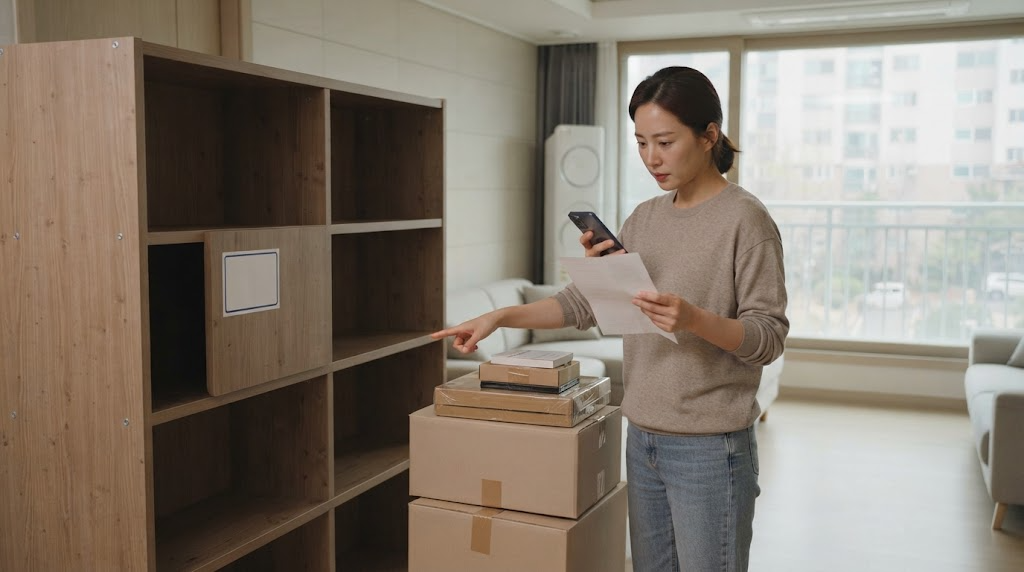
Why Do Bulky Waste Disposal Costs Vary by Region and Company?
The reason bulky waste disposal costs differ by neighborhood and by the method used is due to differences in fee determination methods according to each local government’s ordinance and differences in the service scope of private companies. Looking at the specific factors, they are as follows.
- Characteristics and Regional Differences of the Local Government (Community Service Center) Reporting Method
Differences in fee ordinances by local government: Bulky waste sticker prices are not determined collectively by the state, but rather decided according to waste management ordinances enacted by each city, county, and district. Because of this, even for the exact same bed or wardrobe, a difference occurs in the fee amount charged by district A in Seoul and city B in the provinces.
Principle of direct transport by the generator: Since the local government sticker system is basically premised on residents directly bringing out the waste to a designated spot, labor costs or transport costs are not included in the fee, making it inexpensive.
- Cost Estimation Method of Private Home Collection Companies
Turn-key service and labor cost reflection: When using a private company, they visit inside your house to directly dismantle and collect furniture, so incidental costs such as on-site labor costs, vehicle transport fees (such as a 1-ton truck), and ladder truck usage fees are added to the estimate in addition to item-by-item fees.
Working environment and volume: Depending on the presence of an elevator, stair work difficulty, total volume of waste, etc., estimation criteria are applied differently by company, creating differences in the total cost.
While the local government sticker method is the cheapest, it entails the effort of having to move furniture yourself, so it is efficient to utilize comparative estimates from private home collection companies when the volume is large due to moving or major organization.
If you check the accurate item-by-item fee table in advance through the district office homepage or community service center of your place of residence, you can prevent unnecessary expenditures.
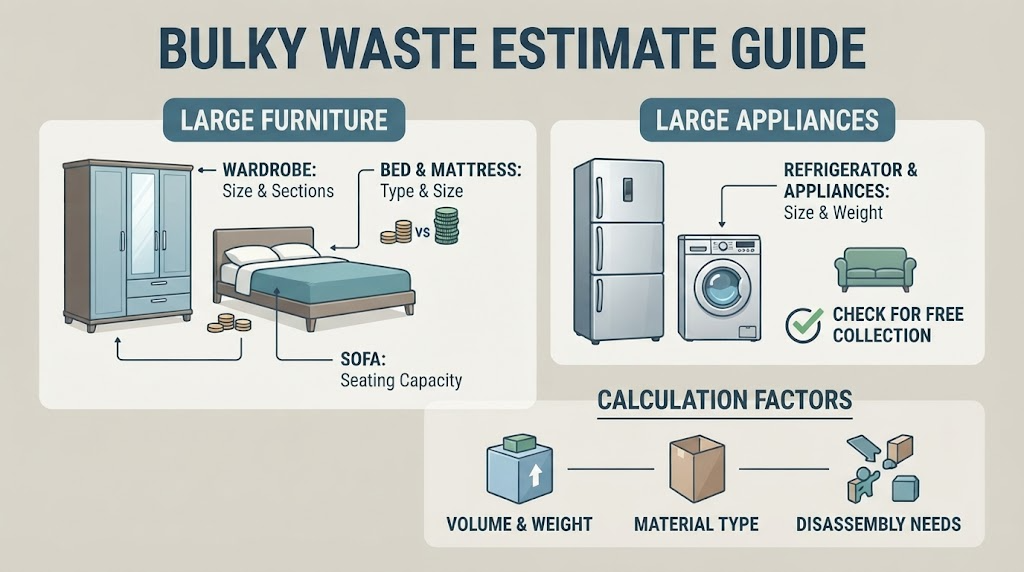
Estimated Waste Disposal Cost Estimation Criteria by Item and Type
When throwing away bulky waste, the question people are most curious about is naturally the estimated cost: “How much will the item I’m trying to throw away cost?” Grasping the approximate fees based on local government (community service center) reporting standards and the item-by-item calculation criteria in advance can be very helpful for setting a budget.
We have organized the representative estimated waste disposal cost estimation criteria by item and type.
- Large Furniture Items (Wardrobes, Beds, Sofas, etc.)
Furniture items tend to have large cost differences depending on volume, weight, and material (whether it is solid wood, etc.).
Wardrobes/Built-in Closets: Calculated based on size and number of tiers (per ja or per section basis), with a fee of approximately 10,000 KRW to over 30,000 KRW charged. (Additional costs may occur if dismantling work is required)
Beds (Including Mattresses): Varies depending on specifications such as single/double/queen, and frames and mattresses often need to be reported as separate items individually. Expected to be around 10,000 KRW to the 20,000 KRW range when combined.
Sofas: Determined by the number of seats (1-seater, 3-seater, 4-seater or more) and presence of a chaise lounge, with fees generally applied in the range of 5,000 KRW to 20,000 KRW.
Desks/Dining Tables/Dressers: Relatively inexpensive, around 3,000 KRW to 15,000 KRW depending on specifications (small/medium/large).
- Large Home Appliance Items (Refrigerators, Washing Machines, TVs, etc.)
It is advantageous to check if home appliances are eligible for free collection before issuing a local government sticker, but when free collection is impossible due to small size or damage, they are discharged with a sticker attached.
TVs/Refrigerators/Washing Machines/Air Conditioners: For large appliances, a fee at the level of 5,000 KRW to 15,000 KRW is charged depending on specifications and capacity (liters, kg, etc.).
Small Appliances (Microwaves, Vacuum Cleaners, etc.): Appliances with relatively small volume can be disposed of for around 2,000 KRW to 5,000 KRW.
- Other Household Goods and Sundries
Mattresses, Carpets, Mirrors, etc.: Around 3,000 KRW to 10,000 KRW depending on material or size.
Precautions: When attaching a waste sticker, you must accurately measure the specifications of the item (width x height dimensions). If the specifications and the actual item differ, collection may be refused or it may become subject to a fine, so caution is required.
In the next section, we will learn about the cost calculation method when using private home collection companies because the volume is too large or difficult to move yourself.
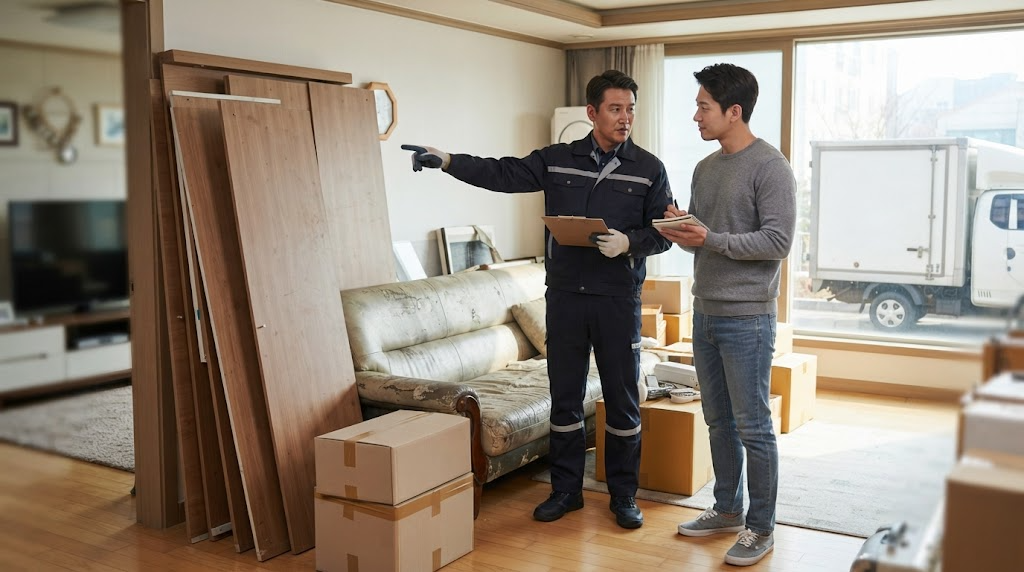
Cost Calculation Method of Private House Organization and Waste Home Collection Companies
When the amount of waste to be discarded due to moving, deep cleaning, or organizing keepsakes is too large or there are too many pieces of furniture making it difficult to directly discharge by issuing stickers at the local community service center, the most useful thing to utilize is a private house organization and waste home collection company. Private companies have the advantage of coming directly inside the house to take out heavy loads and collect them, but costs are inevitably set higher compared to local government stickers.
We will meticulously organize the representative criteria and structures by which private home collection companies calculate costs.
- Vehicle Tonnage and Transport Fee Criteria (Based on a 1-Ton Truck)
Estimates from home collection companies are basically determined based on how many truckloads the volume and weight of the waste amount to.
Unit price based on a 1-ton truck: When organizing loads on the scale of a general studio or two-room apartment, usually 1 truckload of a 1-ton truck is consumed. Although there are differences depending on the company, region, and whether a ladder truck is used, approximate basic truck transport fees and collection costs are calculated.
When loading capacity is exceeded: If loads exceed the loading bed of a 1-ton truck, requiring large vehicles such as 1.5-ton or 2.5-ton trucks to be deployed or multiple trucks to be mobilized, costs rise significantly in proportion to the number of trucks.
- On-Site Labor Costs (Number of Workers)
The part that takes up a large portion of the cost when using a private company is none other than labor costs.
Number of personnel deployed: The number of workers deployed to the site is determined by the work intensity of dismantling furniture inside the house and transporting it outside. Typically, 1 to 2 personnel are deployed, and personnel are added if there is a lot of large furniture or if the load is massive.
Reflection of labor intensity: If items requiring special work are included, such as dismantling built-in closets, all-glass tables, or heavy large stone beds, rather than simply moving light loads, the proportion of manual work by professional personnel increases, raising the labor cost estimate.
- Working Environment Conditions (Presence of Elevator and Ladder Truck)
The physical environment of the site where work is performed is also an important variable in cost estimation.
Presence of an elevator: Even in high-rise apartments or officetels, if there is an elevator so that loads can be easily loaded and transported, work often proceeds at the basic estimate.
Stair work and ladder truck costs: For low-rise villas and multi-family housing where there is no elevator or loads must be carried down layer by layer through narrow stairs, work difficulty rises sharply. In this case, depending on field conditions, ladder truck usage fees may be billed separately or labor costs may be additionally added.
- Types of Waste and Recyclability
Waste disposal processing fees (incineration and landfill costs): If unburnable waste or special materials are mixed in, the waste disposal certificate issuance fee paid by the private company to the local government is reflected in the estimate.
Reflection of recycling value: Conversely, for home appliances in relatively clean condition or furniture that can be resold, depending on the company, purchase prices or collection costs are offset against each other to discount the overall collection estimate, so it is best to check during preliminary estimate consultations.
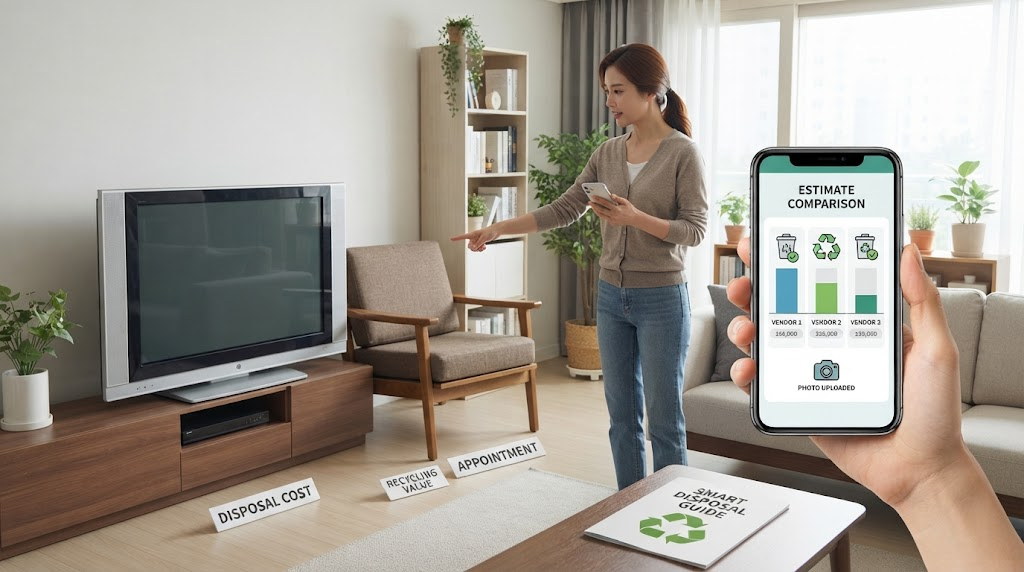
While private companies are convenient, estimate variations among companies can be large, so it is safe to attach photos to at least 2 to 3 companies and receive non-face-to-face estimate comparisons before entrusting home collection.
In the next section, we will take a detailed look at free collection services and separate discharge tips that can dramatically reduce costs.
Tips for Saving Costs and Smartly Handling Separate Collection and Free Collection
When disposing of bulky waste and furniture, if you blindly rely only on paid collection companies or local government stickers, more costs may be expended than expected. With a little bit of legwork and utilization of systems, there are smart ways to reduce disposal costs to 0 KRW or even save money.
We have organized the core tips to dramatically save on waste disposal costs and handle them wisely.
- Utilize ‘e-Circular Governance’ Free Home Collection for Large Home Appliances
When throwing away large home appliances such as refrigerators, washing machines, air conditioners, and TVs, there is absolutely no need to issue paid stickers at the local community service center or pay costs to call a private company.
Service Details: If you use ‘e-Circular Governance (Waste Home Appliance Free Home Collection Service)’ operated in cooperation with the Ministry of Environment and local governments, professional collection technicians will directly visit inside your house and collect heavy large home appliances for free.
Usage Tip: In the case of small home appliances, free home collection may be difficult on their own, but if you discharge them together when applying for a large home appliance, free collection as a set is possible, so it is advantageous to unconditionally utilize this service as top priority for home appliances.
- Utilize Used Trading and Free Sharing for Furniture and Appliances in Good Condition
If the furniture or home appliances you are trying to throw away are still usable, disposing of them as used goods or sharing them is much more economical than paying waste costs to throw them away.
Utilizing Used Trading Platforms: If you post them on regional-based platforms such as Danggeun Market or Used Nara at phenomenal prices (or for free sharing), you can quickly dispose of them on the condition that the buyer takes them away.
Advantages: Not only can you save on waste fee or labor cost expenditures, but you can also avoid physical exhaustion because buyers often collect them directly without you having to carry heavy loads yourself.
- Check for Free Collection Benefits Linked with Local Governments and Recycling Centers
Some local governments or regional self-sufficiency centers operate programs that independently link free collection or connect donations for vulnerable groups, limited to recyclable furniture in clean condition. Before starting a move or organization, checking the resource circulation-related guides on the jurisdictional district office homepage allows you to discover hidden benefits.
- Thoroughly Utilize Neighborhood Mart/Convenience Store Stickers and Separate Discharge for Small Waste
For small furniture or household goods fitting specifications, purchasing bulky waste discharge stickers directly from the community service center or designated sales outlets (convenience stores, neighborhood marts, etc.) and attaching them is the way to save the most on fees.
In addition, you must thoroughly separate general trash and recyclables, discharge what can be put into volume-rate bags to the maximum extent, and accurately report only items classified as bulky waste to prevent unnecessary fines or additional costs from occurring.
In the next section, we will learn about checkpoints to prevent additional fees when booking home collection and safely finish up.
Checkpoints for Failure-Free Home Collection Booking and Estimate Comparison
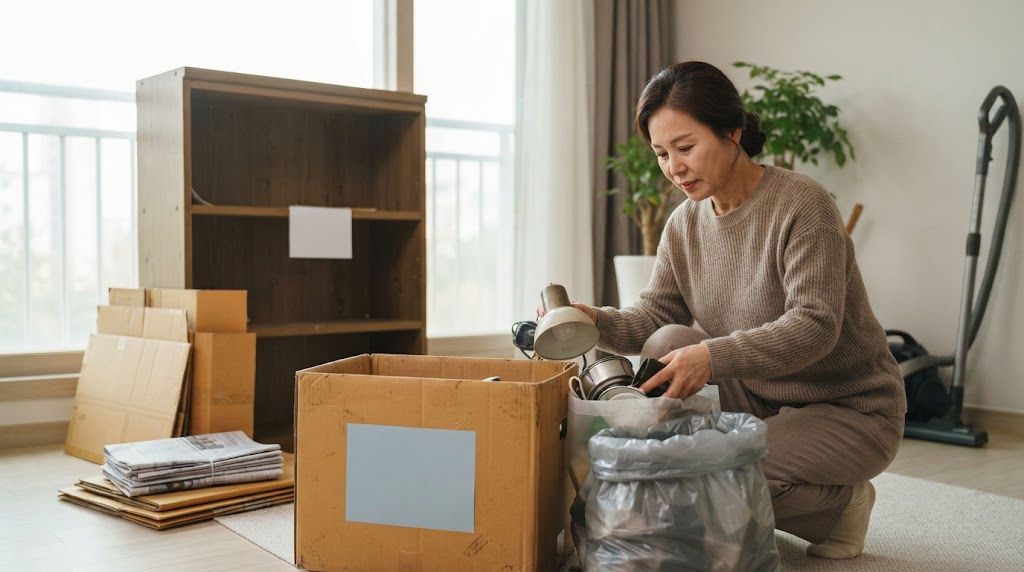
When you want to neatly organize your house through a home collection company or need to dispose of bulky waste all at once, if preliminary preparation is insufficient, unexpected additional fees may occur on-site or friction with the service provider may arise.
We have organized the core checkpoints that you must verify before and after booking for failure-free home collection.
- Preparing ‘Accurate Load Photos’ for Cost Estimation
Increasing the accuracy of non-face-to-face estimates: Most home collection companies calculate a primary estimate based on photos and item lists sent by the customer before visiting the site.
Checkpoint: You must take and deliver photos from multiple angles so that not only the overall appearance of the furniture or home appliances to be discarded, but also the specifications (size), quantity, and special notes (e.g., whether stone beds or built-in closets need dismantling) are clearly visible, which can prevent on-site deductions or additional fee disputes.
- Notifying On-Site Working Environment and Special Conditions in Advance
If variables that were not agreed upon in advance occur when company staff visit, additional costs are easily billed. You must clearly inform them of the following details in advance.
Presence of an elevator and floor level: You must notify in advance if it is a high floor but the elevator is small or missing, requiring work via stairs, or if it is a site where a ladder truck must necessarily be used.
Parking and entry environment: Check whether collection vehicles such as 1-ton trucks can enter right up in front of the house, and whether parking is cramped or the parking space is narrow, resulting in a long separate transport distance.
- Receiving ‘Comparative Estimates’ from at Least 2 to 3 Places
Depending on the number of vehicles owned, labor cost calculation methods, and in-house recycling processing capabilities of each waste collection and house organization company, estimate amounts can differ by hundreds of thousands of KRW.
Rather than blindly looking for the cheapest place, it is safe to comprehensively compare whether waste is handled legally (whether it is an officially licensed company) and post-treatment (whether clean finishing cleanup is provided) to select a reasonable place.
- Clearly Checking Reasons for Additional Fees and Refund/Cancellation Regulations
Before confirming your booking, clearly check through text or phone calls “under what circumstances additional fees may occur.” (e.g., cases where extra trash comes out on-site in addition to items notified in advance)
In addition, you must check in advance whether a penalty is incurred when schedules are changed or cancelled due to personal circumstances and what the refund regulations are, so that you can avoid awkward situations.
Through thorough preliminary information checking and transparent comparative estimates, we hope you neatly, thriftily, and stress-free wrap up bulky waste and house organization that used to be a headache!
Korean version: 한국어로 읽기