Introduction: Why Thorough Prior Comparison Is Essential Before Registering for a Government-Funded Training Academy
“Are you feeling overwhelmed about where to choose among countless training institutions and similar curriculums to receive training without regrets, after deciding to register for a government-funded academy for a new career challenge? Or do you have an experience of panicking due to teaching methods that didn’t suit you or unexpected additional costs after registering on impulse?”
For both job seekers and office workers trying to learn new skills or obtain certifications through government-funded education, finding the exact training institution and course that fits them is the most crucial first step for a successful career transition. However, if you register for an academy on impulse by trusting only advertising reviews floating on the internet or flashy promotional phrases, you are likely to experience the frustration of wasting precious time and your National Employment Support Card subsidy due to formal classes that do not actually help with practical work or poor support management.
“Is it okay to just roughly pick any academy because it’s a national subsidy and not my own money?”
“If you are curious about the real reason why you must carefully examine curriculums and enrollment conditions before registering for an academy, in order to use your precious time and opportunity fully as a stepping stone for your growth?”
The success or failure of successful government-funded education is sharply divided depending on how thoroughly you went through prior comparison and analysis before registering at the training institution. By carefully examining everything from the tuition fee subsidy ratio to actual class contents, the professionalism of the instructional staff, and post-completion management, you can enjoy much higher learning effectiveness and employment linkage synergy than ordinary private academies.
“No more regretting being tempted by words that it is close to home or simply gives out a certificate!”
“We will clearly dissect why you must carefully examine the curriculum and enrollment conditions before registering for an academy, and perfectly point out the criteria for choosing a government-funded education without failure.”
Then what are the core conditions that we must check first before utilizing the Ministry of Employment and Labor’s National Employment Support Card? Let’s take a look at everything about those essential check points one by one from now on!

Ministry of Employment and Labor National Employment Support Card Eligibility and Limits That Must Be Checked Before Course Application
“If you want to register for a government-funded academy and start studying in earnest, is it the priority to accurately figure out the eligibility and remaining limit of the National Employment Support Card in your wallet first? How should you prevent the frustration of being excluded from the support target or lacking limits after applying blindly?”
The Ministry of Employment and Labor’s National Employment Support Card, which anyone who is a job seeker or office worker aiming for a career jump-up through government-funded education receives at least once, is a core system that solidly supports the lifelong vocational competency development of Korean citizens. However, since it is not provided free of charge without limit and the scope of benefits varies depending on individual income levels, employment types, and card limit balances, it is essential to carefully check eligibility and limits before pressing the course application button.
- National Employment Support Card Basic Eligibility and Issuance Targets
Anyone who is a Korean citizen can apply, but there are some exclusion targets from support according to the purpose of the system.
Basic Issuance Target: Anyone among Korean citizens who needs vocational competency development, such as job seekers, incumbents (office workers), self-employed individuals, and special-type contract workers, is eligible for issuance.
Support Exclusion Target: Incumbent public officials, private school faculty and staff, minors (under 15 years old), large-scale enterprise workers with monthly income above a certain standard, and high-income self-employed individuals have restricted issuance or must meet separate requirements.
- Understanding Support Limit Amounts and Self-Payment Structures
You must accurately understand the principles of card limits and personal co-payments to prevent unexpected expenses.
Basic Support Limit: An account balance ranging from 3 million won to a maximum of 5 million won per individual is granted and remains valid for use over 5 years.
Additional Support Benefits: For target groups meeting specific requirements, such as low-income families and participants in the Employment Success Package (National Employment Support System), limits are supported with additional upward adjustments.
Training Cost Co-Payment: Depending on the employment rate of the course and training costs by job category, a certain percentage of self-payment occurs in addition to the national subsidy, so you must definitely check the exact amount you need to bear on Employment 24 before course application.
💡 Core Points for Checking Support Eligibility and Limits
If you do not check the National Employment Support Card balance and support target types in advance, setbacks such as excessive self-payment occurrence or approval rejection may occur during the course application stage, so it is safest to query your card status and remaining limit first through the Employment 24 homepage.
Then what are the core checkpoints for selecting the optimal curriculum that will truly foster your skills among numerous academies and courses? We will examine them in detail in the next chapter!
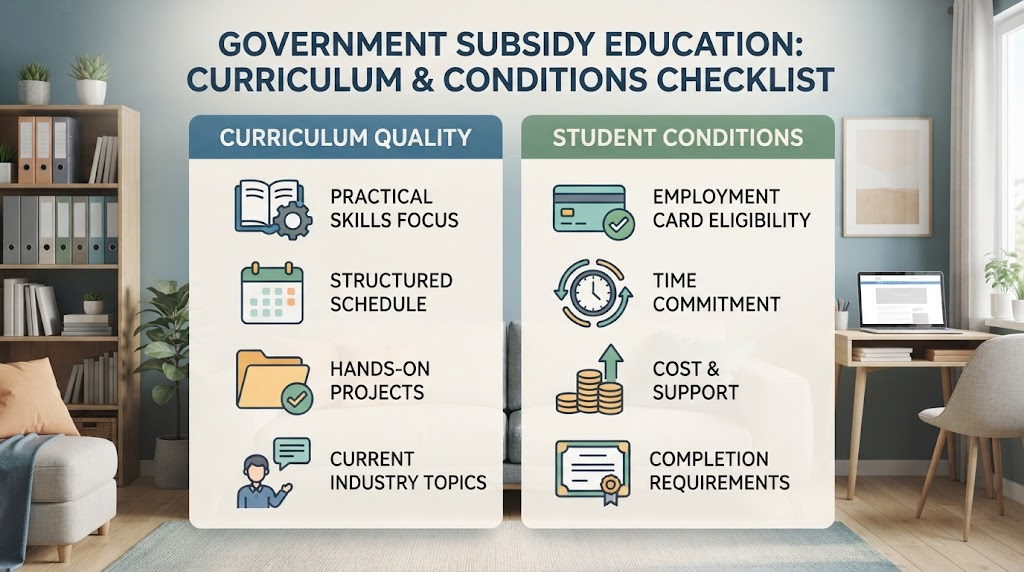
Curriculum Analysis Core Checkpoints for Selecting a Failure-Free Government-Funded Education Academy
“What if a government-funded academy looks like it has many graduate reviews and decent facilities on the surface, but when you actually take the classes, they are old-style theory-centered lectures or teach only skills not used at all in practical work? To avoid wasting your precious National Employment Support Card limit and valuable months of time, which curriculum elements should you carefully tear apart before academy registration?”
Numerous government-funded training institutions display flashy promotional phrases such as ‘highest employment rate’ and ‘100% practical work customized’ among themselves, but the criteria for discerning a good academy that actually pulls up your skills reliably are separate. We meticulously point out the core curriculum checkpoints that you must analyze for a government-funded education academy selection without regrets.
- Ratio of Theory to Practice and Whether Latest Tech Stacks Are Reflected
This is the most certain standard to judge whether education is directly connected to practical deployment.
Practice-Centered Curriculum Ratio: If the proportion of the instructor’s unilateral theory lectures among the daily class hours is too high and practice time is short, you should avoid it. Check whether at least 60 to 70 percent or more is composed of practice and practical skills centering on direct coding, handling accounting programs, and writing documents.
Reflection of Latest Trend Technologies: In the case of the IT field, carefully cross-check through the training plan whether latest tech stacks actively used in the current field (e.g., Python-based data analysis, latest accounting practice programs, etc.), rather than old-fashioned languages or frameworks, are melted into the curriculum.
- Whether Portfolio Production and Enterprise-Linked Projects Are Included
This is a core element determining the success or failure of actual employment success beyond obtaining certifications.
Presence of Practical Project Courses: Check whether time for graduates to form teams in the latter half of the training course and complete actual enterprise-type projects or portfolio results is organized as a separate independent module.
Field Expertise of Instructional Staff: Check through prior consultations or student reviews whether field experts who have accumulated practical experience in the relevant industry for several years, rather than simple certification instructor backgrounds, directly give feedback and guide portfolios.
💡 Core Points for Curriculum Analysis
The curriculum of a good academy is not simply a place that progresses fast, but a place equipped with a systematic roadmap flowing smoothly from ‘entry to certification acquisition, and final portfolio completion’. We hope you meticulously request and compare detailed lecture plans of training institutions.
Then what is the reality of self-payments and hidden costs that we must carefully examine besides tuition fees exposed on the surface? We will examine them in detail in the next chapter!

Examining Self-Payments and Hidden Costs Easily Missed When Applying for National Employment Support Card Courses
“Have you ever been panicked because you thought the tuition fee would be entirely free or cost only a few thousand won since it is government-funded education, but when you actually tried to apply for the course, a self-payment amount much larger than expected was billed? Or haven’t you faced a situation where you had to dig into your pocket money due to unexpected additional costs such as textbook fees, material costs, and exam application fees besides training costs?”
Many people register for training courses feeling relieved by the word ‘government support’, and then experience setbacks in their budget planning after belatedly learning about the hidden self-payment and incidental cost systems. To simultaneously achieve successful self-development and economic expenditure management, we meticulously point out the structure of self-payments and the reality of hidden costs that you must carefully examine when applying for National Employment Support Card courses.
- Understanding Training Cost Self-Payment Determination Structures and Differences by Type
It is rare for the National Employment Support Card to have full support as a principle, and self-payments occur differently depending on the individual’s employment type and the employment rate of the course.
Differential Imposition by Employment Rate and Job Category: Courses with high training demand and excellent employment rates may have low or exempted self-payment rates, but general incumbent-targeted courses or specific popular job categories can incur training cost self-payments ranging from 10% up to 40-50%.
Reduction Benefits by Support Target: If you fall under vulnerable groups such as National Employment Support System Type 1 participants or low-income families, self-payments are largely exempted or reduced, so you must first check your exact target type on Employment 24 to accurately predict the scope of self-payments.
- Identifying Hidden Incidental Costs Such as Textbook Fees, Material Costs, and Certification Exam Fees
You must reflect hidden costs that are spent invisibly besides tuition fees into your budget in advance.
Textbook and Practice Material Costs: Textbook fees are sometimes partially included in government subsidies, but specialized major books or expensive practice material costs are often borne privately by students.
Certification Exam Fees and Additional Costs: Completion of a training course does not directly mean obtaining a certificate, and written and practical exam application fees must be paid separately by individuals, so they must be considered together when calculating total required costs.
💡 Core Points for Managing Self-Payments and Hidden Costs
It is wise to not only finally check the ‘self-payment settlement amount’ on the course application screen, but also clearly inquire with the academy side in advance through phone or visit consultations about whether textbook fees or incidental costs occur separately, thereby completely blocking out-of-budget expenditures in advance.
Then what are the evaluation grades and review utilization methods that objectively evaluate the reliability of training institutions and make the failure probability zero? We will examine them in detail in the next chapter!

How to 100% Utilize Training Institution Evaluation Grades and Actual Graduate Employment Rates and Reviews
“Looking around the Employment 24 homepage, there are truly a mountain of certified government-supported training institutions, but what are the objective indicators for picking out the ‘truly excellent academy’ among them where you can trust and entrust your money and time? If you want to know the know-how to 100% utilize the vivid reviews and employment rates of real graduates without being deceived by promotional reviews left by others saying it’s good?”
Numerous government-supported academies recruit students by putting forward flashy graduate reviews and high employment rates, but if you trust only the figures shown on the surface, you are bound to face frustration. For a government-funded education without failure, we meticulously point out practical know-how to discern and 100% utilize genuine reviews of actual graduates starting from the official certification evaluation grades of training institutions.
- How to Utilize Ministry of Employment and Labor Certification Evaluation Grades and Vocational Training Portal (Employment 24) Indicators
This is a method of verifying the basic physical strength of training institutions through official grades evaluated and granted by the government based on objective standards.
Checking Certification Evaluation Grades: The Ministry of Employment and Labor comprehensively evaluates training institution employment rates, dropout rates, instructor professionalism, facility satisfaction, etc. every year to select excellent training institutions (3-year certification, 5-year certification, etc.). You should prioritize institutions with long certification periods and excellent grades to avoid the risk of poor operation.
Understanding the Truth of Publicized Employment Rates: Do not just look at simple employment rate numbers promoted by the academy, but carefully compare and cross-check the actual graduate employment retention rate and average annual salary level of the relevant course provided in the Employment 24 detailed page.
- Know-how for Verifying Actual Graduate Reviews and On-Site Visit Consultations
This is the wisdom to filter out the voices of real students beyond good reviews on advertising blogs or the academy’s own homepage.
Exploring External Communities and Real Reviews: Since reviews on the official academy homepage are likely filtered, you should search far and wide for honest class atmospheres and instructor reputations of seniors who actually graduated from the relevant cohort in job seeker communities (e.g., Blind, Dokchisa, etc.), government support-related open chat rooms, or cafes.
Mandatory Visit Consultation Before Registration: Do not make payments relying only on online information, but definitely visit the academy in person to check with your own eyes whether the actual practice room equipment condition is good and whether additional costs or textbook fees are guided transparently during consultation.
💡 Core Points for Utilizing Training Institution Evaluations
A good training institution is backed by objective government certification grades and proven by word-of-mouth and high employment rates of graduates. Through thorough prior verification, we hope you meet the best partner that will completely make the value of your precious National Employment Support Card shine.
Then what are the attendance rate management and precautions that must be guarded to prevent dropouts and subsidy reductions during government-supported courses? We will examine them in detail in the next chapter!

Attendance Rate Management and Precautions to Prevent Dropouts and Subsidy Reductions
“After finishing course application with difficulty at a government-supported academy and starting your first attendance with motivation, what should you be most careful about to avoid facing absurd situations where training support is cut off or you are treated as a dropout and your National Employment Support Card limit is deducted because you repeated lateness or early leaving a few times due to a busy daily life or sudden personal circumstances?”
Many students start government-supported education with a free or light heart, and then experience frustration by missing the strict attendance management standards of the Ministry of Employment and Labor. We meticulously point out attendance rate management and practical precautions that you must thoroughly understand to safely grasp a certificate without suffering fatal disadvantages such as subsidy reduction or dropout due to a single moment of carelessness in the government-funded education course.
- The Magic Line of Attendance Rates in Ministry of Employment and Labor Government-Funded Courses: The 80% Rule
This is the absolute Maginot Line that must not be crossed in order to fully receive government subsidies and graduate normally.
Sanctions for Falling Below an 80% Attendance Rate: Normal graduation is only possible if you attend 80% or more of the entire training days, and if your attendance rate drops below 80%, you are immediately treated as a ‘dropout’, meaning you not only fail to receive the remaining subsidies but also face the disadvantage of a certain amount being deducted from your National Employment Support Card account balance.
National Employment Support System Linked Disadvantages: If you are receiving job seeker employment support allowances or training participation allowances together, dropout due to attendance shortage directly leads to the suspension of allowance payments, so special attention is required.
- Know-how for Preventing Attendance Check Omissions and Managing Lateness/Early Leaving
Attendance check regulations that are easy to make mistakes with and strict daily attendance management secrets.
Utilizing the HRD-Net Attendance Management App: Upon entering and leaving class, you must complete identity verification and Beacon checks through the designated smartphone app (HRD-Net Attendance Management) or the terminal inside the academy. Be careful because if you simply sit in your seat and omit the check, it will be treated as an absence.
Cumulative Management of Lateness, Early Leaving, and Going Out: Keep in mind that 3 instances of lateness, early leaving, and going out are converted to 1 day of absence, so if you take minor lateness or going out lightly and repeat them, the 80% attendance rate line can collapse in an instant.
💡 Core Points for Attendance Rate Management
Success in government-supported education begins with ‘faithful attendance and steady participation’ rather than outstanding brains or skills. We hope you safely protect your precious support benefits through thorough attendance management.
We sincerely hope that this article served as a solid compass for your wise choice of government-funded education academy and successful spec-up journey. Shall we now check the warm closing remarks that will decorate the finale of a wonderful posting?
Conclusion: Starting Successful Government-Funded Education Through Thorough Curriculum and Enrollment Condition Analysis
So far, we have looked together at the Ministry of Employment and Labor’s National Employment Support Card eligibility and limits that must be carefully examined before academy registration, core curriculum analysis checkpoints for selecting a failure-free training institution, the reality of self-payments and hidden costs that are easily missed, training institution evaluation grades and actual review utilization methods, and attendance rate management know-how to prevent dropouts.
When preparing for a new career or knocking on the door of a job change, government-supported education where the state attaches solid wings to my learning and growth is a priceless and powerful opportunity. However, if you register for an academy on impulse without thorough prior comparison based on the complacent thought that “it’s government support so picking roughly is fine,” you are likely to face bitter results of wasting only precious time and National Employment Support Card balances without achieving the desired spec-up or dreams of employment.
Shall we lightly retrace the core contents we shared today once again?
First, accurately grasp your National Employment Support Card remaining limit, eligibility, and expected self-payment through Employment 24 before course application.
Second, carefully cross-check whether it is a substantial curriculum with a high proportion of practice, latest trends, and portfolio production included, rather than being centered on simple theory lectures.
Third, verify reliable training institutions by thoroughly examining objective government certification evaluation grades and real reviews from senior graduates from all directions.
Fourth, perfectly prevent fatal disadvantages such as dropouts and subsidy reductions through guarding an 80% attendance rate and thorough attendance management.
Thorough prior analysis and wise choices are the most certain keys to completing a successful government-funded education. Taking today’s posting as a solid compass, we hope you make the dream of career leaps into reality wonderfully with the best training institution that fits you perfectly.
We sincerely hope that this article served as a warm lighthouse for your successful government-funded education challenge and spec-up journey. If you have any questions during the preparation process, please feel free to leave comments anytime, and we sincerely cheer for everyone to smartly take care of government support benefits and perfectly achieve your desired goals!
Korean version: 한국어로 읽기