Introduction: The Importance of National Health Check-ups and the Dilemma of Choosing an Endoscopy
“Whenever you face the notice for the national health check-up that returns every year or two, have you ever wanted to postpone it out of annoyance and worry, thinking, ‘What tests should I take this time?’ Especially ahead of the essential health check-up item, the upper endoscopy, when opinions are split around you—such as ‘Non-sedation is better because it ends quickly even though it feels like you’re going to throw up’ or ‘Sedation is best since you don’t even remember and can take the test comfortably’—have you ever felt lost and clueless about what the wise choice for your body is?”
Within the health check-up system, to detect and treat diseases without conscious symptoms early, the core of the most critical and sensitive check-up choice supported by the National Health Insurance Act is ‘accurate understanding of the comparison of health check-up health insurance support contents and the selection criteria for sedation versus non-sedation endoscopy’.
To detect cancer and chronic diseases early, increase treatment rates, and alleviate the medical expense burden on citizens through the National Health Insurance system, the government operates a customized national health check-up system by age and cycle. Among them, since stomach cancer is one of the cancers with the highest incidence rate among Koreans, anyone over the age of 40 should receive upper endoscopy support on a 2-year cycle to regularly check their stomach health status.
“In light of my health status and pain sensitivity, will sedation be safe or is non-sedation more efficient for the endoscopy method I actually need to choose in this health check-up?”
“If you want to clearly compare the check-up scope and out-of-pocket cost structure supported by the National Health Insurance, as well as the pros and cons of each endoscopy method?”
The success or failure of a health check-up endoscopy depends on an accurate understanding of National Health Insurance application items and support criteria, choosing between sedation and non-sedation according to one’s health status and schedule, and thoroughly familiarizing oneself with preliminary preparation tips. To prevent panicking or regretting during the check-up process after blindly choosing simply because ‘everyone else does sedation’ or ‘to save money’, you must carefully examine the characteristics of each method.
“No more unfair situations where you miss out on precious national health check-up benefits or go through unnecessary hardships in the endoscopy selection process due to failing to properly understand the criteria!”
“We will clearly uncover everything about the process of health check-up health insurance comparison and criteria for choosing sedation vs. non-sedation endoscopy, and perfectly pin down the standard for fail-safe smart stomach health check-ups.”
Then, what exactly are the specific contents of health insurance-supported check-ups and the practical criteria for a safe and regret-free choice between sedation and non-sedation endoscopy? From now on, let’s examine all of those essential checkpoints one by one!

Comparison of National Health Insurance Check-up Items and General Health Check-up Support Contents
“Taking the health check-up form sent from the Service every year or two, have you ever been confused thinking, ‘What tests can I actually receive for free this time?’, ‘What exactly is the difference between the office worker health check-up and the local subscriber health check-up, or the general health check-up and cancer check-up supported by the government?’ Or have you ever felt anxious because you didn’t know clearly ‘up to what point I can receive support without fees or additional costs even though I am a target’?”
The most decisive first step that serves as the backbone of successful health check-up utilization and wise disease prevention is ‘accurate comparison and understanding of National Health Insurance check-up items and general health check-up support contents’.
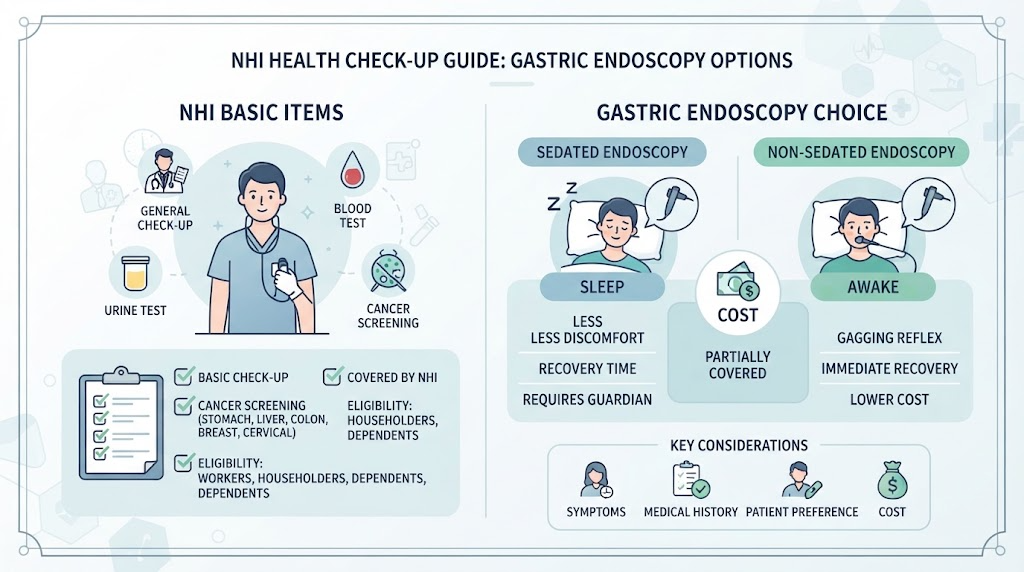
The National Health Insurance Service operates a systematic national health check-up system according to age and gender so that subscribers can detect and treat diseases early. Representative categories include the ‘general health check-up’ conducted annually or biennially, the ‘life-transition/specific cancer check-up’ available upon reaching specific age groups, and the ‘national cancer check-up’ (stomach cancer, colorectal cancer, liver cancer, breast cancer, cervical cancer, etc.) targeting those aged 40 and older. For general health check-ups, basic items such as consultation and counseling, physical measurements (height, weight, waist circumference, vision, hearing), blood pressure measurement, urine protein, blood sugar, blood lipids, and chest X-ray (tuberculosis, etc.) are provided entirely at the Service’s expense (or ₩0 out-of-pocket cost).
“Am I accurately included in this year’s national health check-up targetees, and what cancer check-up items can I receive additional support for for free or at a low cost besides basic general check-ups?”
“If you want to thoroughly check what differences exist in the support scope and items up to workplace subscribers, local household heads, and dependants as well as dependant household members aged 20 and over?”
The success or failure of receiving a health check-up depends on an accurate understanding of basic national health check-up items, checking the presence of out-of-pocket costs, and accurately grasping the linkage cycle between general check-ups and cancer check-ups. To prevent the unfortunate event of missing check-up cycles or confusing items that require personal cost sharing by blindly trusting only the notice, you must carefully examine the support criteria for each item.
“No more unfair situations where you miss out on national health check-up benefits you could enjoy due to not properly knowing the support details or receive check-ups at your own unnecessary expense!”
“We will clearly uncover everything about the comparison of National Health Insurance check-up items and general health check-up support contents, and perfectly pin down the standard for fail-safe smart health check-up reception.”
Then, what exactly are the specific mandatory general check-up test items and the differences in support benefits by targetee? From now on, let’s examine all of those essential checkpoints one by one!
Necessity of Upper Endoscopy and National Cancer Check-up Stomach Cancer Check-up Cycle
“Even when mild gastrointestinal symptoms like indigestion or heartburn repeat, have you ever felt your heart sink upon encountering stories of people who brushed it off thinking, ‘Surely it’s not a major disease,’ only to regret it after receiving a belated stomach cancer diagnosis? Or were you curious about the medical necessity and exact test cycle of upper endoscopy, wondering, ‘They say I must definitely get an upper endoscopy every 2 years through the national cancer check-up, but exactly how decisive a role does upper endoscopy play in early detection of fatal stomach cancer in my body?’”
The most decisive stage that serves as the backbone of health check-up upper endoscopy selection and disease prevention is ‘accurate understanding of the medical necessity of upper endoscopy and the national cancer check-up stomach cancer check-up cycle’.
Stomach cancer is one of the most common cancers among Koreans, but in its early stages, it has almost no special conscious symptoms, making early detection very tricky. However, through upper endoscopy—which allows direct visual observation of the gastric mucosa state via endoscopy equipment and immediate biopsy of suspicious areas—stomach cancer can be detected early in over 90% of cases, and in the case of early stomach cancer, the cure rate can be maximized solely through endoscopic resection without open surgery. For this reason, the National Cancer Check-up hosted by the National Health Insurance Service strongly recommends and supports upper endoscopy (or upper gastrointestinal series) on a **2-year cycle for men and women aged 40 and older**.
“Am I properly receiving the upper endoscopy support provided by the government every 2 years by falling under the target group aged 40 and older without missing out?”
“If you are curious about the practical merits of detecting and managing pre-stomach cancer diseases like atrophic gastritis or intestinal metaplasia in advance through upper endoscopy rather than just enduring it with simple digestive medicine prescriptions?”
The success or failure of stomach cancer check-ups depends on accurately recording and keeping the 2-year national cancer check-up schedule on the calendar, early diagnosis of chronic gastritis or polyps through upper endoscopy, and not omitting regular follow-up examinations. To prevent the unfortunate event of missing the golden time by postponing check-ups simply because it’s ‘bothersome’ or ‘the stomach feels comfortable’, you must keenly recognize the necessity of upper endoscopy.
“No more unfair situations where you miss out on the precious opportunity for early detection of stomach cancer and worsen the disease due to not properly knowing the cycle!”
“We will clearly uncover everything about the necessity of upper endoscopy and the national cancer check-up stomach cancer check-up cycle, and perfectly pin down the standard for fail-safe smart stomach health defense.”
Then, what exactly are the specific medical advantages of upper endoscopy and the practical reasons why we must strictly adhere to the 2-year national cancer check-up cycle? From now on, let’s examine all of those essential checkpoints one by one!

Upper Endoscopy Sedation vs Non-Sedation Endoscopy Complete Comparison and Selection Criteria
“As the upper endoscopy reservation date approaches, have you ever fallen into worry thinking, ‘Should I definitely do sedation because I’m afraid of pain, or should I try non-sedation, which has lower costs and faster recovery time?’ Or when hearing mixed reviews around you—such as ‘Non-sedation is totally unbearable because it’s hard to breathe and makes you gag’ or ‘Sedation is the best since you don’t even remember and take the test comfortably’—were you frustrated because you couldn’t figure out which method to choose?”
The decisive stage to successfully receive a health check-up and wisely minimize the pain during the test process is ‘complete understanding of the comparison of pros and cons between upper endoscopy sedation (conscious sedation) and non-sedation endoscopy and the selection criteria that suit me’.
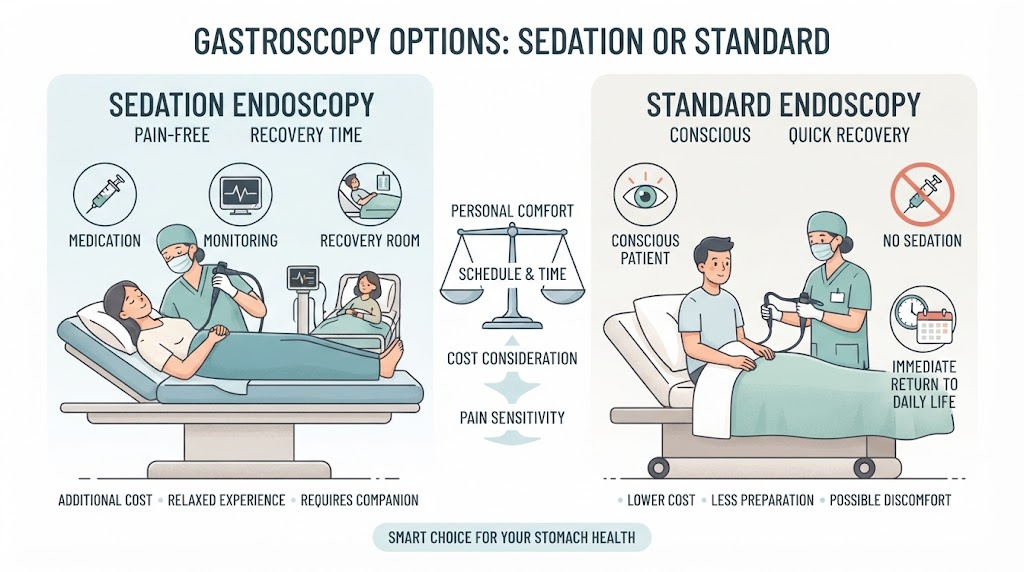
When receiving an upper endoscopy through the National Health Insurance National Cancer Check-up, patients can directly choose between sedation and non-sedation according to their preferences and budget. **Non-sedation upper endoscopy** is a method of inserting the endoscopy hose with a clear head without administering anesthetics. It has strong advantages in that the test time is very short at around 5 minutes, costs are low, and no separate recovery time is required, allowing immediate return to daily life right after the check-up. However, there is a burden of having to fully endure extreme gagging, suppressing burps, and psychological fear and pain when passing through the esophagus and pharynx. On the other hand, **sedation upper endoscopy** proceeds with the test in a sleeping state (or a groggy state) by administering sedatives, allowing patients to finish the test comfortably with almost no pain or discomfort. However, additional costs (sedation fees) occur due to the administration of sedatives, driving or important tasks are impossible on the day due to residual medicine effects after the test, and respiratory side effects or sleeping pill allergic reactions may rarely occur, making prior consultation essential.
“Will I be able to endure non-sedation since my gag reflex is severe, or would it be wise to choose sedation even while accepting the burden of sedation anesthesia and additional costs?”
“If you want to thoroughly compare practical constraints such as recovery time after sedation endoscopy and the necessity of accompanying a guardian when considering your workplace schedule or same-day schedule?”
The success or failure of choosing an endoscopy method depends on accurately weighing your gag reflex sensitivity, the presence of trauma from past endoscopy experiences, schedule leeway on the check-up day, and receptivity to additional sedation costs. To prevent the unfortunate event of giving up midway through the test or ruining your schedule after the test by making an impulsive decision simply because ‘everyone else does it’ or ‘out of fear’, you must carefully examine the details of each method.
“No more unfair situations where you feel terrified of the upper endoscopy test itself or suffer unnecessary physical pain due to failing to properly understand the selection criteria!”
“We will clearly uncover everything about the upper endoscopy sedation vs non-sedation endoscopy complete comparison and selection criteria, and perfectly pin down the standard for fail-safe smart stomach check-up defense.”
Then, what exactly are the specific sedation and non-sedation selection guides that perfectly match you and practical coping tips for each method? From now on, let’s examine all of those essential checkpoints one by one!
Practical Checklist for Health Check-up Upper Endoscopy Reservation and Preliminary Preparation
“After booking an upper endoscopy, have you ever felt anxious worrying that the test might be canceled or you might have to retake it because of a minor preparation detail like ‘Exactly when should I fast from the evening before the check-up?’ or ‘Should I take my regular blood pressure or diabetes medication in the morning, or should I stop taking it?’ Or have you ever been worried that you might go through useless trouble by missing diet controls due to letting your guard down trusting only the reservation date?”
The most decisive practical step that serves as the backbone of successful health check-up upper endoscopy reception and accurate disease diagnosis is ‘complete understanding of the practical checklist for upper endoscopy reservation and preliminary preparation’.
For a successful upper endoscopy, thorough preparation is required starting from the hospital reservation stage. First, **dietary control the day before the check-up** requires avoiding foods that linger in the stomach for a long time—such as seeded fruits (kiwi, watermelon, oriental melon, etc.), mixed grain rice, seaweeds (seaweed, kelp, etc.), and high-fiber vegetables—at least 3 days before the test date, and eating centered around soft foods (porridge, white rice, tofu, etc.). Second, **compliance with fasting hours** requires finishing dinner lightly around 7 PM the evening before the test, maintaining an empty stomach state for at least 8 hours (generally 12 hours or more) before the test, and fasting including water. However, essential medications such as blood pressure pills may need to be taken with a minimal amount of water early in the morning on the day of the check-up, so you must definitely check in advance according to your attending physician’s or the hospital’s guidance.
“Will the endoscopy field of view be blocked due to food I inadvertently ate the day before the check-up, causing trouble in accurate gastric mucosa observation?”
“If you want to check details thoroughly, such as how to handle regular medications you are taking on the day of the check-up and what to watch out for when returning home after sedation endoscopy?”
The success or failure of upper endoscopy preliminary preparation depends on observing the golden time for dietary control, strictly keeping fasting hours, checking with the hospital in advance regarding regularly taken medications, and making a safe return home plan after the sedation test. To prevent the unfortunate event of being refused a test or having to rebook due to bowel preparation status or foreign substances in the stomach on the day of the test after letting your guard down thinking you can just roughly starve, you must carefully examine the checklist.
“No more unfair situations where you hurriedly visit the hospital without properly knowing the preliminary preparation matters, only to be unable to receive the test and turn back!”
“We will clearly uncover everything about the practical checklist for health check-up upper endoscopy reservation and preliminary preparation, and perfectly pin down the standard for fail-safe smart stomach check-up completion.”
Then, what exactly are the specific date-by-date diet control guides, mandatory items to bring on the day of the check-up, and safe coping rules after sedation endoscopy? From now on, let’s examine all of those essential checkpoints one by one!

Conclusion: Protecting Stomach Health Through Thorough Comparison and Correct Upper Endoscopy Selection
“Leaving behind the desire to postpone whenever seeing the national health check-up notice that returns every year or two, did you gain the confidence thinking, ‘Now I too can properly protect my stomach health’ by carefully examining everything from National Health Insurance support items to the necessity of early stomach cancer detection, comparison of pros and cons between sedation and non-sedation, and thorough preliminary preparation matters? Or are you now ready to set up wise health check-up countermeasures, putting aside the worries of ‘Which endoscopy method should I actually choose?’ or ‘Might I ruin the test by missing preliminary preparation?’”
Concluding the entire journey of the health check-up health insurance comparison and criteria for choosing sedation vs. non-sedation upper endoscopy, the final core point we must remember is ‘execution power to overcome the information gap and proactively choose the check-up method that best suits me’.
The national health check-up and 2-year cycle stomach cancer check-up benefits provided by the National Health Insurance Service do not cure diseases first for those who simply wait. Accurately understanding general check-up items and cancer check-up support ranges, wisely choosing sedation or non-sedation methods according to one’s pain sensitivity and schedule, and practicing thorough preliminary preparation such as dietary control and compliance with fasting hours—this series of processes is truly the ultimate health risk management strategy to protect your body amidst high inflation and hardships.
“Based on the valuable upper endoscopy selection and preliminary preparation know-how learned today, if you want to practice with confidence starting from your upcoming health check-up reservation?”
“If you do not want to repeat the foolish regret of missing precious national health check-up benefits and missing the golden time for stomach health due to a single clue of lack of information or negligent preparation?”
Access the National Health Insurance website or The Health Insurance app right now and carefully check whether you are this year’s health check-up targetee and your designated check-up institution once again. Small interest and thorough preliminary preparation will provide practical health contributions to your daily life and serve as a primer for great health assets designing a vibrant life of a lifetime.
“Everything about seizing the valuable national health check-up benefits that everyone else gets into your own hands without hesitation now!”
“Concluding the grand journey of the health check-up health insurance comparison and criteria for choosing sedation vs. non-sedation upper endoscopy, we sincerely cheer for you to be reborn as a truly smart stomach health guardian with complete preparation against strict check-up procedures without failure.”
Start your wise first step toward fail-safe smart upper endoscopy check-ups and health maintenance right now!
Korean version: 한국어로 읽기