Introduction: The Importance of State-Funded Job Training Open to Both Workers and Job Seekers
“Have you ever hesitated to prepare for a job change by developing new job competencies amid a rapidly changing employment market because of hefty education costs? Or, while currently working at a job, do you feel that the economic burden is too great to attend an academy out of pocket for self-improvement for your future career?”
For both job seekers preparing for employment and workers currently employed, challenging new fields and strengthening competencies are always a big concern and essential tasks. However, the economic pressure to acquire professional skills or certifications out of one’s own pocket is high, and staying still brings great anxiety about being left behind in rapidly changing trends.
“When you want to build a new career on your own but education costs are burdensome…”
“If you are curious about the reality of state-funded job training where the government reliably supports tuition fees for the growth of both workers and job seekers?”
The representative state-funded policy where the government directly steps up for the lifelong vocational competency development of Korean citizens is the various vocational training systems of the Ministry of Employment and Labor. As long as you meet certain eligibility requirements, the state subsidizes a significant portion of the training costs and provides customized benefits by target, creating tremendous self-improvement synergy incomparable to regular private academies.
“Stop putting off learning while worrying blindly about costs!”
“Let’s meticulously compare the differences in benefits by target between workers and job seekers, and thoroughly dissect the utilization strategy for state-funded job training that is most advantageous to you.”
So, what benefits can workers and job seekers enjoy respectively, and what is the optimal educational course suited to my situation? Let’s take a look at all those amazing support benefits one by one starting now!

Reviewing the Basic Concepts and Core Support Structure of State-Funded Job Training
“I’ve heard a lot that state-funded job training is an essential item for lifelong competency enhancement, but exactly what kind of structure is this system operated under and what benefits does it provide to workers and job seekers respectively?”
Since the state-funded benefits are exceptional, it is most important to carefully examine the overall basic concepts and core support structure of the system. We will detail the core structure of state-funded job training and the support systems you must check to reliably protect your assets and build your competencies during the training period.
- Core Structure of State-Funded Job Training: Integrated Support Through the National Tomorrow Learning Card
State-funded job training is a representative state-led training system designed to support citizens in developing their vocational competency enhancement capabilities on their own to respond to the rapidly changing labor market.
Integrated support with a single card: By integrating previously separated support methods for job seekers and workers into one, you can continuously use a single issued National Tomorrow Learning Card regardless of unemployment, employment, or self-employment status, which is very convenient.
Differential support limit per individual: A basic support limit of 3 million won is granted, and you can receive generous training cost support of up to 5 million won depending on your income level or employment status (such as whether you are a job seeker or worker) to take desired training courses.
- Powerful Support System Ranging from Tuition Support to Training Incentives
There are powerful hidden benefits that lower the self-pay ratio you bear and provide additional cash-like support depending on conditions by target.
Breakthrough training cost support: When taking various vocational training courses such as computers, design, baristas, and certification acquisition at state-designated excellent training institutions, the government directly subsidizes from 45% up to a maximum of 85% of the tuition fee.
Attendance-linked training incentives: If certain requirements are met (e.g., taking a training course of 14 days or longer and achieving an attendance rate of 80% or higher), you can receive a designated ‘training incentive’ every month during the training period, greatly alleviating your financial burden.
💡 Core Points of State-Funded Job Training Benefits
Since practical support is provided considering living expenses and incidental costs during the actual learning and growing process—rather than simply discounting tuition—it is wise for both workers and job seekers to actively utilize it without hesitation if they have a career they are aiming for.
So, what are the specific benefits and utilization strategies you can enjoy when you are in the status of a job seeker? Let’s dissect them in detail in the next chapter!
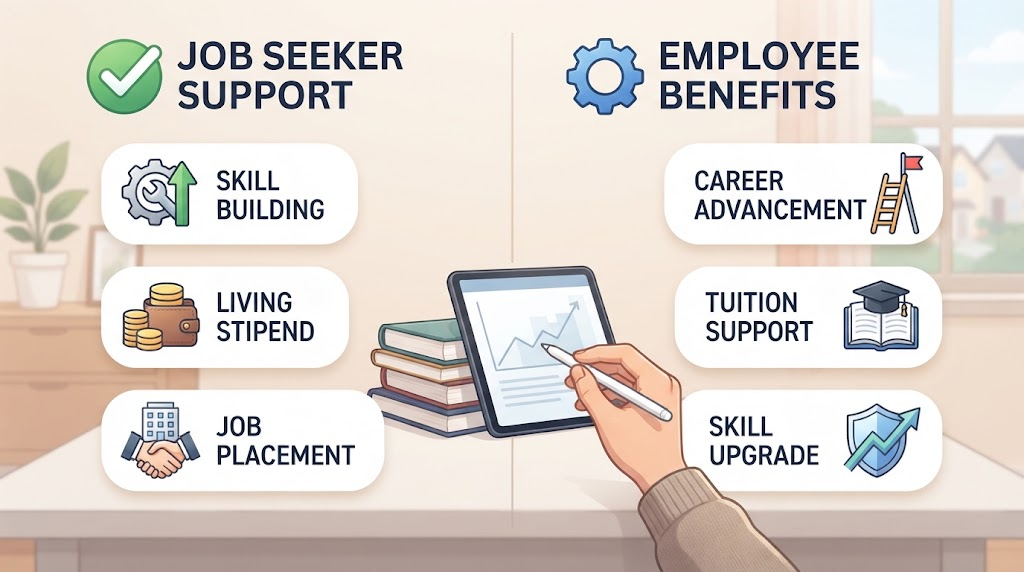
Major Benefits and Utilization Strategies of State-Funded Job Training for Job Seekers
“For job seekers who want to build job competencies to get a new job but are worried due to lack of experience, what benefits can they reap through state-funded job training and how should they utilize them to grab acceptance?”
For job seekers betting their lives on job preparation, state-funded job training is a core opportunity that goes beyond simply taking courses to lay the stepping stone for a new life. We detail the breakthrough benefits you can enjoy in the status of a job seeker and practical strategies to maximize your employment success rate by utilizing them 100%.
- Major Benefits of State-Funded Job Training Exclusively for Job Seekers
Since job seekers are in a state where economic activities are suspended, support is carefully designed not only for education costs but also for livelihood stability.
Training cost support and minimization of self-burden: When receiving vocational training in the status of a job seeker, a more favorable support rate than general courses is applied to drastically lower the tuition burden, and for specific high-employment-rate courses or national core and strategic industry sector training, opportunities to take courses entirely free of charge (0 won self-burden) are open.
Training incentive payment benefits: For job seekers who meet certain requirements (such as participants in the National Employment Support System), you can receive up to 300,000 won or more or a designated training incentive every month during the training period to alleviate financial pressure and concentrate fully on job search activities.
- Customized Utilization Strategies for Job Seekers
This is the know-how to connect state-funded job training to actual employment rather than just building specs.
Selecting practice-oriented courses: Rather than theory-oriented ones, you must select practice-oriented courses dealing with skills used directly in the field (IT development, UI/UX design, tax accounting, video editing, etc.) to make a strong appeal to corporate interviewers.
Actively utilizing employment linkage programs: You must utilize employment support services provided by the training institution itself—such as resume consulting, mock interviews, and partner company matching—without missing any, and knock on the employment door simultaneously with completion.
💡 Key Point of Utilization for Job Seekers
Since time is soon an asset for job seekers, the wisest strategy is to accurately link the education completion schedule and the open recruitment season you are aiming for to minimize gaps.
Then, what benefits can workers currently employed at a job enjoy? Let’s compare them in detail in the next chapter!

Major Benefits and Career Growth Strategies of State-Funded Job Training for Workers
“For workers who are currently employed but want to broaden their job professional expertise, or workers who want to build their competencies in advance for an upcoming job change and a future career leap, what benefits can they reap through state-funded job training and how should they utilize them?”
For office workers who do not let go of the string of self-improvement even amidst busy work schedules, state-funded job training is the most reliable wing that allows them to upgrade their careers while balancing current work and learning. We detail the practical benefits you can enjoy in the status of a worker and practical strategies to achieve successful career growth through them.
- Major Benefits of State-Funded Job Training Exclusively for Workers
Since office workers must proceed with learning in flexible forms such as weekday nights, weekends, or online lectures, a customized support system tailored to this is provided.
Support for enhancing workers’ job competencies: Using the National Tomorrow Learning Card, you can receive support for a portion of the tuition fee according to your needs without economic burden, ranging from advanced courses to enhance the professionalism of your current job to basic certification courses for transitioning to a completely new field.
Flexible course methods and learning after leaving work: Considering the schedules of office workers, you can choose courses opened in various forms such as weekday night classes, weekend classes, and 100% non-face-to-face online lectures, allowing you to balance work and studies without undue burden.
- Customized Career Growth Strategies for Workers
This is the know-how to connect state-funded job training to actual career leaps such as promotion, job change, and salary negotiation, rather than just a hobby or a one-time course.
In-depth learning linked to current job duties: By selecting courses that can be applied immediately to work, such as programs used in the current workplace, data analysis techniques, and the latest practical trends, you enhance work performance and strengthen internal competitiveness.
Strategic job change and side job preparation: If you are preparing for a job change to another industry or entrepreneurship/freelancing (side job) after resignation, you actively utilize it as a stepping stone to acquire related certificates in advance and build up a portfolio while in the stable state of maintaining a job.
💡 Key Point of Utilization for Workers
Since the greatest resource for an office worker is ‘time’, the core is to carve out commuting time or weekend leisure time to safely maintain a course attendance rate of 80% or higher, and seize the final certificate of completion without dropping out midway.
Then, what specific differences are there between the benefits for workers and job seekers, and how should you choose according to your situation? We will clearly compare them in the next chapter!
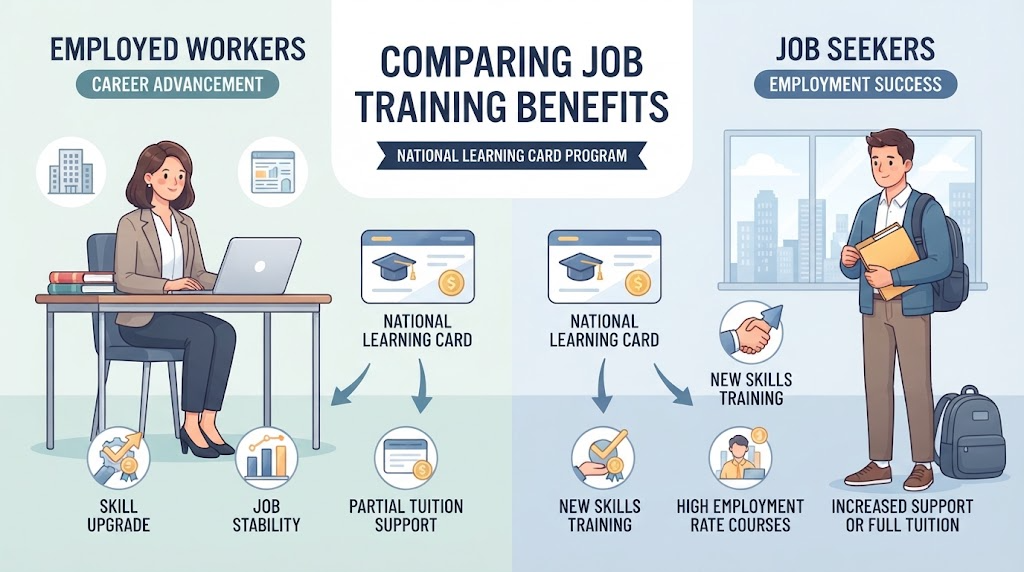
Comparison Summary of Benefits Between Workers and Job Seekers and Customized Selection Guide
“I know that both workers and job seekers can receive state-funded job training, but what are the specific differences in benefit ratios or support ranges depending on my status, and what course should I choose in my current situation to be most advantageous?”
When strengthening competencies using the National Tomorrow Learning Card, the support conditions and focus of benefits applied vary slightly depending on your employment type (worker vs. job seeker). We thoroughly review the clear differences between the two targets and provide an optimal selection guide tailored to your career goals.
- Comparison of Major Benefits and Support Conditions Between Workers and Job Seekers
We clearly compare the core differences in support structures and benefits according to current employment status.
Support limit and card commonality: The fact that a basic support limit of 3 million won to 5 million won is granted for 5 years upon issuance of the National Tomorrow Learning Card is identical for both workers and job seekers.
Self-burden rate and application of free courses: In the case of job seekers, when they fall under national core and strategic industry sector training with a high employment rate or specific employment support targets, the scope of receiving entirely free (0 won self-burden) benefits or preferential support rates for general job seekers is relatively wide. On the other hand, for workers, the self-burden rate may be partially applied differentially depending on their income level or company size (such as large-scale enterprise workers).
Payment of training incentives: For job seekers, training incentives are actively paid every month upon satisfying certain attendance conditions to promote job search activities and help stabilize livelihoods, whereas for workers, payment criteria are applied differently depending on whether they work during the daytime or the prescribed training hours requirements.
- Customized Selection and Utilization Guide Tailored to My Situation
We present clear criteria on what strategies you should establish according to your current job status and future career direction.
Customized selection guide for job seekers: If you are currently unemployed or preparing to transition to a completely new job (e.g., developer, designer, etc.) for a job change, it is advantageous to carefully check the entirely free courses or training incentive support benefits and select a daytime full-time intensive training course to complete your specs in a short period.
Customized selection guide for workers: If you are currently working at a job to enhance your job professional expertise or preparing for an after-work side job or future job change, it is wise to select flexible courses that can be balanced without undue burden with current work, such as weekday night classes, weekend classes, or 100% online non-face-to-face courses.
💡 Key Point of Selection Between Workers and Job Seekers
Since the utilization purpose of the system and detailed conditions of subsidies differ slightly depending on your status, inquiring in advance about your exact employment status-based eligibility requirements and expected self-burden fees through the Employment 24 website before applying for the card is the surest method.
What are the essential checklists you must remember for successful course completion? We will dissect them in detail in the next chapter!

Essential Checklists and Tips for Successful Course Completion
“I applied for a state-funded job training course, successfully passed after a hard time, and started taking classes. What points should I meticulously check to successfully complete the course without dropping out midway or suffering disadvantages, and achieve my desired goal?”
Since state-funded job training is a precious opportunity where national budgets are invested, there are practical know-hows and checklists you must remember to finish without dropping out midway and maximize benefits by 100%. We point out the core tips that reduce trial and error you may experience during the course and lead to successful completion.
- Essential Checklist for Successful Course Completion
These are core management items that must be checked before and during the start of the educational course.
Thorough attendance rate management: When taking a training course, if your overall attendance rate falls below a certain standard (generally 80% or higher), you may be treated as dropped out midway or disadvantages may occur in future card re-issuance and subsidies, making thorough management of tardiness, early leave, and absence essential.
Checking self-burden payment and administrative procedures: Accurately pay the self-burden fee you must bear before the course start date, and check the expiration date and limit balance of the National Tomorrow Learning Card in advance so that there are no setbacks in course registration.
- Practical Tips to Maximize Benefits by 100%
This is the know-how to reap the fruits of actual employment, job change, or career growth beyond mere completion.
Claiming training incentives and additional benefits: Do not miss out on receiving the training incentives paid monthly by meeting attendance conditions or requirements, and actively utilize benefits such as textbook support or free special lectures.
Portfolio buildup and post-linkage utilization: Neatly organize assignments or project results produced during the education course into a personal portfolio, and draw out the best effects compared to investment by utilizing certificate acquisition and employment support services linked after completion.
💡 Core Point of Course Completion
The more actively you participate and leave records in state-funded job training, the more it becomes a powerful weapon that enhances the value of your career. We hope you achieve the joy of learning and practical spec-up simultaneously through systematic schedule management.
You have completely mastered all strategies for asset building and career leap! Shall we check out the warm concluding remarks that will decorate the grand finale of a wonderful posting?
Conclusion: Raising Future Competitiveness with State-Funded Job Training Suited for Me
So far, we have looked together at the basic concepts and major benefits of state-funded job training by target for workers and job seekers, the specific support differences between the two targets, and essential checklists and tips for successful course completion.
In a rapidly changing employment market and job-hopping trend, self-improvement and job competency enhancement go beyond simply building specs; they are the surest first steps to erase future anxiety and solidify your own competitiveness. However, trying to learn solely out of pocket amidst hefty education costs inevitably brings clear limitations and financial burdens.
Shall we lightly retrace the core contents we shared today once again?
First, actively utilize a reliable state-funded support limit of up to 3 million won to 5 million won for 5 years as long as you are a Korean citizen through the National Tomorrow Learning Card.
Second, carefully compare and choose the focus of benefits, self-burden rates, and training incentive payment conditions depending on whether your current status is a worker or a job seeker.
Third, successfully complete the course through thorough attendance rate management and practice-oriented education courses, and connect it to an actual career leap.
Grabbing this precious opportunity where the state adds strength to your learning quickly when you meet the conditions is the wisest self-improvement strategy. We hope you make the dream of a solid career leap a reality with state-funded job training perfectly suited for you, taking today’s posting as a reliable compass.
We sincerely hope this article became a warm lighthouse for your successful competency enhancement journey. If you have any questions during the preparation process, please feel free to leave comments anytime, and we sincerely cheer for everyone to smartly secure state-funded benefits and perfectly achieve your desired goals!
Korean version: 한국어로 읽기