Prologue: 3 to 5 Million KRW in Government Benefits, Am I Eligible?
This is a draft for the prologue section designed to capture the interest of Naver Blog readers and build rapport.
- Prologue: 3 to 5 Million KRW in Government Benefits, Am I Eligible?
When learning a new job skill or seeking to acquire a certification, the very first realistic barrier encountered is ‘the burden of academy tuition and educational expenses.’
Courses for developing job competencies, such as computer programming, accounting and taxation, design, and practical certification exams, routinely exceed hundreds of thousands to as much as millions of KRW after attending just a one- or two-month program.
The Tomorrow Learning Card is the exact system provided by the government to dramatically relieve this educational cost burden.
Because it provides government-funded training expenses ranging from a baseline of 3,000,000 KRW up to 5,000,000 KRW per person, it has essentially established itself as an ‘essential item’ not only for young job seekers preparing for employment, but also for employed workers preparing to change jobs and middle-aged adults looking to learn new skills.
“The Tomorrow Learning Card, can I apply for it too?”
In reality, when visiting Work24 to apply for the card, many people hesitate due to concerns such as the following:
“I am an enrolled student still attending university, can I get it issued?”
“Since I am employed and have income, won’t I get rejected?”
“I heard that sole proprietors and freelancers also have restrictions based on sales criteria…”
Under the motto ‘Any citizen willing to work,’ the Tomorrow Learning Card significantly expanded its eligible recipients, but clear application criteria and exception clauses exist based on employee income levels, business owners’ annual sales, and university students’ remaining period of study (academic year).
To avoid experiencing application rejection or wasting unnecessary time by applying blindly without properly verifying qualification requirements, this article will clearly outline only the essentials of the most confusing income criteria and the issuance requirements for university students and prospective graduates.
Shall we proceed with writing the main text for the next step?
Section 2: Writing the Basic Eligible Recipients & Issuance Exclusions
Creating a 16:9 aspect ratio image prompt suitable for the prologue section

Tomorrow Learning Card Basic Eligible Recipients & Issuance Exclusions
This is a draft for Section 2, written with enhanced readability and clarity so that Naver Blog readers can determine their eligibility at a glance.
- Tomorrow Learning Card Basic Eligible Recipients & Issuance Exclusions
The Tomorrow Learning Card is a system introduced to help citizens develop their competencies if they wish to receive vocational training. The fundamental principle is “Any citizen of the Republic of Korea willing to work can apply,” but because it is operated through national finances, there are statutory exclusion criteria.
Before applying, you must first check whether you fall under ‘Eligible Recipients’ or ‘Exclusions’ to avoid unnecessary steps.
- Basic Eligible Recipients: An Open Principle for Everyone
Fundamentally, citizens under the age of 75 who need vocational competency development training can apply if they belong to the following categories:
- Unemployed individuals and job seekers: College graduates preparing for employment, young job seekers, career-interrupted women, individuals who closed micro-businesses, etc.
- Employed workers: Small and medium-sized enterprise (SME) workers, large enterprise workers (when meeting certain criteria), fixed-term, dispatched, and part-time workers, etc.
- Special types of employment workers & freelancers: Insurance agents, home study teachers, delivery riders, IT freelancers, etc.
- Self-employed individuals: Small business owners running a business after registering as a sole proprietorship (when meeting sales criteria).
- Undergraduate and graduate students: Enrolled students and students on leave of absence whose remaining prescribed study period until graduation is within 2 years.
- Issuance Exclusions: Cases Where Issuance is Legally Restricted
Those falling under the following categories are excluded from issuance in accordance with the Employment Insurance Act and the Act on the Development of Vocational Skills of Workers:
- Active public officials and military personnel: National public officials, local public officials, career military personnel (however, conditional permission applies to some fixed-term public officials and military personnel scheduled for discharge).
- Private school faculty and staff: Teachers and administrative staff covered by the Teachers’ Pension.
- Individuals aged 75 and older: Exceeding the age limit for employment insurance training support.
- High-income large enterprise workers: Those under 45 years of age employed at large enterprises (large-scale enterprises) whose average monthly wage over the past 3 months is 3,000,000 KRW or more.
- High-revenue self-employed individuals: Real estate rental business operators (excluding real estate management) or business operators with annual sales of 400,000,000 KRW or more.
- High-income special-type workers and freelancers: Special types of employment workers whose average monthly income over the past 3 months is 5,000,000 KRW or more.
- Certain recipients of livelihood benefits: Cases where individuals are not classified as job-seeking targets, such as those with deferred conditional obligations.
- Undergraduate (graduate) students with more than 2 years remaining until graduation: Freshmen and first-semester sophomores based on 4-year universities.
💡 Self-Diagnosis Table for Issuance Eligibility at a Glance
| Classification | Application Eligibility | Key Checkpoints |
|---|---|---|
| General Job Seekers / Unemployed | Eligible (O) | Issued immediately upon application without separate proof of income or sales |
| SME Employees | Eligible (O) | Fully/partially government-funded regardless of salary amount |
| Large Enterprise Employees | Conditionally Eligible (△) | Eligible if 45 years of age or older, or if monthly salary over the past 3 months is under 3,000,000 KRW |
| Self-Employed / Small Business Owners | Conditionally Eligible (△) | Proof of annual sales under 400,000,000 KRW for the past 1 year is required |
| Freelancers / Special Types of Employment Workers | Conditionally Eligible (△) | Eligible if average monthly income over the past 3 months is under 5,000,000 KRW |
| Public Officials / Private School Faculty & Staff | Ineligible (X) | Issuance restricted in principle |
| College 3rd–4th Year / Prospective Graduates | Eligible (O) | Eligible if remaining period of study until graduation is within 2 years |
If you are an employee, a self-employed individual, or a university student, you need to examine the detailed income and enrollment criteria thoroughly. In the following content, we will break down the most frequently asked income criteria and university student enrollment requirements in detail, step by step.
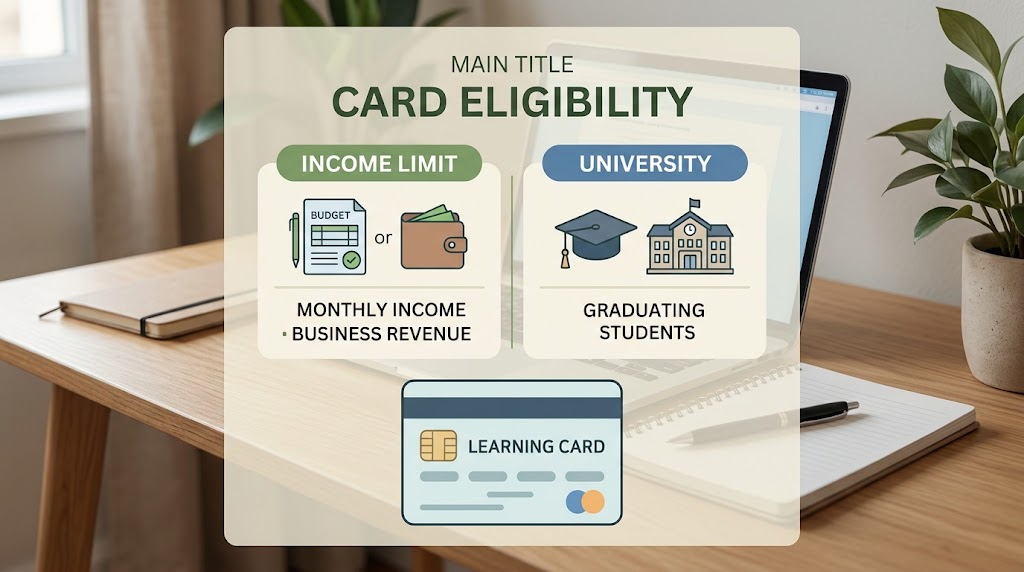
Comprehensive Guide to the Most Confusing ‘Income Criteria’
This is a draft for Section 3, clearly laying out the income criteria where employees, self-employed individuals, and freelancers most often experience rejections during the application process.
- Comprehensive Guide to the Most Confusing ‘Income Criteria’
While unemployed individuals or job seekers can receive the card immediately without separate proof of income, individuals currently generating a regular income or sales must not exceed the statutory income ceiling to be issued the Tomorrow Learning Card.
There is much misinformation, such as “You cannot get it under any circumstances if you have a job,” or “You are excluded if you hold a business registration certificate.” Let us clearly examine the actual income criteria and proof methods for each occupational group one by one.
① Large Enterprise & Mid-Sized Enterprise Employees (Large-Scale Enterprise Workers)
Employees of SMEs (preferred support target enterprises) are eligible for issuance regardless of their salary level. On the other hand, employees of large-scale enterprises (large corporations and mid-sized enterprises above a certain scale) must satisfy at least one of the following two conditions to become eligible for issuance.
- Age Criteria: Workers aged 45 or older (can apply regardless of salary amount)
- Income Criteria: If under age 45, workers whose average monthly wage over the past 3 months is under 3,000,000 KRW
💡 Checkpoint: Even if you work at a large enterprise, you can receive issuance if you are aged 45 or older, or if you are an entry-level worker whose pre-tax average monthly salary (base salary + fixed allowances, etc.) over the past 3 months is under 3,000,000 KRW. Verification is provided via pay stubs or withholding tax receipts for earned income.
② Self-Employed Individuals & Sole Proprietors (Small Business Owners)
Even if you are a registered sole proprietor with a business license, you are not unconditionally excluded; eligibility is determined based on the scale of annual sales.
- General Taxpayers / Simplified Taxpayers: Business operators whose annual sales (gross income) over the past 1 year are under 400,000,000 KRW
- Early-Stage Startups with Less Than 1 Year Since Opening: If the business operation period is less than 1 year, average monthly sales under 33,330,000 KRW (applying the annualized standard of under 400,000,000 KRW)
- Tax-Exempt Businesses: VAT-exempt business operators are also eligible upon meeting the requirement of annual gross income under 400,000,000 KRW
- Issuance Exclusions: Real estate rental business operators (excluding real estate management) and business operators with annual sales of 400,000,000 KRW or more
💡 Checkpoint: Sales are verified by submitting a Certificate of VAT Tax Base or a Certificate of Income Amount for Tax-Exempt Businesses, which can be issued via the National Tax Service Hometax.
③ Special Types of Employment Workers & Freelancers
These are the criteria for individuals working under consignment or subcontract contracts rather than employment contracts, such as insurance planners, home-visit tutors, golf caddies, parcel delivery/food delivery riders, and IT/design freelancers.
- Income Criteria: Issuance is available if the average monthly income (pre-tax) over the past 3 months is under 5,000,000 KRW
- Monthly Income of 5,000,000 KRW or More: Classified as high-income freelancers, making issuance restricted.
💡 Checkpoint: Apply by attaching deposit transaction statements, withholding tax receipts (3.3% business income tax withheld), or service/consignment contracts that can prove income over the past 3 months.
📊 Summary Table of Tomorrow Learning Card Income Criteria by Occupational Group
| Target Classification | Eligible Income & Sales Criteria | Required Verification & Supporting Documents |
|---|---|---|
| SME Employees | Income irrelevant (fully eligible) | Automatic inquiry of Employment Insurance subscription history |
| Large Enterprise Workers | Aged 45 or older, or monthly average wage under 3,000,000 KRW | Pay stubs for the last 3 months, withholding tax confirmation |
| Sole Proprietors & Self-Employed | Annual sales under 400,000,000 KRW over the past 1 year | Certificate of VAT Tax Base (Hometax) |
| Special-Type Workers & Freelancers | Monthly average income under 5,000,000 KRW over the past 3 months | Withholding tax receipt (3.3%), payroll/deposit bank statement |
Once you satisfy the income requirements, even employees or business owners can significantly lower their out-of-pocket costs to take job skill-up courses.
What about college students, then? From which academic year can you apply, and what documents need to be prepared? In the next section, we will examine the issuance requirements for university students in detail.

Issuance Criteria for College Students & Prospective Graduates: From Which Academic Year Is It Available?
This is a draft for Section 4, organizing the issuance criteria for university students and prospective graduates that college students and job-seeking readers search for and find most confusing.
- Issuance Criteria for College Students & Prospective Graduates: From Which Academic Year Is It Available?
In the past, the Tomorrow Learning Card could only be applied for by college students in their ‘last semester before graduation.’
However, as the legislation was amended to help young people strengthen their early job competencies and prepare for employment, the scope of support has now been significantly expanded so that any college (graduate) student whose “remaining prescribed study period until graduation is within 2 years” can receive it.
Then, based on the academic system of the university you attend (2-year, 3-year, 4-year, or graduate school), exactly when can you apply? Here is a clean summary of the issuance timing by academic year and the required supporting documents.
① Comprehensive Breakdown of Eligible Issuance Timing by Academic System
The core formula is just one: “Is there 2 years (4 regular semesters) or less remaining until final graduation?”
4-Year Universities: Available to apply from the point the 2nd semester of the 2nd year ends (winter vacation)
Those scheduled to enter the 1st semester of the 3rd year, 3rd and 4th-year enrolled students, and students delaying graduation are all eligible. (Enrolled students in the 1st year through the 1st semester of the 2nd year cannot be issued)
3-Year Junior Colleges: Available to apply from the point the 2nd semester of the 1st year ends (winter vacation)
Those scheduled to enter the 1st semester of the 2nd year through all enrolled students in the 2nd and 3rd years are eligible.
2-Year Junior Colleges: Available to apply immediately upon admission
For 2-year colleges, since the remaining study period from admission until graduation is already within 2 years, it can be issued right from the 1st semester of the 1st year.
5-Year Academic Programs (Architecture, etc.): Available to apply from the point the 2nd semester of the 3rd year ends (remaining study period within 2 years)
General & Professional Graduate Students: Available to apply if the remaining period until completing the master’s or doctoral program is within 2 years
Korea National Open University, Cyber Universities, Night Universities, Academic Credit Bank System: Available to apply at any time regardless of academic year (open universities and the Academic Credit Bank System are permitted for issuance at all times while enrolled)
💡 Can students on leave of absence also receive it?
Yes, it is possible. Even while on leave of absence, if the remaining semesters after returning to school are within 4 semesters (2 years), you can obtain the Tomorrow Learning Card under leave-of-absence status and attend certification and job training courses.
② 3 Essential Documents to Submit When Applying for Issuance
When applying on Work24 under college student status, supporting documents are required to prove through the system that the ‘remaining prescribed study period is within 2 years.’
- Certificate of Enrollment (or Certificate of Leave of Absence): Basic document proving current enrolled or leave-of-absence status
- Transcript: Document to verify the previous semesters completed up to the present and earned credits
- Certificate of Expected Graduation (applicable candidates): Attached if in the final semester of the 4th year or in graduation-delayed status
📌 Document Submission Tip: If you upload a PDF file or a clearly scanned image obtained from the school website’s civil application portal or ‘Gov24’ to the ‘Attachment’ field on the Work24 application screen, the competent Employment Center will review and approve it within 2 to 3 business days.
💡 Government Funding Utilization Tips for College Job Seekers
Issuing the Tomorrow Learning Card in advance during vacations or semesters of the 3rd and 4th years creates great synergy in job preparation.
Completing Foundational Specs: Utilize semesters or vacations to acquire short-term certification courses such as Computer Specialist Level 1, Computerized Accounting/Tax, and SQLD with reduced out-of-pocket costs
K-Digital Training (KDT) Full-Stack Bootcamp: Complete long-term big data, AI, and web development project courses worth millions of KRW 100% free of charge during 4th-year job preparation to finalize a practical portfolio
Rather than rushing to create a card after graduation when jumping into the job market, we recommend issuing it in advance when entering the 3rd year—once eligibility requirements are met—to build up specs systematically.
Shall I proceed with writing the next section or materials?
Section 5: Writing Funding Limits & Additional Support Conditions
Creating a 16:9 image generation prompt for the college student issuance criteria section
Tomorrow Learning Card Subsidy Limits & Additional Support Conditions
This is a draft for Section 5, clearly explaining the government-funded training subsidy limit structure, calculation standards for self-pay rates, and 100% full-support benefits.
- Tomorrow Learning Card Subsidy Limits & Additional Support Conditions
When you are issued the Tomorrow Learning Card, cash is not deposited into your personal bank account; instead, a ‘government-funded training subsidy limit credit’ is granted to your Work24 virtual account.
The base amount provided is 3,000,000 KRW, but the limit can increase up to 5,000,000 KRW depending on whether you belong to vulnerable employment groups or your income level. Here is a breakdown of the specific support system and how self-pay rates are calculated.
① Basic Support Limit (3,000,000 KRW) & Validity Period
Basic Support Amount: 3,000,000 KRW per person
Validity Period: Valid for 5 years from the card issuance date
Utilization Method: Over 5 years, you can take multiple short-term and long-term vocational training courses divided within the 3,000,000 KRW limit. The government-funded training cost for the course you take is deducted from this limit.
② Up to 5,000,000 KRW! Conditions for 1,000,000 to 2,000,000 KRW in ‘Additional Support’
If you have nearly exhausted the basic 3,000,000 KRW or meet eligible criteria, you can receive an additional 1,000,000 KRW or 2,000,000 KRW in government training subsidies through a review by the competent Employment Center.
Eligible for 1,000,000 KRW Additional Support:
Non-regular workers (fixed-term, dispatched, part-time, daily workers)
Insured employees working at enterprises eligible for preferential support (SMEs)
Workers in employment crisis areas and special employment support industries
Individuals with standard median income above 50% and up to 60% for the current year
Eligible for 2,000,000 KRW Additional Support:
Recipients of livelihood benefits under the National Basic Living Security Act
Individuals with standard median income of 50% or below for the current year (near-poverty and vulnerable groups)
💡 How to Apply: After exhausting most of the basic support amount (3,000,000 KRW), prepare supporting documents for additional support (employment contract, recipient certificate, etc.) and apply for a limit increase via the Work24 website or your competent Employment Center.
③ Training Cost Self-Pay Rate Calculation Standards (15% to 55%)
Just because a course is government-funded does not mean every lecture is 100% free. The government applies differentiated ‘self-pay rates (out-of-pocket costs)’ to trainees according to the employment rate of each job category.
Fields with high average employment rates by occupation: Self-pay rates are very low at 15% to 20%
Fields with low average employment rates by occupation: Self-pay rates are higher at 45% to 55%
Preferential Support Targets: Participants in Type 1 of the National Employment Support Program or near-poverty groups receive much lower self-pay rates or full self-pay exemptions compared to standard rates.
④ 0 KRW Self-Pay! Specialized Courses Available 100% Free of Charge
If you want to build practical skills intensively without cost burden, it is most advantageous to target government policy specialized courses where a 0% self-pay rate applies.
K-Digital Training (KDT):
Intensive training in new digital technology fields such as AI, big data, cloud, and web/app full-stack development, with a special benefit where 100% of the entire training cost (worth several millions to 10,000,000 KRW) is fully covered by government funding once in a lifetime without deducting from the basic 3,000,000 KRW card limit.
National Key and Strategic Industry Occupational Training (NSIOT):
Training in national core infrastructure industries such as machinery, welding, electricity, electronics, and automotive maintenance, offering 100% free tuition and monthly training allowance benefits.
K-Digital Basic Competency Training (KDM):
100% online short-term lectures on coding fundamentals, data literacy, etc., where a separate 500,000 KRW credit is provided, allowing you to pay a 10% self-pay deposit and receive a 100% full refund upon completion.
Shall I proceed with writing the next section or materials?
Next Section: Writing the 5-Step Application Process on Work24
Creating a 16:9 image prompt for the subsidy limits and benefits section

5-Step Application Process & Required Documents on Work24
This is a draft for Section 6, organized so that anyone can easily follow along according to the reorganized Work24 system.
- 5-Step Application Process & Required Documents on Work24
Without needing to visit an Employment Center in person, you can conveniently apply for the Tomorrow Learning Card online via the Ministry of Employment and Labor’s integrated employment and training portal, ‘Work24 (work24.go.kr)’.
If you familiarize yourself in advance with the video watching and document attachment steps during the application process, you can complete the registration in 10 minutes without rejection.
- Essential Documents to Prepare (Only for Applicable Individuals)
General job seekers and unemployed individuals can apply simply by entering basic personal information without separate supporting documents. However, depending on your status, prepare the following documents in advance as files (PDF or clear image).
University Students / Students on Leave of Absence: Certificate of Enrollment (Certificate of Leave of Absence) and transcript (confirming that 2 years or less remain until graduation)
Large Enterprise Employees: Recent 3 months of pay stubs or Class A earned income tax withholding receipts
Sole Proprietors (Self-Employed): Certificate of VAT Tax Base (issued by Hometax)
Special Types of Employment Workers / Freelancers: Withholding tax receipts (3.3%) or transaction history of the bank account where deposits were made over the past 3 months
- 5-Step Online Application Process on Work24
[Step 1] Log in to Work24 & Access Menu
Access the Work24 website and log in using a joint certificate, financial certificate, or simple authentication (Kakao, Naver, PASS, etc.).
In the top menu, click [Vocational Competency Development] ➜ [Tomorrow Learning Card] ➜ [Apply for Issuance].
[Step 2] Self-Diagnosis of Issuance Eligibility (Checklist)
Check about 10 self-diagnosis questions to confirm whether you are subject to statutory issuance restrictions, such as public official status, annual sales exceeding 400 million KRW, remaining university semesters, etc.
[Step 3] Watch Educational Video (Takes about 10–15 minutes)
You must watch the mandatory educational video that explains the purpose of the Tomorrow Learning Card, attendance management regulations, penalties for dropping out, etc. You must watch the video to the end to activate the button for the next step.
[Step 4] Enter Basic Personal Information & Upload Supporting Documents
Select your target support category (unemployed, employed, university student, etc.).
Select the card issuance type.
Affiliated Bank: Choose between NH Nonghyup Card or Shinhan Card
Card Type: Check card (linked bank account required) or credit card
Receipt Method: Mail (home/workplace) or direct in-person pickup at a bank branch
If supporting verification is required, such as for university students or business owners, register the prepared documents in the file attachment section.
[Step 5] Designate Competent Employment Center & Complete Final Application
Verify the competent Employment Welfare Plus Center based on your residence or business location and complete [Apply for Issuance].
💡 Time Required Until Card Receipt & Training Start
Review Period: After submitting the application, review is usually completed by the competent Employment Center within 2 to 5 business days, and an approval SMS is sent.
Card Receipt:
Mobile/In-person Pickup: Same-day immediate pickup is possible when visiting the designated bank after printing the Employment Center approval confirmation
Mail Delivery: Takes about 4 to 7 business days from card company issuance to home delivery
Immediately after receiving the physical card, you can search for desired training courses on Work24 and apply for enrollment (pay the self-pay amount).
Shall we continue writing the text for the final concluding step?
Final Section 7: Writing Epilogue Draft
Creating a 16:9 Image Generation Prompt for the Application Process Section
Epilogue: Tips for Efficiently Selecting Training Courses After Card Issuance
This is a draft for Section 7, serving as the conclusion of the post to provide practical guidelines and positive motivation to readers.
- Epilogue: Tips for Efficiently Selecting Training Courses After Card Issuance
If you have received approval for the Tomorrow Learning Card and hold the physical card in your hands, you have now completed half the preparation.
However, the truly important phase starts now. This is because your career growth over the next 5 years will vary entirely depending on how you use this valuable government-funded subsidy limit of 3 million to 5 million KRW.
To choose a ‘lucrative course’ tailored perfectly to you among thousands of training courses registered on Work24, here are 3 tips you must check before applying for enrollment.
- Check the ‘Employment Rate’ and ‘Exemplary Training Institution Certification’ Mark First
Objective metrics take priority over flashy marketing slogans from academies. Check the Work24 details page to see if the average employment rate over the past 3 years is higher than the national average for the same occupational category.
Academies verified through Ministry of Employment and Labor evaluations that carry a ‘3-Year Certified’ or ‘5-Year Certified Exemplary Training Institution’ mark maintain robust instructor practical experience, hands-on PC and equipment specifications, and employment support infrastructure.
- Check Training Incentives and Consultation Requirements Based on the ‘140-Hour Standard’
Courses with 140 hours or more: Mid- to long-term courses genuinely aimed at job transition or acquiring qualifications, where up to 116,000 KRW per month is paid as a training incentive allowance upon meeting requirements, and they go through the Employment Center vocational training counseling procedure.
Courses under 140 hours: Centered primarily on short-term skill-ups or basic certifications (Computer Specialist Level 2, basic Excel, etc.), allowing immediate enrollment application online on Work24 without in-depth counseling at a separate Employment Center.
- Check whether it is a ‘completable schedule’ considering dropout penalties
If you are an office worker, compare schedules in advance to see whether attending weekday evening classes or weekend classes after work is realistically feasible for your stamina and schedule, and if you are a university student, whether exam periods and the training timetable do not overlap.
If you drop out of training midway without justifiable reasons, a penalty deducting 200,000 to 1,000,000 KRW from your support limit will occur, so aim to maintain an attendance rate of 80% or higher and complete any course you start to the very end.
The Tomorrow Learning Card is the most dependable national support ladder open to anyone who has a passion for learning.
After checking qualification criteria, income standards, and remaining semesters thoroughly to get your card issued, we sincerely support you in achieving your desired career goals through training courses perfectly tailored to your target job functions.
Do you need additional work to complete the entire post?
Generate 10 SEO hashtags and thumbnail copy for blog traffic
Compile a collection of 16:9 image generation prompts to insert between body sections
Korean version: 한국어로 읽기