Introduction: 20-Somethings Dreaming of Independence, What Is the ‘Separate Payment of Housing Benefits’ to Ease the Housing Cost Burden?
This is a draft of the introduction written in a friendly and empathetic Naver blog style.
Introduction: 20-Somethings Dreaming of Independence, What Is the ‘Separate Payment of Housing Benefits’ to Ease the Housing Cost Burden?
Life in a foreign area started with fluttering excitement, or the reality of a studio apartment met after leaving the embrace of parents for employment and studies, is quite harsh.
From the monthly rent bills that arrive unfailingly every month to maintenance fees, electricity bills, and communication fees… For young people in their 20s whose income is unstable or who have just taken their first steps into society, housing costs are the biggest headache taking up the largest portion of household expenditures. There are truly many young people sighing, saying, “Trying to live entirely on my own strength without my parents’ help makes half of my salary vanish into rent.”
Is your family already receiving the government’s ‘Housing Benefits’?
If so, please pay attention! If you have a child in their 20s living away from their parents, there is a ‘Separate Payment of Housing Benefits’ system where you can receive the youth’s share of housing benefits separately in addition to the existing housing benefits.
“My family is also eligible for housing benefits, but only I can receive monthly rent support separately?” Many people might find it unfamiliar. With just a little bit of legwork, it is a very precious government support benefit that can become a reliable strength to your bank account every month.
In this post, we will easily and thoroughly break down the eligibility requirements and application methods for the youth housing benefit separate payment that 20-somethings living away from their parents must check. Shall we check right now if our family qualifies?

What Is the Separate Payment of Youth Housing Benefits? (Basic Concept)
This is a clean and easy-to-understand draft of the basic concept of the youth housing benefit separate payment in a Naver blog style.
What Is the Separate Payment of Youth Housing Benefits? (Basic Concept)
“Living separately from your parents, but what if our family is a recipient of basic livelihood security?”
This is the basic concept you must understand first to grasp the ‘Separate Payment of Youth Housing Benefits’ system, which is the core of today’s post.
- What Are Housing Benefits?
Housing benefits, one of the basic livelihood security systems, are a government system that supports rental fees (such as monthly rent) and home repair costs to stabilize housing and improve housing life for low-income households whose income and property are below certain criteria.
- What Does ‘Separate Payment’ Mean? (Difference from Existing System)
Originally, since housing benefits were paid on a ‘household’ basis, even if there was a child living separately from their parents, they were lumped together into a single household, and housing benefits were usually supported only for the house where the parents resided.
Because of this, young people in their 20s living away from their parents in a different region due to studies or work while paying separate monthly rent often found themselves in a blind spot of support while practically bearing housing costs for two places.
What was introduced to solve this problem is precisely the ‘Separate Payment of Youth Housing Benefits’!
Core content: A system where, if an unmarried child aged 19 to 30 within a housing benefit recipient household lives separately from their parents in a different residence, the youth’s share of the rental benefit is separated and paid independently from the housing benefits paid to the parents.
- Why Is It Essential for Youth?
Since cash-style monthly rent support funds are added separately every month to university students or entry-level young workers living alone in a studio room or officetel in a foreign area, it is a benefit like rain in a drought that drastically eases the economic burden on the household.
Then, exactly what kind of person must you be to receive this benefit? In the next section, we will thoroughly review the 3 most important core support qualifications and requirements!
Who Can Receive It? 3 Core Support Qualifications and Requirements
This is a draft of the ‘Who Can Receive It? 3 Core Support Qualifications and Requirements’ section, written in an accurate and easy-to-understand Naver blog style.
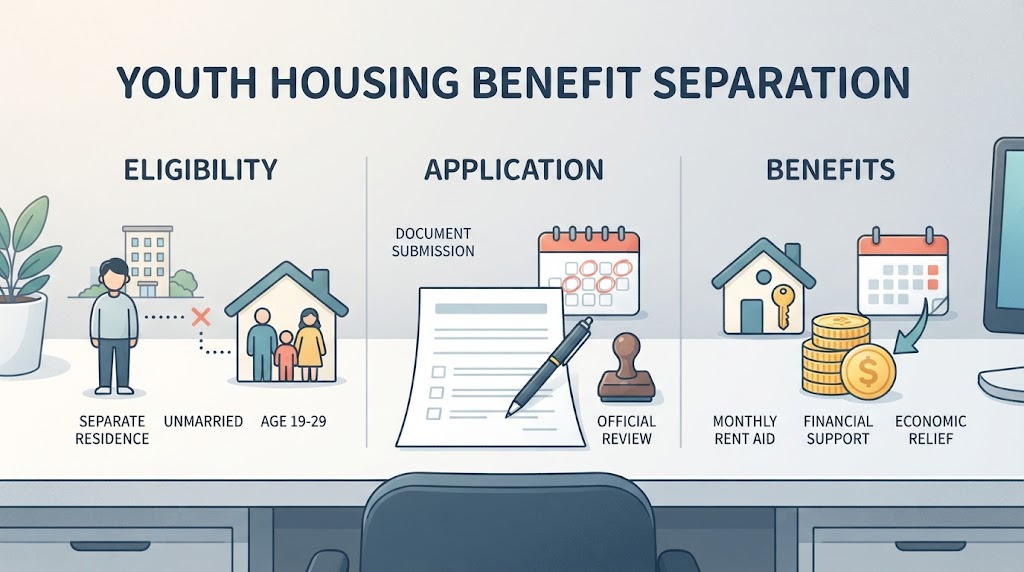
Who Can Receive It? 3 Core Support Qualifications and Requirements
“Huh? Our family also receives housing benefits, can I get support funds separately too?”
This is probably the part you are most curious about! To receive the youth housing benefit separate payment benefits, there are 3 core requirements that must be met. Shall we check them carefully one by one?
- Income Criteria: Whether Applicable to Existing Housing Benefit Recipient Households
The youth housing benefit separate payment does not provide a ‘new independence support fund,’ but targets recipient households that are already receiving housing benefits.
Basic eligibility is granted only if it is a basic livelihood security housing benefit recipient household whose total household’s recognized income is 48% or less of the standard median income. (In other words, the original household including your parents must already be receiving housing benefits to stand at the starting line!)
- Age Criteria: Unmarried Youth Aged 19 to Under 30
The youth’s age must be between 19 and under 30 years old.
Your status as a college student, job seeker, or office worker does not matter, but please remember that you must be in an “unmarried” status!
- Residence requirement: Living separately in a different residence from parents
Your residential address on the resident registration must be different from your parents.
Geographical criterion: As a principle, the city/county where the parents reside must be different from the city/county where the youth resides. (However, even within the same city/county, exceptions may be recognized if the city/county/district acknowledges it considering significant inconvenience in using public transportation or residential conditions.)
Mandatory lease agreement: You must sign a lease agreement under the youth’s name and actually reside in that housing. (Housing in the name of a relative or unauthorized residence is naturally excluded from eligibility, right?)
💡 Check point:
Have you checked whether all 3 of the above requirements (income, age, residence) are met? If you are confused about whether you are eligible, you can easily check in advance from home through the Bokjiro website.
Then, in the next chapter, we will take a detailed look at how the support amount by region is calculated to see how much financial support you can actually receive once you meet the conditions!

How Much Can You Receive? Calculation Method of Support Amount by Region and Number of Household Members
This is a clean and easy-to-understand Naver blog-style draft of the main text for How Much Can You Receive? Calculation Method of Support Amount by Region and Number of Household Members.
How Much Can You Receive? Calculation Method of Support Amount by Region and Number of Household Members
“I know I meet the conditions, but exactly how much money will actually go into my bank account every month?”
If you fall under the support target, the support amount will likely be the part you look forward to and are most curious about. The youth housing benefit separate payment does not come out as the same amount nationwide, but is calculated differently depending on the region of residence (tier), income level, and rent level.
I will organize the criteria by which the amount is determined in an easy-to-understand way!
- Differential payment according to standard rent by region
Housing benefits for rent divide regions into 4 tiers according to housing price levels and set an upper limit for the standard rent. The youth separate payment is also calculated based on this standard rent.
Tier 1 (Seoul): Highest support amount limit
Tier 2 (Gyeonggi/Incheon): Metropolitan area regions
Tier 3 (Metropolitan cities and Sejong Special Self-Governing City, etc.)
Tier 4 (Other remaining regions)
Depending on where your region of residence is, there will be a difference in the maximum support amount you can receive. (For example, a youth living alone in Seoul has a higher standard rent upper limit set than a youth living alone in a regional area.)
- Payment by comparison with actual rent (monthly rent)
The government does not unconditionally deposit the fixed maximum amount!
It is calculated based on the lower amount by comparing the monthly rent you actually contracted (actual rent) with the standard rent by region.
If the actual rent is lower than the standard rent for that region, you will only receive support equal to the actual rent, and if the monthly rent is higher than the standard rent, you will only receive support up to the upper limit of the standard rent for that region.
- Deduction of self-payment amount according to income level
For households whose recognized income is higher than the livelihood benefit selection criteria (30% of standard median income), the final support amount is determined after partially deducting the self-payment amount (a certain percentage of the monthly rent) from the standard rent (or actual rent).
However, for beneficiary households with very vulnerable incomes, the full amount of the standard rent may be supported without any self-payment amount.
💡 Reference Tip:
Since our household’s standard rent by tier and estimated support amount change slightly every year, if you use the housing benefit mock calculator on the “MyHome Portal” or “Bokjiro” website, you can check the accurate estimated amount that matches your conditions in advance!
Next, we will carefully go through everything from A to Z on how to apply to receive this benefit and what documents are required!
Application Method and Essential Preparation Documents A to Z
This is a thorough and practical Naver blog-style draft of the main text for Application Method and Essential Preparation Documents A to Z.
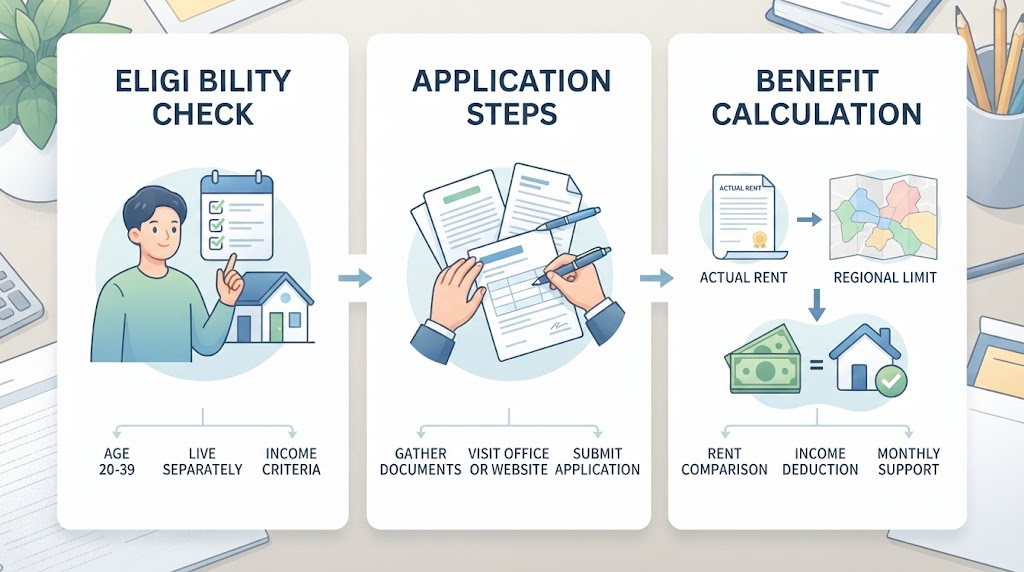
Application Method and Essential Preparation Documents A to Z
If you have checked the conditions and even looked over the expected support funds, now is the most important practical step! It is time to take care of the application method and essential preparation documents. As the saying goes, “Government support funds go to those who apply,” so it is important to prepare the documents thoroughly and apply quickly, right?
I will organize where and how to apply in an easy-to-understand way!
- Youth housing benefit separate payment, how do I apply?
The application method is largely divided into two ways. Choose the method that is convenient for you!
Online application (the most convenient method)
You can apply by accessing the website of Korea’s representative welfare portal, “Bokjiro (bokjiro.go.kr),” logging in with a joint certificate, etc.
Since you can easily apply from home via PC or smartphone, it is recommended for office workers or college students.
Offline visit application
You visit and submit directly to the eup/myeon/dong administrative welfare center (community center) with jurisdiction over your parents’ resident registration address, not the region where the youth currently resides.
Caution point: Please remember that since it proceeds in connection with the housing benefit recipient eligibility of your parents’ household, the receiving institution is often based on your parents’ place of residence!
- Essential preparation document checklist to bring when applying
You wouldn’t want to make a wasted trip by missing documents, right? Additional documents may be requested depending on the situation, so make sure to prepare the basic documents thoroughly first.
Social Security Benefit Provision (Change) Application Form (available at the community center or downloadable from Bokjiro)
Copy of the lease (jeonse/monthly rent) agreement under the youth’s name (contract of the housing actually residing in)
Monthly rent expenditure proof documents within the last 3 months (account transfer receipt, wire transfer deposit slip, etc.)
Youth’s enrollment/employment certificate or employment wage confirmation, etc. (may be requested for checking residence reason and income if necessary)
Applicant’s (youth or parents) ID and copy of bankbook
Household member verification documents such as a family relationship certificate
💡 Tip: Since additional documents (e.g., documents proving the separation of residence between parents and youth) may be requested depending on the judgment of the local government or the person in charge, it is much easier if you call the competent administrative welfare center in advance to check the required documents once more before visiting!
Next, I will neatly wrap up the entire content of today’s post!
Conclusion: A Valuable Housing Benefit That 20-Somethings Living Alone Must Check
This is a warm and practical Naver blog-style draft of the conclusion main text.
Conclusion: A Valuable Housing Benefit That 20-Somethings Living Alone Must Check
We have carefully examined everything from the concept, core requirements, support amount, and application method of the “youth housing benefit separate payment” system that 20-somethings living apart from their parents must check.
Living independently alone for studies or employment, the monthly rent and maintenance fees that go out every month weigh much heavier on 20-something youth than expected. Especially if your household already falls under the government’s housing benefit recipient category, but you miss out on this precious support benefit because you are not well aware of this “separate payment” system, wouldn’t that be such a regrettable thing?
“What if our household is eligible for housing benefits, but I am living separately in another region?”
“What if I am an unmarried youth aged 19 to under 30?”
Rather than just worrying and letting it pass, I hope you check the Bokjiro website today or inquire at the administrative welfare center with jurisdiction over your parents’ home to confidently claim your share of housing benefits.
A little bit of interest and legwork will become a reliable strength in your bank account every month! Amidst soaring prices and housing costs, I sincerely cheer for your independence, and I hope today’s post was a warm addition to your tough life living alone. I will come back with more useful and solid policy information next time!
💡 If this post was helpful, please don’t miss out on receiving the valuable youth policy benefits updated every week through a heart (♥) and adding neighbors!
Korean version: 한국어로 읽기