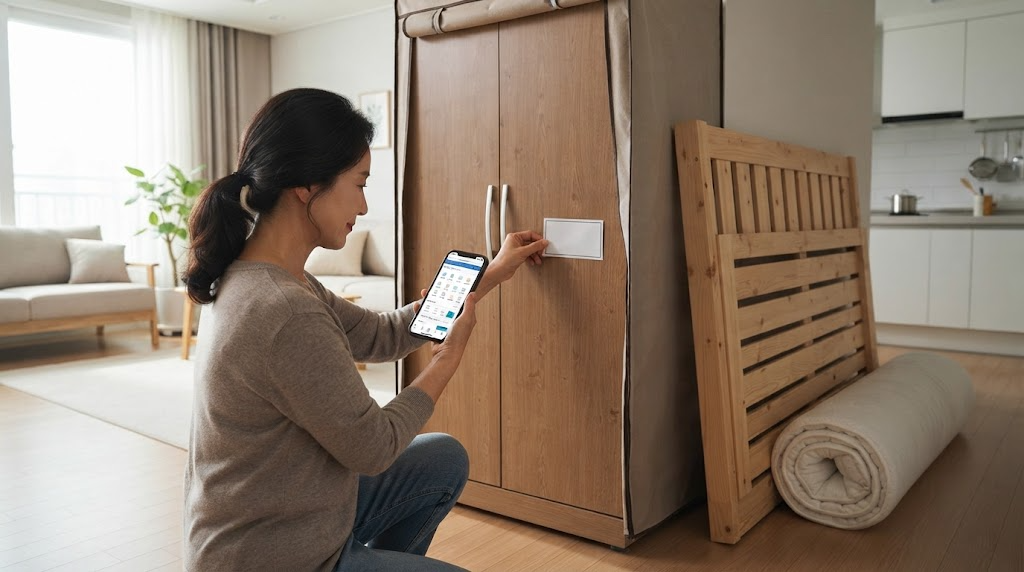
Large Waste Disposal Fees, Why Do Prices Differ by Local Government? (Overview)
When cleaning up a house or changing furniture, one of the first obstacles you encounter is large waste disposal. When you go to the community center to buy a sticker or try to report online, a question naturally comes to mind.
“The wardrobe in front of my house costs 10,000 won, but why is the exact same wardrobe 15,000 won in my friend’s neighborhood?”, which is the curiosity of “Why does the price of large waste disposal differ by local government?”
In fact, large waste disposal fees are not operated under a uniform standard fee system nationwide. The reasons are as follows.
Autonomous affairs according to local government ordinances: Large waste collection and disposal work is not an affair managed collectively by the state, but an autonomous affair operated according to local government ordinances determined by each city, county, and district.
Differences in regional treatment environments and costs: Because the operation costs of landfill sites and incinerators in the region, the unit price of proxy contracts with private collection companies, labor costs, and the amount of waste generated in the region are all different, differences in the fee setting standards among local governments are inevitable.
Because the specifications and fees by item vary widely depending on the ordinance of the region where you reside, if you pay fees or dispose of large waste blindly trusting past memories or other neighborhood standards, you can face troubles such as collection refusal or fee errors.
Then where and how can we check the exact large waste prices and fee standards of our own neighborhood where we live? From now on, we will guide you in detail step by step on how to check the fees by local government ordinance most easily and accurately.
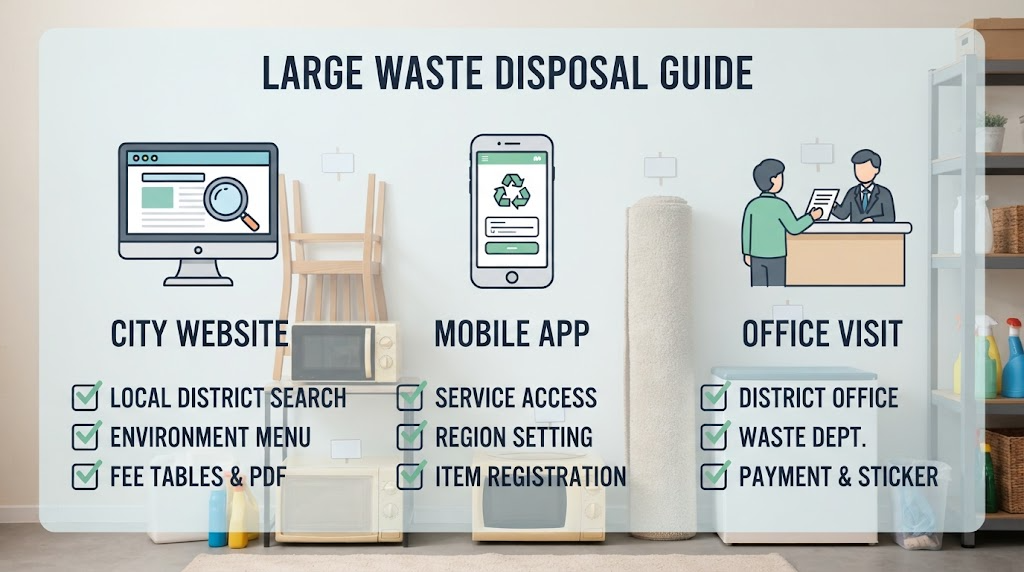
3 Representative Methods to Check Large Waste Disposal Fee Standards in Our Neighborhood
Because large waste disposal fees and item classification standards differ by local government, it is essential to check the exact standards of the region where you reside before disposal. Let’s examine 3 representative methods to check the fees of your jurisdiction most quickly and accurately.
- Using the Official Website of the Competent City/County/District Office and Large Waste Disposal Report Page
How to use: This is the most standard and reliable method. Search for “OO City (District/County) Large Waste Disposal” or “OO District Office Large Waste Internet Report” on a portal site and access the official website.
Check points: If you navigate to the [Information by Field], [Cleaning/Environment], or [Large Waste Disposal Report] menu within the website, they provide ‘Fee Guide by Item’ or ‘Fee Item Table’ in the form of a PDF file or webpage. Here, you can carefully compare the prices by specification of the furniture and home appliances you intend to throw away.
- Utilizing Local Government-Linked Mobile Apps (App) (Ppagi, Ppaesio, etc.)
How to use: Recently, most local governments support convenient large waste disposal services through smartphone apps. Representative apps include ‘Ppagi’ and others, and you can use them after setting your residential area.
Check points: If you select the item of the thing you want to throw away or take a picture and upload it on the app main screen, the exact fee reflecting the latest ordinance of the corresponding local government is automatically calculated in real time. It is very convenient because you can instantly solve price comparison and payment at once with your smartphone without the hassle of searching for a PC or website.
- Telephone Inquiry to the Civil Petition Room of the Competent Community Center (Administrative Welfare Center) and Reference to the Fee Table
How to use: This is the surest method when you are not familiar with using the internet or smartphone apps, or when item classification is confusing because the specifications of the large waste are ambiguous. Call or directly visit the civil petition room of the administrative welfare center (community center) of the dong where you currently reside.
Check points: If you explain the approximate size of the furniture to the staff in charge (e.g., 3-tier drawer, single bed mattress, etc.), you can kindly receive guidance on the exact fee amount according to the local government ordinance standards and the payment method (online certificate printing or visiting purchase at the community center). It is also a good idea to refer to the handout ‘Large Waste Fee Items and Standards Table’ provided at the civil petition room counter.

Understanding Large Waste Fee Calculation Standards by Item and Specification
When reporting large waste disposal, you will find that even for the same type of item, the prices vary widely. For example, it’s the exact same wardrobe or desk, but one costs 5,000 won while another exceeds 15,000 won. Fees according to local government ordinances are meticulously set based on the type of item and physical specifications (size and volume).
Let’s look at the main criteria by which fees are calculated by item and specification.
- Furniture: Differential Imposition According to Size (Specification) and Detailed Form
Length and height criteria: Furniture items such as beds, wardrobes, desks, and sofas are usually divided into grades for fees depending on their width, length, and height specifications (in cm units) or how many people they are for. For example, sofas have different prices depending on whether they are for 1 person, 3 people, or 4 or more people, and wardrobes have different unit prices per panel or per meter.
Disassembly and accessory status: In the case of beds, in most cases, the frame and mattress must be reported as separate items and the fees must be calculated separately. You must be careful because the classification between spring mattresses and latex mattresses may differ.
- Home Appliances: Free Collection of Small Home Appliances vs. Large Home Appliance Disposal Standards
Small home appliances: Small home appliances below a certain size, such as electric fans, vacuum cleaners, and small microwave ovens, can be disposed of without paying a fee depending on the local government, or it is much more advantageous to use the ‘Small Home Appliance Free Visit Collection Service’.
Large home appliances: Large home appliances such as refrigerators, washing machines, air conditioners, and TVs are often collected for free through the ‘Waste Home Appliance Free Visit Collection Service (Waste Home Appliance Collection Fairy, etc.)’ linked between the Ministry of Environment and local governments. However, if the original shape is damaged, such as arbitrarily breaking the home appliance or missing parts, you may have to attach a paid large waste sticker and dispose of it according to local government ordinances.
- Other Household Goods and Special Specification Items
Bicycles, strollers, musical instruments, etc.: Items other than furniture and home appliances, such as pianos, bicycles, travel carriers, and mirrors, also have different fees depending on specifications (small/large) or weight. For example, bicycles have different classifications between regular bicycles and electric bicycles, or fees are differentially applied for children’s and adults’ use.
Distinction from business waste: Waste generated from businesses such as shopping malls or offices, rather than municipal large-scale household waste generated at homes, does not follow the local government’s municipal waste ordinance standards and must go through a separate treatment company or apply business fee standards, so prior confirmation is required.
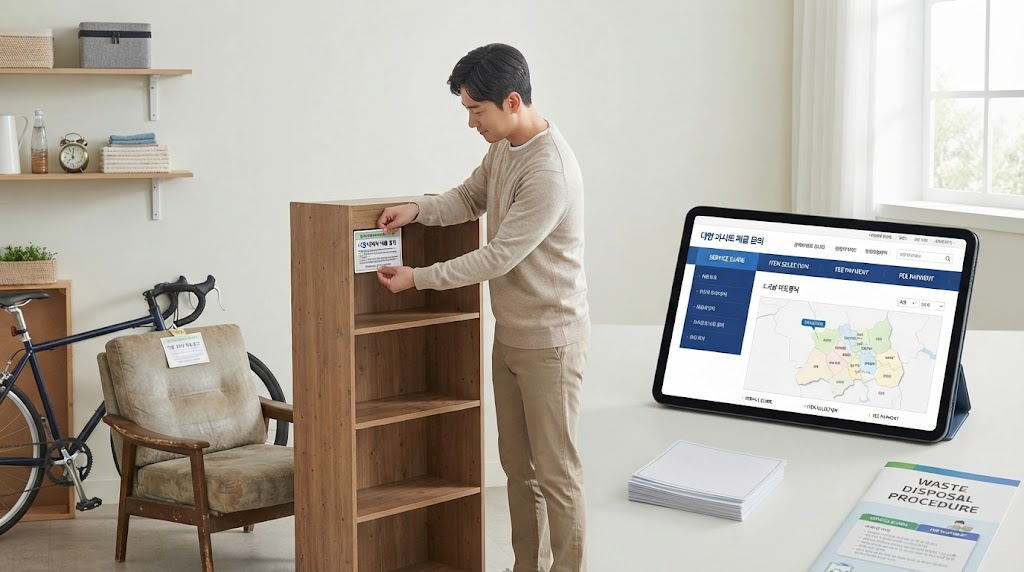
Core Precautions and Tips to Check When Consulting Local Government Ordinances
When checking large waste disposal fees via the internet or app and proceeding with disposal reports, if you are careless, you may experience difficulties such as collection refusal or being mistaken for illegal dumping. We have organized the core precautions and tips that must be checked when checking and applying local government ordinances for successful and safe disposal.
- Final Confirmation of Whether It Is the Standard of the Competent Local Government of Your Residence (Prohibition of Attaching Other Region Stickers)
Precautions: One of the most common mistakes is miscalculating fees by looking at the standards of the neighborhood before moving, a relative’s neighborhood, or an old rate table, or purchasing and attaching payment certificates (stickers) from a different city, county, or district.
Resolution Tips: Large waste disposal fees and disposal stickers follow the ordinance of the competent district office (city/county/district) of the address where you actually reside. When searching on internet portals, be sure to finally check whether the accurate dong and district names where you currently reside are included and proceed with reporting. Attaching stickers from other regions can lead to ‘collection refusal’ as well as being considered illegal dumping, making you subject to administrative fines.
- Re-confirming the ‘Disposal Zone’ If It Is the Day of Moving-In and Moving Out
Precautions: In the process of moving, waste is occasionally placed at the boundary between the pre-move-in district and post-move-in district, or people confuse the competent administrative district because it hasn’t been long since they moved in.
Resolution Tips: During the period when your residence changes, you must check the exact competent local government to which the building of the disposal location belongs. In the case of villas or apartment complexes, the jurisdiction of the place where the management office is located and the waste disposal zone may slightly differ, so if you are confused, it is safe to first inquire with the management office or the relevant dong community center to receive clear guidance on which district office’s standards you should use for disposal.
- Understand Fee Refund Regulations and How to Modify Declaration Details in Advance
Precautions: Occasionally, after paying fees via the internet or mobile app, you might select the wrong item or need to cancel your disposal plan.
Resolution Tips: Depending on the local government’s online system, cancellation and refund processing after payment can be somewhat tricky. Before clicking the disposal declaration button, it is best to build a habit of carefully double-checking with your eyes whether the specifications and quantities of the items you selected match the actual items to be discarded. If you have made an incorrect declaration, you must contact your local district office’s cleaning division or customer service call center before the disposal date to quickly make corrections and prevent collection delays.

Completing Large Waste Disposal Without Wasting Money Through Accurate Lookup (Conclusion)
So far, we have carefully examined everything from why large waste treatment fees vary by local government ordinance, to 3 representative methods for checking our neighborhood’s standards, item-by-item and specification-by-specification calculation criteria, and precautions to keep in mind when disposing.
Disposing of large waste is not merely about throwing away trash, but an important daily procedure that must be accurately declared and processed in accordance with the administrative standards of the region where you live.
To avoid the hassle of paying incorrect fees based on rash guesses or information from other regions,
or facing collection refusals or fines due to disposing in the wrong area,
it is most important to develop the habit of accurately looking up the latest ordinance standards beforehand through your local city, county, or district office website, mobile app, or administrative welfare center.
Even a little bit of interest and prior lookup can prevent unnecessary waste of money and help keep your neighborhood cleaner and more pleasant. Based on the information provided today, we sincerely hope your house cleaning and large waste disposal are completed smoothly and neatly!
Korean version: 한국어로 읽기