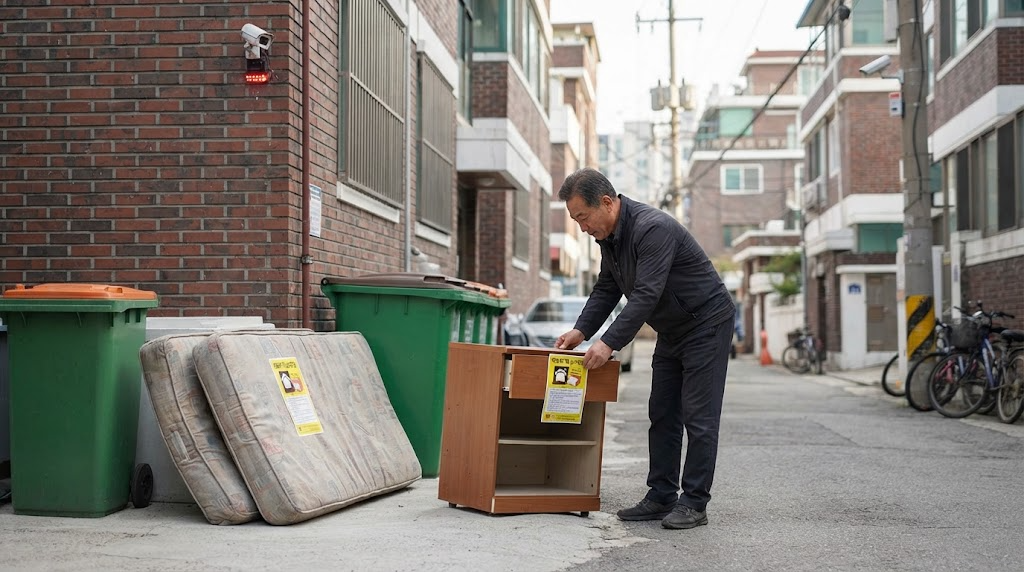
Introduction: “Could This Little Thing Really Matter?” The Bomb Fine Triggered by Carelessly Thrown Away Trash
This is a draft for the first subheading of a Naver blog post. It was written in a realistic and sincere tone so that readers can realize the dangers of illegal dumping and sympathize with the need for proper disposal.
Introduction: “Could This Little Thing Really Matter?” The Bomb Fine Triggered by Carelessly Thrown Away Trash
After finishing a move or a major house cleaning, you are bound to be exhausted to the point of draining all your energy. The urge grows strong to somehow sweep away the old chest of drawers or unused mattress that occupied a corner of the house to a place out of sight.
There are actually quite a many people who, with the complacent thought, “Surely nothing bad will happen just leaving this big furniture in the alley for a day?” or “If I just leave it standing at the recycling area, they’ll pick it up on their own,” carelessly put out furniture or large waste, only to be left dumbfounded a few days later upon receiving a fine notice worth hundreds of thousands of won.
- Illegal Dumping Caught in No Time Through Surveillance Cameras and Resident Reports
Many people think that if they throw away large waste late at night or at dawn when people are scarce, nobody will know, but residential areas and apartment complex alleys nationwide are surrounded by surprisingly dense CCTV networks and black boxes.
Not only through constant patrols by local government crackdown teams, but also due to active reports by neighboring residents (such as paparazzi), the probability of getting caught for illegal dumping is very high.
When caught, a fine of up to 1 million won can be imposed according to the Wastes Control Act, resulting in much greater financial loss than the fees you tried to save.
- Why the Excuse “I Didn’t Know” Does Not Work
Even if you appeal with grievances saying, “I thought the district office would collect it if I put it there” or “I thought the moving company would throw it away for me,” trash left unattended without a sticker (payment certificate) attached is regarded as illegal dumping without exception.
Ultimately, even in the midst of being frantic with a move or major cleaning, the only way to avoid a bomb fine and cleanly organize your belongings is to follow ‘accurate prior reporting and correct disposal procedures’.
Then, through what method should we dispose of them legally, and what actions might be misunderstood as illegal dumping? In the next chapter, we will examine the clear criteria for legal disposal.
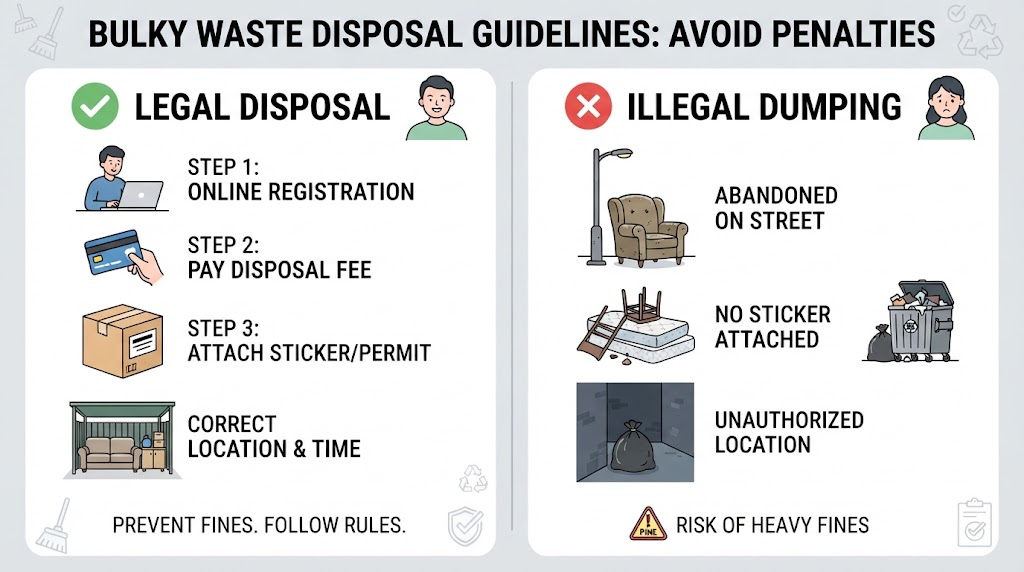
Understanding Core Concepts: Clear Criteria for Legal Disposal and ‘Illegal Dumping’
This is a draft for the second subheading of a Naver blog post. It was structured so that readers can clearly understand the difference between legal disposal and illegal dumping and prevent unfair fines.
Understanding Core Concepts: Clear Criteria for Legal Disposal and ‘Illegal Dumping’
When discarding large waste, there are many people who get confused, thinking, “Why is it considered illegal dumping even though I paid the money?” or “Why do I get a fine when I thought it was okay just to leave it in the recycling area?”
To avoid unfair fine bombs caused by being misunderstood for illegal dumping, you must clearly know the clear criteria that separate ‘legal disposal’ from ‘illegal dumping’.
- 3 Major Elements of Legal Large Waste Disposal (Safe if You Just Follow This!)
Normal waste disposal recognized by law is completed only when all three of the following steps are satisfied.
Advance Reporting and Fee Payment: You must accurately report the specifications of the items to be discarded on the jurisdiction community service center or ward office internet homepage and pay the fees.
Attaching Payment Certificate (Sticker) or Recording Number: Attach the official declaration certificate (paper sticker) issued after payment, or if you do not have a printer, write [receipt number, item name] in large letters with an oil-based pen on a blank piece of paper and attach it to the waste so it does not fall off.
Discharge at Designated Location and Time: You must strictly observe the disposal location permitted by the local government, such as the apartment designated recycling area or in front of the gate of a detached house, and the time between the evening before collection and dawn on the day of collection.
- Representative Types Crackdown as Illegal Dumping
Conversely, the following actions are all regarded as ‘illegal dumping’ regardless of intent and become subject to fine imposition.
Cases Without a Sticker or Receipt Number: Cases where furniture or home appliances are left out on the street without attaching proof (certificate or number) even though the fee was paid.
Acts of Leaving in Non-Standard Locations: Acts of covertly placing items in empty lots, alley corners, or in front of nearby commercial buildings rather than in front of your own house or designated collection zones.
Cases of Leaving Waste That Does Not Fit in Standard Trash Bags: Cases of piling up large waste home appliances or furniture haphazardly next to small trash bags.
💡 Core Summary
In large waste disposal, complacent thoughts like “It’s fine to throw it away however I want” are strictly prohibited. The standard route of ‘advance reporting ➡️ attaching certificate ➡️ disposal at designated location’ is the only way to 100% avoid fines.
Now that you clearly know the criteria for legal disposal, it is time to look at the practical steps to actually put out waste perfectly without worrying about fines. In the next chapter, we will organize the specific 3-step disposal tips in detail.

Practical Follow-Along: 3 Steps to Safely Discharge Large Waste with 0 Won in Fines
This is a draft for the third subheading of a Naver blog post. It systematically organizes 3 practical steps so that readers can follow along easily and clearly as if looking at a screen.
Practical Follow-Along: 3 Steps to Safely Discharge Large Waste with 0 Won in Fines
The most surefire way to perfectly avoid illegal dumping fines is to follow the official procedures set by the local government as they are. Although it may feel complicated, we clearly summarize the 3 steps for large waste disposal guaranteeing 0 won in fines, which can be completed in just a few minutes using a smartphone or PC.
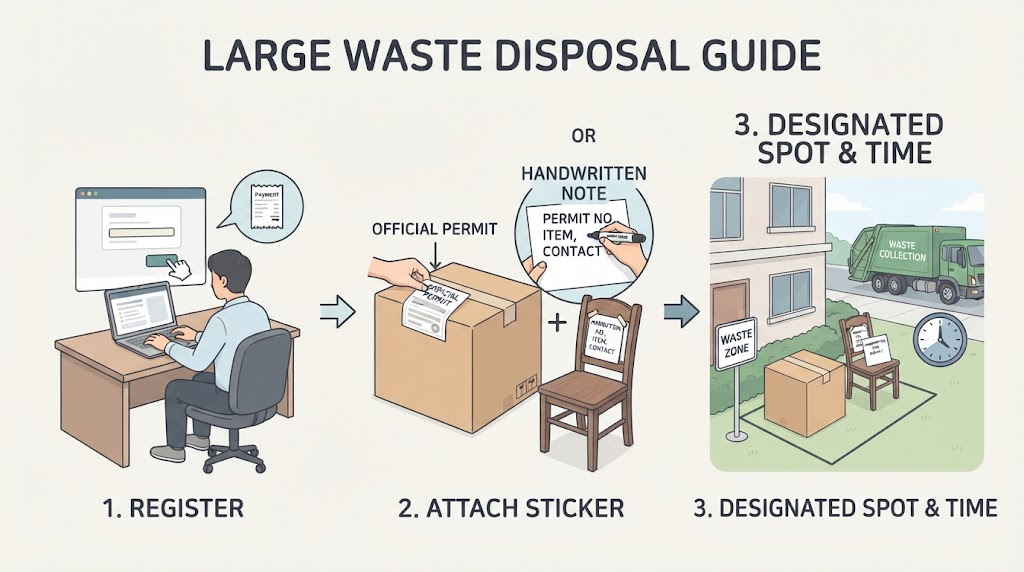
Step 1: Advance Reporting via Jurisdiction Local Government Homepage or Visiting Community Service Center
Search ‘[Residential Area Ward Name] Large Waste Disposal Report’ on the portal site you are using and access the official local government homepage. (Or directly visit the administrative welfare center having jurisdiction over your residence.)
After going through simple authentication or non-member login, accurately select the items you wish to discharge (wardrobes, sofas, mattresses, desks, etc.) and specifications, and pay the fee.
Point: The ‘payment certificate number (receipt number)’ issued at this stage serves as an exemption proving your legal disposal, so you must definitely check or make a note of it.
Step 2: Attaching the Payment Certificate (Sticker) or Writing an Alternative Number
When you have a printer: Firmly attach the official ‘declaration certificate (sticker)’ printed from the ward office homepage to a visible place on the waste using tape.
When you do not have a printer (Great Tip!): Write the [payment certificate number, receipt number, discharge item, applicant’s contact information] in large letters with an oil-based pen on an A4 sheet or blank paper, and wrap it securely with tape so it does not fall off the waste. (Even if community service center crackdown teams or collection technicians only check the number, they recognize it as a normal reported case and exclude it from fine targets.)
Step 3: Strictly Observing the Designated Disposal Location and Collection Time
For apartment complexes, discharge at the recycling area and large waste disposal zone designated by the management office; for detached houses or villas, discharge in front of your gate or at the edge of the building where it does not interfere with traffic.
You must put them out to match the time when collection vehicles visit (usually dawn on the day of collection or the evening of the previous day), preventing situations where you leave them on the street in advance for days, obstructing the passage of neighboring residents or being misunderstood for illegal dumping.
💡 Core Summary
If you thoroughly follow only these 3 phases: “Report ➡️ Attach Number ➡️ Discharge at Designated Location”, worries about fine bombs worth hundreds of thousands of won are goodbye forever.
However, even after completing disposal normally like this, there are times when you end up in unfair situations due to delayed collection or overlapping moving schedules. Let’s find out further in the next chapter about essential verification matters to fundamentally block fines.
Essential Verification Matters & Response Tips to Avoid Unfair Fines
This is a draft for the fourth subheading of a Naver blog post. It was written containing useful tips so that readers can prevent situations where they unfairly receive fine penalties and cope wisely.
Essential Verification Matters & Response Tips to Avoid Unfair Fines
Even after completing local government reporting by the book and meticulously attaching a sticker before discharging, there are times when you feel anxious that you might be unfairly misunderstood for illegal dumping or receive a fine notice. This is especially true when collection vehicle visits are delayed or in the chaotic situation right before a move.
We summarize 3 practical response tips to safely discharge large waste and completely block any unexpected misunderstandings.
- Leaving Evidence Without Panicking When Collection Is Delayed (Taking Verification Photos)
Even if you reported normally to the local government and discharged it with a sticker (or alternative number) attached, collection delays of about 1 to 2 days later than the scheduled date occasionally occur due to schedule delays or heavy workloads of the collection company.
Since you might catch the eye of administrative crackdown teams during this period and be mistaken for illegal dumping, turning on your smartphone and taking verification photos so that the condition of the furniture right after discharge, the attached payment certificate (or receipt number paper), and the surrounding environment come out well is the most surefire defensive measure.
- Reducing Neighbor Misunderstandings When Discharging in CCTV Blind Spots or Alleys
Areas densely populated with villas or detached houses have many blind spots without CCTV, so nearby residents often pile trash on top without permission or file complaints with the ward office due to misunderstandings.
You should uprightly place items in a safe spot as much as possible on your building’s exterior wall or where they do not interfere with traffic at all, and neatly tidy up the surroundings so that other people’s trash does not mix in, allowing you to avoid unnecessary friction.
- Utilizing Expert Help If Time Is Short on the Moving Day
If the moving date and waste disposal date overlap and you simply do not have the leeway to wait for the local government collection schedule (usually takes several days after application), it is the best policy to utilize private waste disposal companies or free visiting collection services (for home appliances, etc.) early rather than forcing items out onto the street.
Considering the risk of fines due to illegal dumping (up to 1 million won) and peace of mind, entrusting visiting collection safely can be a much wiser and more economical choice.
💡 Core Summary
The core of preventing unfair fines is ‘leaving verification photos after completing discharge’ and ‘placing items upright in designated spots’. A single small habit solidly protects your wallet.
We have now looked at all the core contents. Finally, let’s wrap up the article by organizing the core summary for preventing large waste illegal dumping and clean organization.

Conclusion: Clean Organization Without Fine Worries Through Thorough Advance Reporting and Proper Disposal
So far, we have carefully examined the dangers of illegal dumping that people easily commit without thinking when discarding large waste, as well as legal disposal tips to prevent this and completely avoid unfair fines.
When cleaning up furniture while exhausted from a move or major house cleaning, it is easy to become impatient with just getting rid of things right in front of your eyes. However, a fine notice that flies in after leaving waste unattended without a sticker with the complacent thought, “Surely it’ll be fine,” becomes much greater stress than you think.
- Accurately make an advance report and pay fees through the jurisdiction ward office or community service center
- Firmly attach the official payment certificate (sticker) or an eye-catching alternative number paper so it does not fall off
- Observe the designated disposal location and collection time, and leave discharge verification photos just in case
If you only practice proper disposal keeping principles for large waste treatment that felt complicated and cumbersome, you can head to your new home lightheartedly without unnecessary expenditures and worries about fines. We sincerely cheer for your safe and fresh daily life!
If you have any additional questions, please feel free to leave them in the comments below. Thank you!
Korean version: 한국어로 읽기