
Introduction: Why Do We Need Beotimmok Jeonse Loan Refinancing?
Do you find yourself sighing every time the monthly Jeonse loan interest is deducted from your account?
With interest rates rising significantly over the past few years, those using general Jeonse loans or commercial bank products will undoubtedly feel the full impact of the growing interest burden. Even though the lease term is not yet over, this is a time when deep concerns arise about whether there is a way to reduce monthly fixed expenses.
In situations like this, the first savior to look out for is the “Housing and Urban Fund Beotimmok Jeonse Loan.”
The Beotimmok Jeonse loan is a representative policy product supported by the government at a much lower level (2% to 3% range annually) than commercial interest rates to secure housing stability for homeless lower-income families. Unfortunately, many people give up, thinking, “I already have another loan, so it won’t work for me.”
However, did you know that even if you are currently using a general Jeonse loan, “refinancing” to switch to a low-interest Beotimmok product is possible as long as you meet the conditions?
If you want to drastically save on monthly interest costs
If you want to enjoy government-supported low-interest benefits instead of expensive commercial bank interest
In this posting, we will clearly and easily organize everything from Beotimmok Jeonse loan refinancing conditions to the essential documents you must prepare before visiting the bank, so please read until the end and be sure to reliably reduce your monthly fixed costs!
If there are any subsequent subtitle contents or parts that need modification, please feel free to let us know at any time!
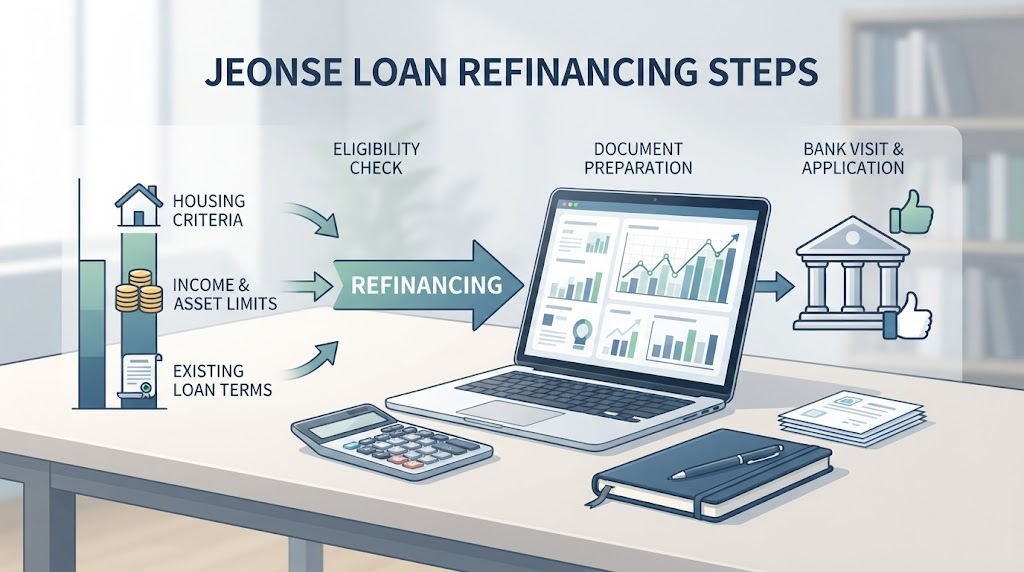
Core Summary of Beotimmok Jeonse Loan Refinancing Conditions (Who Can Apply?)
This is the draft of the second core body of the Naver blog posting [2. Core Summary of Beotimmok Jeonse Loan Refinancing Conditions (Who Can Apply?)]. We have cleanly organized the complex qualification requirements by item so that readers can grasp them at a glance.
- Core Summary of Beotimmok Jeonse Loan Refinancing Conditions (Who Can Apply?)
If you want to switch to the Beotimmok Jeonse loan, you must first carefully check whether your situation meets the support qualifications. Let’s look at it by dividing it largely into three categories: housing summary, income and assets, and existing loan conditions.
① Housing Summary (Based on Target Housing)
Housing area: Housing with an exclusive area of 85㎡ or less (however, up to 100㎡ or less is allowed in eup and myeon regions). Residential officetels are also included.
Lease deposit limit:
Metropolitan area (Seoul, Gyeonggi, Incheon): 300 million won or less (400 million won or less for newlywed households and households with 2 or more children)
Non-metropolitan area (local): 200 million won or less (300 million won or less for newlywed households and households with 2 or more children)
② Income and Asset Summary (Based on Applicant)
Combined annual income:
General households: 50 million won or less
Newlywed households, public institution employees relocating to innovative cities, tenants in redevelopment zones relocating from other regions: 60 million won or less
Households with 2 or more children: 70 million won or less (separate preferential income criteria applied for youth households)
Asset screening: You must meet the asset criteria set by the Housing and Urban Fund (usually a certain amount or less of total asset value, criteria change annually), and accurate verification is carried out through the Housing and Urban Fund portal or the Fund e-Deun든 preliminary screening.
③ Existing Loan and Housing Ownership Conditions
Number of houses owned: All household members must be homeless or own 1 house or less. (However, when refinancing, it is essential to check the regulations while holding the existing loan)
Existing loan status: You must be normally using a general Jeonse loan from a commercial bank or other financial institution, and there must be no loan delinquency or legal issues.
If you need the next subtitle or additional content to write, please feel free to let us know!

Essential Document Checklist Before Visiting the Bank
This is the draft of the third core body of the Naver blog posting [3. Essential Document Checklist Before Visiting the Bank]. We have cleanly organized the necessary documents by category so you don’t have to make a second trip to the bank.
- Essential Document Checklist Before Visiting the Bank
If you have decided to refinance your Beotimmok Jeonse loan, the most critical hurdle is “visiting the bank and submitting documents.” If even a single required document is missing, you might have to turn back, so please review the checklist below before your visit to ensure you have prepared everything perfectly!
*(※ All documents must be issued so that the resident registration numbers are fully exposed (unmasked)*, and must be originals issued within the past 1 month.)
① ID and Resident Registration Related
Personal ID: One of a resident registration card, driver’s license, or passport
Resident registration copy (Deungbon): A document including address change history for the past 5 years or confirming household member change details (issued at a community center or Government24)
Resident registration extract (Chobon): Including past address history (may be requested depending on circumstances)
Family relationship certificate (detailed): Confirmation of relationship with unmarried or separated family members, mandatory for newlywed couples (issued at a community center or Supreme Court Electronic Family Relations Registration System)
② Employment and Income Proof Documents
For wage earners:
Certificate of employment (company seal verification required where a copy of the business registration is attached)
National Health Insurance qualification acquisition/loss confirmation letter
Income amount certificate or earned income withholding receipt (based on the latest year)
For business owners:
Copy of business registration certificate
Income amount certificate or business income withholding receipt
③ Housing and Lease (Contract) Related
Original lease contract with a fixed date: A contract concluded through a licensed real estate agent and given a fixed date
Deposit receipt: A receipt proving that 5% or more of the deposit has been paid (receipt at the time of initial contract, etc.)
Building registry (Certified copy of the register): For checking the rights relationship of the loan target property (issued at a nearby unattended kiosk or Internet Registry)
④ Existing Jeonse Loan Related (Core Refinancing Documents)
Existing Jeonse loan debt certificate (or financial transaction confirmation letter): Available from the bank currently in use, and must accurately specify the balance and account number of the loan to be refinanced.
Copy of existing loan agreement (may be additionally requested depending on the bank)
💡 Tip: Depending on the bank branch, the loan officer in charge, and personal conditions (freelancer, business owner, newlywed couple, etc.), additional documents may be requested. We strongly recommend calling the bank branch you plan to visit in advance to double-check the required documents before you go!
If there are any subsequent subtitles or parts that need modification, please feel free to let us know!
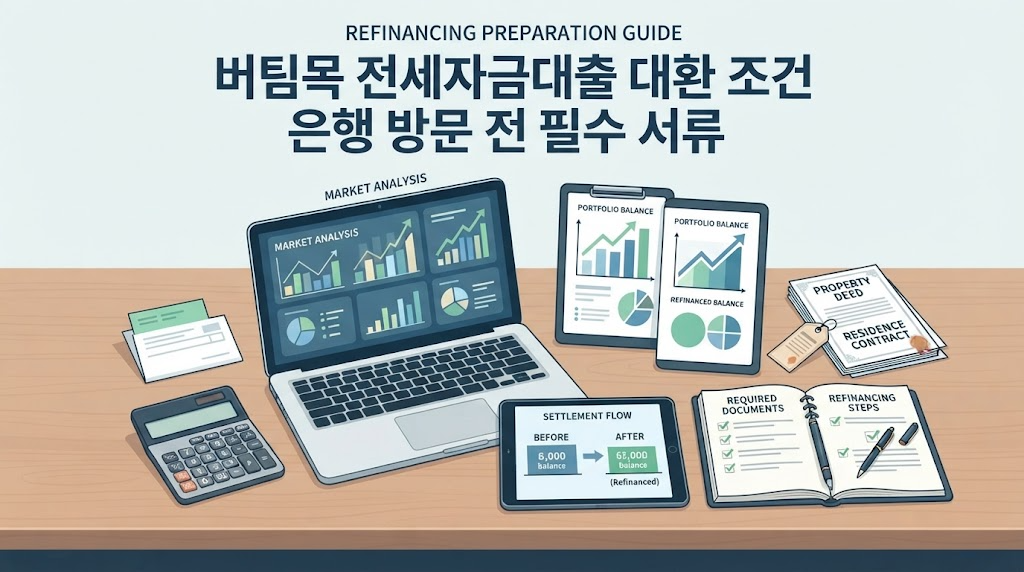
Beotimmok Refinancing Loan Application Procedure and Precautions (Reducing Failure Probability)
This is the draft of the fourth core body of the Naver blog posting [4. Beotimmok Refinancing Loan Application Procedure and Precautions (Reducing Failure Probability)]. It walks through the overall process step by step and contains practical tips to reduce trial and error commonly experienced during the refinancing process.
- Beotimmok Refinancing Loan Application Procedure and Precautions (Reducing Failure Probability)
Unlike general new loans, Beotimmok Jeonse loan refinancing is intertwined with the repayment of existing loans, so missing the order and timing can lead to significant difficulties. We have organized the core procedures and precautions to reduce the probability of failure and proceed smoothly at once.
① At-a-glance refinancing loan application procedure
- Fund e-Deun든 preliminary application (online):
First, proceed with the loan application online through the Housing and Urban Fund portal or the official “Fund e-Deun든” website. (Official certificate required)
- Waiting for qualification screening:
After application, asset and income screening results are notified via text message within approximately 1 to 2 business days. It is smooth to visit the bank after receiving a text message saying “screening passed” or “asset qualified.”
- Visiting the bank and submitting documents:
Choose one of the fund custodian banks (Woori, KB Kookmin, Shinhan, NH Nonghyup, IBK Corporate, etc.) and visit with the essential documents prepared in advance. Finalize the maximum available loan limit and interest rate.
- Loan approval and execution (existing loan repayment):
The loan is executed by the bank in accordance with the balance payment date or the maturity date of the existing loan, and with this money, the existing commercial bank Jeonse loan is automatically repaid (refinanced).
② Precautions to know when proceeding with a refinancing loan
Matching the application timing (most important):
Refinancing is usually only possible around the contract renewal time (upon re-contracting) or the maturity date of the existing Jeonse loan. If you move too hastily, the screening may not be completed by the maturity date of the existing loan, resulting in overdue interest, so it is safe to prepare with plenty of time from 1 to 2 months before maturity.
Maintaining homelessness or 1-house requirements:
All household members must maintain a homeless (or qualified 1-house) status from the loan screening until execution is completed. Be careful as changes such as additionally acquiring a house or winning a subscription in the middle may result in the refinancing being rejected.
Calculating the loan limit in advance:
The Beotimmok Jeonse loan has limitations on a certain percentage of the deposit (up to 80% in the metropolitan area, up to 70% in non-metropolitan areas) and limit amounts (general household metropolitan area 120 million won / local 80 million won, etc.). Since the limit may come out lower than the loan you received previously, you must calculate your deposit and limit in advance and check if you are ready to repay the difference on your own.
If you need to write the final conclusion part or have parts you want to modify, please feel free to let us know!

Conclusion: Final Tips for Successful Refinancing
We have carefully reviewed everything from the Beotimmok Jeonse loan refinancing conditions to the essential documents before visiting the bank, and the overall application procedure.
The high interest passing through our bank accounts every month is a wasteful expense just to think about. If you have been considering switching because the general Jeonse loan interest rate is burdensome, we hope you will step-by-step check the qualification requirements and documents we organized today and be sure to take advantage of the government support benefits.
Lastly, one thing I want to urge for successful refinancing is “moving in advance with spare time.” Since the bank screening process and coordination for existing loan repayment take quite a bit of time than expected, rather than rushing as the maturity date approaches, we recommend starting step-by-step from the Fund e-Deun든 preliminary application with about one to one and a half months of spare time.
We hope this posting was of small help in easily reducing your monthly fixed expenses. If you have any further questions regarding the Beotimmok loan, please leave a comment anytime. Have a pleasant day today as well!
If there are any parts of the entire posting content that need modification or if you need companion image generation prompts, please let us know anytime!
Korean version: 한국어로 읽기