
Why Is It Not Mandatory to Print a Certificate After Reporting Large Waste Online?
In the past, to dispose of large items such as bulky furniture, home appliances, and mattresses, you had to visit a community center or district office civil service room in person to purchase a paper payment certificate (sticker), and then securely tape it to the waste for collection to take place. However, over the past few years, with the full implementation of non-face-to-face reporting systems via the internet and mobile, “printing a paper certificate” has shifted from an absolute requirement to an optional choice. What are the reasons for this?
- Digital Transformation and Computerization of Local Government Administrative Systems
In the past, sanitation workers in charge of collection visually checked whether paper stickers were attached and cross-checked payment numbers on-site to crack down on illegal dumping.
However, nowadays, the administrative systems of most cities, counties, and districts have been computerized, meaning that the moment a resident pays the large waste fee via the internet or mobile, the corresponding disposal information (item, address, reception number) is shared in real time with the collection company and the terminals of the workers in charge. In other words, an environment has been established where it can be immediately verified in the system that the fee has been properly paid even without a paper certificate.
- Decrease in Home Printer Penetration Rates and Increased User Convenience
As households lacking home printers have surged, frequent complaints were raised about the inconvenience of having to go to an internet café or find a nearby acquaintance solely to print out a payment certificate.
Taking such public convenience into consideration, the Ministry of the Interior and Safety and various local governments flexibly improved regulations to state that “if printing is impossible due to the lack of a printer, writing the reception number by hand (handwriting) on a blank piece of paper and attaching it will still result in normal collection.”
💡 Summary
The reason why printing a certificate after reporting large waste online is not mandatory is because disposal approval details are shared in real time through a computer system instead of paper stickers. Even if you do not have a printer, as long as you accurately use the reception number assigned after payment completion, you can easily proceed with disposal without the stress of printing.
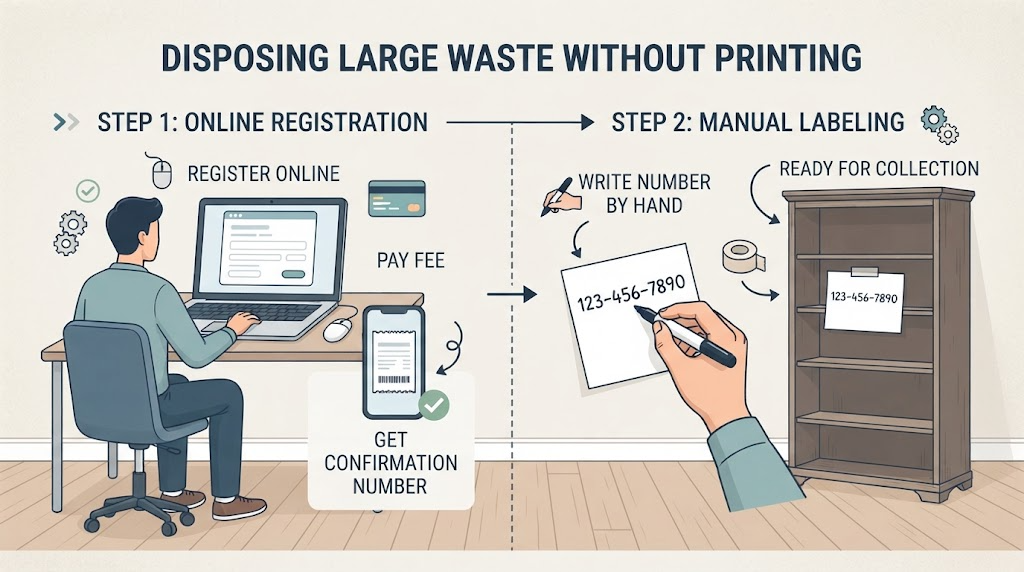
How to Handwrite the Disposal Number (Reception Number) After Internet or Mobile Reporting
Even though you have completed the payment for large waste disposal fees via PC or smartphone, if you do not have a printer at home and cannot print the payment certificate, you can substitute it by accurately handwriting the reception number on a blank piece of paper and attaching it to the waste.
Let us look at the tips and essential items that must be followed when handwriting so that the collection worker does not mistake it for illegal dumping on-site and can collect it properly.
- Essential Information That Must Be Included When Handwriting
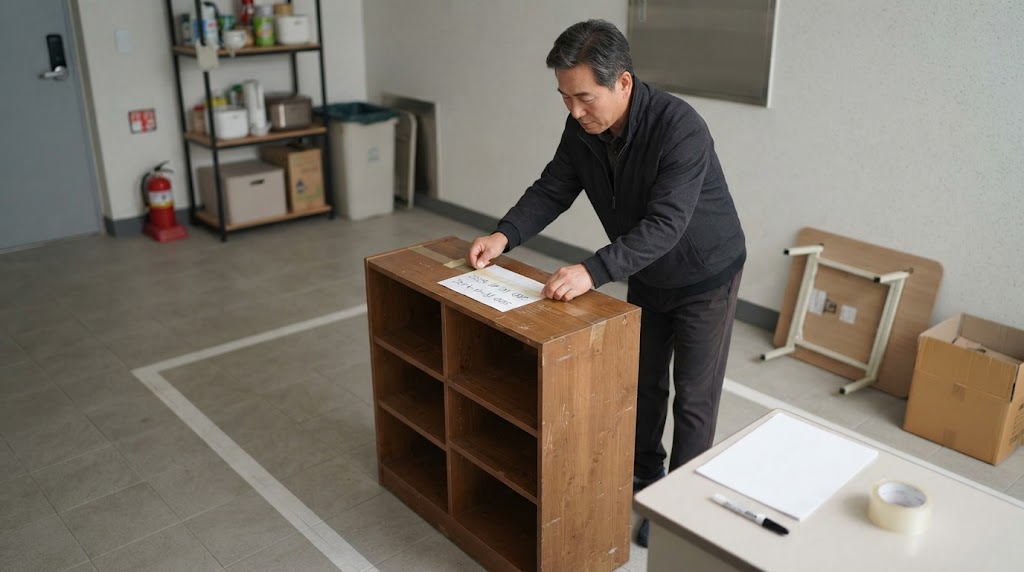
Using an oil-based marker or a dark namepen on an A4 sheet or a clean blank paper, you must write the following core information in large and easily readable letters:
Reception Number (Report Number): The unique reception number issued after completing the internet payment (most important)
Disposal Item: e.g., Wardrobe, 3-seater sofa, mattress, etc. (Item name matching the report details)
Report Details & Fee Payment Confirmation: e.g., Fee payment completed
Disposal Location (Address): The exact residential address where collection will take place
⚠️ Caution: If you write the reception number or item name too small or hard to read, the on-site collection driver may not be able to check it, resulting in missed collection or being mistaken for illegal dumping. The key is to write it in large, clear letters so that it stands out even from a distance.
- Attaching Securely So It Is Not Damaged by Wind or Rain
A disposal certificate handwritten on paper can easily be torn, soaked, and erased by rain, snow, or wind if attached as normal paper.
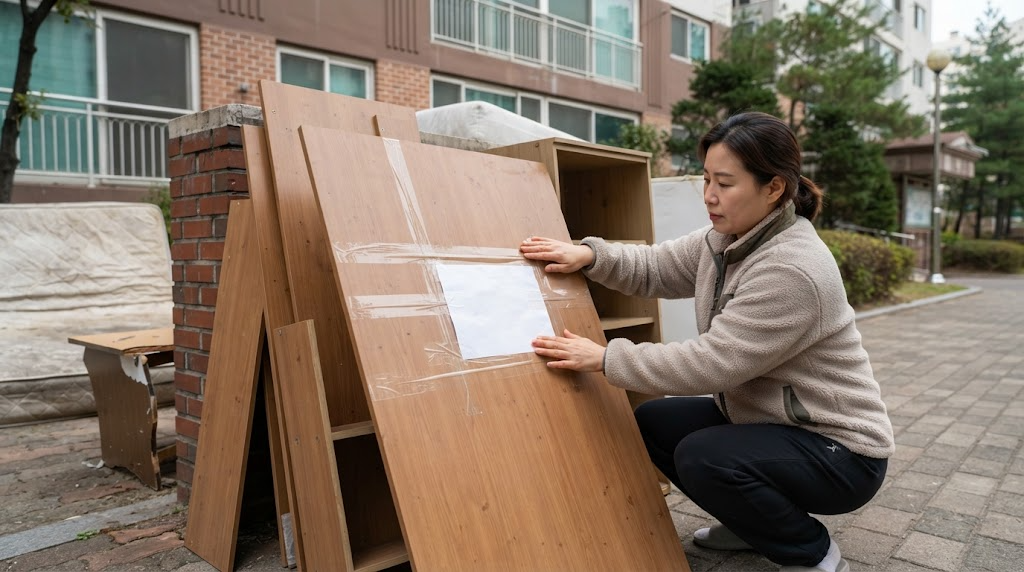
Using Clear Tape: Wrap the entire surface of the written paper thoroughly with clear tape or wrap it like coating to provide waterproof treatment.
Attaching in a Visible Place: Fix it securely with tape in an easily visible location where the collection personnel can check it at a glance on-site, such as the front or top of the waste.
💡 Summary
Even if you do not have a printer, if you handwrite the reception number, item, and address issued at the time of payment in large letters on a blank paper, seal it securely with clear tape, and attach it, you can safely and smoothly dispose of large waste without a paper payment certificate.
Checking Regulations by Local Government: Verifying Handwritten Allowance and Exception Rules
The method of handwriting the reception number on a blank piece of paper and disposing of large waste without a printer after internet reporting is widely accepted in most regions. However, because exceptional rules may occasionally exist depending on the detailed guidelines of certain local governments or collection agencies, it is safe to check a few things in advance before actually throwing the items away.
- Why do regulations and atmospheres differ by local government?
Large waste collection work is not directly managed by the central government; rather, it is a local government affair where each city, county, and district office consigns it to private companies by jurisdiction or operates its own environmental sanitation crew.
While some local governments prioritize citizen convenience above all by fully allowing and encouraging handwriting,
other regions may have subtle differences in their detailed operating methods, such as strictly adhering to the attachment of a payment certificate in a designated format to manage illegal dumping more strictly, or requiring a prior phone inquiry to the local community center when handwriting.
- Exception Rules and Verification Methods to Check Before Disposal
To prevent unnecessary collection rejections or misunderstandings, going through the following procedures is recommended.
Check notices on the local government website or reporting page: In the Frequently Asked Questions (FAQ) or Usage Guide sections of the large waste online disposal reporting page, there are often explicit guidance phrases stating whether handwriting is allowed when printing a payment certificate is impossible.
Inquire with the district office sanitation department or community center: You can get the most reliable answer by making a quick phone call to the sanitation department of the district office or the civil service room of the neighborhood community center in your area and asking, “If I report online and write the reception number on paper and attach it, will you still collect it?”
💡 Summary
The vast majority of regions allow handwriting the reception number without any issues, but differences can occasionally occur depending on the guidelines of the consignment agency for each local government. If you want to eliminate any uncertainty and complete the collection reliably, it is wise to briefly review the guidance notices of your local government or check in advance by phone before reporting.
Precautions During Disposal and Tips to Prevent Collection Delays
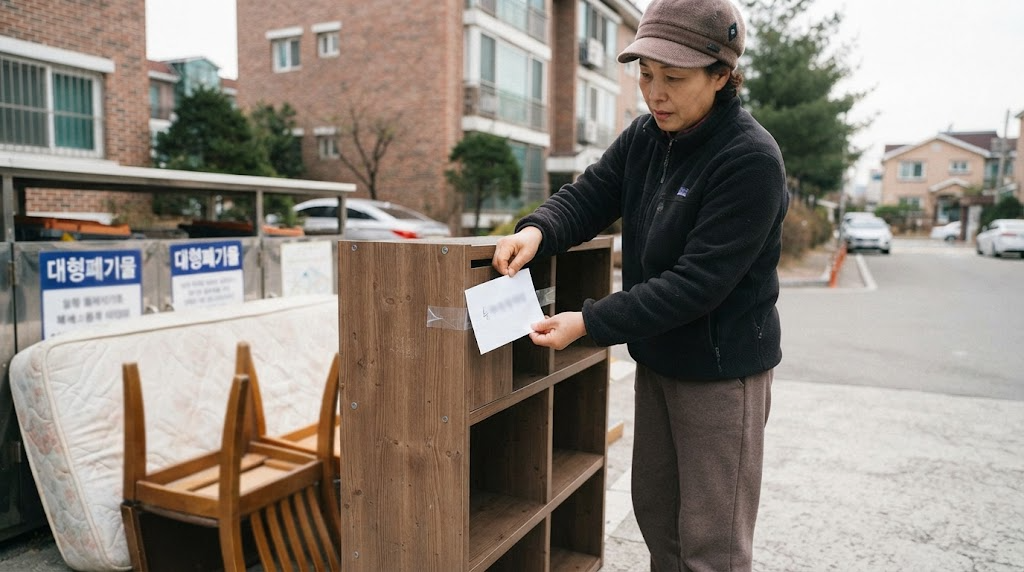
Even if you have completed the large waste internet report and neatly written and attached the reception number on paper, making minor mistakes or failing to follow regulations during the disposal process can lead to collection delays or being mistaken for illegal dumping, resulting in disadvantages. Here are the precautions and tips you must know to process your waste safely and smoothly.
- Sealing Handwritten Paper to Withstand Weather (Against Rain, Snow, and Wind)
As mentioned earlier when handwriting the reception number on a blank paper, leaving it outside in its raw paper state can cause the handwriting to smudge or the paper to tear and blow away due to sudden rain, snow, or strong winds.
You must thoroughly wrap the entire paper with clear tape to provide waterproof treatment like coating so that when the collection driver arrives on-site, they can accurately identify the reception number without damage or blurring.
- Strictly Adhering to Designated Disposal Locations and Times
Disposal Location: You must place the waste precisely at the location you designated yourself during the internet report (e.g., right side of the front gate, corner of the 1st-floor parking lot of a villa, etc.). Placing it in the wrong location may result in it being omitted from the collection targets.
Disposal Time: Usually, collection companies start their collection work from early morning or morning hours, so it is safest to put it out the evening before collection or just before sunrise (dawn) on the day of collection. Putting it out too early can ruin the neighborhood aesthetics or easily be mistaken for illegal dumping.
- Checklist for Preventing Collection Delays and Complaints
Check if the item you reported and the actual item you disposed of match exactly. (e.g., Reporting a 2-seater sofa and putting out a 3-seater sofa, or secretly throwing away additional items together, will make it subject to collection refusal.)
Place it stably in an appropriate space that does not obstruct other people’s passage or vehicle parking to prevent safety accidents.
💡 Summary
The punctuation marks of large waste disposal are “putting it out in the correct place and time” and “securing the handwritten paper tightly so it is not damaged by weather.” If you thoroughly pay attention to these two things, you can clean up around your house neatly without collection delays or misunderstandings.
Korean version: 한국어로 읽기