
What is the Earned Income Tax Credit Regular Application? (System Overview and Purpose)
The representative income support system through which the state provides cash support to support the livelihood of working low-income households and boost their willingness to work is the ‘Earned Income Tax Credit’.
The Earned Income Tax Credit aims to promote a practical income increase effect by paying the calculated grant to households that meet certain requirements according to income and property criteria. In particular, the ‘regular application’ conducted every May is the most universal and core application period during which grants are collectively reviewed and paid based on the income of the previous year.
Why should you not miss the May regular application?
Confirmation of the previous year’s income criteria: Every May is the time when the National Tax Service accurately grasps and confirms the income attributable to the previous year (January to December) and property conditions. Therefore, during the regular application period, you can receive the grant calculated without omission to match your exact income bracket.
Embracing a wide range of targets: It is a comprehensive period during which applications are received including not only earned income earners who are targets of semi-annual applications, but also households with business income or religious income.
Stable payment timing: If you complete the regular application in May, the grant is usually paid between late August and mid-portion of September after review, providing a solid boost to the household economy in the second half of the year.
💡 Core Purpose of the Earned Income Tax Credit System
Going beyond simply being a welfare support fund that helps the low-income class on a one-time basis, the Earned Income Tax Credit aims to induce self-reliance and increase work connectivity by adding practical compensation to ‘working people’. This is why single-households, single-earner households, and dual-earner households who are working hard but experiencing living difficulties due to low income must definitely seize the May regular application opportunity that comes every year.
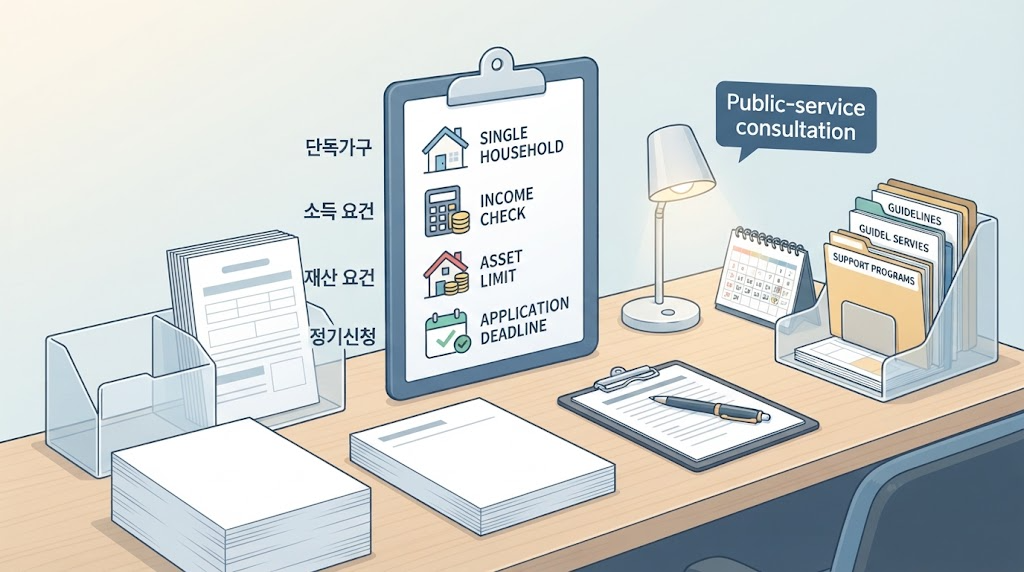
2026 Earned Income Tax Credit Single-Household Core Qualification Requirements
When preparing for the earned income tax credit regular application, the very first thing you need to check is the type of household you belong to and whether you meet the strict criteria accordingly. In particular, ‘single-households’ require accurate verification because the applied income criteria and household member composition requirements differ from single-earner or dual-earner households.
- Household Member Composition Criteria: What is a Single-Household?
In the Earned Income Tax Credit system, a single-household refers to a household that has no spouse, dependent children, or lineal ascendants aged 70 or older.
Even if people live together on the resident registration record, if there are no household members corresponding to the above three requirements (spouse, children, parents aged 70 or older), they are legally classified as a single-household even if they are not a one-person household.
Regardless of the number of household members, single-households are evaluated based on the applicant’s own income and the total combined property of all household members.
- Income Criteria: Below the Annual Total Income Standard Amount
For a single-household to receive the tax credit, the total annual income combined for the previous year (based on the individual for a single-household) must be less than the standard amount.
All income earned by household members, including earned income, business income, and religious worker income, is combined and calculated.
Since the income standard amount is adjusted annually according to the inflation rate and government policies, you must finally check through the National Tax Service Hometax or announcement notices to see if you meet the previous year’s attributable income requirements (less than approximately 22,000,000 KRW for single-households) based on the application year (2026).
💡 To summarize
The core of the 2026 single-household qualification requirements is ‘household member composition with no spouse, children, or parents aged 70 or older’ and ‘the previous year’s total income meeting the criteria’. You must clear these two basic hurdles to enter the next gateway of property requirement screening.

The Most Tricky Gateway: Household Member Total Property Condition (Under 200 Million KRW Standard)
Even if you safely pass the income requirements in the Earned Income Tax Credit screening, the most tricky gateway that you cannot rest easy about is the ‘total property condition’. This is because even if you worked hard to meet the income criteria, if the property you own exceeds a certain standard, you will be excluded from the tax credit payment target or your amount will be reduced.
- Household Member Total Property Standard: Under 200 Million KRW
For the Earned Income Tax Credit, the total combined property owned not only by the applicant individually but also by all household members must be under 200 million KRW.
Here, household members include only the individual for single-households, and all household members including the spouse for single-earner or dual-earner households.
The scope of properties included in the calculation is very broad, including real estate (housing, land, buildings), passenger cars, jeonse (lump-sum housing lease) deposits, financial assets (savings, stocks, bonds), membership rights, and even inherited property.
Particularly in the case of jeonse deposits, caution is required because they are evaluated according to standards set by the National Tax Service rather than the actual full jeonse amount, so the property value may be calculated higher than you think.
- Reduction Payment Regulation for Properties Ranging from 140 Million KRW to Under 200 Million KRW
Even if your total property amount does not exceed the baseline of 200 million KRW, there is a bracket where the payment amount varies depending on the scale of your assets.
Total property amount under 140 million KRW: 100% of the calculated earned income tax credit is paid in full.
Total property amount from 140 million KRW to under 200 million KRW: Only 50% of the calculated tax credit is deducted (reduced) and paid.
Therefore, if your assets fall within this bracket, your expected receipt amount may be cut in half, so you must keep this in mind during advance calculations.
- Debt (Loans) Are Not Deducted from Property
The part that many people misunderstand and get disappointed by the most is whether debt is reflected.
Various debts such as mortgage loans received when buying a house, jeonse loans, and credit loans are unfortunately not deducted (subtracted) when calculating the total property amount.
For example, even if you own a house worth 200 million KRW and 100 million KRW of that is a mortgage loan, the property value in the National Tax Service screening is not 100 million KRW minus the loan, but is reflected as 240 million KRW—wait, as the pure real estate evaluation amount of 200 million KRW as is, which may lead to disqualification due to exceeding the property criteria.
💡 To summarize
The earned income tax credit property requirements are strictly evaluated based on the total assets owned rather than net asset criteria excluding loans. Therefore, before applying, we strongly recommend carefully gauging the sum of all properties under household members’ names—such as real estate, vehicles, and deposits—and checking whether you safely fall into the bracket under 200 million KRW (under 140 million KRW recommended).
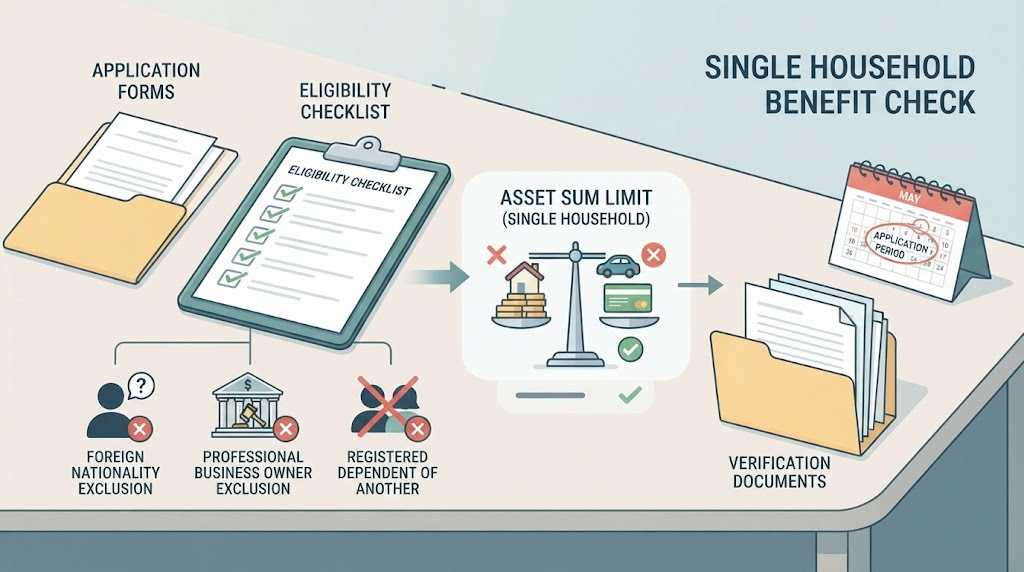
Earned Income Tax Credit Application Exclusion Targets and Reduction Reason Checklist
The earned income tax credit is a solid system supporting working low-income households, but no matter how much you meet the income and property criteria, there are exclusion targets who cannot apply at all. In addition, even if you apply while meeting the requirements, the tax credit can be significantly reduced depending on the situation, so careful advance checking is necessary.
- Earned Income Tax Credit Application Source Exclusion Targets
If you fall under any of the following, unfortunately, you are excluded from the earned income tax credit application targets.
- Individuals who do not hold the Republic of Korea nationality:
- Individuals without the Republic of Korea nationality are excluded from application targets in principle. (However, some cases where a person is married to someone with Republic of Korea nationality or has a dependent child with Republic of Korea nationality are exceptionally recognized.)
- Professional business operators:
- If you or your spouse have business income corresponding to professional business operations such as lawyers, certified public accountants, tax accountants, or doctors, you are completely excluded from the support target regardless of your income level.
- Individuals registered as dependent children of other household members:
- A person listed as a dependent child of another resident cannot apply for the tax credit separately even if they form an independent household and have income.
- Major Reduction Reasons for Tax Credit Reductions (Late Application, etc.)
Even if you meet all the requirements, if you fail to observe the set deadline or changes occur in your reported details, the tax credit will be reduced.
- 10% reduction upon late application:
- If you miss the regular application period conducted every May, you can make a ‘late application’ from June 1 to November 30 of that year.
- However, in this case, 10% of the calculated final tax credit amount is deducted (reduced) and paid, so it is advantageous to definitely finish within the May regular application period.
- Reduction according to income and property changes:
- As examined earlier, if the total property amount of household members falls within the bracket of 140 million KRW to under 200 million KRW, 50% of the calculated amount is reduced and paid.
📋 Final Checklist to Prevent Tax Credit Reception Disqualification and Reduction
| Inspection Item | Confirmation Content | Check Status |
|---|---|---|
| Nationality and Qualification | Whether holding Republic of Korea nationality and whether corresponding to professional business income | [ ] Confirmed |
| Application Deadline | Whether application is processed within the May regular application period (preventing 10% reduction upon late application) | [ ] Confirmed |
| Property Bracket | Whether falling into the reduction bracket for household member total property amount of 140 million KRW to under 200 million KRW | [ ] Confirmed |
💡 To summarize
Before applying for the earned income tax credit, you must first check whether you fall under exclusion targets such as professional status or nationality requirements, and above all, you must strictly observe the May regular application deadline to receive the full support fund without a 10% reduction.
Regular Application Methods and Essential Preparation Items (How to Use Hometax and Sontax)
If you have checked both the earned income tax credit qualification requirements and property criteria, it is now time to proceed with the most important actual application procedure. During the regular application period every May, you can easily apply through the National Tax Service Hometax (PC), Sontax (mobile app), and ARS phone calls.
- Essential Preparation Items and Advance Checkpoints Before Application
Check whether you received a notification letter (individual authentication number):
If you received a mobile notification letter or postal notification letter from the National Tax Service, check in advance the individual authentication number (8 digits) written on the notice. Having the authentication number makes logging in and applying much simpler.
Smartphone in your own name or joint certificate (financial certificate):
Prepare in advance since a means for identity verification is required when accessing Hometax or Sontax.
- Regular Application Method Guide by Channel
① How to Use the Mobile App (Sontax) (Most Recommended)
Install and launch the ‘National Tax Service Sontax’ app on your smartphone.
Log in using a simplified certificate or financial certificate.
Select the [Earned/Child Tax Credit Application] menu on the main screen.
Enter the individual authentication number you received or check your eligibility based on your resident registration number.
Accurately enter your receiving account information, such as contact details and account number, and click [Apply] to complete.
② How to Use PC Hometax
Access the official National Tax Service Hometax website and log in.
Navigate through the top menu in the order of [Apply/Submit] ➔ [Earned/Child Tax Credit Regular Application].
After checking the application requirements, enter your resident registration number and individual authentication number on the simplified application screen.
Review the loaded income and property details, enter the account in your own name to receive the refund, and submit.
③ ARS Telephone Application (When Digital Devices Are Inconvenient)
Call the National Tax Service tax credit dedicated ARS number (1544-2144).
Follow the voice prompts to enter your resident registration number and the received individual authentication number.
Register the account number in your own name to receive the tax credit, and the submission is easily completed.
- What Should You Do If You Did Not Receive a Notification Letter?
Even if you did not receive a notification letter, if you determine that you meet the income and property requirements, you can apply directly through the general application corner after logging into Hometax.
However, when applying directly, you must accurately understand and enter your own income details and property status yourself, so careful checking is necessary to prevent omissions.
💡 To summarize
The May regular application is simple enough to be completed in just a few minutes by simply entering the individual authentication number from the notification letter through the Sontax app or Hometax PC screen. Please safely finish your application by entering accurate account information within the deadline.
Korean version: 한국어로 읽기