Introduction: Government-Funded Training, the Meaning of ‘Completion’ as Important as the Start
[Subtitle Body] Introduction: Government-Funded Training, the Meaning of ‘Completion’ as Important as the Start
There are truly many people who get issued a National Employment Support Card and knock on the door of government-funded education to prepare for a new career, change jobs, or for self-development. Everyone will remember the excitement and motivation on the first day of class, carefully comparing courses through the Ministry of Employment and Labor’s HRD-Net or Employment24 and applying with great determination.
However, once education actually begins and weeks or months pass by, people often encounter unexpected difficulties.
“The progress is much faster than I thought, so it’s too hard to keep up…”
“I suddenly got a job at a good place and have to go to work, should I keep taking the classes?”
“It’s an evening class for office workers, and it’s physically too exhausting to juggle it with work…”
At first, it was a burning passion, but when faced with a busy daily life and realistic barriers, people feel the temptation of dropping out, thinking, ‘Should I just quit?’
Of course, unavoidable personal circumstances may arise, but government-funded training is not a structure where you can simply register and freely quit whenever you want like a regular private academy. Since it is training supported by the national budget, dropping out entails unexpected disadvantages and penalties.
Then, what are the causes of disadvantages that you must know before quitting blindly, and how should you wisely cope when unavoidable circumstances arise? From now on, let’s look one by one into the reality of dropping out of government-funded education and wise coping methods.
If there are any additional subheadings that need writing or revision, please feel free to let us know!

STEP 1. Major Disadvantages Actually Incurred When Dropping Out of Government-Funded Training
[Subtitle Body] STEP 1. Major Disadvantages Actually Incurred When Dropping Out of Government-Funded Training
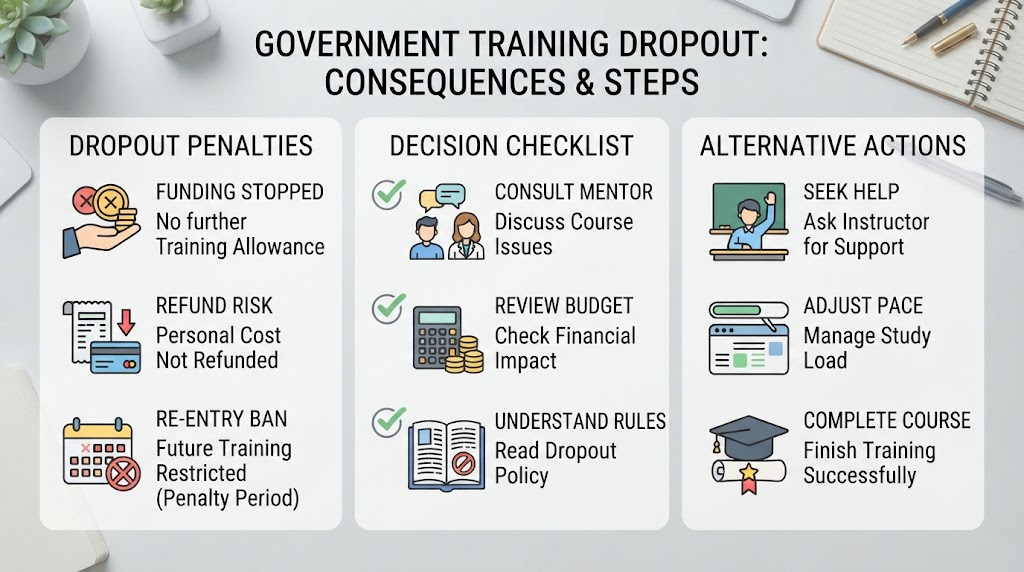
If you inevitably drop out (through expulsion or course cancellation) while receiving government-funded training, practical penalties occur that cannot be lightly brushed off with “I’ll just stop taking classes.” Because the National Employment Support Card supported by the state is operated based on strict attendance rates and completion criteria, dropping out mid-course results in the following disadvantages coming right back at you.
Here is a summary of the 3 core penalties waiting for you.
- Deduction of National Employment Support Card Account Balance (Subsidy Cut)
If the training course is processed as a drop-out (expulsion), a certain amount is deducted from the lifetime account limit (3 million to 5 million won) granted to the National Employment Support Card.
Usually, upon the first drop-out, a certain amount (e.g., equivalent to 200,000 won) is deducted, and as the number of occurrences accumulates, the total amount that can be supported in the future gradually decreases, so that when you later find education you truly want to learn, you will not be able to fully receive the benefits.
- Recoupment of Self-Paid Amount and Suspension of Training Allowance Payments
Process of self-paid amount generation: If trainees bore some out-of-pocket expenses depending on the course, depending on the timing of the drop-out, the self-paid amounts already paid may not be refunded or disadvantages of a penalty nature may occur.
Non-payment of training allowance: The training allowance (transportation expenses, meal expenses, etc.) paid monthly upon achieving an attendance rate of 80% or higher is entirely suspended from the point of dropping out onward. Payments for the attendance days up until the point of quitting may also become complicated.
- Future Re-participation Restriction Period (Penalty Period Application)
This is one of the most fatal disadvantages. Depending on the number of drop-outs, taking government-funded training courses itself is restricted for a certain period.
Upon the first drop-out, re-support may be restricted for a certain period (usually several months) or disadvantages may not be significant, but in the case of repeated drop-outs or unauthorized expulsions, the use of the National Employment Support Card may be suspended altogether for a certain period or penalties may be aggravated, causing major disruptions in job preparation or competency development.
Like this, dropping out of government-funded education can result in eating away at your precious subsidy limit and even getting future educational opportunities revoked.
Then why on earth do trainees agonize over dropping out while enduring such disadvantages? In the following content, we will examine those fundamental causes!
STEP 2. Analysis of Major Causes Why Trainees Drop Out of Education
[Subtitle Body] STEP 2. Analysis of Major Causes Why Trainees Drop Out of Education
It was a government-funded education started with passion, but quite a few trainees declare dropping out right in the middle of the course. For what reasons on earth do they make the regrettable choice of dropping out midway?
We realistically point out the representative 3 causes why trainees actually end up quitting education.
- Cause A (Failure to Adapt to Classes): Lack of Basic Knowledge Making It Hard to Keep Up with Progress
Many of the government-funded education courses are advertised as targeting non-majors or beginners, but once classes actually begin, the progress is often much faster and the difficulty much higher than expected.
Because you have to learn practice-oriented skills such as programming, computerized tax accounting, accounting, and design in a short period, missing even a little makes it difficult to follow the next class, and eventually, you end up agonizing over quitting along with a sense of frustration that ‘this is not for me.’
- Cause B (Personal Environment Changes): Sudden Employment Success, Job Change, Health Deterioration
This is one of the most fortunate yet common causes. It is when early employment at a desired company is confirmed while taking the course, or in the case of office workers, sudden changes occur in the work environment such as overtime or department transfers.
Alternatively, a situation arises where you inevitably drop out because you cannot meet the designated attendance rate due to unavoidable personal circumstances such as sudden illness, health deterioration, or family matters.
- Cause C (Institutional and Curriculum Complaints): Subpar Educational Quality and Lack of Communication
Even after thoroughly researching and choosing through HRD-Net and the like in advance, it is when you open the lid and find that the instructor’s lecturing ability falls short of expectations or it is operated with an outdated curriculum far removed from actual practice.
Not a few cases occur where interest and trust in education are completely shattered due to communication problems with the training institution or negligence in managing trainees, causing them to even lose the motivation to attend.
Like this, each person agonizes over dropping out due to unavoidable reasons or regrets, but abruptly cutting off contact or ghosting is the worst response to avoid at all costs.
Then what is the method to minimize penalties and cope wisely when a crisis situation strikes? We will look into it in detail in the following content!

STEP 3. Coping and Wise Resolution Methods in Case of a Drop-Out Crisis
[Subtitle Body] STEP 3. Coping and Wise Resolution Methods in Case of a Drop-Out Crisis
While taking classes, critical moments of crisis may arrive where it is hard to continue the course any further due to various unavoidable circumstances. The behavior you must be most wary of at this time is taking unauthorized absences with a ‘what the heck’ attitude, or cutting off contact and ghosting (getting expelled).
If you ghost, not only are you automatically expelled for failing the attendance rate, but you also cannot avoid massive disadvantages and administrative sanctions when using the National Employment Support Card in the future. Be sure to remember the 3 solution methods to minimize penalties and cope wisely even amidst a crisis situation.
- Be Sure to Go Through ‘Formal Completion/Expulsion Procedures’ Instead of Unauthorized Expulsion
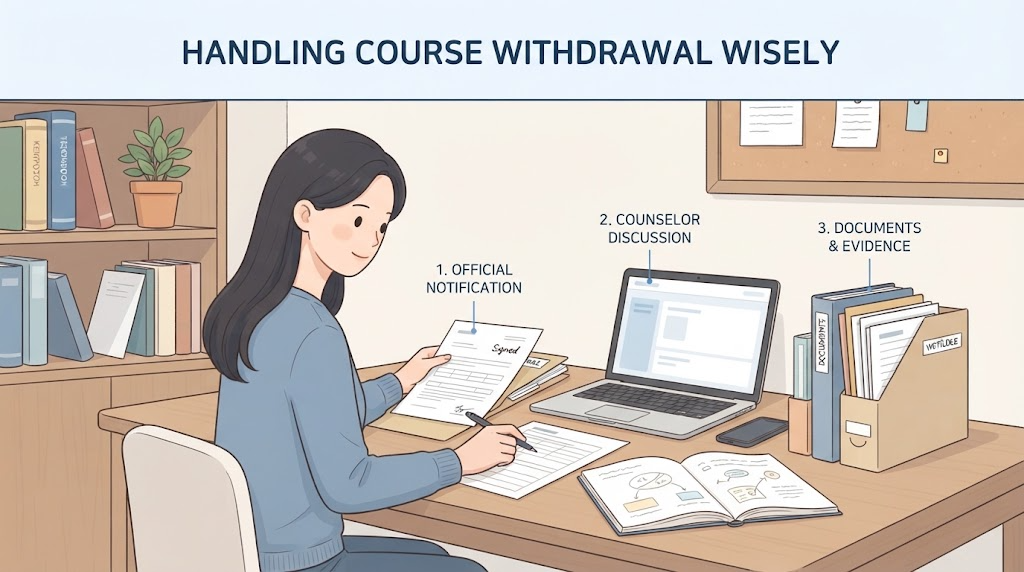
If you are in a situation where you inevitably have to quit, do not agonize alone and make sure to officially express your intention to drop out to the training institution (academy) administration office or the responsible instructor.
You must fill out the designated documents and go through normal procedures for expulsion processing so that penalties such as future card account balance deductions or re-participation restriction periods can be minimized according to legal and administrative standards.
- Prior Coordination and Explanation of Reasons with Training Institution Counselors and Employment Center Personnel
Before giving up on the training course, it is best to honestly confide the difficulties you are currently experiencing to the employment center person in charge or the training institution counselor.
Sometimes you may be guided through alternatives that allow you to continue your education, such as a leave of absence system, transfer to a course at a different time slot (class change), or makeup classes.
- Thoroughly Submitting Evidentiary Documents in Case of Unavoidable Reasons (Early Employment, Illness, etc.)
Dropping out due to early employment: Quitting because you get hired in the middle of education is the most fortunate case. In this case, if you submit evidentiary documents such as a certificate of employment or an employment contract, unlike regular drop-outs, you can receive a significant exemption from disadvantages or benefits equivalent to normal completion processing.
Illness and accidents: Submitting objective medical evidentiary documents such as a medical certificate is of great use to be recognized as dropping out due to unavoidable reasons and to defend against penalties.
When a drop-out crisis strikes, rather than hiding or avoiding it, following the procedures matching the regulations and gathering evidence is the wisest way to protect your National Employment Support Card.
Then what are the practical tips we should prepare in advance to prevent such drop-out situations in the first place and complete the course all the way to the end? Find out in the final content!
TIP. Practical Tips to Prevent Dropping Out and Complete to the End
[Subtitle Body] TIP. Practical Tips to Prevent Dropping Out and Complete to the End
Everyone is passionate when applying for government-funded education, but completing the long journey lasting weeks or months without getting exhausted is not as easy as it sounds. What things should we prepare in advance so that we do not experience the crisis of dropping out in the first place, and instead complete it all the way to secure both National Employment Support Card benefits and a certificate of completion?
Here is a summary of 3 practical tips to help you achieve a successful completion.
- Choosing a Course That Perfectly Fits Your Capabilities and Realistic Schedule
Checking course difficulty: If you are a non-major or lack basic knowledge, rather than recklessly choosing an advanced course or an excessive night/weekend full-time course, it is better to first choose an introductory course that steadily builds skills step by step from the basics.
Checking availability of time investment: You must objectively compare your current daily life (working hours, childcare, personal schedule) and training time, and carefully examine whether it is a realistic course where you can consistently attend and review every day before applying.
- Managing Attendance Rate (80% or Higher) and Utilizing Employment24/HRD-Net
The absolute rule for completing government-funded education is ‘achieving an attendance rate of 80% or higher.’ If tardiness, early leaves, and absences accumulate, your attendance rate may be chipped away without you even knowing, leading to falling short of the completion criteria.
You must frequently check your own attendance status through the mobile Employment24 or HRD-Net app, and if a reason for tardiness or early leave inevitably arises, develop the habit of notifying the training institution in advance and gathering evidence.
- When a Slump Hits: Actively Utilizing the Leave of Absence System or Course Change
If physical limitations or a severe slump strikes in the middle of education and it becomes truly hard to endure, before declaring resignation unconditionally, first inquire with the institution whether a leave of absence or a training course change (transfer) is possible.
Since systems are sometimes arranged to let you catch your breath for a moment or adjust to a course better suited for you, actively knocking on the door rather than suffering alone is the shortcut to completion.
Thorough prior preparation and small practices come together to eventually yield results like successful completion and employment. Even if it is a bit tough, I encourage you to catch your breath and complete it all the way to the end!

Conclusion: Enjoying 100% of Government-Funded Education Benefits Through Wise Choices and Completion
[Subtitle Body] Conclusion: Enjoying 100% of Government-Funded Education Benefits Through Wise Choices and Completion
Up to this point, we have carefully examined everything from the causes of disadvantages occurring when dropping out of government-funded training, wise coping methods amid unavoidable crises, to practical tips for completing to the end.
Government-funded education goes beyond simply being an opportunity to learn skills for free; it is a precious stepping stone that can upgrade your career and life to the next level. However, if you start with vague expectations and face the regrettable result of dropping out due to a lack of thorough preparation or realistic constraints, only painful penalties such as National Employment Support Card account balance cuts or re-participation restrictions will remain.
If you have decided on a new challenge, the most important things are ‘a wise choice tailored to you’ and ‘completion without giving up until the end.’
📌 Before starting: Carefully comparing and choosing a course that fits your schedule and capabilities
📌 During progress: Thoroughly managing your attendance rate and, when a crisis strikes, going through formal counseling and procedures instead of unauthorized expulsion
📌 Wrap-up: Fully securing the fruits of training allowances and certificates of completion to succeed in a pleasant job search or career change
Referring to the information shared today, I sincerely cheer you on to wisely prevent unnecessary disadvantages and enjoy 100% of all benefits from the government-funded education you prepared.
Always rooting for your shining new beginning!
If there are any parts that additionally need modification or supplement, please feel free to let us know!
Korean version: 한국어로 읽기