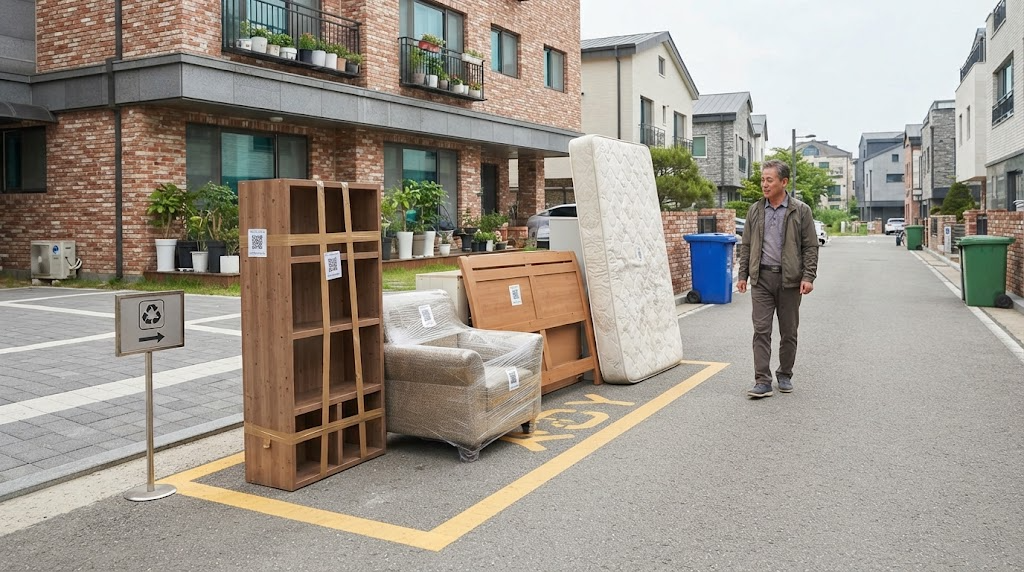
Why You Must Strictly Follow the “Designated Location” When Disposing of Large Waste
After finishing a major cleanup or moving, people often carelessly place large furniture or home appliances in front of their houses. It’s easy to think, “Since I’m throwing it away anyway, it should be fine as long as I leave it somewhere visible,” but did you know that this single action can come back as hundreds of thousands of won in fine bombs?
The reasons why you must strictly comply with the location designated by the local government when disposing of large waste are clear.
- Preventing Illegal Dumping Enforcement and Fines
Even for large waste that has been properly reported to the local government, dumping it arbitrarily in a place other than the reported disposal location (such as alley corners, in front of commercial buildings, or roadside) is considered illegal dumping. If caught by enforcement cameras or local government street cleaners’ patrols, a fine of up to 1 million KRW can be imposed in accordance with the Wastes Control Act, so caution is required.
- Preventing Collection Refusal and Administrative Processing Delays
Collection companies carry out collections along designated routes based on the regional disposal lists and report details contracted with the local government. If it is placed in an unexpected spot rather than the designated location, collection workers are likely to miss it without noticing, causing inconvenience where collection is omitted or processing is delayed by several days.
- Blocking Inter-neighbor Disputes and Civil Complaints
If large waste is left unattended in front of someone else’s house, in locations that obstruct passage, or in parking zones, it easily leads to serious conflicts and complaints among neighbors due to pedestrian inconvenience as well as concerns about vehicle damage during parking. The designated location is a promise to protect the rights and interests of both yourself and your neighbors.
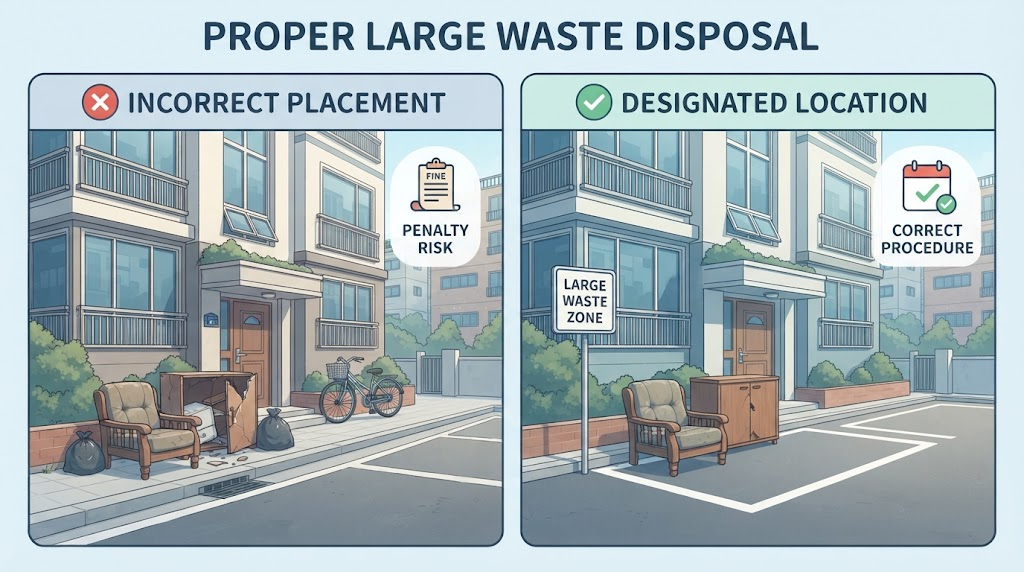
You’ll Get Hit With a Bomb if You Carelessly Throw It Away! Typical Cases Easily Mistaken for Illegal Dumping
There are unexpectedly many cases where garbage carelessly discarded with the thought, “Surely this much is fine,” gets caught straight in enforcement teams’ eyes as “illegal dumping.” In particular, we look at typical on-site cases where people easily get hit with unfair fine bombs after reporting large waste disposal or even without making a report at all.
- “It’s in front of my house so it’s fine?” Leaving items in front of the shared entrance of a villa or multi-family housing
Many people think that if they put large furniture in front of the 1st-floor shared entrance or in the corner of the parking lot of the villa where they reside, it will naturally be collected. However, if the disposal location reported to the local government is not the “designated garbage disposal area of the corresponding building,” or if it is a public space adjacent to the roadside, it is bound to be mistaken for illegal dumping. In particular, if it is in a location that encroaches on another household’s parking space or obstructs passage, it can immediately become a target for enforcement due to neighbor complaints.
- Places with heavy pedestrian traffic such as alley corners, under streetlights, or near bus stops
The act of stealthily pushing bulky wardrobes or mattresses, which are hard to drag out from inside the house, to an alley corner right in front of the gate, under a streetlight, or even adjacent to a bus stop, is the most dangerous. These areas are zones where local governments intensively operate illegal dumping enforcement cameras or where street cleaners patrol frequently. Even if a report certificate (sticker) is attached, it is judged as unauthorized stacking on public land rather than the “designated disposal location,” making it difficult to avoid fine penalties.
- Leaning items against commercial buildings or other people’s building exterior walls
This is the case when large waste is boldly leaned against a commercial building near a residential area or a parking lot wall of a studio apartment complex assuming the space is empty. The act of leaving garbage unattended in front of another person’s private property or business premises rather than your own house requires special attention, as it can escalate into illegal dumping enforcement as well as serious conflicts regarding property damage and business obstruction with the building owner.
- Leaving items in a “non-collectible area” or deep inside an alley despite attaching a sticker
There are times when people receive fine notices even after paying large waste fees and attaching stickers via the internet or the community center. This happens when items are placed deep inside narrow alleys where collection trucks cannot enter or deep under stairs, leaving them unnoticed and abandoned by collection workers. As time passes, they can be mistaken for abandoned garbage, leading to unauthorized dumping reports or administrative actions due to accumulated collection refusals, so you must place them in a visible spot easily accessible to trucks.
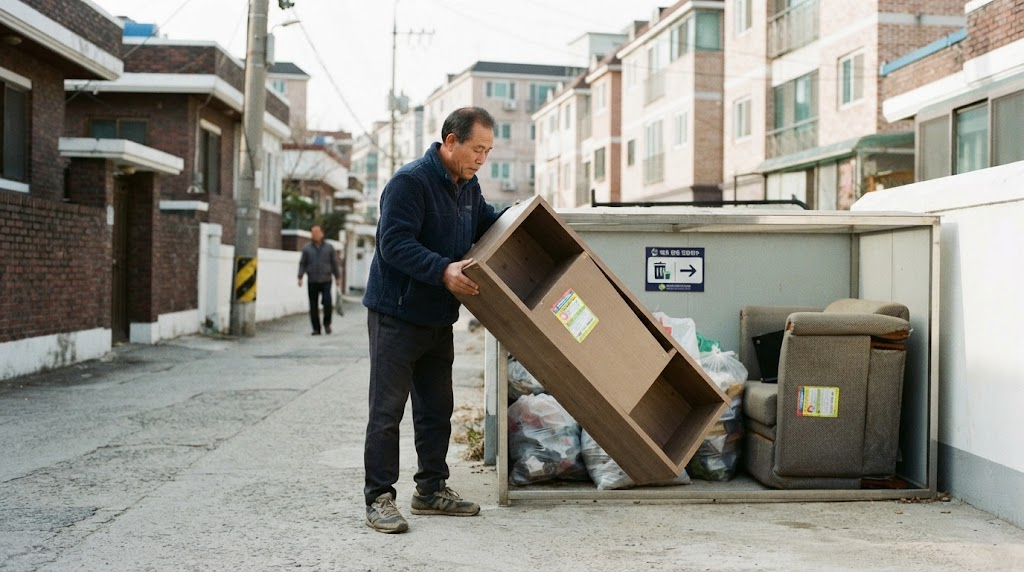
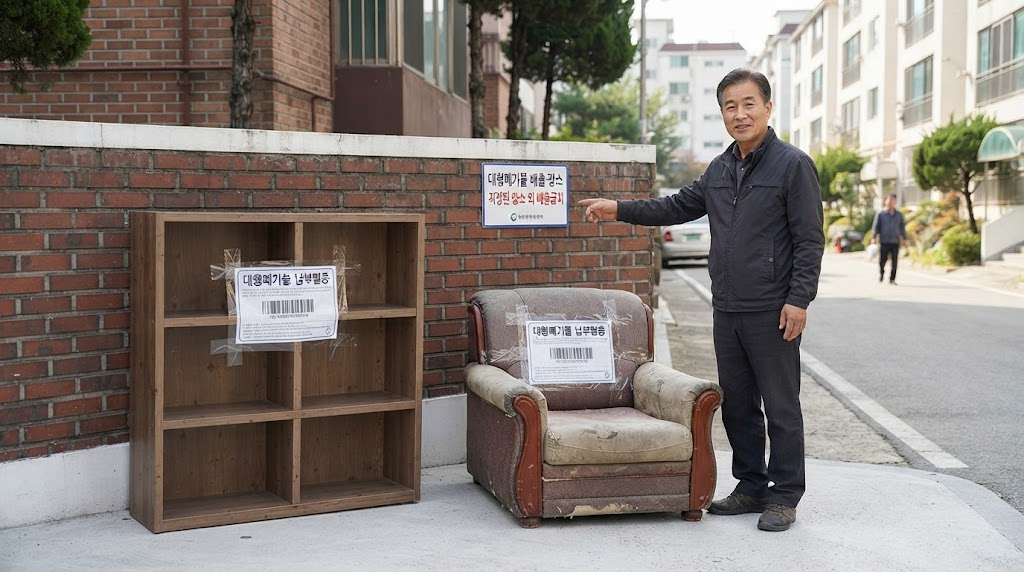
4 Practical Prevention Methods to Completely Block Fine Penalties
To completely block unfair fines and collection refusal issues that occur when disposing of large waste in advance, there are clear principles that must be followed in practice. If you meticulously understand and practice just the 4 prevention methods below, you can surely prevent unnecessary expense outflows and stress.
- ① Properly attaching the report certificate (sticker) from the jurisdiction’s administrative welfare center (community center)
The basics and most important step of large waste disposal are accurate fee payment and attaching the report certificate.
Accurately report the disposal items and obtain a payment certificate (sticker) through the internet district office website or by visiting the community center.
The sticker must be firmly fixed and attached using transparent tape or the like so that it does not blow away in the wind or get damaged by rain. If there are multiple items, individual stickers must be attached to each item to avoid enforcement or collection refusal.
- ② Selecting an accurate disposal location that collection workers can recognize at a glance
The “disposal location” entered or recorded during reporting must be a place where collection trucks can actually approach and easily check.
It should be placed in a location with good visibility directly connected to the collection vehicle’s access route, such as inside the front gate of your house or a designated multi-family housing separate recycling area.
Avoid deep inside alleys, other people’s private property, or places that obstruct passage, and choose the optimal location where assigned collection workers can immediately discover it upon arriving at the site.
- ③ Strictly observing designated disposal times and days
Large waste is often not collected right away just because it is put out at any time.
Designated collection days and time slots (mainly the night before collection or early morning on the day of collection) are set for each local government or collection company.
Putting it out too early before the collection date not only ruins the urban scenery but also makes it easy to be mistaken for illegal dumping. It is safe to always dispose of it according to the times recommended by the local government, such as the evening before the scheduled collection date or early in the morning on the day.
- ④ Leaving on-site verification photos after completing disposal
Securing evidence just in case is the surest way to defend against unfair fines.
Take photos using a smartphone camera dividing into an overall shot and a sticker close-up shot showing the large waste with the sticker attached properly placed in the designated location.
If a collection delay complaint occurs or an illegal dumping fine notice arrives mistakenly, submitting these photos as evidentiary material to the local government responsible department allows you to smoothly resolve the misunderstanding.
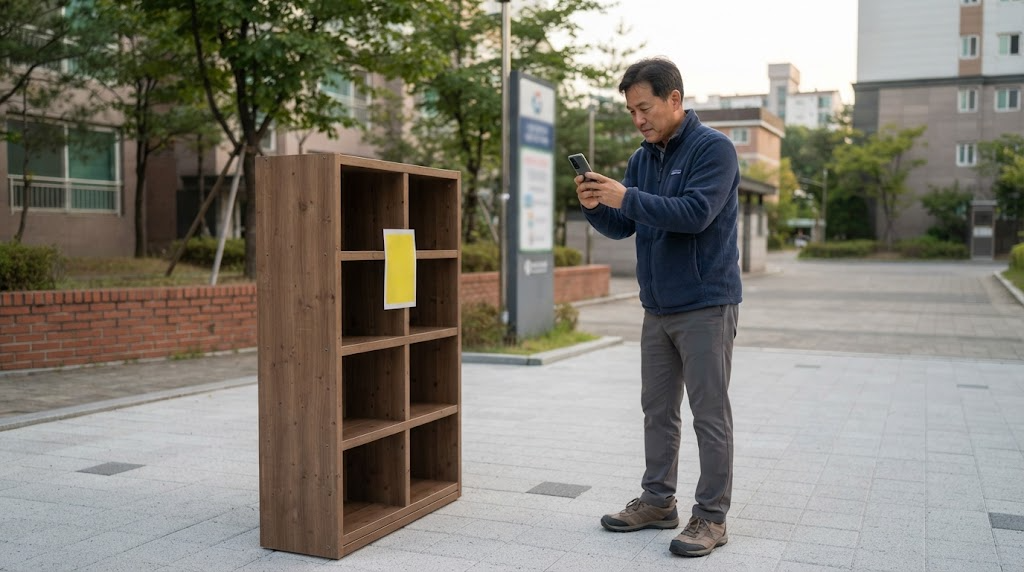
Core Checkpoints to Verify If You Have Already Completed the Disposal Report
Even if you have conveniently completed the large waste disposal report via the internet and finished paying the fees, complacency is forbidden. Check out these 2 core checkpoints to review for the last time until collection is smoothly carried out.
- Re-confirming whether the scheduled collection date and disposal location match the details written on the sticker
Checking the disposal date and time: Double-check once more to see if the scheduled collection date printed on the report certificate (sticker) or voluntarily written down matches the actual date of disposal. Occasionally, collection is omitted because people confuse the date by a day and put items out too early or too late.
Checking whether the disposal location matches: You must inspect whether the disposal location entered during the internet reporting process (e.g., in front of your own house gate, a specific villa’s separate recycling area, etc.) exactly matches the actual location where you placed the items. Since collection workers operate based on registered system addresses, if the location differs, they may simply pass by.
- Tips for considering weather and surrounding environments during rainy days or nighttime disposal
Waterproofing and securing: If rain or snow is forecasted on the scheduled disposal date, the paper-material report certificate can get wet and damaged or the barcode/serial number can be erased. You must carefully wrap the sticker attachment area with transparent tape to make it waterproof so that collection workers can properly recognize it.
Checking visibility and obstruction of passage: When putting items out at night or early in the morning, wisdom is needed to look around the surrounding environment once more to see if it is a place well reached by streetlight light, or if there is a risk of causing a safety accident by obstructing the passage of passing pedestrians or bicycles.
Korean version: 한국어로 읽기