
Introduction: ‘Investment for Health’ Supplements, Do They Strain the Kidneys the Longer You Take Them?
Taking a handful of supplements every morning to maintain health and boost immunity has now become a very familiar daily routine for us. From vitamins for fatigue recovery to calcium for bone health and lutein for eye health, many people have been steadily taking supplements for years with the belief that “they must be good for the body.”
However, did you know that taking supplements started for health like this can actually place an excessive burden on the ‘kidneys,’ which act as our body’s water purifier? The kidneys are core organs that filter out waste products in our body and balance fluids and electrolytes, and the supplements and metabolic byproducts we consume are also ultimately excreted through the kidneys.
Therefore, if you take too many types of supplements for a long period without properly considering their ingredients or consume them exceeding the recommended amounts, it can cause unnecessary fatigue and strain on kidney function. In particular, for modern people who live with supplements for a lifetime without a clear rest period, kidney health is an important checkpoint that can never be overlooked.
Then, what should we watch out for to avoid straining the kidneys during long-term supplement intake? From now on, we will examine practical checklists one by one for safely taking supplements while protecting kidney health.
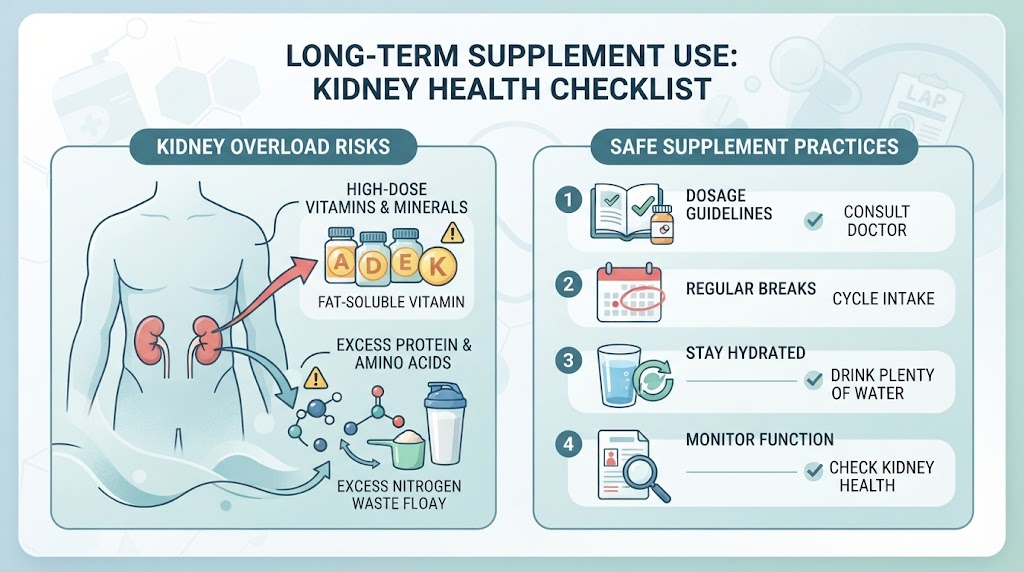
Representative Supplements and Misuse Patterns That Can Overload the Kidneys
Supplements add vitality when consumed correctly, but taking them for a long time in the wrong way without considering the characteristics of the ingredients can place a heavy burden on the kidneys, which are our body’s filters. Let’s examine the representative types of supplements and common misuse patterns that easily induce kidney overload.
Excessive accumulation of high-dose fat-soluble vitamins and minerals:
Unlike water-soluble vitamins, fat-soluble vitamins such as vitamins A, D, E, and K do not easily excrete remaining amounts through urine and have the property of accumulating in the body (fat tissue, liver, kidneys, etc.). In particular, indiscriminately taking high-content products long-term can induce toxicity in the body, and excessively consuming calcium or vitamin D together can raise blood calcium levels, causing calcium stones to form in the kidneys or becoming a cause of decreased kidney function.
Indiscriminate intake of protein supplements and high-protein amino acids:
For muscle growth or weight management, protein supplements or specific amino acids (such as creatine) are often consumed excessively beyond recommended amounts. Nitrogenous waste products (such as urea) generated during the process of protein metabolism must be completely filtered through the kidneys. When a high-protein diet or supplement exceeding the amount the kidneys can process continues for a long time, continuous pressure is applied to the glomeruli of the kidneys (‘glomerular hyperfiltration’), sharply increasing kidney fatigue.
Indiscriminate polypharmacy of complex preparations and ingredient duplication:
Saying “this is good and that is good” while eating multi-vitamins, omega-3, joint supplements, fatigue recovery agents, etc., from various brands all at once is one of the most dangerous habits for the kidneys. As ingredients overlap from product to product, the total daily intake of specific vitamins, minerals, or herbal extracts far exceeds the allowable range, and the kidneys and liver that must detoxify and excrete them fall into an overload state without a moment to rest.

4 Core Checklists for Long-Term Intake to Safely Maintain Kidney Health
To take supplements for a long time while keeping kidney health safe without harming it, criteria that need to be thoroughly checked in daily life are necessary. Check out the 4 core checklists that help reduce kidney load and assist wise consumption.
Check 1. Check for ingredient duplication (checking overlapping ingredients in the supplements you take):
When taking various kinds of multi-vitamins or individual supplements together, it is easy to unconsciously consume the same ingredients redundantly. In particular, if fat-soluble vitamins, specific minerals, or herbal ingredients are redundantly included in multiple products, it easily exceeds the daily allowable intake, giving unnecessary detoxification burdens to the kidneys. Opening up the ingredient labels of all products you are taking and periodically checking whether there are overlapping ingredients is the first step.
Check 2. Comply with recommended intake (following the daily maximum dosage based on the Ministry of Food and Drug Safety and experts):
The thought that “the more you eat, the better it is for the body” is the misconception that should be most guarded against in supplement intake. The higher the content product, the more the amount of metabolic byproducts the kidneys must filter out increases, so you must strictly follow the daily maximum intake dosage (Upper Limit) recommended by the Ministry of Food and Drug Safety or experts. Unless for a special treatment purpose, rather than blindly insisting on high-content products, steadily eating the appropriate amount essential for your body is the shortcut to cherishing your kidneys.
Check 3. Sufficient water intake (maintaining daily water intake to help excrete kidney waste products):
The kidneys are core filters that balance water in our body and excrete waste products through urine. Sufficient water intake must be supported so that residues or byproducts remaining after metabolizing supplements do not stagnate in the kidneys and smoothly exit. Instead of coffee or beverages, build the habit of drinking 1.5 to 2 liters or more of pure water a day dividedly to smoothly help the filtration activity of the kidneys.
Check 4. Regular health checkups (periodically checking status through kidney function tests):
The kidneys are called the ‘silent organ,’ so even if function deteriorates by 50% or more, it is difficult to feel any particular subjective symptoms in the early stages. Therefore, if you have been taking supplements long-term for several years or more, it is safest to periodically check through annual regular health checkups the creatinine levels, which are blood kidney function indicators, glomerular filtration rate (eGFR), and urine tests to objectively inspect whether your kidneys are holding up well.
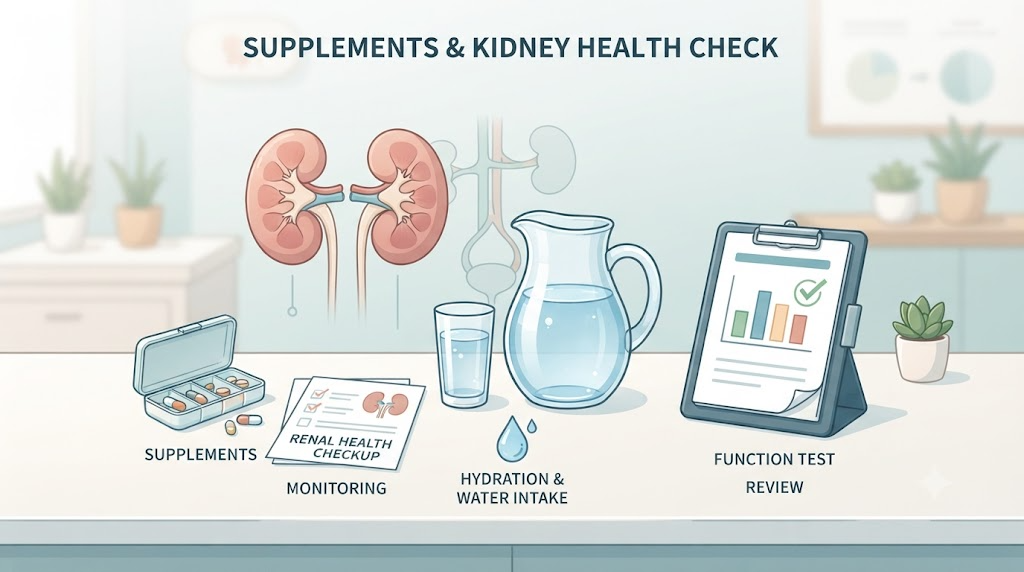
The Necessity of Supplement Off-Periods and Smart Utilization Methods
Just as a car needs maintenance and rest to prevent engine overheating when driven for a long time without stopping, the kidneys and liver, which are responsible for our body’s detoxification and excretion, can also accumulate fatigue from processing the supplement components that come in every day. In an era where people take supplements for a lifetime, wisdom is needed to smartly utilize ‘supplement off-periods’.
Why supplements also need ‘resting time’:
Vitamins, minerals, herbal extracts, etc., assist bodily functions, but when they flow into the body for a long time without a break, they continuously stimulate the kidneys and liver during the metabolic process. In addition, a phenomenon may occur where the body gets accustomed only to specific supplement components, decreasing its self-regulatory ability or lowering absorption efficiency. Proper off-periods provide a precious opportunity for the kidneys and liver to cleanly clear out accumulated waste and recharge.
Tips for setting periodic off-periods according to specific components:
There is no need to stop all supplements at the same time. In particular, fat-soluble vitamins, high-content minerals that easily accumulate in the body, and specific functional herbs (e.g., milk thistle, etc.) or joint supplements can be steadily taken for about 3 to 6 months, and then a method of stopping intake (off-period) for about 2 to 4 weeks can be applied. On the other hand, basic supplements that are consumed daily or require settlement in the intestines, such as B-complex vitamins or probiotics, should be steadily maintained, but it is reasonable to adjust the period centering on high-content products or functional supplements with clear purposes.
How to diet (organize) your intake list while observing your body’s response:
An off-period is not simply a period of not eating and resting, but a time for a ‘supplement intake list diet’ to coldly check whether the supplements you are currently taking are truly essential for your body. If there is no major change in your condition during the off-period, it is fine to boldly exclude that supplement or reduce the frequency of consumption. Observing your body’s signals yourself and reducing the number of supplements is the surest way to ease the burden on the kidneys.

Conclusion: A Sustainable Health Routine That Cares for Your Body’s Filter, the Kidneys
To avoid facing a paradoxical situation where taking nutritional supplements, which started as an investment to protect health, rather imposes excessive strain on the kidneys, which are the core filters of our body, “eating and emptying smartly” is much more important than “taking unconditionally in large amounts for a long time.”
Guarding against the abuse and misuse of fat-soluble vitamins and protein supplements, and the small habit of thoroughly checking for overlapping ingredients among multiple supplements noticeably reduces kidney fatigue. In addition, the routine of complying with the Ministry of Food and Drug Safety’s recommended intake, along with sufficient fluid intake and regular kidney function tests, becomes a reliable shield that protects the long-term vitality of your body.
From this moment on, calmly check the list of nutritional supplements you are taking every day. The wisdom of boldly dieting on unnecessary products and taking appropriate rest periods will be the safest and most sustainable health routine to protect lifelong health.
Korean version: 한국어로 읽기