
Introduction: Growing Supplement Costs, Why a Smart Comparison is Necessary
Supplements that you take every day to look after your health—haven’t they started taking up a considerable portion of your monthly expenditure list from at some point? From vitamins for fatigue recovery to probiotics for immunity, and supplements for joint or eye health, as you add them one by one, the fixed costs going out every month are quite significant.
Especially recently, a great number of people are purchasing supplements that are said to have better ingredients or better value for money through overseas direct purchase (direct buying) rather than just domestic products. Naturally, questions tend to arise such as, “Is the supplement I’m buying right now really the best choice?” or “Is buying via direct import unconditionally cheaper?”
If you choose supplements simply because others recommend them or because the price is low, you might end up missing out on ingredients truly essential for your body and only increasing unnecessary spending.
In this post, we will clearly organize the core methods for comparing prices between direct import products and domestic products in order to wisely save on supplement intake costs and protect both your wallet and your health. If you want to smartly reduce your monthly supplement expenses, check it out right now!
Domestic Products vs. Overseas Direct Import Products: Fundamental Differences in Pricing Structure
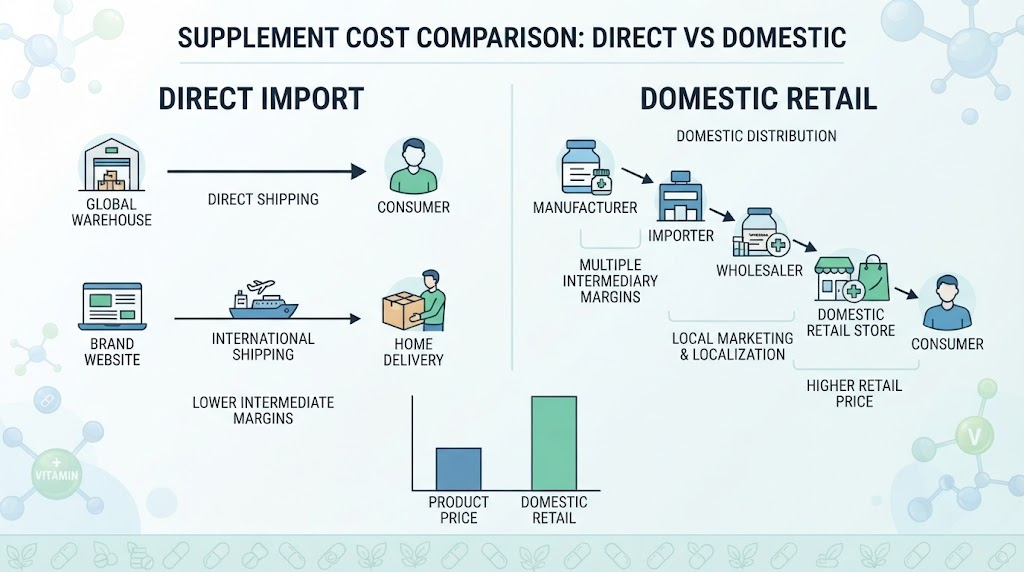
When comparing supplement prices, the first thing that stands out is the fact that even with the same ingredients or similar contents, overseas direct import products are often noticeably cheaper than officially imported domestic products. The reason for the price difference between the two product groups stems not simply from brand markups, but from differences in distribution structures, marketing costs, and regulatory costs.
- Differences in Distribution Stages and Intermediate Margins
Officially imported domestic products: Products manufactured by the manufacturer go through multiple distribution stages before finally entering offline stores such as pharmacies, Olive Young, and department stores, or domestic shopping malls via importers, general distributors, and wholesalers. In this process, intermediate margins, logistics costs, and storage costs for each stage accumulate, causing the final consumer price to rise.
Overseas direct import products: These are structured to be shipped directly from local warehouses to consumers through brand official websites or large global distribution platforms (such as iHerb, Coupang Rocket Direct Overseas, etc.). Because complex multi-tier distribution stages are significantly eliminated, intermediate margins can be minimized.
- Marketing Costs and Brand Localization Costs
Domestic products: To settle into the domestic market, packaging designs are completely replaced with Korean, labeling work tailored to the standards of the Ministry of Food and Drug Safety (MFDS) is performed, and marketing featuring famous domestic models, influencer sponsorships, and large-scale advertising costs are injected. These marketing costs are directly reflected in the product prices.
Overseas direct import products: Products sold locally are sold as-is without separate Korean packaging or domestic-only large-scale marketing, so the burden of marketing costs is relatively low.
- Costs According to Certification and Import Procedures
Domestic products: Products undergoing official import customs clearance must go through the MFDS’s demanding and strict ingredient inspections, precise quarantines, and import declaration procedures. Various fees, inspection costs, and food safety management costs incurred during this process are calculated into the price.
Overseas direct import products: Because it is a form where individuals purchase directly for personal consumption purposes, costs are saved by bypassing official import customs clearance procedures and large-scale quarantine expenses. However, there is a corresponding responsibility for consumers to meticulously check the product’s safety and compliance with domestic standards themselves.
Due to such structural differences, direct import products appear much more advantageous in terms of unit price, but when considering hidden costs such as shipping fees, customs duties and value-added taxes, and large-capacity purchases, the actual perceived cost may vary. In the next section, we will look at criteria for comparing prices more accurately, including these hidden costs.

3 Criteria for Practical Price Comparison Considering Hidden Costs (Shipping Fees, Tariffs, Capacity)
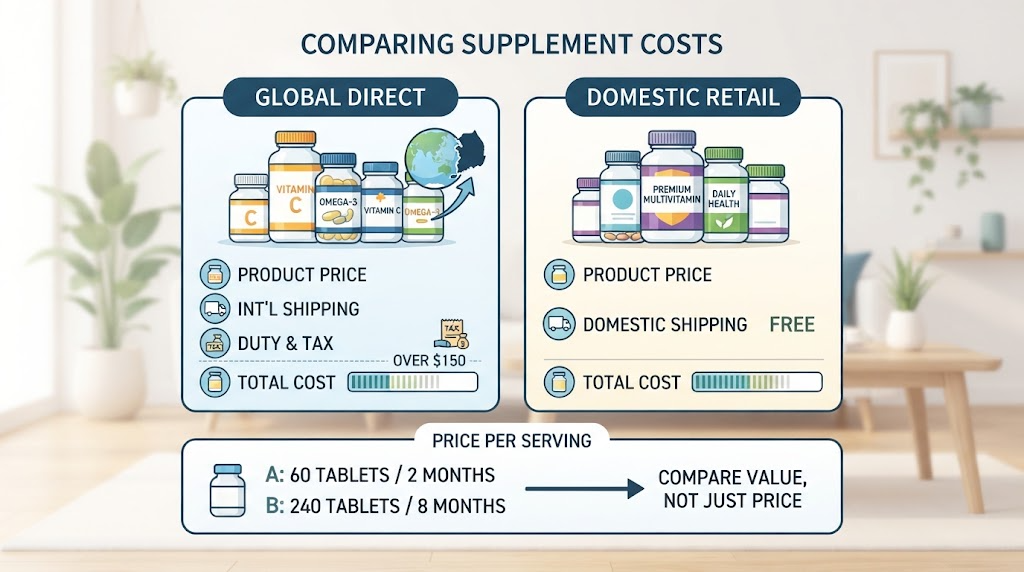
Overseas direct import supplements seem much cheaper when looking only at the listed product price, but it is common to experience the total cost increasing more than expected once you add them to your cart and proceed to the checkout stage. To compare the true value for money between direct import products and domestic products, you must carefully examine the following 3 practical price comparison criteria.
- Shipping Fees and Combined Taxation (Check Free Shipping Thresholds)
The trap of shipping fees: Even if the base product price of overseas direct imports is low, adding international shipping costs can make the price similar to or even more expensive than domestic purchase prices. Most global shopping malls provide free shipping benefits only when you purchase over a certain amount (e.g., $40 to $50 or more).
Caution regarding combined taxation: Even if you order supplements separately from multiple shopping malls on the same day, if 2 or more list-cleared items arrive and overlap on the same day, the amounts may be combined and tariffs imposed. Since you might end up paying unexpected taxes while trying to save on shipping fees, a strategy of staggering the arrival dates or ordering them all together at once is necessary.
- Tariffs and Value-Added Tax (Duty-Free Limit Criteria)
Duty-free limit for personal consumption: When an individual purchases supplements overseas for personal use, tariffs and value-added taxes are exempted only if the total is $150 or less based on the United States ($200 for other countries).
Cost occurrence upon exceeding: If you purchase a large quantity of family supplements at once and exceed the duty-free limit, tariffs and value-added taxes amounting to about 18% to 20% of the total purchase amount are levied. You must compare the final payment amount, including taxes, with the price of officially imported domestic products.
- Unit Price Relative to Capacity (Converting to Cost per Tablet and Cost per Daily Intake)
Comparison of total capsule count and serving size: At a glance, Product A looks cheaper at 15,000 won while Product B is 25,000 won, but Product A might be 60 tablets (a 2-month supply) while Product B could be a large-capacity package of 240 tablets ( an 8-month supply).
Unit price conversion method: Converting by dividing the total price of the product by the ‘total intake days’ or ‘price per tablet’ is the most accurate. You can find the true value for money only by comparing the ‘price relative to content’, taking into account even the ingredient content (mg) to see how much more effective ingredients necessary for your body are included.
How to Wisely Choose Supplement Purchase Channels According to Your Budget and Health Status
When purchasing supplements, ‘where you buy from’ is a very important factor that determines not only cost but also product safety and efficiency. Because both officially imported domestic products and overseas direct import products have distinct pros and cons, you need know-how to wisely choose your purchase channel according to your current budget situation and health status.
- Cases Where Overseas Direct Import Channels Are Advantageous (Value-for-Money Focus)
Target: Cases where you need to steadily consume high-content products of specific ingredients and want to save costs by purchasing in large quantities over a long period
Recommended items: Globally verified brand products with relatively simple ingredient specifications, such as multi-vitamins, omega-3, vitamin D, and silymarin
Selection tips: When using large global direct import shopping malls (such as iHerb, Coupang Rocket Direct Overseas, etc.), it is recommended to meet the free shipping threshold and place your order while keeping in mind the duty-free limit ($150 US based on the United States) and combined taxation.
- Cases Where Official Domestic Distribution Channels Are Advantageous (Safety and Convenience Focus)
Target: Cases where you are uneasy about the ingredients or customs clearance safety of overseas direct import products, or where you lack experience in taking supplements and need consultation and management from a professional
Recommended items: Probiotics (live bacteria products requiring refrigerated shipping), supplements for pregnant women, and customized health functional foods formulated to meet domestic MFDS standards
Selection tips: Purchasing through department stores, large supermarkets, brand official stores, and pharmacies makes the distribution process transparent and makes consumer damage relief, returns, or exchanges easy if a problem arises with the product. In addition, it is also an excellent method to go through the public health center customized nutrition consultation we looked at earlier first, and then choose domestic or overseas channels in line with the direction recommended by the expert.
Ultimately, the core of purchasing supplements is to make a balanced choice by weighing “Are these ingredients truly essential for me?” and “Are they within a budget range where I can continue to take them safely?” rather than blindly chasing places that are cheap or famous.

Conclusion: Wise Consumption Habits to Reduce Cost Burdens and Increase Health Effects
So far, we have closely looked at everything from comparing the pricing structure of overseas direct import products and officially imported domestic products to reasonably save on supplement intake costs, to practical price comparison criteria considering hidden costs such as shipping fees, tariffs, and capacity, as well as tips for choosing channels.
These days, countless supplements and brands overflow the market, making it easy to blindly follow products that are simply cheap or said to be good by others. However, if you keep increasing supplements without considering your body’s exact condition and budget range, your wallet will become lighter and it may even have an adverse effect on your health.
Based on the differences in pricing structure and practical comparison criteria shared today, we hope you will check once again whether the ingredients are truly essential for your body and choose a wise purchase channel within a reasonable budget range where you can continue to take them safely.
We hope today’s post was a small help in completing your wise and frugal supplement consumption habits, and if you have any further questions regarding supplement cost comparison or purchase, please feel free to leave a comment anytime. Have a healthy and pleasant day today!
Korean version: 한국어로 읽기