
Introduction (Intro) : “The Supplement Costs Leaving My Account Every Month, Are They Really All Being Absorbed by My Body?”
Vitamins swallowed in handfuls with the morning alarm sound, and colorful supplement bottles filling a corner of the drawer.
At some point, this has become an indispensable landscape in our daily lives.
From Vitamin B for fatigue recovery, Vitamin C and zinc for immunity, to lutein for eye health…
Why are there so many things we need to take, and why are the prices so expensive?
When clicking the payment button, we nod thinking, “It’s an investment in my health,” but whenever I suddenly check my bank balance or open the drawer, this bitter thought crosses my mind.
“Are these supplement costs going out every month really being properly absorbed by my body?”
Could you be consuming even ingredients you don’t necessarily need in duplicate, driven by advertisements or the anxiety that “everyone else is taking them”?
Stop shopping for supplements that are only expensive and lack substance!
In today’s post, we will thoroughly dissect how to boldly cut unnecessary expenses and smartly select only the core ingredients your body truly needs.
Shall we start together now with a wise supplement diet that lightens both your wallet and your body?
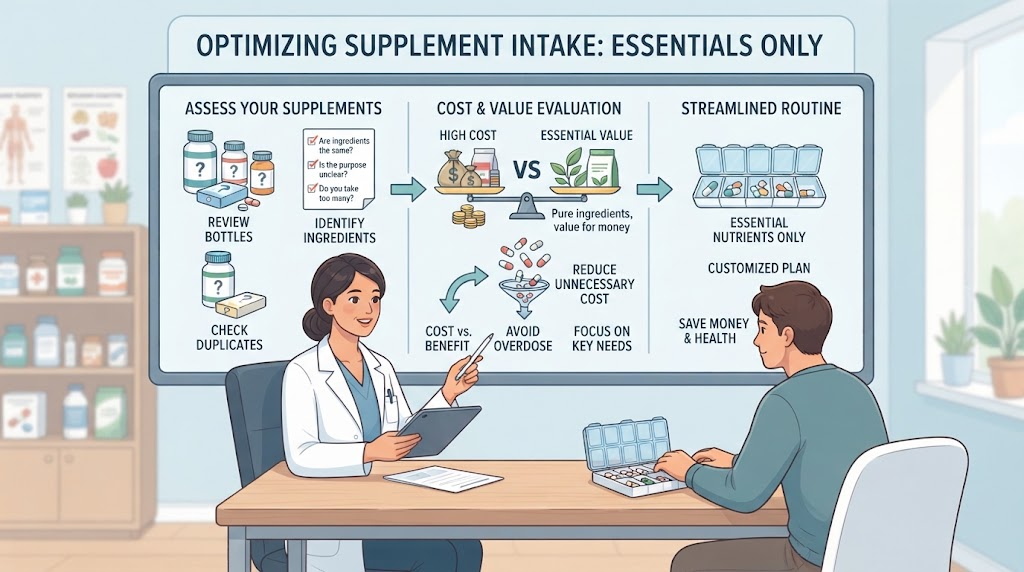
Reality Check : The Supplements I Take, Am I Perhaps Throwing Away Money?
Supplement bottles neatly displayed on top of the vanity or one side of the dining table. They look reassuring just by looking at them, but we need to check whether we are consuming excessively compared to our current dietary habits and routines. Just blindly taking them does not mean the body absorbs everything.
Let’s point out 3 representative realities that make us mindlessly throw away money.
- The Trap of ‘Ingredient Overlap’ That Accumulates Without Knowing
There are truly many cases where people take a multivitamin every day, buy a Vitamin B group supplement separately because they feel tired, and take a high-dose Vitamin C product again for immunity.
When this happens, certain ingredients far exceed the recommended daily intake. Because our body absorbs only as much as it needs and excretes the rest out of the body, it ultimately results in flushing expensive ingredients straight down the drain.
- Expensive Doesn’t Always Mean Better? ‘Excess Excretion and Burden on the Liver’
There are people who insist only on high-priced products thinking, “The more expensive the supplement, the higher the absorption rate.” However, if fat-soluble vitamins or certain minerals accumulate excessively in the body, they can rather become toxic or put an unnecessary burden on the liver.
Trying to forcibly put in amounts exceeding your body’s metabolic capacity is just a shortcut to exhausting your body and lightening your wallet.
- ‘Substance’ Masked by Fancy Packaging and Marketing
The supplement market overflows with numerous subsidiary ingredients and savory marketing phrases. When you put items in your shopping cart guided by copies saying “It is good for somewhere,” you end up repeatedly buying products with similar functions while missing the core ingredients your body truly needs.
💡 Wait a moment, check your supplement drawer!
Are there 2 or more products with overlapping identical ingredients?
Are there any supplements where the reason you are taking them for what effect is unclear over the past month?
If you chase other people’s recommendations without understanding your body’s condition and true needs, it easily becomes ‘supplement waste’ rather than ‘supplement tech’. Then, how on earth should we cut back? We will refreshingly unpack the answer in the next chapter!

Core Solution : Sorting Out Essential Supplements ‘Truly’ Needed for My Body
This is the text draft for the third section of the Naver blog post [Core Solution : Sorting Out Essential Supplements ‘Truly’ Needed for My Body]. Clear criteria were presented so that readers can objectively sort out the ingredients they truly need.
We previously pointed out our intake habits that were unnecessarily wasting money, right? Then now it is time to open the drawer and enter a massive cleanup.
We organize 3 criteria for leaving only the essential ingredients ‘truly’ needed for my body among countless supplements.
- Criteria 1 : Finding the Most Deficient Nutrients in My Dietary Habits and Lifestyle
Supplements are merely ‘supplements’, and the basis is meals. First look back at your usual eating habits.
If you don’t eat fish and seaweed well?
→ Omega-3
If your indoor life is long and you rarely see sunlight?
→ Vitamin D
If you suffer from chronic fatigue and recovery is slow?
→ Vitamin B group
Instead of trying to take everything, catching just 1 or 2 ‘deficiency nutrients’ that are hard to fill from your diet as the main target is the first step.
- Criteria 2 : Boldly Reducing Overlapping Ingredients and Integrating into ‘Complex’
The very first thing to do is to compare the ingredient labels.
If you have a multivitamin or multi-mineral product as a base, there is a high probability that most vitamins and minerals are already contained within it.
Example: If you are taking a multivitamin while separately taking single Vitamin C or zinc?
→ Boldly stop the single product and fulfill the recommended daily intake with just one multi product.
Simply organizing products with overlapping ingredients can drastically drop the fixed expenditures going out every month.
- Criteria 3 : Constructing a ‘Minimal Stack’ Tailored to My Body’s Purpose
Discard greed and reduce the combination to just two according to the purpose most urgent for your body right now.
[Office Worker / Student Fatigue Recovery Combination]
Base: Multivitamin & Minerals (Basal metabolism and nutritional balance)
Plus: Vitamin B group (Energy production and fatigue improvement)
[Immunity & Gut Health Centric Combination]
Base: Probiotics (Intestinal environment improvement and immunity foundation)
Plus: Vitamin D (Immune cell activation and bone health)
💡 Core Summary
Increasing the number of supplements is not the way to increase health. The mindset of “leaving only what is strictly necessary and emptying the rest” is soon a shortcut to protecting your wallet and making your body comfortable.
Now, having filtered out the unnecessary ingredients, in the next chapter we will unpack cost reduction know-how on how to buy more thriftily and how to catch the intake timing!
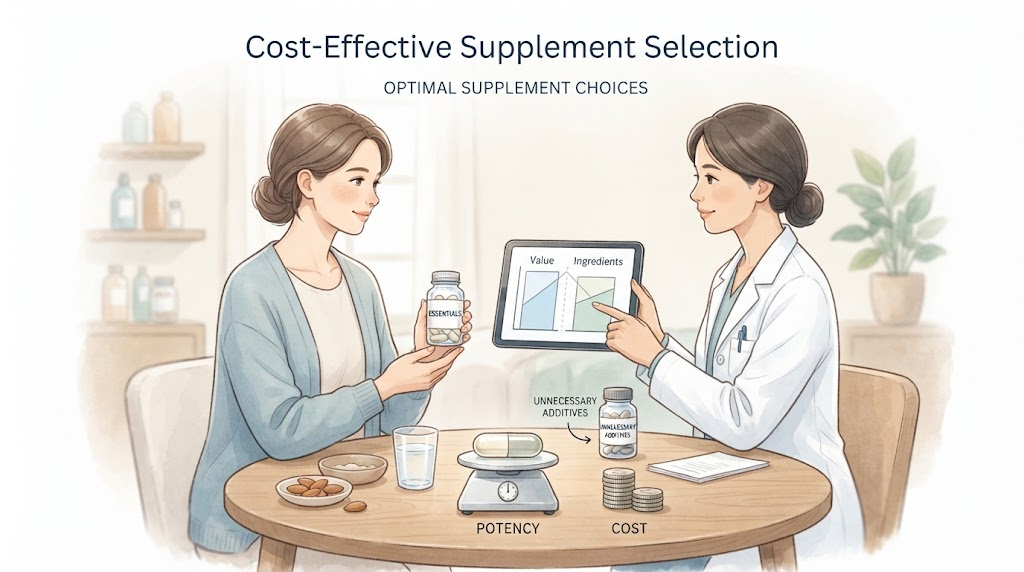
Cost Reduction Know-How : Tips to Make Your Wallet Light and Keep Your Health Robust
This is the text draft for the fourth section of the Naver blog post [Cost Reduction Know-How : Tips to Make Your Wallet Light and Keep Your Health Robust]. We have organized practical know-how to substantially reduce expenditures while increasing absorption rates.
If you have left only the essential ingredients, now it is time to take practical know-how that can drastically reduce spending depending on ‘how you buy and how you eat’. Let me tell you 3 tips to catch both cost-effectiveness and emotional satisfaction through smart consumption!
- Meticulously Checking ‘Cost-Effectiveness (Price per Active Ingredient)’ Relative to Content
Not being fooled unconditionally by expensive brands or pretty packages is the first step.
Check the ‘Nutrition & Functional Information’ on the back of the supplement.
If you divide the total price by the content per pill or the pure active ingredient (mg), you can clearly see how much you are paying per ingredient actually entering your body.
Since there are many cases where renowned overseas direct purchase products or popular domestic cost-effective products have excellent ingredient content, trust the ingredient label rather than the brand name.
- Avoiding Combinations That Hinder Absorption and Optimizing ‘Intake Timing’
If you buy expensive supplements and take them at the wrong time, reducing the absorption rate, it literally turns into throwing away money. Even by slightly changing the timing according to the characteristics of each ingredient, you can maximize the effect.
Fat-soluble vitamins (Vitamin D, Omega-3, etc.): Absorption rate increases when taken right after or during a meal containing oily components.
Water-soluble vitamins (Vitamin B, C, etc.): It is good to consume sufficiently with water on an empty stomach or after breakfast.
Iron and calcium: Because they hinder each other’s absorption, you should consume them leaving time intervals rather than taking them together.
- No Need to Take Them Every Day Unconditionally! Adjusting ‘Intake Cycle’
You do not need to buy all supplements fixedly 365 days a year.
For example, during the summer season when there are many outdoor activities and you soak up enough sunlight, you can temporarily rest Vitamin D intake or adjust the cycle.
Flexibly adjusting the intake cycle according to your body’s condition and lifestyle, such as consuming intensively only during season-changing periods when fatigue rushes in or busy project periods, is also a great cost reduction strategy.
💡 Money-Saving Consumption Habit Checklist
Did you check the ‘Raw Materials and Content’ on the back first rather than fame or advertisements?
Are you taking them matching the time slot where absorption into your body is good?
Now, we have even learned how to reduce spending by filtering out unnecessary ingredients and selectively containing only the ingredients truly needed by our body. Finally, shall we neatly summarize today’s content?

Conclusion (Outro) : Protecting Both Health and Wallet with a Smart Supplement Diet
This is the text draft for the fifth and final section of the Naver blog post [Conclusion (Outro) : Protecting Both Health and Wallet with a Smart Supplement Diet]. It was written to neatly summarize the entire post and induce reader participation.
Think of the supplement costs going out of your bank account every month, and the pills piled up full in the drawer.
Starting today, it is time for us to start a ‘diet’ on that heavy supplement drawer.
If taking supplements, which we started with the mindset of taking care of our health, has rather exhausted our bodies and wallets with overlapping ingredients and unnecessary spending, now it is time to boldly reset.
Shall we summarize the core content we shared together once again?
First, inspect your diet and lifestyle and leave only 1 or 2 truly scarce ‘deficiency nutrients’
Second, boldly cut down single products with overlapping ingredients and integrate them into one complex product
Third, check ‘cost-effectiveness relative to content’ rather than brand names, and observe the intake timing that increases absorption rates
Supplements are merely reliable supporting agents that assist your dietary habits, and increasing the number does not mean health unconditionally improves.
“Rather than eating a lot, being properly absorbed is true health.”
How about taking a little time this evening to open your room’s supplement drawer and start a light spring cleaning? Emptying unnecessary ingredients and filling only essential nutrition, we cheer for you to recover both a light wallet and robust vitality!
💬 Today’s Communication Question
What was the supplement in your drawer that made you think, “I really don’t need to eat this?”
If you have your own supplement diet tips or questions, please feel free to leave them in the comments below!
*If this was helpful, please **[Add Neighbor]** and **[Press Sympathy]**. We will come back with more substantial and practical health information next time!
Korean version: 한국어로 읽기