Introduction: Why the ‘Property Requirement’ is the Trickiest Hurdle for Earned Income Tax Credit Applications
Every year when the regular application period for the Earned Income Tax Credit rolls around, countless single-person, dual-income, and single-income households knock on Hometax’s door with high expectations. “Our household income falls comfortably within the criteria, so of course we’ll get it, right?”
However, on the day results are announced, it is very common to find people around us scratching their heads after receiving a bitter rejection notice. “Wait, why was I rejected when I make so little money?” Looking into the reason out of curiosity, nine times out of ten the culprit is hitting the “exceeding total property limit” threshold.
Although the Earned Income Tax Credit system is designed to support the real income of low-income households, it strictly evaluates not only the “current income being earned” but also the “total property scale” possessed by the household. In particular, the property requirement is considered the trickiest hurdle for applicants for the following reasons.
- Because not only the cash in your bank account, but also all “held assets” are added together.
Houses, land, and cars, as well as deposit money for jeonse (lump-sum housing deposits) or monthly rent, and financial assets such as savings, installment savings, and stocks—every form of property owned by the household is thoroughly placed on the chopping block. Even if you think, “I don’t have cash?”, jeonse deposits frequently exceed the limit and trip applicants up.
- The threshold is applied more strictly than expected.
The total property sum of all household members must be under 200 million won to receive the full payment, and the segment between 140 million won and under 200 million won has a massive 50% deducted from the payment. If the total sum exceeds 200 million won, you are completely excluded (disqualified) from receiving it. Considering the high jeonse prices and real estate market prices in Seoul and the metropolitan area, simply maintaining a normal living arrangement makes it easy to skim close to or exceed this threshold.
- The property value you think of and the criteria calculated by the National Tax Service may differ.
Due to differences between market prices and officially assessed land prices, and limitations in the scope of recognized debt (e.g., credit loans are not deducted from property), applicants who think “There’s no way it exceeds” are often surprised when they see the final property sum captured on the National Tax Service computer network.
As seen here, even if you perfectly satisfy the income requirements, a single property criterion can cause hundreds of thousands to millions of won in subsidies to vanish in an instant. Therefore, before formally submitting your application, thoroughly pre-checking whether your property sum exceeds the threshold criteria or not is the wisest method to prevent wasting time and avoid missing out on benefits.
From now on, let’s examine one by one the tips for accurately checking your property sum through Hometax and gauging whether you have exceeded the limits.

Criteria for Calculating the Earned Income Tax Credit Property Sum (What Should Be Included?)
Among the Naver blog posting table of contents you requested, for the sub-heading ‘Criteria for Calculating the Earned Income Tax Credit Property Sum (What Should Be Included?)’
We have written the main body content corresponding to the sub-heading.
Samjumasam Q
Criteria for Calculating the Earned Income Tax Credit Property Sum (What Should Be Included?)
The ‘property requirement’ is cited as the number one reason for disqualification when applying for the Earned Income Tax Credit. Exactly what assets are included in the evaluation target?
The National Tax Service evaluates by summing all property owned by all household members based not on the application date, but on June 1st of the previous year (based on regular applications). At this time, since it does not simply look at the account balance in your name, but includes various assets spanning overall housing and living, you must accurately understand the calculation criteria for each item.
- Real estate (housing, land, buildings)
Admin Mentor LAB
Calculation criteria:
Evaluated based on the standard market value (officially assessed price, public notice price, etc.) under the Local Tax Act rather than market price.
Admin Mentor LAB
+ 1
Precautions:
Even if it appears to be set lower than the actual transaction price or market price, because it is aggregated based on the publicly assessed price, if you own housing such as an apartment or villa, this proportion is the largest.
Samjumasam Q
- Jeonse deposit (lease deposit)
Admin Mentor LAB
Calculation criteria:
The jeonse deposit on the lease agreement is included in the property.
However, in the case of residential jeonse deposits, according to the National Tax Service evaluation method, it is a rule to apply the lower amount between 55% of the housing standard market value and the actual lease deposit. (Commercial jeonse deposits are reflected as the actual jeonse deposit as is)
Admin Mentor LAB
+ 2
Precautions:
Even if you do not own a home, if the scale of the jeonse deposit is large, you can easily exceed the property criteria, so caution is required.
Samjumasam Q
- Passenger cars
Biznep
Calculation criteria:
For passenger cars, they are aggregated at the vehicle’s standard market value (vehicle reference value).
Admin Mentor LAB
+ 1
Precautions:
Business-use vehicles are excluded from property calculation, but regular private cars or passenger cars are added to the total property amount if residual value remains even if they are old. (Separate criteria may be applied to commercial vehicles such as trucks or freight cars.)
Samjumasam Q
- Financial assets (deposits/savings, stocks, bonds, insurance, etc.)
Admin Mentor LAB
Calculation criteria:
All cash deposited in banks, deposits and savings, stocks, bonds, and surrender values of savings-type insurance are aggregated.
Demand deposits (ordinary deposits that allow free deposits and withdrawals at any time) are calculated as the daily average balance over a specific period (usually March 2nd to June 1st).
Admin Mentor LAB
+ 2
Precautions:
Even if you think, “It’s just money temporarily put into a stock account?” or “It’s a savings account that hasn’t reached maturity yet?”, everything is aggregated through financial inquiries, so you must check without omissions.
Samjumasam Q
- Other property (right-based assets)
Various membership rights such as golf memberships and condo memberships, as well as rights to acquire real estate (such as pre-sale rights), are also included in the total property sum.
Biznep
⚠️ The most important trap: “Debt (loans) is not deducted!”
Samjumasam Q
The issue that applicants misunderstand and feel most unfairly treated about is the handling of ‘debt’.
“I have 100 million won in mortgage loans, jeonse loans, or overdraft account debt?”
Unfortunately, in the Earned Income Tax Credit property evaluation, debts such as bank loans or private loans are not deducted from the property at all.
Mbeup’s Education Story – Tistory
For example, if you have a 300 million won apartment with a 150 million won mortgage loan attached, your net asset (actual personal money) is 150 million won, but in the National Tax Service property evaluation, it is not calculated as the remainder after subtracting the loan, but is captured as the total asset value of 300 million won as is. Because of this, unfortunate situations frequently occur where working-class households burdened with debt are disqualified due to exceeding the property criteria.
Therefore, you must carefully examine whether you fall below 240 million won (under 170 million won for full payment criteria) based on the ‘total asset value’ before excluding various loans, rather than the net assets you possess.
Mbeup’s Education Story – Tistory
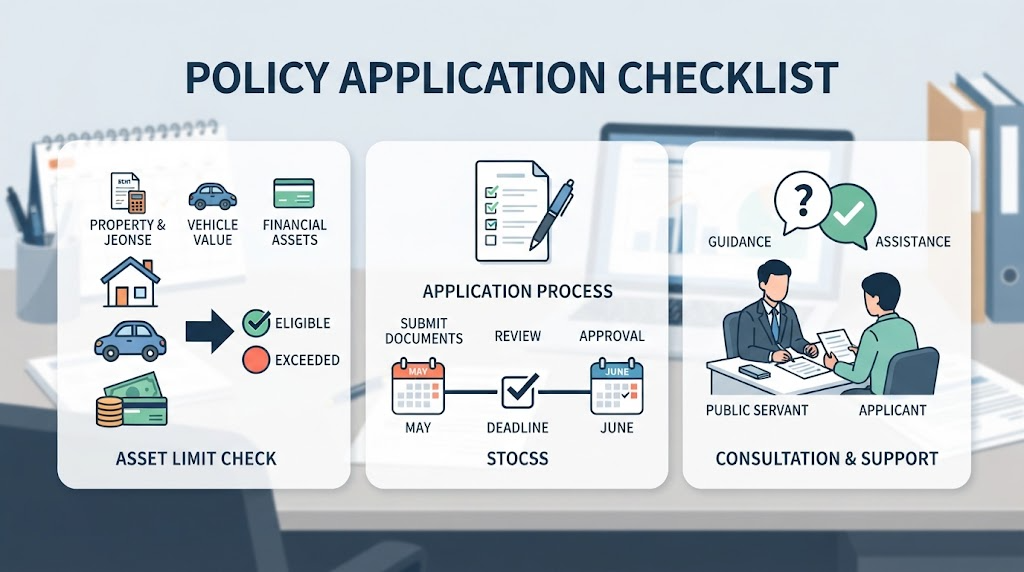
Complete Breakdown of Total Property Sum Thresholds (Latest 2026 Criteria)
As examined earlier, when all properties such as real estate, vehicles, jeonse deposits, and financial assets are summed together, what determines passing or failing is how much the ‘total property value without deducting debt’—rather than the net assets remaining in your bank account—is tallied.
The Earned Income Tax Credit property sum threshold applied as of 2026 is divided precisely into three brackets depending on the scale of the household members’ total property. You should pay close attention to which bracket your household belongs to.
- Total property sum under 170 million won: Full payment target 🎉
LawTalk News
Criteria details:
If the summed property of all household members is under 170 million won, you pass the property requirements perfectly.
Samjumasam Q
Application result: If you meet only the income requirements and other review criteria, you can receive the maximum payment amount (100% of the calculated amount) for your household type in full.
- Total property sum of 170 million won or more to under 240 million won: 50% reduced payment ⚠️
Samjumasam Q
Criteria details:
This is the case where the total property value exceeds 170 million won and falls within the bracket under 240 million won.
Samjumasam Q
Application result:
You avoid disqualification, but an unfortunate penalty is applied. According to the National Tax Service calculation criteria, only exactly 50% (half) of the Earned Income Tax Credit amount you would have originally received is cut and paid. If the calculated subsidy is 2 million won, only 1 million won will enter your bank account if you fall into this bracket.
LawTalk News
- Total property sum of 240 million won or more: Excluded from payment (complete disqualification) ❌
Criteria details:
This is the case where the total property sum of all household members is 240 million won or more.
Samjumasam Q
+ 1
Application result: No matter how low your income is and how difficult your livelihood is, you are completely excluded from the payment targets.
Unfortunately, the moment you exceed the 240 million won line by even 1 won, you will receive an immediate notice of disqualification without any means of objection or relief, so this is the baseline check that you must check most carefully before applying.
LawTalk News
💡 Differences from Past Criteria and Checkpoints
In the past, the property threshold was somewhat strict at under 200 million won (50% reduction for the bracket of 140 million won or more), but reflecting inflation and real estate market price changes, the criteria have now been raised upward to under 240 million won (50% reduction for 170 million won or more).
LawTalk News
Even so, considering the jeonse deposit price levels in the metropolitan area and large regional cities, there are still many households that narrowly cross the 170 million won or 240 million won boundary.
Therefore, do not be complacent thinking “There’s no way my assets would reach 2.4 million won?”, and we strongly recommend that you check in advance exactly how much property in your name is captured on the National Tax Service computer system through the pre-inquiry tips via Hometax/Sontax introduced in the next step.

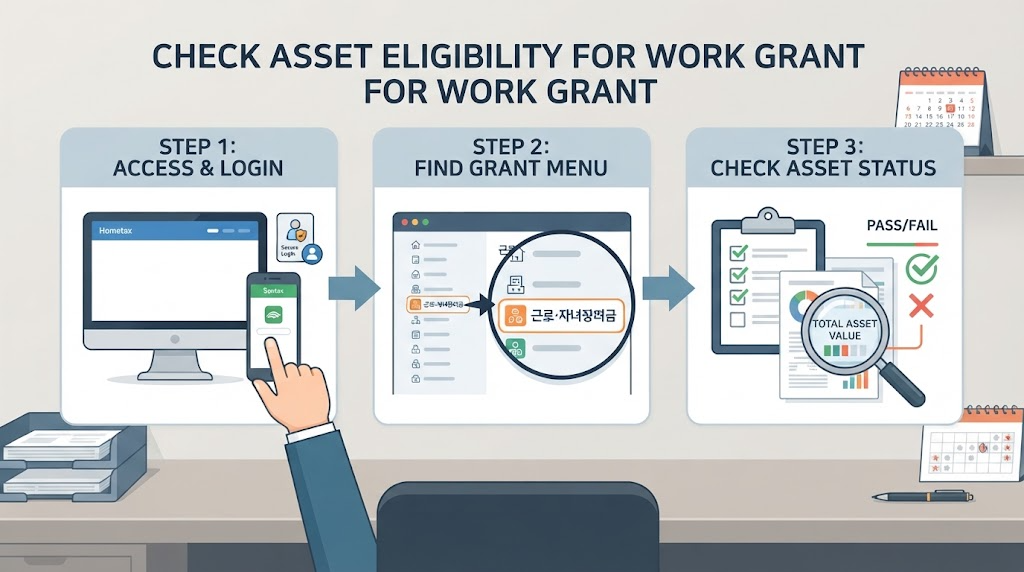
3-Step Tips for Easily Checking Your Property on Hometax (Sontax)
“I know roughly how much my property is, but exactly how much is registered on the National Tax Service computer system?”
Many people calculate it in their heads only to face unexpected distress when they open the application and find unexpected items included. To prevent unnecessary disqualification, we have summarized the most reliable 3-step tips to check your total property sum in advance through National Tax Service Hometax (PC) or Sontax (mobile app) before applying.
[Step 1] Access and Log in to Hometax or Sontax
- Run the ‘Sontax’ app on your smartphone, or access the ‘National Tax Service Hometax’ website on your PC.
- Log in through identity verification (simple authentication, financial certificate, etc.). To ensure accurate inquiries for the subsidy pre-inquiry and application menu, you must log in under your own name.
[Step 2] Enter the ‘Earned / Child Tax Credit’ Menu
- Hometax (PC criteria): Click [Apply/Submit] ➡️ [Earned/Child Tax Credit] in that order from the top menu.
- Sontax (mobile criteria): Touch the [Subsidy/Year-end Tax Settlement/Electricity Bill] menu on the main screen or enter the [Regular Earned/Child Tax Credit Application] corner from the full menu.
- Select the pre-guidance corner related to [Apply for Regular Application] or [Check/Inquire Property Requirements] on the guided application and inquiry screen.
[Step 3] Compare Household Member Property Details and Total Sum
- When you move to the application writing stage or pre-guidance data inquiry page, a ‘Household Member Property Statement’ prepared in advance by the National Tax Service computer network linking data from the Ministry of Land, Infrastructure and Transport, Insurance Association, Korea Federation of Banks, etc., will appear summarized.
- Core points to check:
Real estate (housing/land): Check whether the registered publicly assessed price matches reality.
Vehicles: Check whether the standard market value of vehicles owned by you and your household members is accurately reflected.
Financial assets and others: Briefly scan whether deposits/savings and jeonse deposit details are properly captured.
- Carefully compare where the final property sum appearing on this screen falls among the thresholds examined earlier (under 170 million won / 170 million won to under 240 million won / 240 million won or more).
💡 Cautionary Tips When Inquiring via Hometax
National Tax Service pre-inquiry details may have minor differences from reality depending on the data linkage timing of each institution.
In particular, if you recently moved and your jeonse deposit changed, or if you sold or scrapped your vehicle not long ago, a time lag may occur in computer reflection. Therefore, comparing the inquiry result with your actual contract and documents to prepare thoroughly is safe.
Actions and Objection Methods When Receiving a Property Threshold Exceedance Judgment
“Wait, when I clearly calculated it myself, it was well within the threshold, so why did I receive a rejection notice for ‘exceeding the total property sum’?”
If you were unfairly disqualified after receiving the Earned Income Tax Credit screening result notification, it is natural to feel upset. However, the National Tax Service’s computer network inquiry results do not always reflect 100% real-time situations, and cases of unfair disqualification judgments due to administrative errors or misunderstandings of calculation criteria frequently occur.
If there is a clear reason or if you feel unfairly treated, do not just give up and instead proceed with the objection and explanation procedures. We have summarized realistic coping tips and appeal application methods when you receive a property threshold exceedance judgment.
- Analyze the cause of the ‘error’ between the disqualified notification computer details and actual property
Before preparing an objection, you must first accurately identify the cause of which item the National Tax Service over-counted your property in. The most common errors are as follows:
When already disposed property is reflected: Cases where you sold a car or disposed of real estate not long ago, so it is not yet reflected in the National Tax Service taxation information computer network
When jeonse deposits are duplicated or over-calculated: Cases where lease contracts overlapped during the moving process or deposits were entered higher than reality when calculating deposits
Misunderstandings about debt reflection: As mentioned earlier, loan amounts are not deducted in principle, but the household member scope was incorrectly designated, causing another person’s property or the balance of already terminated financial assets to be over-aggregated.
- Prepare objective supporting documents
To raise an objection with the National Tax Service, you must not merely argue “No, it’s not,” but must perfectly equip objective documents to prove it, which raises the probability of success.
Real estate and vehicle related: Real estate registration certificate (including deleted items), vehicle sales contract, scrap metal 인수증명서 (certificate of acquisition/scrapping), etc.
Jeonse deposit related: Actual lease contract with a confirmed date (fixed date stamp), jeonse deposit transfer receipt/history
Financial asset related: Balance certificate for the relevant period, termination confirmation letter for already terminated accounts, etc.
- Proceed with the appeal (objection) application procedure after notification of screening results
When you are dissatisfied with the subsidy screening results, you must raise an objection within the prescribed deadline.
Application deadline: You must proceed with an appeal claim to the competent tax office within 30 days from the day you received the screening result notification (or the day you checked the results). If you miss the period, it is difficult to receive relief, so you must move quickly.
Reception method:
Use the objection corner within the [Subsidy / Year-end Tax Settlement / Electricity Bill] menu of Hometax/Sontax
Or visit the competent tax office (Income Tax Division or Subsidy Department) in person to submit the objection application and prepared supporting documents
💡 Conclusion: If you feel unfairly treated, knock on the tax office door with your supporting documents
Because National Tax Service screening is basically conducted based on nationwide large-scale computer data, it has limitations in not being able to immediately reflect a household’s minute circumstances or recent change details.
If you crunched the numbers and clearly fell under 240 million won (or under 170 million won) yet unfairly received a rejection text message, please do not panic, re-verify the computer details according to the above content, then inquire with the tax office person in charge or retrieve your precious subsidy through an objection!

Conclusion: Be Sure to Check Your Property Details Before Applying!
So far, we have looked closely at the ‘total property sum criteria’, which is the main reason why countless applicants are disqualified the most during regular Earned Income Tax Credit applications.
No matter how comfortably your income conditions are met, you must keep in mind that the moment the total property value—summing up houses, cars, jeonse deposits, deposits/savings, etc.—exceeds the threshold by even 1 won, you will receive a painful rejection notice. In particular, many people experience unexpected distress due to the trap that loan amounts are not deducted from personal property.
Under 170 million won: Full payment
170 million won or more to under 240 million won: 50% reduced payment
240 million won or more: Excluded from payment (complete disqualification)
Checking in advance on Hometax and Sontax before formally submitting your application to see where your household is positioned within this threshold and whether there is any property excessively captured on the computer system is the surest shortcut to protecting your precious subsidy.
There is nothing more dismayed than roughly submitting an application out of busyness or with the mindset that “it will surely come out,” only to receive a rejection notice after waiting a few months. Utilizing the inquiry tips provided today to thoroughly check your property details in advance, we sincerely cheer for you to receive all the Earned Income Tax Credit benefits proudly without omissions!
Korean version: 한국어로 읽기