
Why Should You Compare Youth Housing Support Projects by Local Government? 🏡
Soaring jeonse and monthly rent prices, alongside growing housing costs day by day, are one of the biggest economic barriers for early-career workers and youths. A few hundred thousand won in monthly rent deals a massive blow to an early-career worker’s thin wallet, making it burdensome even to properly prepare for independence.
To resolve these housing grievances of youths, not only the central government but also various local governments across the country are actively deploying unique and unconventional housing cost support projects.
Then why should you carefully compare and choose among the numerous youth support policies, specifically the ‘housing cost support projects by local government’? We will point out 3 decisive reasons.
- Because subsidies and benefits vary drastically depending on your region of residence 📍
Differences in regional budgets and policies: South Korea’s local governments, such as Seoul, Gyeonggi Province, and Busan, differ in the scale of budgets injected into youth welfare and the directions they emphasize. For instance, while some places directly shoot out cash-like monthly rent subsidies every month, others focus on supporting deposit loan interest or moving expenses.
Exploring the most advantageous benefits for me: You must accurately understand and compare the policies of the local government where you currently reside or plan to move into so that you do not miss out on much larger and more practical benefits under the same conditions.
- Because the criteria for income and qualification requirements differ subtly by local government 🔍
Application of flexible criteria: Unlike the uniform criteria of the central government, each local government reflects the average income level or housing reality of youths within its region, setting median income criteria (e.g., 120% or less, 150% or less, etc.) or age limits (from age 19 to 34 or up to age 39) differently.
Wisdom to lower the elimination rate: Even if you narrowly missed the central government criteria, looking into the detailed criteria by local government often reveals customized projects that perfectly match you more than you might think.
- Because it maximizes overlapping benefit availability and support limits 💡
Finding a prime combination: Since housing-related subsidies often restrict overlapping benefits, wisely choosing the ‘main support project’ that helps your situation the most among multiple local government projects is the core.
Minimizing opportunity costs: It prevents the financial opportunity cost of blindly applying without careful comparison and missing out on more advantageous support systems, serving as a shortcut to practically cutting your housing cost burden in half.
🏡 To summarize: Housing cost support is a representative youth welfare where you “get back as much as you know, and save as much as you compare.”
Then what specific types of representative housing support projects exist by major local government such as Seoul, Gyeonggi, and Incheon, and what benefits can you enjoy near your home? We will compare them in detail in the next chapter!
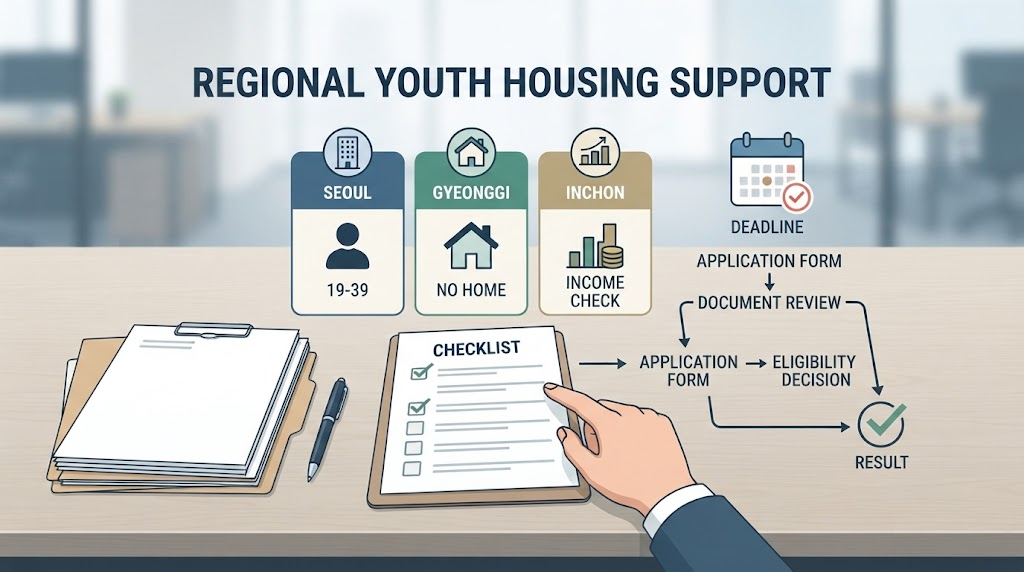
Comparison of Representative Housing Support Projects by Major Local Governments such as Seoul, Gyeonggi, and Incheon 📊
What are the representative housing cost support projects by local government where youths residing or working in the metropolitan area (Seoul, Gyeonggi, Incheon) can receive benefits most intensively? Each local government deploys specialized support measures tailored to the housing conditions and price levels of local youths.
We will clearly compare the representative housing support projects of the 3 major local governments by item.
- Seoul Metropolitan Government: ‘Seoul Youth Monthly Rent Support’ 🏢
- Target for Support: Homeless youth single-person households aged 19 to 39 with resident registration in Seoul
- Income Criteria: 150% or less of the standard median income per household (requires meeting certain income and property criteria)
- Support Content and Limit: Supports monthly rent up to a maximum of 200,000 KRW per month for up to 12 months (once in a lifetime) (if monthly rent is less than 200,000 KRW, supports the actual difference)
- Features: This is a representative popular project that directly pays cash-like monthly rent subsidies every month to directly alleviate the high housing cost burden in the Seoul area.
- Gyeonggi Province: ‘Gyeonggi Youth Monthly Rent Support’ and Housing Welfare 🌾
- Target for Support: Homeless youth aged 19 to 39 with an address in Gyeonggi Province (those who meet housing and income criteria)
- Income Criteria: 120% or less of the standard median income (detailed criteria may vary by local government project)
- Support Content and Limit: Supports up to 200,000 KRW per month within a maximum limit of 2,400,000 KRW per year (supports up to 12 months)
- Features: Considering regional characteristics relatively broader compared to Seoul, it complexly operates and links various housing lease deposit interest support projects for youth housing stability alongside monthly rent support.
- Incheon Metropolitan City: Customized Housing Policies such as ‘Incheon Youth Monthly Rent Support’ ⚓
- Target for Support: Homeless youth single-person households aged 19 to 39 residing with resident registration in Incheon Metropolitan City
- Income Criteria: 150% or less of the standard median income (based on youth independent household)
- Support Content and Limit: Supports up to 200,000 KRW per month (provides support benefits for up to 12 months)
- Features: Targeting the youth class with a high proportion of leased households within the Incheon area, it provides dense supplementary benefits to youths placed in the blind spots of central government support projects (Temporary Special Youth Monthly Rent Support).
💡 Summary Table of Support Projects by Local Government
| Classification | Seoul Metropolitan Government | Gyeonggi Province | Incheon Metropolitan City |
|---|---|---|---|
| Age Criteria | Ages 19 to 39 | Ages 19 to 39 | Ages 19 to 39 |
| Income Requirements | 150% or less of median income | 120% or less of median income | 150% or less of median income |
| Support Amount | Up to 200,000 KRW per month (up to 12 months) | Up to 200,000 KRW per month (up to 12 months) | Up to 200,000 KRW per month (up to 12 months) |
| Core Points | Direct reduction of housing costs for youths residing in Seoul | Customized housing stability for metropolitan province-level units | Relief of blind spots and close support |
Even if it looks like a similar amount of support (up to 200,000 KRW per month) like this, depending on where you reside on your resident registration and which income bracket (median income 120% vs 150%) you fall under, the projects you can apply for and your selection probability will vary.
Then what are the specific support amounts, selection criteria by region of residence, and traps of income requirements to avoid? We will examine them in detail in the next chapter!

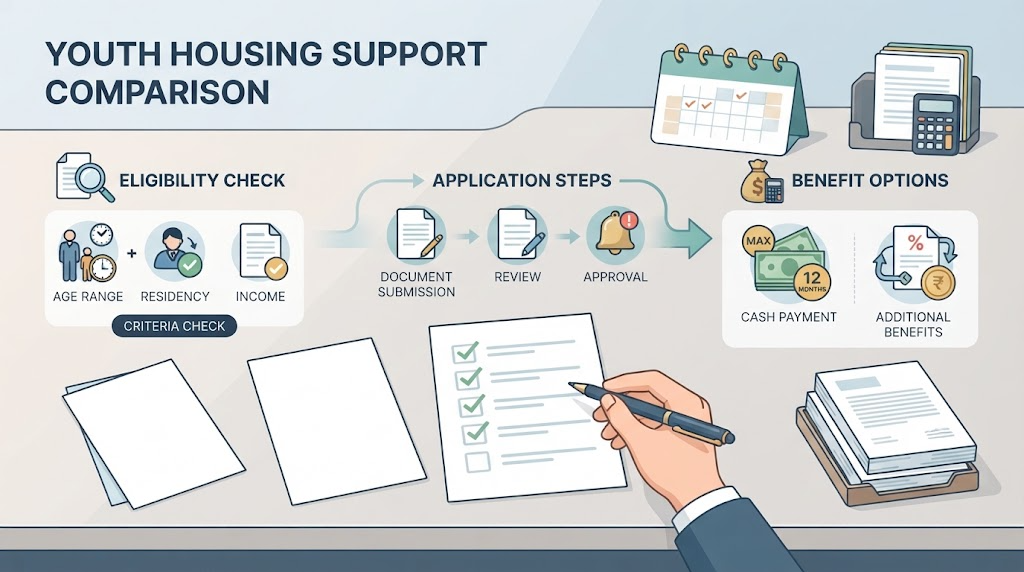
Differences in Support Amounts, Selection Criteria, and Income Requirements by Region of Residence 💰
Although youth housing support projects all look similar at first glance, they show distinct differences in support amounts, selection criteria (age and residence requirements), and income requirements (median income and property criteria) depending on the financial self-reliance and regional characteristics of each local government.
You must accurately grasp the detailed criteria of the region you intend to apply to in order to reduce the probability of disqualification and fully secure your benefits. We will compare the differences by major item one by one.
- Differences in Support Amounts and Payment Methods 💸
Fixed cash payment type (Seoul, Incheon, etc.): In the case of monthly rent support, the majority of major metropolitan local governments adopt a method of paying a fixed amount of up to 200,000 KRW per month, choosing the lesser amount compared to the actual monthly rent paid (or supporting actual expenses within a 200,000 KRW cap). The maximum support period is typically 12 months (1 year).
Additional benefit-linked type (Gyeonggi Province, etc.): In addition to basic monthly rent subsidies, tangible benefits are often diversified utilizing the local government’s own financial resources, such as youth basic income or local currency linkage, or lease deposit loan interest support (covering a certain interest rate of the deposit).
- Subtle Differences in Selection Criteria (Age and Residency Requirements) 👤
Range of age limits: Most commonly adopt ages 19 or older to 39 or younger, but depending on some local government ordinances or youth basic ordinances, there are places that only recognize up to age 34 or conversely flexibly accept youths exceeding age 39 (e.g., adding military service periods, etc.).
Resident registration and homelessness requirements: The applicant must actually be registered for resident registration in that local government, and the condition that all household members must be homeless is common, but the allowable scope for ‘only the applicant themselves being a single-person homeless household’ varies slightly according to detailed guidelines by local government.
- Differences in Thresholds for Income and Property Requirements 📊
Income criteria (Standard median income):
Seoul and Incheon reflect regional characteristics with a relatively heavy housing cost burden, embracing youths in a relatively wide income bracket of 150% or less of the household standard median income.
On the other hand, some province-level local governments or small cities set the income threshold somewhat strictly at 120% or less of the standard median income to concentrate on classes in more urgent need of self-reliance.
Property criteria (Housing and asset evaluation): Not only income is looked at, but the sum of property values such as land, buildings, and automobiles owned by the youth themselves (or household members) must not exceed a certain amount (e.g., 50 million KRW to 100 million KRW or less). Since whether vehicle value is included in this property calculation method differs by local government, you must check the announcement notice.
💰 Core Point: You must accurately contrast the income criteria (e.g., median income 120% vs 150%) and property criteria allowances of the region you live in to prevent unfair elimination due to “exceeding income”.
If you have completely understood the differences in support amounts and income requirements by region of residence, it is now time to look at tips for choosing the youth housing support project by local government that is most advantageous to you among numerous options. We will continue in the next chapter!

Tips for Choosing the Youth Housing Support Project Most Advantageous to Me and Closing Remarks 🌟
So far, we have carefully examined everything from the introduction purpose of youth housing support projects by local government, comparison of representative projects by major regions such as Seoul, Gyeonggi, and Incheon, to the differences in support amounts and income/property requirements.
Although you searched around for information because the monthly rent and housing costs going out every month were burdensome, standing in front of such diverse policies and complex conditions easily makes you fall into contemplation wondering, “Which one should I apply for first to get the most benefit?”
For a regret-free choice, we convey warm closing remarks along with 3 core tips for choosing the youth housing support project by local government that is most advantageous to you!
- Prioritize Based on Residence (Address on Resident Registration) 📍
Tip: The major premise of local government support projects is the ‘residence where resident registration is currently registered’. If you are about to move, you should compare the benefits of the region where you will submit the transfer notification in advance.
How to practice: List up without omission whether there are small-scale housing subsidies or moving expense support projects operated independently by basic local governments (district offices/city halls) where you reside, as well as metropolitan local governments such as Seoul, Gyeonggi, and Incheon.
- Check Whether Overlapping Benefits Between Central Government Projects and Local Government Projects are Possible 🔍
Tip: When central government support supervised by the Ministry of Land, Infrastructure and Transport, etc. (e.g., Temporary Special Youth Monthly Rent Support, etc.) and local government-owned support projects have similar characteristics, overlapping benefits are frequently restricted.
How to practice: Check whether you are already receiving central government support, and if you are not a target, it is much wiser to turn your eyes to local government-specialized projects (e.g., Seoul Youth Monthly Rent Support, etc.) where you can receive complementary benefits to fill the gaps.
- Secure Income/Property Criteria and Application Period (Announcement Date) 📅
Tip: No matter how unconventional the benefits are, it is useless if you miss the application period or narrowly exceed the income and property criteria.
How to practice: The timing when business announcements go up by local government every year (mainly 1-2 times a year in the first and second halves) differs. Bookmark the youth portals of local governments you are interested in (e.g., Seoul Youth Portal, Gyeonggi Civil Application 24, etc.), and as soon as the announcement notice comes up, contrast the income criteria (median income 120% vs 150%) and property criteria to perfectly prepare your documents.
🌟 Closing Remarks
To youths preparing for their future fiercely day by day amidst soaring prices and housing cost pressure, local government housing support projects are precious opportunities like rain in a drought.
Rather than giving up with the mindset of “Will I really get selected?”, we hope you take the comparative analysis and selection tips shared today as a compass to find the support project that best fits your conditions and proudly seize the benefits.
We sincerely cheer for your reliable housing independence and stable asset formation! If you have any further questions, please feel free to leave a comment or inquiry anytime. Have a happy and reliable day today as well!
Korean version: 한국어로 읽기