Introduction: The Importance of Youth Housing Support Amid Soaring Housing Costs
For young people, preparing and maintaining an independent living space is one of the greatest economic burdens during their entry into society. Amid endlessly soaring jeonse and monthly rent prices and a high-interest-rate trend, the lives of young people who must spend most of their fixed costs on housing expenses inevitably hit a limit. When housing stability collapses, it has a negative impact on studies, job-seeking activities, and overall working life, and in the long run, even future planning is shaken.
In this reality, the various “youth housing support” systems implemented by the government and local governments serve as the most powerful safety net that provides economic breathing room for young people and lays the stepping stone for self-reliance. From monthly rent support and deposit loans to the supply of public rental housing, the systems are diverse, but when trying to apply, quite a few people experience confusion because the support amounts and income standards vary wildly by region.
Then, what housing support benefit fits me best, and what limits and standard differences exist by region? In this post, based on the latest 2026 standards, we will carefully compare and analyze the youth housing support amounts and income standards by major region. Through a thorough preliminary understanding of information, we hope you wisely lighten your precious housing cost burden.

Comprehensive Summary of Youth Housing Support Income and Asset Standards Based on 2026
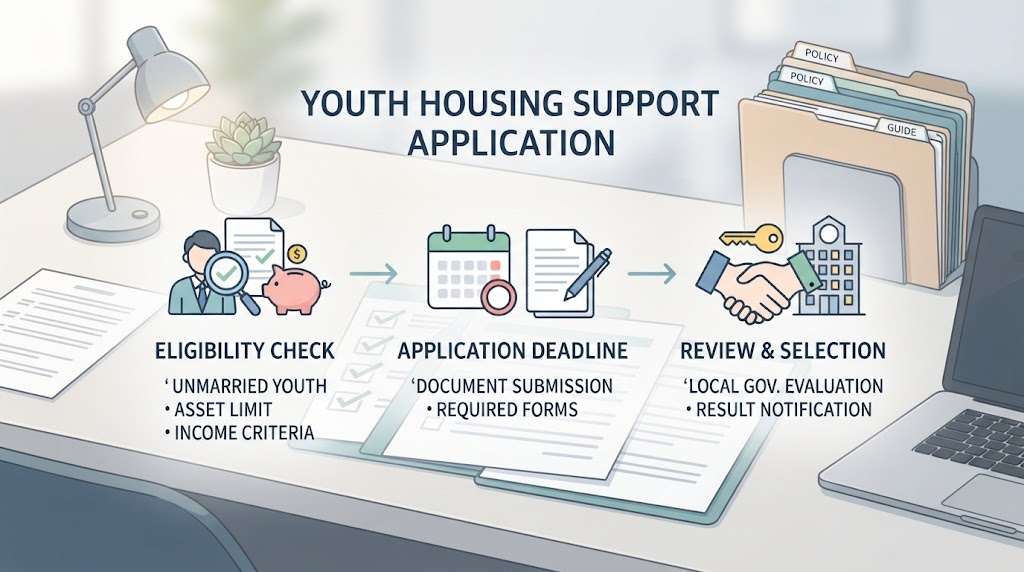
The very first hurdle you must pass when applying for youth housing support programs is the strict income and asset standards set by the government and local governments. No matter how attractive the subsidy amount is, exceeding the threshold even slightly results in an ineligible judgment, making an accurate understanding of your personal economic conditions the shortcut to approval. We have comprehensively summarized the key income and asset screening criteria based on the latest 2026 system.
- Standard Median Income Reflection and Income Calculation Standards
Most youth housing support projects (e.g., youth monthly rent support, etc.) select recipients by converting the standard median income announced by the Ministry of Health and Welfare into a percentage (e.g., 60% or less, 150% or less, etc.).
Pre-tax total income standard: Many young people think based on the actual take-home pay deposited into their bankbooks, but evaluations are based on the “pre-tax total salary” or “monthly remuneration” before taxes and 4-major public insurance premiums are deducted. You must be careful because if recent wage increases or bonuses are reflected, you may exceed the standard.
Youth individual vs. original household (household member) income aggregation: Standards diverge significantly depending on the nature of the project.
Youth independent household: This is the case where only the income of the youth themselves, who have completely achieved household separation such as being aged 19 or older to 39 or younger, is evaluated.
Original household aggregation: Since there are cases where the income and assets of parents are evaluated together—either because they reside together on the resident registration with parents or due to the nature of the housing support (e.g., housing support of certain local governments and specific types of Happy Housing)—you must carefully check the announcement notice.
- Housing-Free Requirements and Common Asset Screening Criteria
Even if you narrowly pass the income standards, cases of failing based on asset standards frequently occur. Since the original intent of housing support is “rescuing vulnerable housing classes and housing-free youth,” asset verification is very strict.
Mandatory housing-free requirement: The applicant themselves (including all household members in the case of original household aggregation) must be a housing-free person of the Republic of Korea. If you have a history of owning a house or hold equity-share housing, you are immediately processed as ineligible.
Total asset and financial asset standards: Total financial assets including savings/deposits, stocks, bonds, etc., plus non-financial assets such as real estate and automobiles, must be within the upper limit set by each local government (e.g., total assets under the 200 million won range, etc.).
Vehicle value restriction: If you own a vehicle under your name, you will be excluded from support targets if the standard market value of the vehicle exceeds a certain amount (usually under 30 million won, etc.). Since even business vehicles or livelihood vehicles are included in the vehicle value without exception, a preliminary inquiry is essential.
Comparison of Major Youth Housing Support Systems and Support Amounts by Region
Youth housing support systems vary widely, ranging from universal projects led by the central government to customized projects independently operated by each local government according to regional conditions. In particular, since the monthly rent support limit or the scale of deposit benefits varies wildly depending on the region you live in, it is advantageous to accurately compare the support policies of the local government where you reside or plan to move. We have organized the characteristics and support amounts of youth housing support systems by major region.
- Seoul Metropolitan Government: Youth Monthly Rent Support and Housing Welfare
Seoul, which bears the heaviest housing cost burden, operates unconventional support systems for the housing stability of young people.
Seoul Youth Monthly Rent Support: It targets housing-free youth (aged 19–39) who meet a certain percentage of the standard median income (e.g., 150% or less, etc.), and supports a maximum amount per month (e.g., around 200,000 won per month, for up to 12 months, etc.). Standards combining lease deposits and monthly rent conversion amounts (e.g., housing with a deposit of 50 million won or less and monthly rent of 600,000 won or less) are applied.
Station Area Youth Housing (Youth Safe Housing): It utilizes private rental housing to supply young people and newlyweds with lower rents than surrounding market prices, and enjoys high popularity among housing-free youth in the form of special supply.
- Gyeonggi Province and Capital Area: Gyeonggi Youth Happy Housing and Regional Housing Cost Support
Projects that simultaneously promote transportation and housing stability by reflecting broader regional characteristics compared to Seoul are predominant.
Gyeonggi Youth Basic Income and Housing-Related Linked Projects: Youth housing cost support projects are variously subdivided by cities and counties within Gyeonggi Province. For example, each basic local government such as Suwon, Seongnam, and Goyang runs its own youth monthly rent support or jeonse/monthly rent deposit interest support projects in parallel.
Capital Area Public Rental and Happy Housing: Supplied at levels of 60% to 80% of surrounding market prices targeting college students, youth, and early-career workers, guaranteeing stable residence for the maximum residence period (usually 6 to 10 years).
- Regional Metropolitan Cities and Other Local Governments: Region-Customized Housing Support Limits
Local metropolitan cities and provincial-level local governments sometimes set unconventional housing support limits to attract and settle young people.
Metropolitan youth monthly rent and housing support in Busan, Daegu, Gwangju, etc.: Payments are made by linking with the central government’s temporary youth monthly rent special support project or by injecting self-governing budgets. If you meet the residency requirements (mandatory move-in registration in the relevant local government) and income standards, you can receive steady cash-like support every month.
Youth housing allowances in small local cities and rural agricultural areas: To prevent the outflow of the youth population, they often provide higher discount rates or support limits than the capital area, such as housing purchase interest support and full coverage of jeonse/monthly rent deposit loan interest.
💡 Key Point: The surest method is to frequently check the subsidy amounts and selection criteria that are newly renewed every year through the official welfare portals of your resident local government (e.g., Seoul Welfare Portal, Gyeonggi Minwon24, Bokjiro, etc.).

Application Methods and Essential Preparation Documents Checklist
No matter how perfectly you meet the standards for youth housing support systems, if you miss the application period or omit essential documents, you will instantly be processed as ineligible or eliminated. We will carefully walk you through online application methods that can be easily submitted via smartphone or PC and the essential preparation document checklist that you must never miss.
- Easy Application Methods Utilizing Mobile and PC
Most central government and local government youth housing support projects can be conveniently applied for non-face-to-face online without offline visits.
Utilizing the Bokjiro Portal: For central government-led projects (e.g., temporary youth monthly rent special support, etc.), you can easily apply by logging into the official Bokjiro website or mobile app using a joint certificate (or financial certificate).
Local government-specific dedicated welfare platforms: For local government self-projects such as Seoul’s “Seoul Welfare Portal,” Gyeonggi Minwon24, and each city/district/county office website, you must use the dedicated reception system of that region. You can submit your application on a one-stop basis by accessing via mobile through the URL or QR code guided in the announcement notice.
Compliance with application timing and deadlines: Since projects often close early when budgets are exhausted or the application period is as short as within a few days, you must set pre-notifications as soon as the announcement is posted and complete submission within the deadline.
- Essential Preparation Documents Checklist
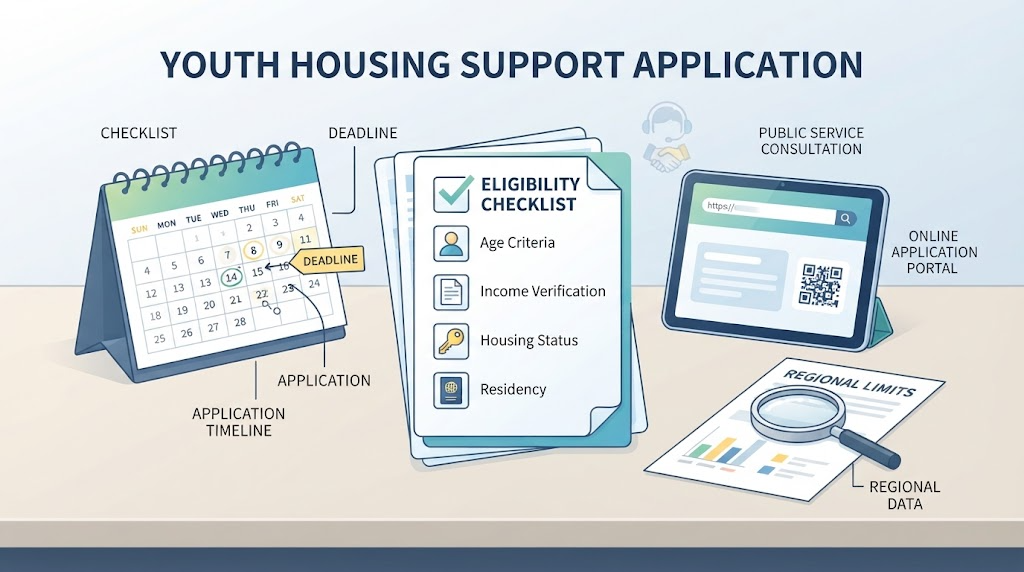
Supporting documents required for accurate evaluation may be excluded from the evaluation targets if they are omitted or exceed the validity period of the issuance date (usually issued within 1 month based on the application date). Utilize the following checklist to prepare them one by one without missing anything.
[ ] ID card and application form: ID card copy for identity verification and online writing format
[ ] Resident registration copy and abstract: For checking recent address change history and household member composition (verification based on resident registration residence)
[ ] Lease contract (jeonse/monthly rent contract): Copy of the housing lease contract concluded under your own name (check whether fixed date is included)
[ ] Intermediated object confirmation and explanation statement: Document for checking the actual area and building use of the leased housing
[ ] Income and asset verification documents: Income amount certificate, health insurance premium payment confirmation certificate (for calculating pre-tax income and monthly remuneration)
[ ] Local tax item-by-item taxation certificate: Essential document to check property and housing ownership status (housing-free verification)
[ ] Bankbook copy under your own name: Account copy where the subsidy will be deposited (beware of payment omission when entering an account under another person’s name)
⚠️ Caution: In the case of support projects that evaluate the income and assets of the original household (household members such as parents) together, parents’ resident registration copies, local tax taxation certificates, and income verification documents are additionally required, so you must communicate with your family in advance and prepare the documents ahead of time.
Frequently Asked Questions (FAQ) and Tips to Increase Subsidy Selection Probability
We have organized practical know-how to resolve the confusion and questions most frequently experienced while preparing for youth housing support systems and maximize your final selection probability. Check out the core tips to prevent minor mistakes and increase your acceptance rate.
- Frequently Asked Questions (FAQ)
Q. I live with my parents on the resident registration. Can I apply as an independent household?
A. It depends on the “household separation” criteria specified in the project announcement notice. If it is a project that evaluates only the youth’s own income, complete household separation must be achieved through a move-in registration. If it is an original household (parents) aggregation project, you must be evaluated together with your parents’ income and assets in the current household combined state, so you must carefully check the announcement notice.
Q. Can I receive support if the lessee on the monthly rent contract is under my parents’ name?
A. Most youth housing subsidies require the lease contract to be concluded under the applicant’s own name. If contracted under your parents’ name, you may be excluded from support targets or processed as ineligible, so you should change the contract to your own name or arrange for the monthly rent to be transferred to an account under your own name before applying.
Q. I am receiving another central government subsidy. Can I also receive a local government housing subsidy overlappingly?
A. In most cases, simultaneous benefits are impossible between housing subsidies of similar nature or projects where central government and local government overlapping receipt restriction rules apply. If you are already receiving benefits, you must definitely inquire in advance whether it violates other project participation restriction clauses before applying.
- Practical Tips to Increase Subsidy Selection Probability
Complete move-in registration and fixed date immediately upon contract: To prove residency requirements, the address on the resident registration and the actual residence must match, and a fixed date on the lease contract is required. Right after concluding the contract, promptly finish the move-in registration and fixed date through your neighborhood community center or Gov24.
Strictly comply with document validity periods: All supporting documents, such as resident registration copies and income amount certificates, must be the latest versions issued usually within 1 month based on the application date. Prevent the regrettable situation of being eliminated due to incomplete documents after submitting old documents obtained in advance.
Read the announcement notice in detail and create a checklist: Since support criteria (age, income bracket, housing area, etc.) slightly differ by local government, reading the “frequently asked questions” or “exclusion target” clauses at the bottom of the announcement notice and comparing them with your own conditions is the surest shortcut to acceptance.

Conclusion: Wisely Securing Housing Support Benefits That Fit You
So far, based on the latest 2026 standards, we have carefully examined everything from youth housing support limits to regional support amounts, strict income and asset standards, easy mobile application methods, and practical tips to increase selection probability.
For young people who must endure alone amid the burden of soaring housing costs and fixed costs, housing support subsidies are a reliable pillar of support with value beyond mere cash. However, because the systems are diverse and the requirements by region and standard are strict, quite a few people miss precious opportunities or are unfairly processed as ineligible due to minor information differences or incomplete documents. The key is the wisdom to accurately understand your economic conditions and housing type and complete preliminary preparation without a single flaw based on the announcement notice.
We hope you actively utilize the income and asset standard checklist and regional support benefit comparison guide provided today to 100% secure the housing support benefits you rightfully deserve. We sincerely cheer you on to wonderfully build economic independence and a stable living space through thorough preliminary inspection and wise application!
We hope this post was useful for your successful receipt of housing support subsidies and reliable independent living. We will return with more substantive and accurate youth welfare and living economy information. Have a happy and cozy day today!
Korean version: 한국어로 읽기