Introduction: Why You Must Carefully Examine Youth Worker Support Funds That Vary by Employment Type
For young people taking their first steps into society and starting their working lives, the monthly salary hitting their bank account is the greatest reward and driving force in life. However, amidst soaring prices, housing costs, transportation costs, and fixed expenses that occur just by breathing, many feel that a salary alone is woefully inadequate for saving and building assets. To ease these economic burdens on young people and help them achieve stable independence, the government and local governments operate various “youth worker support fund” systems.
However, when you actually try to look into these support funds, you inevitably become confused due to complex conditions such as “the items you can apply for differ depending on whether you are a regular or contract worker” and “some support funds accumulate monthly while others are paid as a lump sum.” In reality, youth worker support funds show major differences ranging from application eligibility to payment methods and support amounts depending on the recipient’s “employment type (regular worker, non-regular worker, contract worker, freelancer, etc.).”
Then, what exactly are the support funds you can receive according to your current employment type, and how do their payment methods differ? In this post, we will closely compare and analyze the payment methods of youth worker support funds by employment type, and take a detailed look at practical know-how so you can reap the most advantageous benefits for your conditions.
Representative Support Funds and Payment Methods for Regular Youth Workers
Regular youth workers beginning their full-fledged social life can receive the widest and most systematic asset-building and livelihood stability support from the government and local governments based on a stable employment contract. Being a regular employee is relatively advantageous for meeting enrollment requirements, and representative support projects are operated to help accumulate lump-sum funds. Let us examine the characteristics and payment methods of representative support funds for regular youth workers.
- Characteristics of the Youth Tomorrow Chaeum Deduction and Asset Building Support Projects
Youth Tomorrow Chaeum Deduction: A representative asset-building support product designed so that when a young person employed as a regular worker in a small- and medium-sized enterprise (SME) or middle-standing enterprise works continuously for a certain period (e.g., 2 or 3 years) and saves a certain amount every month, the government and the company jointly match contributions to receive a lump sum upon maturity.
Welfare Projects such as the Youth Tomorrow Savings Account: Targeting low-income regular young workers, the government adds monthly income-matching subsidies to the individual’s savings amount to boost work motivation and help build a foundation for independence.
- Payment Cycle and Structure of Savings/Matching Grant Forms
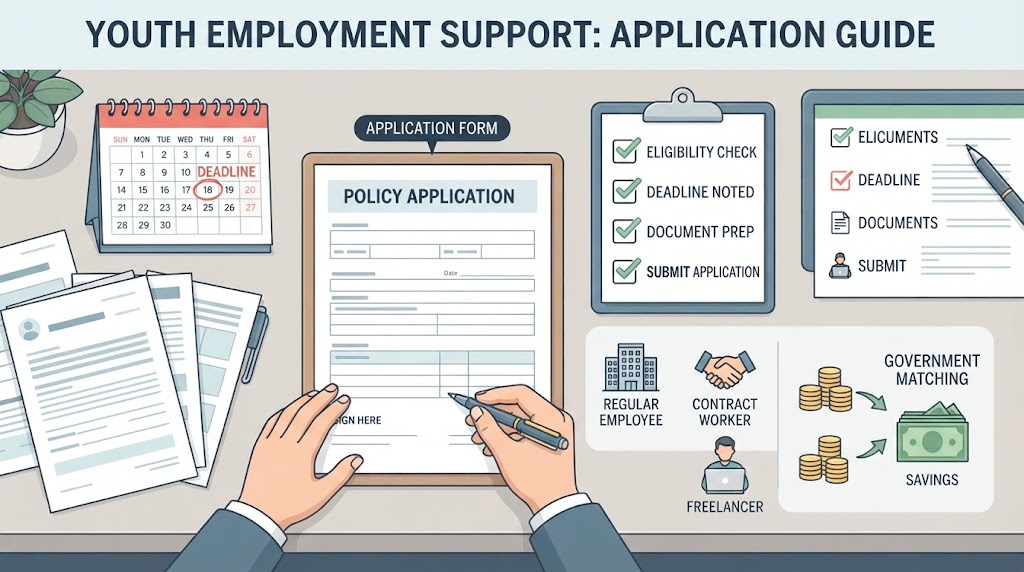
Monthly accumulation and automatic transfer structure: The majority of support funds for regular workers do not take the form of temporarily paying cash, but rather adopt a ‘Matching Grant’ method where the young person’s own savings, government subsidies, and corporate contributions are combined to accumulate a certain amount every month in a joint account.
Lump-sum payment upon maturity: The accumulated funds piled up month by month are paid out in a lump sum only after fulfilling the agreed working period (maturity) in the final form of the principal paid by the individual plus government subsidies and interest. Therefore, since early termination in the middle can drastically reduce benefits, steady employment retention management is essential.

Support Funds and Payment Methods for Non-Regular, Contract, and Freelancer Youth
For young people who do not have regular jobs or whose employment types are flexible—such as non-regular workers, contract workers, and freelancers operating as one-person businesses—a slightly more flexible and direct support method is needed rather than fixed long-term savings products. Keeping pace with changes in the labor market, the government and local authorities are gradually expanding customized support systems for them.
- Customized Support Systems for Short-Term Workers and Freelancers
Short-term and employment blind spot support projects: Young people working in non-regular employment forms, as freelancers, or as platform workers tend to be alienated from general regular-worker-centered support benefits because their four major public insurance subscription histories are irregular or their employment periods are short. To compensate for this, separate welfare allowances and support projects are operated to select recipients based on income proof or appointment contracts.
Youth allowances and activity support funds by local government: Some local authorities, such as the Seoul Youth Allowance, implement systems that encompass non-regular workers, short-term workers, and unemployed youth, paying cash-style support funds for the purpose of job-seeking activities and livelihood stabilization.
- Characteristics and Reception Methods of Lump-Sum and Cash-Style Welfare Support
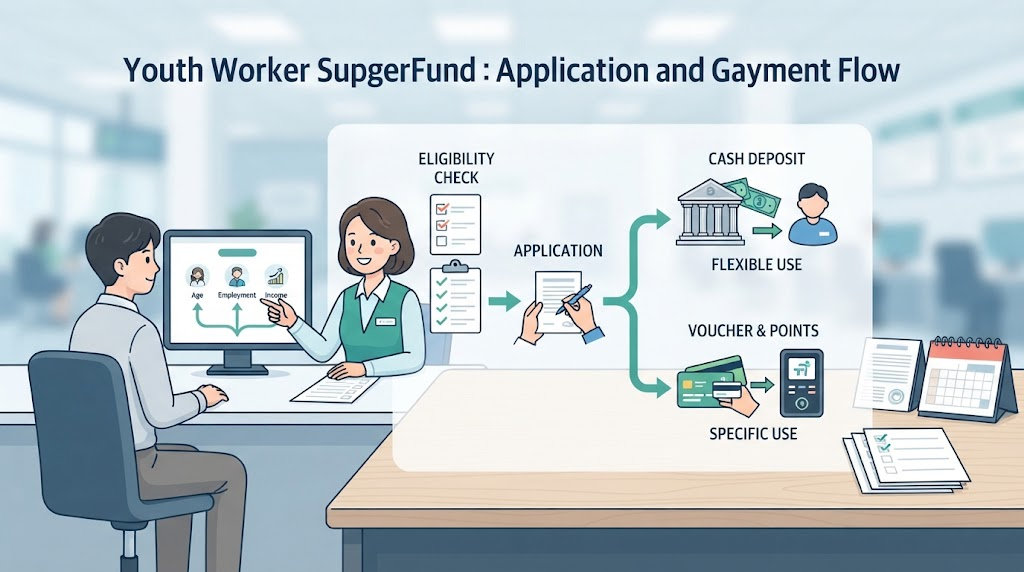
Divided payment or lump-sum payment form: Unlike the long-term savings (matching grant) structure for regular workers, non-regular worker and freelancer support funds are often paid in a lump sum in the form of cash or exclusive points according to a designated cycle after passing screening, or paid in installments over several times.
Use autonomy and settlement method: The paid support funds are directly deposited into accounts or charged to voucher cards so that young people can use them autonomously for living expenses, self-development expenses, job-seeking activities, etc. However, since some projects entail a settlement procedure where funds must be used within a specified period or the post-use location must be proven, it is important to carefully check the payment regulations.
Housing and Livelihood Stabilization Support Fund Payment Methods for SME Youth Workers
Along with differences in employment type, young workers employed in small and medium-sized enterprises (SMEs) and middle-standing enterprises may have relatively weaker wage or welfare systems compared to large corporations. To compensate for this, the government and local authorities have prepared various housing and livelihood stabilization support funds that directly alleviate housing costs and living expenses, which are the biggest concerns for young people working in SMEs.
- Indirect Support Forms Such as Monthly Rent Support and Transportation Vouchers
Youth monthly rent and housing support: For young people working in SMEs and living in monthly-rent housing, a certain amount of monthly rent is directly supported every month, or low-interest rate benefits for housing-related loans (such as SME youth Jeonse loans) are linked to drastically lower the actual housing cost burden.
Core workplace transportation cost support: A certain amount of transportation costs is paid every month in the form of vouchers or card points to young workers commuting to SMEs with frequent public transportation use or located in transportation-vulnerable areas, thereby reducing fixed commuting costs.
- Differences Between Cash and Voucher/Point Payment Methods
Cash account deposit method: In the case of monthly rent support funds or some livelihood stabilization allowances, cash is directly deposited into the recipient’s personal account every month or deducted, providing very high flexibility in usage.
Voucher and dedicated card charging method: Support funds limited to specific purposes, such as transportation costs or cultural welfare costs, are paid in the form of vouchers where a dedicated card containing government subsidies is issued or points are charged to existing check or credit cards. This method restricts payments to be made only in designated industries (public transportation, gas stations, cultural facilities, etc.), thereby having the characteristic of inducing sound consumption matching the purpose.

Practical Comparison: Optimal Support Fund Reception Strategy According to Your Employment Type
As examined above, youth worker support funds show clear differences from support items to payment methods depending on regular employment, non-regular/contract/freelance status, and whether one is employed by an SME. Then, what is the most efficient support fund reception strategy tailored to “my employment type” among countless systems? We have organized the comparison points and benefit maximization strategies that should not be missed in practice.
- Analysis of Benefit Perception and Asset Building Effects by Employment Type
Regular-worker-centered long-term accumulation strategy: If you are a regular youth worker, you should prioritize long-term accumulation products using a matching grant method, such as the ‘Youth Tomorrow Chaeum Deduction’ or ‘Youth Leap Account’, rather than immediate cash-like allowances. Although there is a burden of having to save a certain amount every month, the scale of the lump sum received upon maturity and the benefits of government contributions are overwhelming, making it most advantageous in terms of long-term asset building.
Securing immediate cash flow centered on non-regular workers and freelancers: Freelancer and contract youth whose employment types are flexible or whose incomes are irregular find it difficult to meet the enrollment requirements for long-term accumulation products. Therefore, it is wise to actively target local government youth allowances or customized cash-like welfare projects for short-term workers to secure practical cash flow that supplements monthly living expenses or job-seeking activity expenses.
- Check for Duplicate Receipt Eligibility and Precautions Upon Application
Checking duplication limits among similar projects: A significant number of government support projects strictly restrict duplicate receipt between asset-building support funds or allowances of a similar nature. For example, if you are currently enrolled in a specific asset-building program of the central government, duplicate participation with similar cash-style allowances from local governments may not be possible; therefore, you must thoroughly check the ‘Duplicate Participation Restriction Regulations’ in the announcement notice in advance.
Precautions when changing employment type: If you transition from a contract worker to a regular worker or change employment types through a job change, you may lose the qualification requirements for existing support funds or the products you can newly apply for may change. When your employment certificate or four major public insurances subscription history changes, you must immediately inquire with the responsible organization and manage it so that you do not suffer disadvantages.
Conclusion: Starting Smart Working Life by Utilizing Customized Support Funds by Employment Type
So far, we have carefully examined the types of youth worker support funds that vary depending on employment type (regular worker, non-regular/contract worker/freelancer, SME employment status), their respective payment methods, and even practical reception strategies advantageous to you.
During early-career days, people often blindly apply just by hearing “so-and-so received this much” or wander around looking for products that do not fit their own employment conditions, thus missing precious opportunities. However, what matters is not others’ reviews, but accurately identifying the support system that perfectly fits your current employment type and income structure, and selecting the optimal reception method accordingly.
If you are a regular employee, grow a reliable lump sum with a long-term accumulation product using a matching grant method; if you are a non-regular worker or freelance youth with a flexible employment type, actively utilize customized allowances that subsidize immediate cash flow. Also, if you are an SME employee, wisdom is needed not to miss indirect support systems that help stabilize livelihood, such as housing and transportation costs.
We hope this post served as a reliable financial compass amidst your fierce working life. We sincerely cheer for you to splendidly complete your own smart and stable independence routine through thorough employment type analysis and smart utilization of support funds!
We hope this post was beneficial and helpful to your successful working life and practice of personal finance. We will return with more practical and accurate youth welfare and living economy information. Have a happy and solid day today!

Korean version: 한국어로 읽기